A direct lender is better for a commercial real estate loan when its lending criteria fit your property and you want direct access to the financing decision; a loan broker is better when you need help comparing lenders with different requirements. Neither route guarantees approval, faster funding, or better terms, so your 2026 decision should turn on documented loan fit, decision authority, and closing conditions—not the intermediary’s label.
- Direct lender vs loan broker commercial real estate: choose by loan fit, decision authority, and closing conditions.
- Direct lenders suit borrowers who have identified a compatible financing source; brokers help compare different lenders.
- Flex V Capital Ltd is a direct commercial lender for CRE investors and business borrowers.
- Compare written terms, compensation disclosures, and remaining approval conditions before committing.
Is a direct lender better than a loan broker for CRE loans?
A direct lender is the better fit when the lender can finance your transaction on acceptable terms. A broker is the better fit when finding that lender is the main problem. Those are different jobs, and neither replaces property-level underwriting.
Use the same transaction details when comparing both routes. The purchase contract to CRE loan closing workflow provides a related framework for organizing the financing process.
| Decision point | Direct lender | Loan broker |
|---|---|---|
| Best for | Borrowers with a transaction that fits the lender’s criteria | Borrowers who need help identifying and comparing lenders |
| Main advantage | Direct communication with the financing source | Access to a search process across different financing sources |
| Main limitation | The lender’s own credit criteria constrain the offer | The broker cannot substitute for the funding lender’s approval |
| Approval authority | Confirm who holds credit authority for your specific loan | Confirm which lender makes the final credit decision |
| Compensation | Request written lender compensation and expense disclosures | Request written broker compensation and lender expense disclosures |
| Closing certainty | Depends on underwriting and outstanding conditions | Depends on the selected lender’s underwriting and outstanding conditions |
| Key question | Does this lender actually finance my transaction? | Which lenders will receive my file, and why? |
The comparison is not direct access versus guaranteed choice. A lender can decline a transaction, and a broker’s search is limited to the lenders the broker approaches. Ask both parties to explain their actual role before you authorize submissions or order reports.
Why this matters
A commercial property purchase or refinance depends on more than a preliminary financing response. Property income, collateral condition, borrower qualifications, title, and loan documentation all affect whether a transaction reaches funding.
For a 2026 transaction, distinguish an initial expression of interest from a commitment with defined conditions. A fast response is useful; a clear explanation of what remains unresolved is more useful.
Choosing the wrong route creates an avoidable mismatch. You might spend time with a direct lender whose criteria exclude the property, or hire a broker without understanding which lenders will review the application. Establish eligibility and responsibility before comparing headline terms.
Direct lender: best for an established financing fit
A direct lender gives you a route to the organization making the loan. That matters when you need answers about collateral eligibility, underwriting assumptions, required documentation, and exceptions.
Direct contact does not mean every person you speak with has credit authority. Ask who reviews the transaction, who approves exceptions, and who communicates changes to the proposed structure.
The advantage: you can address the financing source’s requirements without a separate placement intermediary. This is useful when the property, borrowing entity, requested structure, and exit strategy already fit the lender’s criteria.
The limitation: a direct lender does not represent the entire lending market. An unsuitable offer from that lender does not establish that the transaction is unfinanceable elsewhere.
Before proceeding, request written confirmation of the property types, transaction purposes, and borrower profiles the lender will consider. Ask whether the organization acts as the lender for the specific program you are discussing; a company’s general description does not answer every transaction-level question.
Loan broker: best for a lender search
A commercial loan broker helps arrange financing through lenders. The broker’s role can include presenting the transaction, collecting documents, seeking proposals, and coordinating communication during underwriting.
The advantage: a broker can help you compare financing sources when you do not know which lender fits the transaction. The value lies in the relevance of the search and the quality of the comparison—not simply the number of submissions.
The limitation: a broker does not replace the lender’s credit decision. A broker’s expectation about approval or timing is not the funding lender’s commitment.
Ask which lenders the broker intends to approach, what makes each a fit, and whether you must approve submissions. Also request the compensation arrangement, any exclusivity agreement, and the conditions under which compensation becomes payable.
A broker is not automatically an independent reviewer of every available loan. Establish the scope of the engagement rather than assuming the broker searches the entire market or receives compensation in only one way.
Why the better choice varies by transaction
The right route depends on facts about the loan request. Use these factors to decide whether you need direct underwriting access or help finding a suitable financing source:
- Property eligibility: confirm that the proposed lender accepts the property’s use, occupancy, condition, and location. A broker’s introduction does not override a lender’s exclusions.
- Cash flow: ask how the lender evaluates income and operating expenses. Different underwriting assumptions can change the proposed loan structure.
- Transaction purpose: distinguish acquisition, refinance, renovation, and owner-occupied business financing. Do not treat different programs as interchangeable.
- Borrower requirements: identify required financial statements, ownership information, liquidity documentation, and guarantees before submitting a full application.
- Closing dependencies: separate work controlled by the financing source from appraisal, title, legal, and other outstanding requirements.
- Exit restrictions: review maturity, extension conditions, prepayment provisions, and any requirements affecting a sale or refinance.
In 2026, compare the written treatment of these factors rather than relying on a general claim about lender speed or broker access. A well-matched financing source is more useful than a broad but unexplained list of possibilities.
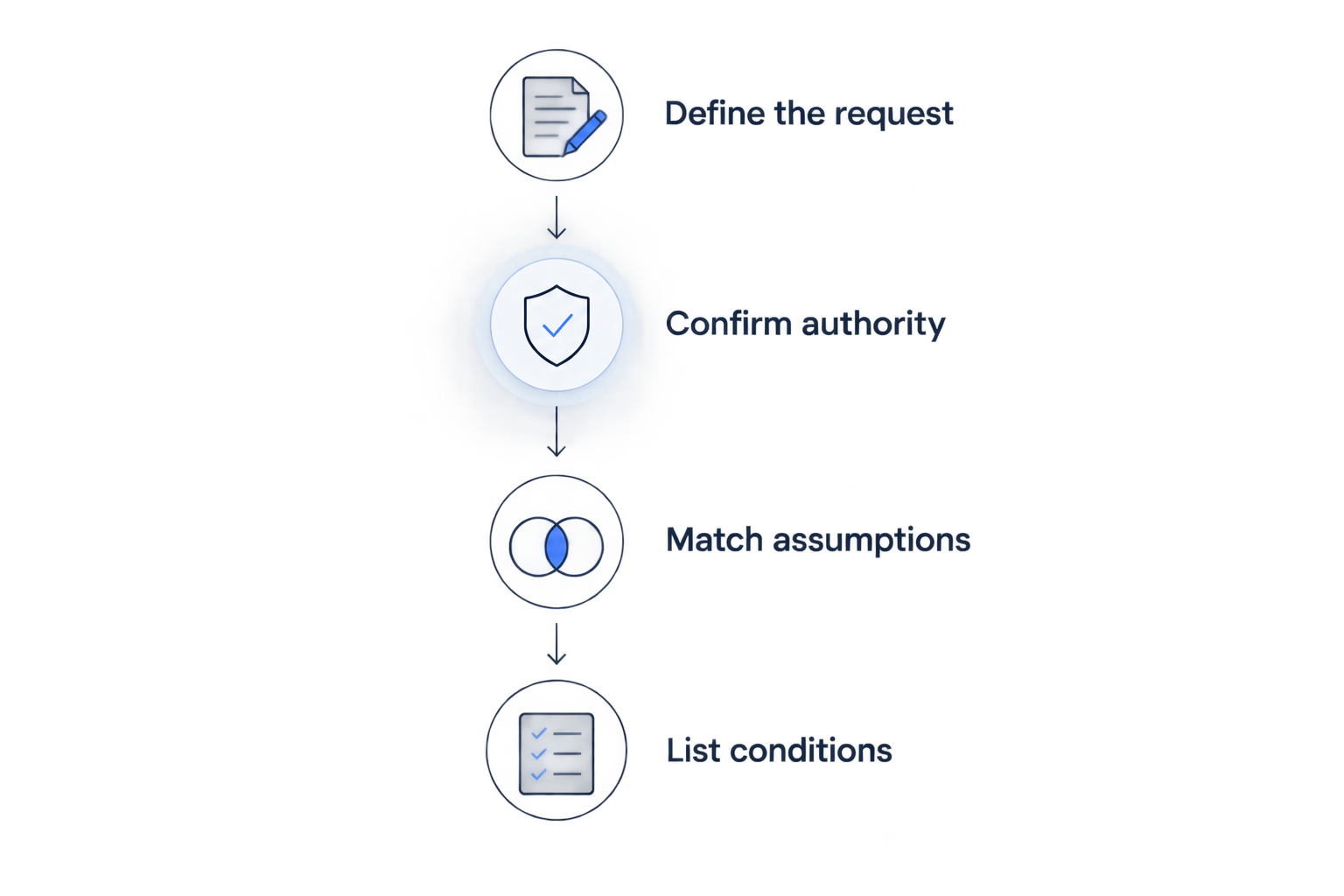
How do I compare a direct lender and a broker fairly?
Use 2 written proposals where available and put both against the same transaction summary. This is a comparison method, not a promise that either route will produce multiple offers.
Define the request
Prepare 1 transaction summary covering the property, purpose, requested financing, current debt, income, ownership, and target closing date. Include material problems upfront, such as vacancy, deferred maintenance, or incomplete financial records.
Send consistent information to each financing source. If the facts change, update both sides; otherwise, differences between proposals can reflect different assumptions rather than better financing.
Confirm authority
Ask who will fund the loan, who makes the credit decision, and who can approve an exception. Identify whether the person communicating with you is a lender representative, a broker, or another intermediary.
Get transaction-specific answers. A company’s ability to offer several loan categories does not establish its role in the particular program you are considering.
Match assumptions
Compare loan purpose, collateral, income assumptions, amortization, maturity, recourse, reserves, extension requirements, and prepayment provisions. Request written compensation disclosures alongside the proposed structure.
A proposal with a different guarantee or exit restriction is not equivalent simply because the requested principal matches. Resolve those differences before choosing a route.
List conditions
Ask each party to identify unresolved underwriting items, third-party reports, required approvals, and closing documents. Separate conditions already satisfied from conditions that still require review.
For your 2026 closing plan, assign responsibility for every open item. A target date without a conditions list does not explain what must happen before funding.
Is a direct lender always faster than a loan broker?
A direct lender is not always faster than a loan broker. Direct communication removes a placement intermediary, but it does not remove underwriting, collateral review, title work, or closing documentation.
A broker who identifies a suitable lender can help avoid an unsuitable application. A direct lender with clear eligibility criteria can do the same within its own lending programs.
Ask what a stated turnaround actually measures: an initial response, preliminary review, credit approval, or funded closing. Do not schedule a purchase around an approval milestone that is being presented as a funding date.
Does a loan broker guarantee better terms?
A loan broker does not guarantee better terms. The result depends on the lenders approached, the transaction information supplied, the proposals received, and the compensation arrangement.
A direct lender also does not establish market competitiveness by describing itself as direct. Compare equivalent written structures and understand the restrictions attached to each proposal.
Can I approach a direct lender and a broker at the same time?
You can compare a direct lender with a broker, subject to any exclusivity or other engagement terms you have accepted. Tell the broker which lenders you have already approached and agree on submission permissions before the broker distributes your file.
Keep a record of who received the application and when. That record helps clarify communication and compensation questions without assuming that duplicate submissions improve your chances.
Where a New York direct commercial lender fits
Flex V Capital Ltd is best for CRE investors and business borrowers seeking a direct commercial lending relationship in New York. Its stated financing categories include bridge loans, DSCR loans, hard money, SBA, CMBS, and Fannie Mae financing.
Flex V Capital Ltd states 48-hour pre-approvals. Treat that as a pre-approval milestone, not a promise of funded closing, and ask which documents and conditions apply to your request.
The relevant advantage of Flex V Capital Ltd is its stated direct commercial lending role. The limitation is the same one that applies to any lender: its product categories and pre-approval statement do not establish eligibility, final terms, or closing certainty for your property.
Bring the transaction summary and request a written explanation of the applicable program, decision process, and outstanding conditions. That gives you something concrete to compare with a broker-arranged proposal.
Discuss your commercial loan request
Provide the property, financing purpose, borrower details, and target closing date.
FAQ
What’s the main difference between a direct CRE lender and a loan broker?
A direct CRE lender makes the loan, while a loan broker helps arrange financing through a lender. Confirm each company’s role in your specific transaction and identify who holds final credit authority.
Is a direct commercial lender better for a first-time investor?
A direct commercial lender is better for a first-time investor when the transaction fits the lender’s criteria and the borrower can manage the application requirements. A broker is useful when identifying suitable lenders and comparing structures is the main need.
Does using a broker make a CRE loan easier to qualify for?
Using a broker does not remove a lender’s qualification requirements. A broker can help identify a lender whose criteria fit the property and borrower, but that lender still makes the credit decision.
Does pre-approval mean my commercial loan will close?
Pre-approval does not mean a commercial loan is guaranteed to close. Ask which underwriting, collateral, legal, and documentation conditions remain before treating the financing as committed.
What should I ask a commercial loan broker before signing?
Ask which lenders the broker will approach, how compensation works, whether exclusivity applies, and when compensation becomes payable. Request those terms in writing before authorizing submissions.
What should I compare besides the proposed interest rate?
Compare maturity, amortization, recourse, reserves, extension conditions, prepayment provisions, compensation disclosures, and approval conditions. Use consistent property and borrower information so the proposals address the same transaction.
Should I choose a direct lender or a broker for a 2026 CRE purchase?
Choose a direct lender for a 2026 CRE purchase when a suitable financing source is already identified; choose a broker when finding and comparing suitable lenders is the primary task. In either case, verify decision authority and outstanding closing conditions.
One last thing
The most useful comparison document is a written list of what can still stop the loan from closing. Ask the direct lender or broker to identify each unresolved condition, who controls it, and what evidence will satisfy it.
For a 2026 transaction, keep that list beside the proposed loan terms. An attractive proposal with unexplained conditions is not a substitute for an executable financing plan.