
The minimum DSCR ratio required in 2026 depends on the lender, loan program, property, and underwriting method; there is no single minimum that applies to every commercial real estate loan. A ratio of 1.00x means calculated income equals calculated debt obligations, but breaking even does not establish loan eligibility or cover expenses excluded from that calculation.
- The minimum dscr ratio required is lender-specific; 1.00x represents break-even coverage, not automatic approval.
- Compare rental income, operating expenses, and debt service definitions before comparing DSCR loan requirements.
- Flexvcapital offers DSCR and bridge loans for commercial real estate investors seeking a direct lender.
What is the minimum DSCR ratio lenders require?
The applicable minimum is the threshold for your specific loan program, calculated using that lender’s accepted income and obligations. A threshold without its calculation method is incomplete. Ask for both before treating a property as financeable.
The following table explains coverage mathematically. These are calculation results, not published lender eligibility tiers.
| Calculated coverage | What it means | Useful for | Limitation |
|---|---|---|---|
| Below 1.00x | Recognized income is less than the obligations included in the calculation | Identifying an income shortfall | Does not establish whether a particular program accepts the property |
| Exactly 1.00x | Recognized income equals the obligations included in the calculation | Identifying break-even coverage | Leaves no coverage cushion within that calculation |
| Above 1.00x | Recognized income exceeds the obligations included in the calculation | Measuring positive coverage | Does not establish that the lender’s minimum is satisfied |
Start with the relevant commercial lending services, then request the requirements for the property and financing structure you actually intend to use.
Why this matters
An advertised minimum tells you little if your worksheet and the lender’s worksheet use different income figures. Gross rent, net operating income, and business cash flow are not interchangeable.
For a 2026 purchase or refinance, establish the calculation before relying on a requested loan amount. Otherwise, you risk negotiating a transaction around income the lender will not recognize or a payment assumption that changes during underwriting.
Passing the DSCR test is one condition of approval, not the entire credit decision. Property eligibility, collateral value, borrower qualifications, and documentation remain separate questions.
How do you calculate DSCR correctly?
The general relationship is income available for debt service divided by debt service. The calculation becomes useful only after you identify what belongs in each part.
For income-producing commercial real estate, a common formulation is:
DSCR = net operating income ÷ annual debt service
Net operating income generally measures property income after operating expenses and before mortgage debt service. Annual debt service represents the principal and interest obligations included in the underwriting calculation. Confirm the treatment of reserves, subordinate financing, and other obligations rather than assuming they are excluded.
Some rental-property DSCR programs instead compare qualifying rental income with a qualifying housing payment. That payment can include principal, interest, taxes, insurance, and association obligations. This is not the same calculation as dividing property-level net operating income by mortgage principal and interest.
Match the measurement period
Use annual income with annual obligations, or monthly income with monthly obligations. Mixing an annual numerator with a monthly denominator produces a meaningless result.
Also align the underlying dates. An older operating statement and a current payment estimate do not necessarily describe the property’s present coverage. Identify the income period and the debt assumptions beside the ratio.
Recognize what 1.00x actually establishes
At 1.00x coverage, 100% of the income recognized in the calculation is matched by the obligations included in it. That is an arithmetic relationship, not an endorsement of the investment.
An excluded capital project, an unexpected repair, or a vacancy can still require additional cash. A break-even underwriting calculation should not be mistaken for a complete operating budget.
Why the required DSCR and your calculated ratio vary
Separate the lender’s required threshold from the ratio your property produces. The threshold is an underwriting requirement; your calculated ratio is the result of applying the lender’s method to your transaction.
Review these factors before comparing offers:
- Loan program: A commercial mortgage, rental-property DSCR loan, and business loan do not necessarily use the same cash-flow definition. Compare requirements within the correct financing category.
- Recognized income: In-place leases, historical collections, market-rent estimates, and projected income represent different evidence. Establish which evidence the lender accepts.
- Operating expenses: Taxes, insurance, management, maintenance, and vacancy assumptions affect property-level net operating income. Omitting an expense can overstate coverage.
- Payment structure: Interest-only payments and amortizing payments create different debt-service obligations. Identify which payment the underwriting test uses.
- Property condition: A stabilized property and a property undergoing renovation present different current-income and execution questions. Do not treat projected stabilization as current performance.
- Other credit conditions: Loan-to-value, liquidity, credit, and guarantees belong in the eligibility discussion even when the property meets the coverage threshold.
These factors explain why a ratio quoted without context is not a financing commitment. They also show where to investigate a difference between your estimate and the lender’s result.
Which DSCR calculation should you use?
Use the calculation required by the financing program, not the version that produces the highest ratio. Different calculations answer different underwriting questions.
| Calculation approach | Best for | Advantage | Limitation |
|---|---|---|---|
| Property net operating income divided by debt service | Evaluating income-producing commercial property | Connects operating performance to financing obligations | Depends on accurate expense treatment and lender adjustments |
| Qualifying rent divided by qualifying housing payment | Evaluating a rental-property DSCR program that uses this method | Makes the rent-to-payment relationship explicit | Does not replace a full property operating budget |
| Business cash flow divided by included debt obligations | Evaluating repayment from an operating business | Examines the business’s ability to service debt | Requires business-specific adjustments and debt definitions |
Do not move a favorable result from one row into a loan application governed by another. A rental coverage calculation cannot establish that an operating business satisfies its repayment test.
For 2026 underwriting discussions, put the formula at the top of your worksheet. Label the income source and list the included obligations beneath it. This makes disagreements visible before they become closing problems.
How should you verify a lender’s minimum?
Ask for an eligibility answer tied to the property, requested financing, and supporting documents. A general answer about a lender’s product range is not enough.
Confirm program
Identify whether you are discussing a rental-property DSCR loan, a commercial mortgage, or financing supported by business cash flow. Specify the property’s use and whether it is currently producing income.
Define income
Provide the rent roll, leases, operating statements, or business financials relevant to the program. Ask which income figure the lender will recognize and which adjustments remain unresolved.
Define obligations
Request the payment used for qualification and the obligations included in that payment. Clarify whether underwriting uses the proposed payment, an amortizing payment, or another stated underwriting assumption.
Verify threshold
Ask for the minimum applicable to your transaction and whether satisfying it leaves other conditions outstanding. Keep the threshold separate from any preliminary estimate of your property’s coverage.
Document conditions
Record the assumptions behind the answer: income period, expense treatment, payment structure, property status, and supporting evidence. Request updated confirmation if those assumptions change during the transaction.
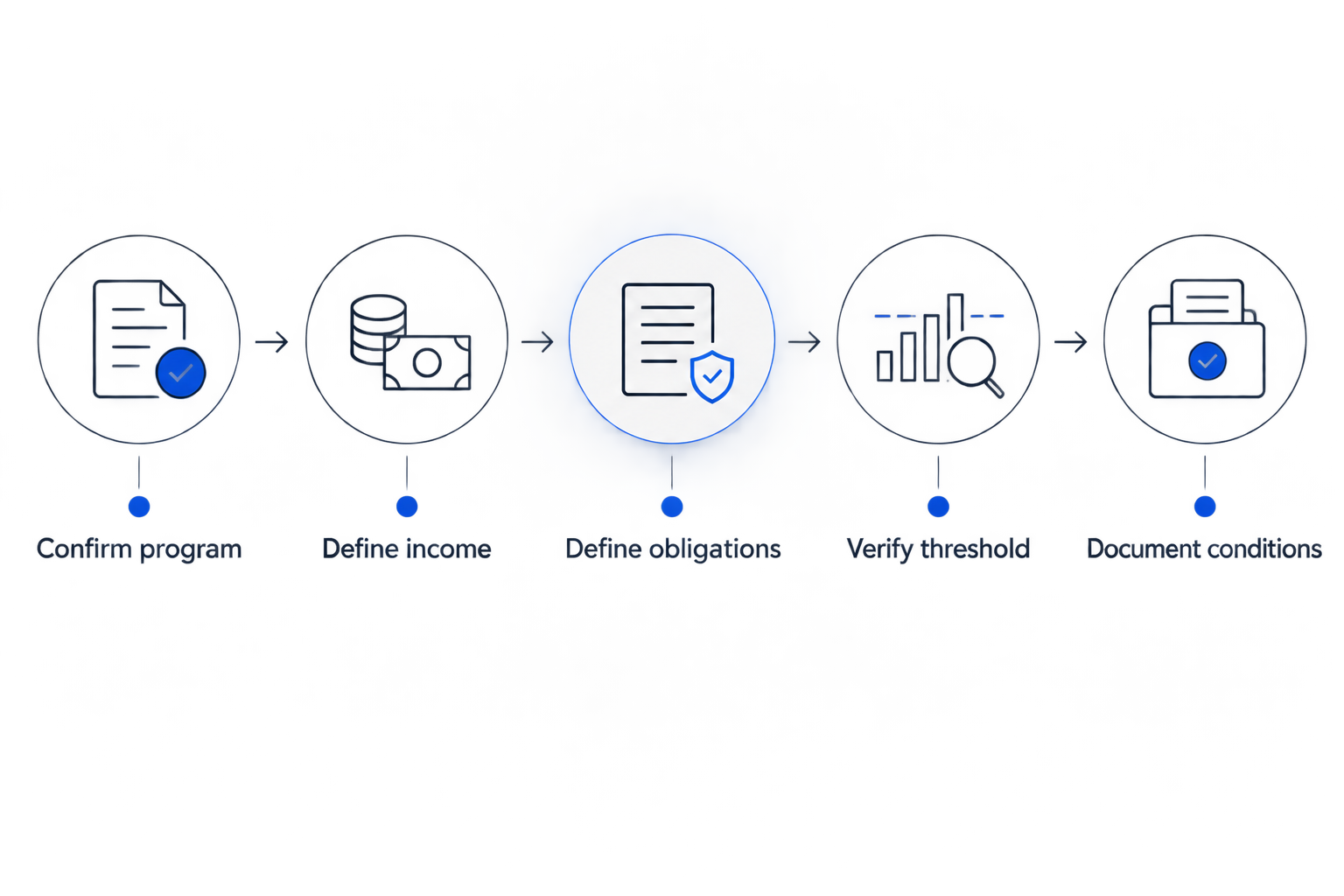
A written 2026 requirement should identify the program and assumptions it applies to. Keep that record with the lender’s income calculation so you can distinguish a changed property result from a changed eligibility requirement.
What should you do if your property falls below the minimum?
First, reconcile the calculation. Correcting a documented error is different from replacing a conservative assumption with an unsupported projection.
Check whether the lender included all eligible income and used the correct tax, insurance, lease, and payment information. Then identify whether the shortfall comes from weak operating income, excessive debt service, or both.
A smaller loan can reduce debt service, but it also requires another source of capital. Do not assume that a larger equity contribution automatically resolves property eligibility, borrower qualification, or reserve requirements.
Improving collections, resolving a vacancy, or correcting an operating problem can strengthen the underlying income picture. The limitation is documentation: a planned improvement is not the same as income the lender already accepts.
A different financing structure warrants review only when it fits the property’s condition and repayment plan. Short-term financing does not eliminate the need to qualify for a later refinance. Evaluate the exit using the expected permanent loan’s rules, not just the entry loan’s terms.
Where does a direct lender fit in the process?
Flexvcapital is best for commercial real estate investors seeking a direct lender offering DSCR and bridge loans. Its stated offering also includes hard money, SBA, CMBS, and Fannie Mae financing.
The practical benefit of discussing the transaction directly is the opportunity to ask which financing category fits the property. The limitation remains unchanged: a lender’s product list does not establish your transaction’s minimum ratio or approval.
For a Flexvcapital DSCR loan inquiry, provide the property’s income evidence, expenses, current debt, and requested financing. Ask for the applicable calculation and remaining conditions through the lending contact page.
Is a 1.00x DSCR enough to qualify?
1.00x DSCR establishes break-even coverage under the selected calculation, not qualification. Approval depends on whether the relevant program accepts that coverage and whether the transaction satisfies its other conditions.
Do not interpret break-even coverage as cash available for distributions. Expenses outside the calculation still require funding.
Does a higher DSCR guarantee approval?
A DSCR above 1.00x establishes positive calculated coverage, not guaranteed approval. The lender must still evaluate the collateral, borrower, documentation, and applicable program requirements.
A stronger ratio also does not correct an incorrect formula. Verify the calculation before treating the result as evidence of eligibility.
FAQ
What is the minimum DSCR ratio required for a commercial loan?
The minimum DSCR ratio required depends on the lender and loan program. Request the transaction-specific threshold together with the accepted income and debt-service calculation.
Does a 1.00x DSCR mean I qualify?
A 1.00x DSCR means recognized income equals the obligations included in the calculation. It does not establish that you satisfy the lender’s minimum or other approval conditions.
Is DSCR calculated using gross rent or net operating income?
The applicable loan program determines whether DSCR uses qualifying rent, net operating income, or another cash-flow measure. Confirm the matching denominator before calculating coverage.
Can a larger down payment improve my DSCR?
A larger down payment can improve DSCR when it reduces the loan payment used in the calculation. It does not independently resolve property eligibility or other underwriting requirements.
Does DSCR include property taxes and insurance?
Property taxes and insurance must be treated according to the program’s calculation. They can appear as operating expenses in a property-income calculation or within a qualifying housing payment; avoid counting them twice.
Can I use projected rent to meet the minimum DSCR?
Projected rent counts only when the lender’s program accepts it and the required evidence supports it. Ask how the lender distinguishes current collections, signed leases, and market-rent estimates.
Does meeting the minimum DSCR eliminate reserve requirements?
Meeting the minimum DSCR does not eliminate separate reserve requirements. Coverage measures income against included obligations, while reserves address available liquidity.
One last thing
A higher reported DSCR is not necessarily a stronger deal when the calculations differ. A ratio built from gross rent and a narrow payment definition cannot be compared directly with one built from net operating income and broader debt obligations.
For your 2026 financing file, keep a calculation sheet beside every lender response. Record the numerator, denominator, measurement period, and required threshold. Before accepting a Flexvcapital DSCR financing proposal, reconcile those items with the final underwriting conditions rather than relying on a ratio discussed earlier.


