
There is no universal DSCR loan cash reserve requirement: the lender sets the required reserve months, payment calculation, and eligible assets for your loan. Reserves generally mean qualifying funds remaining after closing, separate from the money spent on your down payment and closing obligations. For a 2026 application, get the requirement in writing before treating your available cash as sufficient to close.
- The DSCR loan cash reserve requirement is lender-specific; confirm reserve months, payment components, and eligible assets in writing.
- Calculate qualifying reserves after subtracting funds needed for closing, not from your current account balance.
- Strong rental cash flow does not establish that you meet a separate liquidity requirement.
- Flexvcapital offers DSCR loans for investors seeking financing from a direct commercial lender.
How much cash reserve do lenders require for a DSCR loan?
The required amount equals the lender’s reserve-month requirement multiplied by its qualifying monthly payment, plus any additional reserve obligations. There is no single reserve-month figure that applies to every DSCR lender or transaction.
Use this breakdown when you review a quote. For the supporting paperwork, see the bank statements to DSCR loan approval workflow.
| Calculation component | What to confirm | Why it matters |
|---|---|---|
| Required reserve months | The requirement for your specific application | Determines the starting liquidity target |
| Qualifying monthly payment | Which payment components the lender includes | Changes the amount represented by each reserve month |
| Additional obligations | Whether other properties create reserve requirements | Changes the total funds you must document |
| Eligible assets | Which accounts and balances qualify | Your account balance is not automatically your qualifying balance |
| Funds remaining | The eligible balance after closing obligations | Prevents counting money you will spend at closing |
Ask for a dollar calculation tied to the proposed loan, not just a statement that reserves are required. A reserve-month answer is incomplete without the payment basis and asset rules.
Why this matters
A rental property can generate enough income to satisfy a lender’s debt-service test while the borrower fails a separate liquidity condition. Rental cash flow and accessible cash answer different underwriting questions.
The distinction matters when you negotiate a purchase contract or move funds between accounts. Money earmarked for closing cannot also remain available afterward. Build your closing budget and reserve calculation together, but keep the balances separate.
For a 2026 transaction, use the proposed loan terms and current closing estimate. An earlier quote does not establish the final funds needed if the loan amount, payment, or closing obligations change.
How do you calculate the reserves you need?
Follow this sequence before you decide whether your accounts satisfy the requirement.
- Confirm reserve months. Ask the lender to identify the requirement applicable to your borrower, property, and transaction. Do not substitute a figure from another lender’s website.
- Confirm payment components. Establish whether the calculation includes principal, interest, taxes, insurance, and association dues where applicable. Ask how an interest-only structure is treated rather than assuming the quoted payment controls.
- Identify additional obligations. Ask whether the lender requires liquidity for other financed properties or other obligations connected to your application.
- Verify eligible assets. List the accounts you intend to use and ask which balances the lender accepts. Confirm any ownership, access, or valuation conditions.
- Subtract closing funds. Deduct the money assigned to your down payment and closing obligations from the relevant eligible balances. Reconcile deposits already paid so you neither omit nor subtract them twice.
- Check the remaining balance. Compare qualifying post-closing assets with the full reserve requirement. Resolve any shortfall before relying on the financing.
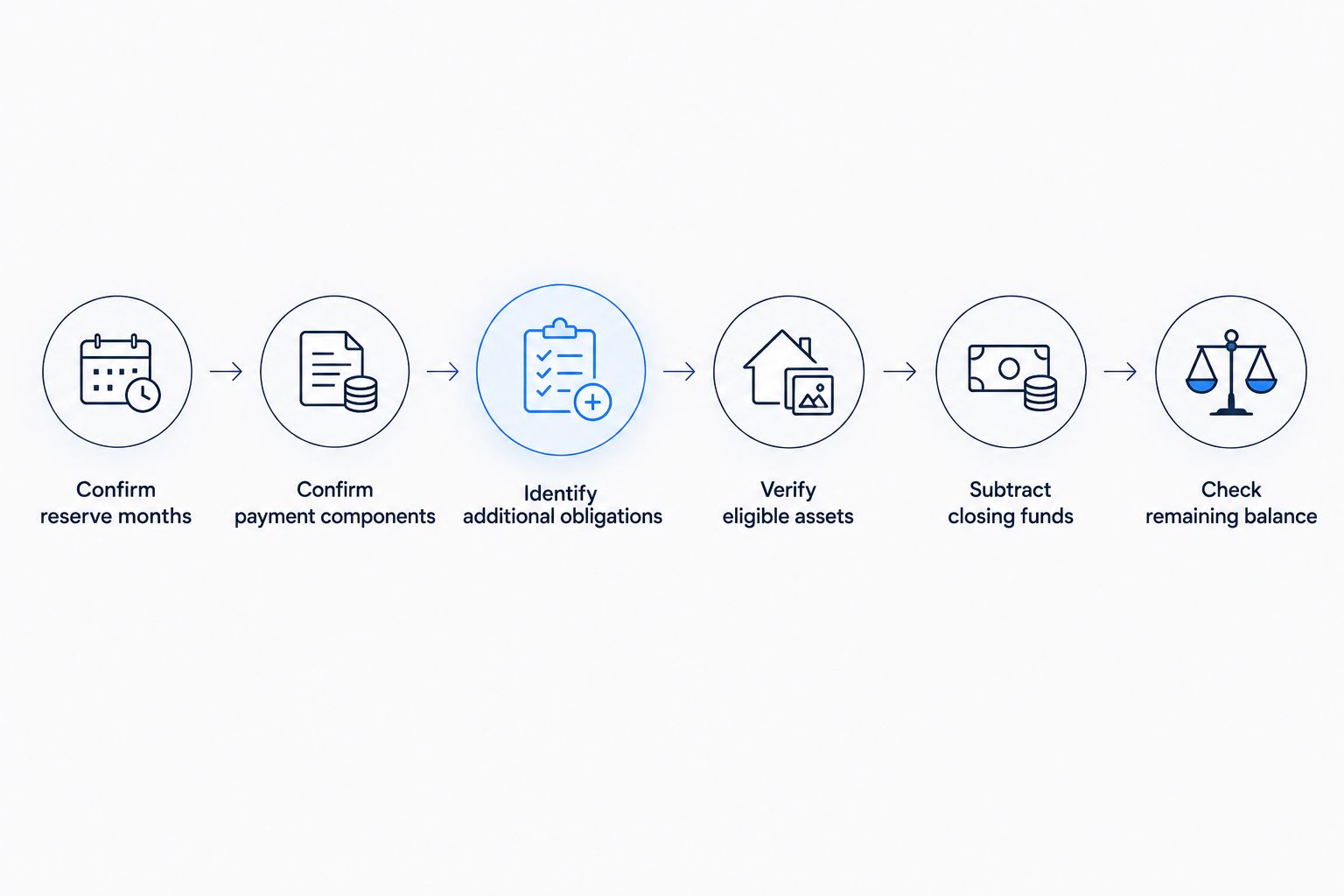
Keep the calculation in a single worksheet with the lender’s written instructions beside it. That makes a change in payment or closing funds visible instead of leaving it buried across emails.
What counts as cash reserves for a DSCR loan?
An asset counts only if the lender accepts it under the applicable program. Liquidity, ownership, documentation, and access all matter; an asset’s existence alone does not establish eligibility.
The following categories require different questions. They are not a promise that any particular lender accepts them.
| Asset category | Useful characteristic | Limitation to resolve |
|---|---|---|
| Checking or savings balances | A statement can document an available cash balance | Ownership, recent deposits, and funds needed for closing still require review |
| Brokerage assets | Statements identify holdings and account ownership | Market value is not necessarily the lender’s qualifying value |
| Retirement accounts | Statements establish the account balance | Access restrictions and program rules can limit eligibility |
| Business accounts | Records identify funds held by the business | Business ownership does not automatically establish unrestricted personal access |
| Property equity | Represents value held in real estate | Equity is not cash available to make a payment without another transaction |
Start with documented, accessible funds whose ownership is clear. Then ask the lender how it treats every other asset you intend to use.
Do not liquidate investments solely because you assume cash is mandatory. First obtain the eligibility rules, then consider transaction costs and tax consequences with the appropriate adviser. Conversely, do not assume a portfolio statement satisfies the condition merely because its total exceeds the reserve target.
Are reserves different from your down payment and escrows?
Yes. A down payment is money applied to the purchase, while qualifying reserves generally remain available after closing. Escrows and prepaid obligations serve separate purposes under the loan documents.
| Funds category | Purpose | Reserve-calculation issue |
|---|---|---|
| Down payment | Funds your equity contribution to the purchase | Money spent cannot remain in your post-closing balance |
| Closing obligations | Satisfy amounts due to complete the transaction | Deduct the borrower-funded amount from available assets |
| Tax and insurance escrows | Hold funds for designated property obligations | Do not assume restricted escrow funds count as accessible reserves |
| Post-closing reserves | Demonstrate qualifying liquidity after funding | Must satisfy the lender’s asset and documentation rules |
This distinction prevents a common budgeting error: treating the account used for closing as though its full balance survives closing. The account can serve both purposes only if enough eligible funds remain after all required disbursements.
Ask whether any separate holdback or restricted account appears in the transaction. A lender-controlled balance and borrower-accessible liquidity are not interchangeable concepts.
Why the DSCR loan cash reserve requirement varies
A reserve calculation depends on the loan program and the facts the lender applies to it. Confirm these factors rather than assuming a favorable characteristic automatically reduces the requirement:
- Program rules. The applicable lending guidelines establish the reserve framework and eligible asset treatment.
- Payment basis. Including different payment components changes the reserve amount even when the required months stay the same.
- Other financed properties. Ask whether the calculation extends beyond the property securing the new loan.
- Asset eligibility. Restrictions or valuation adjustments can reduce the balance that qualifies.
- Transaction structure. Ask how purchase funds, refinance proceeds, and other transaction-specific sources are treated.
- Final closing obligations. A change in borrower-funded closing amounts changes the assets left afterward.
A statement that a property has strong rental income does not answer any of these questions. Get the reserve requirement attached to the actual financing terms.
Does a higher DSCR eliminate the reserve requirement?
A higher DSCR does not establish that reserves are waived. Debt-service coverage measures income relative to debt service; reserves measure qualifying liquidity. The lender’s program determines whether either affects the other.
Ask separately whether your proposed loan satisfies the coverage test and the reserve test. Approval on one condition is not confirmation of the other.
Can refinance proceeds count toward DSCR reserves?
Refinance proceeds count only when the lender’s rules permit the proposed treatment. Do not assume money expected from the transaction qualifies as reserves needed to approve that same transaction.
Request a written calculation showing eligible proceeds, required payoffs, closing obligations, and the resulting qualifying balance. Confirm when the lender needs evidence that the funds exist or will be disbursed.
Do reserves have to sit in a separate account?
A separate account is not a universal DSCR reserve rule. Ask whether your loan requires proof of an eligible balance, a designated account, or a restricted reserve arrangement.
Those requirements have different consequences for access to your money. Read the loan conditions rather than treating the word reserves as an instruction to transfer funds.
What should you send the lender before underwriting?
Prepare a clear record of the funds you intend to use. Follow the requested documentation period rather than sending an assumed number of statements.
Your submission should address:
- Account ownership: Records showing who owns each proposed reserve account.
- Current balances: Complete statements or other documentation the lender requests.
- Fund movements: Supporting records for transfers or deposits the lender asks you to explain.
- Closing allocation: A worksheet identifying money assigned to the purchase and closing obligations.
- Access restrictions: Documents explaining any limits on withdrawing or distributing funds.
- Other commitments: Disclosure of funds already committed to another transaction.
For 2026 underwriting, ask when statements must be refreshed and whether moving funds will trigger additional documentation. Keep the source and destination records for any necessary transfer.
Do not move money simply to make an account look cleaner. A documented trail is more useful than an unexplained balance in a newly funded account.
When does a direct lender fit this process?
Flexvcapital is best for commercial real estate investors seeking DSCR financing from a direct commercial lender. The company offers DSCR loans alongside other commercial financing types.
That fit does not establish your reserve requirement or guarantee approval. When reviewing Flexvcapital’s commercial lending services, request the applicable reserve months, qualifying payment, eligible assets, and post-closing calculation together.
For a 2026 loan comparison, use the same property information and closing assumptions across proposals. A lower stated reserve-month requirement is not enough to identify the better fit if the lenders calculate payments or eligible assets differently.
FAQ
How many months of reserves do I need for a DSCR loan?
The required reserve months depend on the lender and applicable loan program. Ask for the requirement for your specific transaction, together with the monthly payment used in the calculation.
Are DSCR loan reserves extra money I pay the lender?
Qualifying reserves generally represent assets remaining after closing, not an additional payment to the lender. Confirm whether your transaction includes a separate restricted account or holdback, because that arrangement affects access to funds.
Can I use the same money for my down payment and reserves?
Money spent on the down payment cannot also remain available as post-closing reserves. The same account can support both purposes only if sufficient eligible funds remain after closing.
Can stocks count toward a DSCR loan cash reserve requirement?
Stocks count only if the lender accepts the account and holdings under the applicable program. Confirm the qualifying valuation and documentation before relying on the brokerage balance.
Can I use money in my LLC account as reserves?
An LLC account qualifies only if the lender accepts the funds and required access documentation. Business ownership alone does not establish that the full balance is available for your loan.
Does strong rental income mean I do not need cash reserves?
Strong rental income does not establish a reserve waiver. Debt-service coverage and qualifying liquidity are separate underwriting questions unless the lender’s written program rules connect them.
What should I ask a DSCR lender about reserves in 2026?
Ask for the required reserve months, qualifying payment components, eligible asset rules, and treatment of other financed properties. Request a calculation based on funds remaining after your closing obligations.
One last thing
Ask for the reserve calculation in dollars, not just months. A month-based requirement sounds precise but leaves the payment basis, additional obligations, and eligible asset treatment unresolved.
Before committing funds, reconcile that calculation with your expected post-closing balances. The useful answer is not how much cash you have today; it is how much qualifying liquidity remains when the transaction is complete.


