
Instead of manually chasing seller documents and servicer updates, organize your 2026 CMBS loan assumption transfer around written consent, an approved borrower structure, and a coordinated ownership closing. Complete the loan-document review first, then move the buyer, seller, servicer, counsel, and title company through the same approval checklist.
- A CMBS loan assumption transfer requires the consent process specified in the existing loan documents.
- Flexvcapital offers CMBS financing; the existing loan's authorized parties control assumption approval.
- Confirm replacement guaranties and seller releases separately before transferring ownership.
- An ownership-interest transfer can require consent even when the property deed does not change.
Why this matters
A purchase agreement transfers contractual rights between buyer and seller. It does not override the mortgage loan's transfer restrictions. Closing the property sale does not, by itself, complete an authorized loan assumption.
Flexvcapital is a direct commercial lender in New York offering CMBS financing alongside other commercial loan types. Flexvcapital is best for commercial real estate borrowers seeking a direct lender that offers CMBS financing. An existing securitized loan's assumption remains subject to its governing documents and authorized approval parties, not a new lender's pre-approval.
Use this 2026 workflow to separate three questions: whether the transfer is permitted, whether the incoming borrower is approved, and whether the outgoing parties receive the releases they negotiated. Have transaction counsel confirm the contractual requirements before you commit to a closing date.
Before you start
- Secure document access. Obtain the executed loan agreement, note, mortgage or deed of trust, guaranties, amendments, current servicing statement, purchase agreement, and seller authorization for the servicer to communicate with your team.
- Assemble the transaction team and materials. Identify buyer and seller counsel, the servicing contact, title or escrow, and the proposed borrower and guarantors. Prepare ownership charts, organizational documents, financial statements, rent rolls, and property operating reports requested for review.
- Resolve the non-obvious gotcha: seller liability. Approval of an assumption does not automatically establish that the seller or outgoing guarantor is released. Ask counsel to identify the exact release language, retained liabilities, and replacement obligations before the parties treat approval as sufficient.
There is no universal CMBS assumption portal or standard set of button labels. Follow the assigned servicer's current submission instructions; the configuration units below are document packages and approval checkpoints, not software settings.
Transfer eligibility and approval map
- Read the transfer provisions. Have counsel review both property-transfer and ownership-interest restrictions, including permitted transfers, notice requirements, defaults, and conditions for consent. Do not rely on the seller's summary that the loan is assumable.
- Confirm the approval channel. Ask the servicing contact who receives the request, who reviews it, and which parties have consent rights. Whether special-servicer involvement or other review is required depends on the transaction and governing documents.
- Request the current assumption requirements. Obtain the written submission checklist, required authorizations, document delivery method, and process for receiving comments. Identify which materials must be current at closing.
- Map contract deadlines. Align diligence, financing contingencies, extension rights, and the outside closing date with the consent process. Do not treat an initial acknowledgment as an approval or a promised completion date.
- Select the financing path. Compare retaining the existing debt with replacing it before spending the transaction's remaining diligence period on an unsuitable structure.
| Path | Best for | Advantage | Limitation |
|---|---|---|---|
| Loan assumption | Buyers whose transaction fits the existing debt and transfer provisions | Keeps the existing loan in place under the approved assumption documents | Existing maturity, covenants, and consent requirements constrain the transaction |
| Replacement financing | Buyers needing a different loan structure | Allows negotiation of a new financing arrangement | Requires new underwriting and resolution of the existing loan's payoff or defeasance requirements |
For the threshold document review, use the guide to whether a CMBS loan is assumable. The controlling answer comes from the actual loan documents, not the CMBS label.
Expected result: You have a written approval map, a submission checklist, and a contract schedule that accounts for lender consent.
Borrower and property submission package
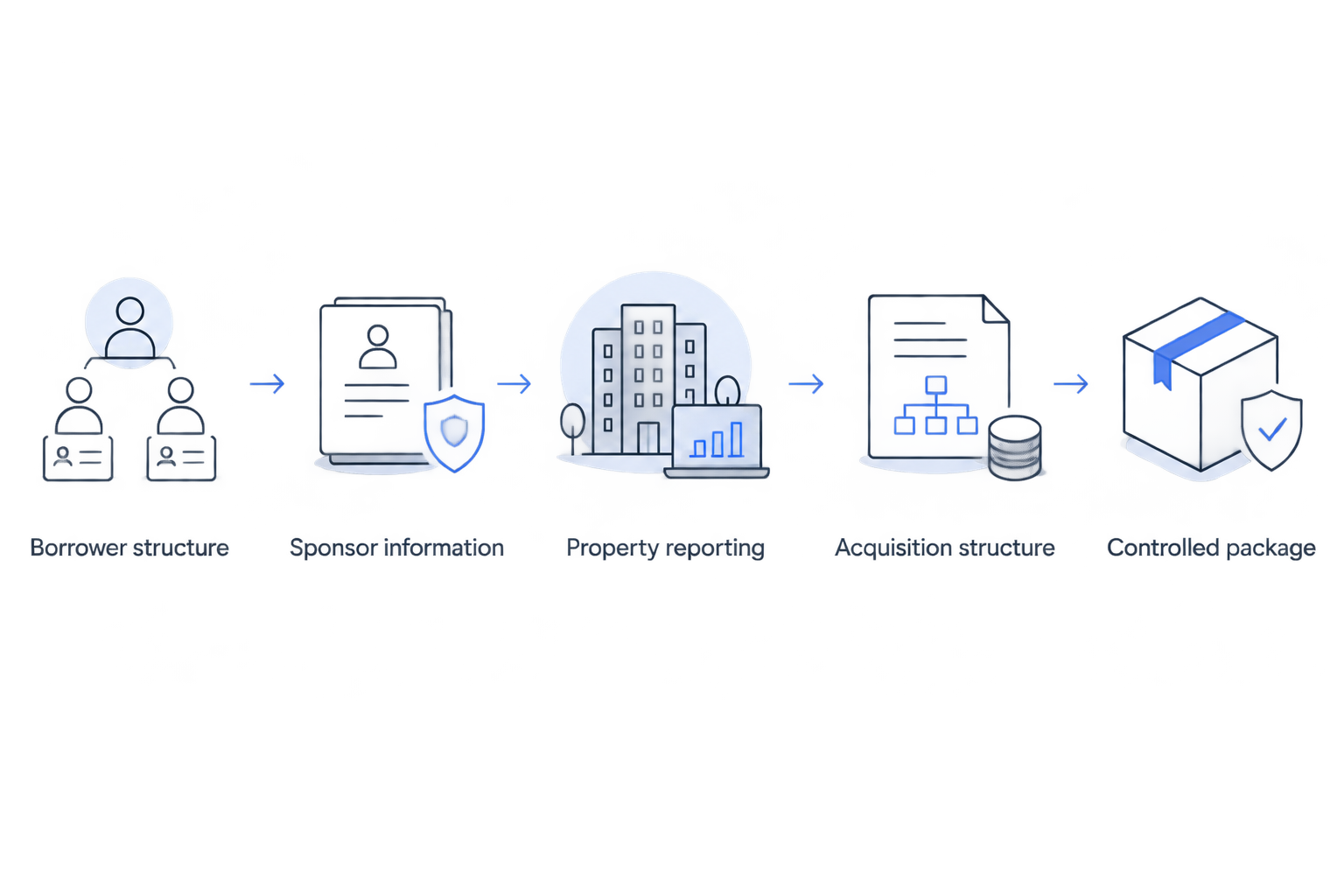
- Fix the proposed borrower structure. Prepare 2 ownership charts: the current structure and the proposed post-closing structure. Show entity names, ownership percentages, controlling parties, and proposed guarantors consistently across the application and legal documents.
- Assemble sponsor information. Provide the experience, financial information, liquidity evidence, identification, and organizational records the reviewer requests. Explain ownership through intermediate entities rather than leaving the reviewer to reconstruct it.
- Reconcile property reporting. Match the rent roll, leases, operating statements, and servicing records. A trailing 12-month operating statement is a useful starting point; submit the reporting periods the servicer actually requires.
- Document the acquisition structure. Identify the buyer's equity sources, transaction entities, proposed management, and any additional financing. Disclose subordinate debt or ownership arrangements before counsel drafts around a structure that has not been approved.
- Submit a controlled package. Use the authorized delivery channel, date the submission, and keep a document index. Maintain a single comment log showing each request, responsible party, response, and unresolved issue.
DSCR means debt service coverage ratio: the relationship between qualifying cash flow and debt service. For an assumption review, ask which cash-flow adjustments and debt-service figures apply rather than substituting the buyer's acquisition model for the reviewer's calculation.
Expected result: The reviewer can trace the property cash flow, buyer qualifications, ownership structure, and equity sources without contradictory versions.
Consent conditions and legal documents
- Separate acknowledgment from consent. Record whether the response confirms receipt, requests information, grants conditional approval, or provides final consent. Give each outstanding condition an owner and a completion requirement.
- Reconcile the approved structure. Compare the consent with the purchase agreement, ownership charts, borrower formation documents, and management arrangements. Obtain confirmation before changing a buyer entity or controlling party after review.
- Review the assumption agreement. Confirm which obligations the incoming borrower assumes, the effective date, required representations, and continuing loan terms. Identify any amendments rather than assuming the original documents remain unchanged in every respect.
- Resolve guaranties and releases. Compare replacement guaranties with the proposed release of outgoing parties. Have counsel distinguish future obligations from retained liabilities arising before closing; do not infer a release from silence.
- Clear closing conditions. Coordinate required insurance evidence, title materials, organizational certificates, legal opinions, reserve treatment, and other conditions specified for the transaction. Track requested items separately from accepted items.
Flexvcapital advertises 48-hour pre-approvals for its commercial lending offering. That statement is not a CMBS assumption approval deadline and does not bind the existing loan's servicer or consent parties.
For a 2026 transfer file, keep the approval and its conditions together. An email saying the transaction looks acceptable is not a substitute for the executed documents and required consent.
Expected result: Counsel can identify the operative consent, the final borrower structure, every remaining condition, and the exact treatment of outgoing liability.
Ownership closing and servicing handoff
- Build the closing checklist. Assign responsibility for consent delivery, executed assumption documents, guaranties, releases, title requirements, settlement reconciliation, and recording instructions. Identify who authorizes escrow to release documents and funds.
- Reconcile the settlement. Confirm the outstanding loan balance, payment status, reserves, escrows, and required adjustments against current statements and closing instructions. Resolve differences before signatures and disbursement.
- Verify closing authority. Obtain the confirmations required by the consent and escrow instructions. Do not record a deed or release ownership-transfer documents merely because the buyer and seller have signed.
- Complete the approved transfer. Execute, deliver, and record the applicable documents under counsel's and title's instructions. Whether the transaction uses a deed transfer or an ownership-interest transfer determines which instruments and records change.
- Confirm servicing continuity. Obtain payment instructions through a verified channel, update authorized contacts, and confirm insurance and reporting delivery. Verify changed wiring instructions independently with a known contact.
Your 2026 closing checklist should distinguish legal completion from administrative completion. A recorded deed does not prove that the servicing account, reporting contacts, and authorized payment arrangements have been updated.
Expected result: The ownership transfer matches the approved transaction, the closing file contains the required executed documents, and the incoming borrower knows how to perform ongoing obligations.
Variant: transfer ownership interests without changing the deed
An equity transfer can change control while leaving the property-owning borrower on title. An unchanged deed is not proof that lender consent is unnecessary.
For this adjacent workflow, begin with the same loan-document review, then change the transaction package:
- Classify the interest transfer. Have counsel assess direct and indirect ownership changes, control changes, and any applicable permitted-transfer provisions.
- Show the ownership chain. Present current and proposed charts through the relevant controlling parties. Identify related transaction steps rather than treating each transfer in isolation.
- Confirm the required process. Obtain required consent or satisfy the documented notice and other conditions for a permitted transfer. Preserve the written basis for proceeding.
- Close the equity documents. Coordinate interest assignments, company records, guaranties, and servicing updates with counsel. Do not use deed-recording completion as the checkpoint for an equity transaction.
Best for: Buyers acquiring interests in the existing property-owning entity where that structure fits the transaction and loan documents. The advantage is continuity of the title-holding entity; the limitation is that transfer restrictions and existing entity obligations still require review.
Troubleshooting
The servicer keeps requesting ownership clarification
Fix: Reconcile entity names, ownership percentages, and control rights across every chart and document. Explain intermediate entities and submit a consolidated response instead of disconnected attachments.
Consent arrived, but the seller refuses to close
Fix: Compare the negotiated seller release with the actual consent and assumption documents. Resolve retained guaranty obligations explicitly; buyer approval alone does not answer the seller's liability question.
The approved buyer structure changes before closing
Fix: Notify the servicing contact and counsel before executing the revised structure. Ask whether updated review or consent is required, and reset closing instructions to match the authorized transaction.
The closing date arrives with unresolved conditions
Fix: Identify which conditions remain unaccepted and who can clear them. Use the purchase agreement's negotiated extension or termination provisions with counsel; do not transfer ownership first and seek required consent afterward.
The first servicing statement does not match closing
Fix: Reconcile the statement against the executed settlement documents and servicing confirmations. Contact the verified servicing team promptly and obtain payment directions while the discrepancy is resolved.
Customize your workflow
For a 2026 acquisition with several buyer entities, add a separate entity-document tracker. For a management change, assign responsibility for management agreements, insurance updates, and required approvals. Keep these workstreams inside the same closing checklist.
If assumption conditions do not fit the acquisition, evaluate replacement financing before your contractual deadlines expire. Flexvcapital offers CMBS financing and other commercial lending options; that is a separate financing discussion, not authority to approve another loan's transfer.
Discuss your commercial financing structure
Review CMBS and other commercial financing options for your acquisition.
FAQ
What is a CMBS loan assumption transfer?
A CMBS loan assumption transfer lets an approved incoming borrower take on an existing CMBS loan through the required assumption and consent documents. Coordinate it with the ownership closing; a property purchase alone does not complete the assumption.
Can I assume a CMBS loan without lender consent?
You must follow the existing loan's transfer provisions. Some documents permit specified transfers subject to conditions, while other transfers require consent; have counsel classify the proposed transaction before closing.
How long does a CMBS loan assumption take in 2026?
There is no universal CMBS assumption timeline for 2026. Obtain the assigned servicer's process and outstanding requirements, then align the purchase agreement with that review rather than relying on a new-loan pre-approval timeline.
Does a CMBS assumption release the seller's guaranty?
A CMBS assumption does not establish a seller guaranty release unless the applicable documents provide it. Counsel should verify replacement guaranties, release language, effective dates, and any retained liabilities.
Can I transfer LLC interests instead of recording a new deed?
An LLC interest transfer requires its own review under the loan's ownership and control restrictions. Keeping the same property-owning entity does not automatically make the transaction a permitted transfer.
Is assuming a CMBS loan better than refinancing?
Assumption fits buyers who can accept the existing debt structure and satisfy its transfer requirements. Refinancing fits transactions needing different financing terms, but requires new underwriting and review of the existing loan's exit provisions.
What documents should I prepare before requesting an assumption?
Prepare the existing loan documents, purchase agreement, ownership charts, borrower organizational records, sponsor financial information, rent roll, and property operating reports. Obtain the assigned servicer's current checklist before treating the package as complete.
One last thing
Negotiate the seller release before the closing rush. The buyer's obligation to assume the loan and the seller's right to leave the transaction without continuing liability are separate issues. Put both on the opening checklist, not just the signature list.


