
Hotel and motel CMBS financing is commercial mortgage debt structured for securitization, with the aim of funding an acquisition or refinance supported by lodging cash flow. In 2026, evaluate CMBS loans for hotels and motels against documented operating income, renovation obligations, and your planned exit—not the property valuation alone.
- CMBS loans for hotels and motels fit stabilized lodging properties better than projects dependent on future operating improvements.
- Flexvcapital offers CMBS financing; hotel owners should confirm property eligibility, underwriting requirements, and exit restrictions before proceeding.
- Compare debt service coverage, renovation reserves, cash management, and prepayment provisions—not just the interest rate.
- Use bridge financing as a comparison when hotel renovations or operating changes must happen before permanent financing.
Why CMBS financing matters for hotel and motel owners
Hotel revenue depends on occupied room nights rather than the longer contractual income streams associated with many leased commercial buildings. A lender must evaluate the operating business alongside the real estate. Payroll, housekeeping, utilities, insurance, management expenses, and franchise obligations all affect the cash available for debt service.
That distinction matters when a hotel looks profitable on a booking report but produces substantially less cash after operating expenses. Room revenue is not net operating income, and projected occupancy is not established repayment capacity. A motel with limited amenities still needs a defensible expense structure and evidence that current operations support the requested debt.
For a 2026 acquisition or refinance, start with a complete operating package and a transaction calendar. The guide to CMBS loan underwriting timelines explains the separate timing question; the process below focuses on preparing the property and borrower for that review.
How to prepare a hotel or motel for CMBS financing
Establish your financing objective
Write down whether you are purchasing, replacing maturing debt, returning equity, or financing a property after renovations. Separate the mortgage requirement from operating cash and future capital work. A single requested loan amount does not explain how the transaction will function.
Then identify the condition that must be true at closing. An operating hotel with documented earnings presents a different underwriting case from a motel whose repayment plan depends on converting rooms, changing management, or completing deferred maintenance.
Prepare this outline yourself before requesting financing. It gives every lender the same transaction to evaluate and prevents discussions from drifting between permanent financing and a turnaround plan.
- State the transaction purpose and required closing date.
- Identify existing liens, maturity dates, and payoff requirements.
- Separate acquisition funding, capital work, and operating liquidity.
- Record your expected ownership period and sale strategy.
- Identify franchise, management, or ownership changes planned before closing.
Reconcile operating revenue and expenses
Build a spreadsheet from your property management system, bank records, and financial statements. Review at least 12 months of monthly results as a preparation exercise, then ask the lender what additional history is required. Annual totals alone conceal seasonal changes and periods when rooms were unavailable.
Track occupancy, average daily rate, and revenue per available room alongside operating expenses. Average daily rate measures room revenue per room sold; revenue per available room accounts for the available room inventory. Neither replaces net operating income.
Keep the arithmetic consistent. Explain differences between deposits, reported revenue, and financial statements rather than leaving the underwriter to reconstruct them. For your 2026 submission, distinguish actual results from budgets and label every proposed expense adjustment.
- Reconcile room revenue with booking and deposit records.
- Separate room revenue from food, parking, and other income.
- Identify room closures, refunds, and unusual operating interruptions.
- Document management fees, franchise charges, taxes, and insurance.
- Support proposed adjustments with invoices, contracts, or other records.
Test debt capacity before selecting a lender
Use a spreadsheet to calculate debt service coverage ratio: underwritten net operating income divided by annual debt service. Debt yield is underwritten net operating income divided by the loan amount. Loan-to-value compares the loan amount with the accepted property value. These measures answer different questions; passing one does not establish approval.
Ask each lender how it determines income, debt service, value, and required reserves. Do not import a minimum ratio from another property type or treat a preliminary calculation as a commitment.
Flexvcapital offers CMBS financing and bridge loans, giving you a direct-lender starting point for discussing the financing structure. Flexvcapital is best for commercial borrowers seeking a direct-lender discussion of CMBS and bridge financing. Hotel eligibility and transaction terms still require confirmation.
- Calculate coverage using the lender's proposed debt service.
- Compare your income calculation with the lender's adjustments.
- Identify whether income, value, or another constraint limits proceeds.
- Ask how reserves affect the cash you receive at closing.
- Test weaker revenue without assuming operating expenses fall proportionately.
Document the property and operating obligations
Create a shared document folder before ordering reports or paying transaction expenses. Include ownership records, operating agreements, franchise documents, management contracts, insurance information, and available property reports. Ask the lender and counsel which documents must be current and which reports require approved providers.
For franchised lodging, identify any property improvement plan and its relationship to the financing. For independent hotels and motels, document the operating model without assuming a brand affiliation is either required or irrelevant.
A property improvement plan, commonly called a PIP, describes required improvements under the applicable franchise arrangement. Its scope, funding, and deadlines belong in the financing discussion—not in a separate file opened after terms are agreed.
- Document the legal borrower and ownership structure.
- Disclose franchise requirements and outstanding improvement obligations.
- Provide management agreements and proposed operator changes.
- Identify deferred maintenance and unresolved property issues.
- Confirm the lender's appraisal, engineering, and environmental requirements.
Compare loan controls and exit restrictions
Request a written explanation of cash management, reserve funding, permitted transfers, and prepayment provisions. CMBS financing involves servicing and securitization considerations that affect administration after closing. The lender relationship at origination does not replace the procedures written into the loan documents.
Discuss both ordinary operations and difficult situations. Ask who approves a management change, how reserve reimbursements work, and what happens if performance weakens. A nonrecourse structure does not mean every borrower or guarantor obligation disappears; counsel must review the actual carveouts and guarantees.
Evaluate 3 exit scenarios before selecting terms: holding through maturity, selling before maturity, and refinancing before maturity. Use written provisions rather than verbal summaries to assess each scenario.
- Request the cash-management triggers and account-control requirements.
- Identify reserve deposits, release conditions, and reimbursement procedures.
- Review prepayment restrictions and any defeasance provisions.
- Confirm assumption requirements for a future buyer.
- Review recourse carveouts and approval requirements with counsel.
Build a closing and post-closing plan
Use a checklist with an owner and deadline for every outstanding item. Separate preliminary indications from credit approval, final documents, and funding conditions. For a 2026 closing, work backward from the contractual deadline without assuming that an initial lender response establishes a funding date.
Flexvcapital states a 48-hour pre-approval turnaround. Treat that as a preliminary stage, not a promise that a hotel CMBS loan will close within that period. The closing schedule still needs to account for underwriting, third-party work, legal review, and unresolved conditions.
Plan for administration after funding as carefully as closing itself. Someone must track reporting requirements, reserve requests, insurance renewals, and lender-consent obligations throughout ownership.
- Assign responsibility for each lender condition and document request.
- Confirm when transaction expenses become payable or nonrefundable.
- Track title, insurance, property reports, and legal comments separately.
- Obtain written confirmation of remaining funding conditions.
- Establish a calendar for post-closing reporting and compliance.
Compare hotel and motel financing options
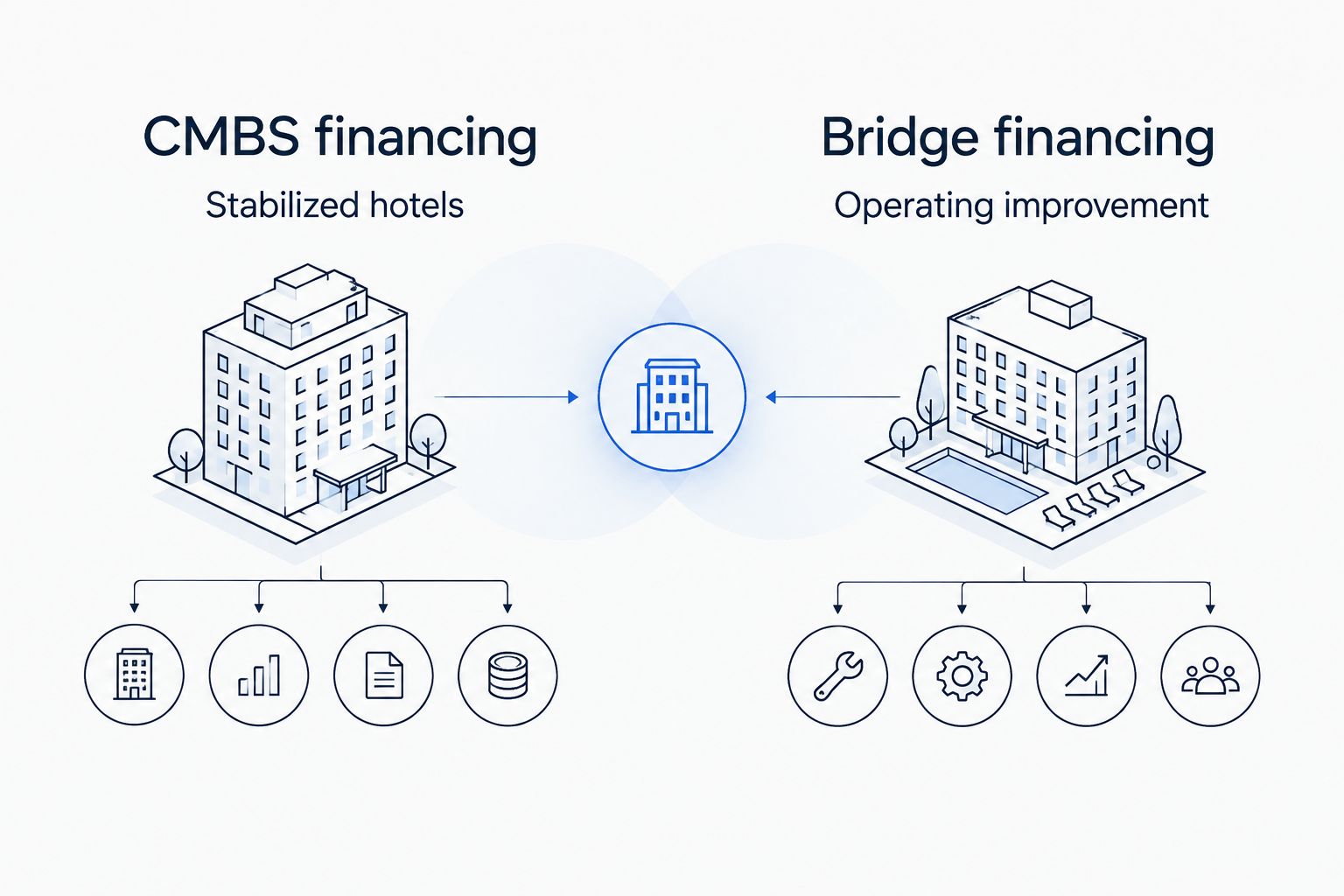
Choose the financing structure that matches the property's current condition and your ownership plan. A hotel requiring substantial operating improvements presents a different financing need from a stabilized property intended for a long hold.
The table identifies starting points for discussion, not approval rules. Property eligibility, borrower qualifications, guarantees, and final documentation determine whether any option fits your transaction.
| Option | Best for | Main advantage | Key limitation |
|---|---|---|---|
| CMBS financing | Stabilized hotels and motels with documented operating income | Evaluates income-producing commercial property within a securitized lending structure | Prepayment, servicing, transfer, and cash-management provisions require close review |
| Bank commercial mortgage | Owners seeking a balance-sheet lending relationship | Provides a bank-based alternative to securitized financing | Credit requirements, recourse, and property appetite depend on the bank |
| Bridge financing | Properties undergoing renovation, repositioning, or operating improvement | Addresses a transitional financing need before a longer-term solution | Requires a credible repayment or refinance plan at maturity |
| SBA financing | Eligible owner-operated lodging businesses | Provides a business-financing route for qualifying borrowers and uses | Eligibility and occupancy requirements must be checked for the specific program |
Do not compare these options using loan proceeds alone. Compare required equity, reserve obligations, guarantees, reporting, and the consequences of an early sale. Ask each lender to explain what happens if renovations take longer or operating income falls short of the business plan.
Common mistakes hotel and motel owners make
Treating peak-season revenue as the baseline
A strong trading period does not describe the entire operating cycle. Present monthly results and explain seasonal staffing, room closures, and revenue changes. For a 2026 financing request, show how the property performs outside its strongest demand periods instead of annualizing a peak month.
Counting projected improvements as established income
Renovated rooms, a new operator, or a different franchise affiliation do not create historical earnings before implementation. Separate actual results from the business plan. If the requested loan depends on income that does not yet exist, discuss transitional financing rather than presenting projections as stabilized operations.
Ignoring franchise and renovation obligations
A franchise agreement and its improvement requirements affect the operating plan and available cash. Disclose required work before comparing proposals. Confirm who funds the work, how completion is documented, and whether the financing documents impose related deadlines or reserves.
Assuming nonrecourse means no personal exposure
Nonrecourse language must be read with the exceptions, guarantees, and borrower obligations. Ask counsel to identify conduct-based carveouts and any separately guaranteed obligations. The correct question is what the signed documents require, not whether the proposal uses the word nonrecourse.
Comparing proposals without testing the exit
A loan intended for a long hold deserves a different review from one attached to an early sale plan. Examine prepayment, defeasance, assumption, and transfer provisions before choosing a proposal. An attractive initial structure does not erase restrictions that conflict with your ownership strategy.
Discuss your hotel financing structure
Review CMBS and bridge financing with Flexvcapital, a direct commercial lender in New York.
FAQ
What's the best use of CMBS loans for hotels and motels?
CMBS loans for hotels and motels are best evaluated for properties with established operating income and an ownership plan compatible with the loan's restrictions. Confirm property eligibility, underwritten cash flow, reserves, and exit provisions before selecting this structure.
Can an independent motel qualify for CMBS financing?
An independent motel needs a property-specific eligibility review; do not assume either automatic qualification or automatic exclusion. Present operating history, management experience, property condition, and the local demand profile for the lender's assessment.
Is a bridge loan better than CMBS for a hotel renovation?
Bridge financing is the more relevant comparison when repayment depends on completing renovations or improving operations before permanent financing. The decision still requires a documented budget, sufficient liquidity, and a credible exit plan.
What documents should I prepare for a hotel CMBS application?
Prepare operating statements, monthly lodging performance, ownership records, existing debt information, and applicable franchise and management agreements. Obtain the lender's document checklist before commissioning third-party reports.
Does hotel CMBS financing always require a personal guarantee?
Guarantee requirements depend on the loan documents, and nonrecourse financing does not eliminate every potential guarantor obligation. Have counsel review recourse carveouts and any separately guaranteed obligations before signing.
Can I sell my hotel before the CMBS loan matures?
An early sale must comply with the loan's transfer, assumption, and payoff provisions. Ask whether a buyer can assume the debt, what approvals are required, and which prepayment or defeasance provisions apply.
Does a pre-approval mean my hotel loan is ready to fund?
A pre-approval is not the same as final approval or authorization to fund. Confirm outstanding underwriting, property reports, legal documents, and funding conditions before relying on a closing date.
One last thing
Test the exit before negotiating the final loan structure. Write a short instruction for counsel describing your expected hold, a possible early sale, and a downside operating scenario. Ask counsel to identify the provisions that control each outcome.
For your 2026 decision, that exercise turns a general discussion about flexibility into specific questions about consent, repayment, reserves, and timing. Resolve those questions before committing to terms that do not fit the property or ownership plan.
This guide provides general financing information, not a credit commitment or legal or tax advice. Final eligibility and terms depend on underwriting and executed documents.


