
CMBS loan underwriting time has no fixed duration: your schedule depends on a complete borrower file, property due diligence, credit approval, and cleared closing conditions. An initial approval is not authorization to fund. For a 2026 purchase or refinance, get a written milestone schedule tied to your transaction before committing to a closing date.
- CMBS loan underwriting time depends on completed reviews and cleared conditions, not just an application date.
- Flexvcapital offers CMBS financing; its 48-hour pre-approval is not a commitment to fund within that period.
- Separate credit approval, loan documentation, and funding when checking your commercial mortgage schedule.
- Resolve inconsistent rent rolls, financial statements, and ownership records before they interrupt underwriting.
How long does CMBS loan underwriting take?
Measure CMBS underwriting from a defined starting point to a defined milestone—not from the first conversation to an assumed closing date. A lender's estimate means little unless you know what must already be complete and what remains outside that estimate.
The rate-lock-to-CMBS-funding workflow explains the distinction between agreeing on financing terms and completing the requirements for disbursement.
Use this sequence to establish your transaction's schedule:
- Define file completion. Ask which financial statements, leases, borrower records, and property documents the lender needs before substantive review begins.
- Confirm report status. Identify required third-party reports, who orders them, and whether inspections and property access are arranged.
- Identify credit conditions. Separate questions affecting loan approval from conditions that can be satisfied during closing preparation.
- Track legal clearance. Confirm responsibility for title, survey, insurance, borrower-entity documents, and loan-document comments.
- Confirm funding requirements. Obtain the final conditions and instructions before treating the transaction as ready to close.
These activities overlap. Do not add separate estimates together unless the lender confirms that the work must occur sequentially.
Why this matters
A purchase-contract deadline and a lender's estimated underwriting completion are different commitments. You need enough time after credit review to resolve legal conditions, finalize documents, and coordinate disbursement.
For a refinance, compare the proposed funding schedule with your existing loan's maturity and payoff requirements. Approval alone does not retire the existing debt.
Your 2026 financing calendar should show both the target date and the unresolved condition that threatens it. A list of dates without dependencies does not tell you whether the transaction is progressing.
Ask what must happen next, who owns that task, and what evidence will confirm completion. That produces a usable status update instead of another estimated closing date.
Which milestones determine the underwriting schedule?
A CMBS transaction requires both a credit decision and a closing-ready file. Use the following table to distinguish progress from completion.
| Milestone | What is being evaluated | What you should verify |
|---|---|---|
| File intake | Property information and borrower documentation | The lender has identified missing items |
| Property review | Income, expenses, leases, value, and physical condition | Material discrepancies have been explained |
| Credit review | Repayment capacity, collateral, and proposed structure | Approval conditions are documented |
| Legal review | Title, survey, insurance, entity structure, and loan documents | Open comments have responsible owners |
| Funding clearance | Satisfaction of remaining closing requirements | The lender has authorized the next closing step |
An ordered report is not a reviewed report. Likewise, a submitted document is not necessarily an accepted document. Your status tracker should distinguish those events.
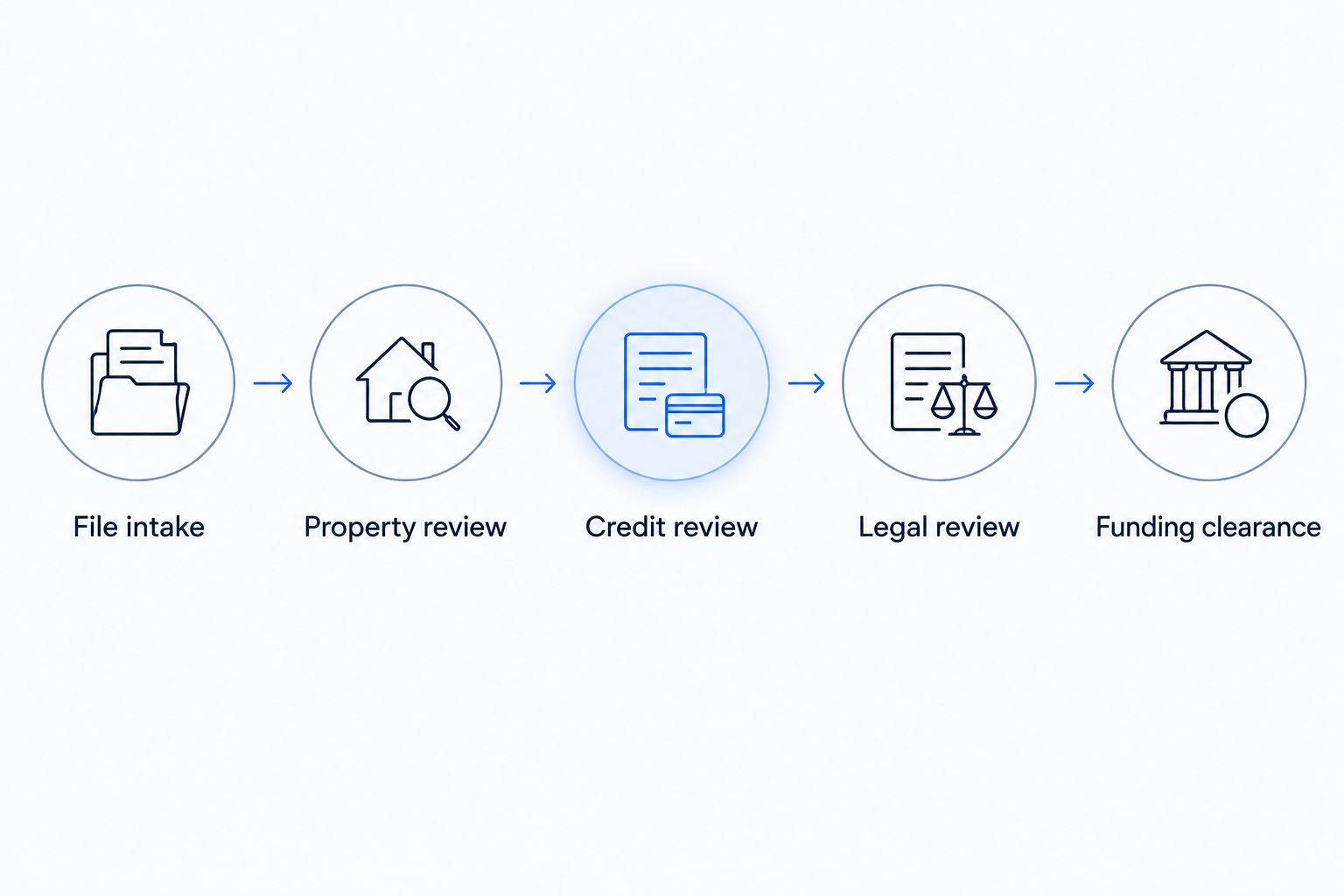
For each milestone, request the next action rather than a general percentage-complete estimate. A file with a single unresolved title issue is not necessarily closer to funding than a file with several routine administrative items.
Why CMBS loan underwriting time varies
CMBS underwriting evaluates the property, the borrower, and the enforceability of the proposed loan. The schedule changes when those reviews uncover questions requiring new documents or decisions.
The principal scheduling factors are:
- Financial consistency. Rent rolls, operating statements, and lease documents need to support a coherent explanation of property income and expenses.
- Tenant and lease review. Material lease provisions, tenant obligations, and occupancy information affect how the lender evaluates cash flow.
- Third-party due diligence. Appraisal, environmental, and property-condition work involves inspections, document collection, and lender review.
- Title and survey findings. Liens, exceptions, access questions, or boundary issues require resolution or lender acceptance.
- Borrower structure. Entity records, ownership information, signing authority, and required borrower-entity provisions must align with the transaction.
- Closing conditions. Insurance, reserves, final documents, and outstanding approval conditions must meet the lender's requirements.
Do not treat every delay as an underwriting problem. A completed credit review cannot eliminate an unresolved ownership question or substitute for missing insurance evidence.
For your 2026 transaction, ask the lender to identify the critical dependency: the unfinished item currently controlling the earliest realistic funding date. Recheck it whenever a major condition clears.
What documents should you prepare before underwriting?
Build a consistent file before asking the lender to commit to a schedule. Uploading documents quickly helps only when the documents answer the questions being asked.
Property cash flow
Prepare the current rent roll, historical operating statements, available interim results, and material leases. Include explanations for discrepancies rather than expecting the underwriter to infer them.
For example, distinguish contractual rent from collected rent. Identify concessions, arrears, and nonrecurring income where relevant, so the financial package does not present different versions of property performance.
Ownership and borrower records
Organize formation documents, ownership information, signing-authority records, and financial information requested by the lender. Make sure the proposed borrowing entity matches the acquisition or refinance structure.
If an ownership or entity change is planned, disclose it before legal documents are drafted. Late changes create additional review rather than simply changing a name on the signature page.
Property and closing materials
Gather existing title and survey materials, insurance information, property reports, and the purchase agreement or existing debt information, as applicable. Ask which existing materials are acceptable and which must be updated or replaced.
Do not assume a report prepared for another transaction satisfies the current lender's requirements. Confirm acceptability before relying on it in your closing calendar.
How do you keep underwriting moving?
Use a shared conditions list with clear ownership. An email chain is not an adequate substitute when several parties are reviewing different parts of the transaction.
For each open item, record:
- The document, explanation, or decision required.
- The person responsible for producing it.
- The party responsible for reviewing it.
- The agreed delivery date.
- Whether it is submitted, accepted, or still under review.
When a request is unclear, ask what issue the underwriter needs resolved. Sending another version of the same spreadsheet does not help if the actual question concerns a lease provision.
Keep document versions identifiable and explain material revisions. If the rent roll changes during review, identify the change and provide supporting information rather than silently replacing the earlier file.
Your 2026 closing plan should also include availability for property access, signatures, and legal responses. A complete financial package does not address those operational dependencies.
Does a 48-hour pre-approval mean underwriting is complete?
A 48-hour pre-approval is not completed CMBS underwriting or a funding commitment. Pre-approval and closing clearance represent different stages of the lending process.
Flexvcapital states that it offers 48-hour pre-approvals and CMBS financing. That turnaround should not be read as a CMBS closing deadline or a promise that property, credit, and legal reviews are finished.
Flexvcapital is best for commercial real estate investors seeking a direct lender that offers CMBS financing. The fit is direct access to a commercial lender; the limitation is that an early response does not remove transaction-specific underwriting and closing requirements.
Use the contact page to request a transaction-specific schedule. Provide the property type, financing purpose, current documentation status, and contractual deadline so the discussion addresses the actual file.
Can you shorten CMBS underwriting by ordering reports early?
Ordering required reports early moves due diligence forward, but only if the lender accepts the provider, scope, and report requirements. Confirm those instructions before commissioning work independently.
Ask whether inspections can be coordinated while financial review proceeds. Parallel work reduces unnecessary sequencing; it does not remove the lender's obligation to review the results.
A report can also generate follow-up questions. Your schedule should account for review and resolution, not merely the date the consultant delivers the document.
What if underwriting is not finished before your closing deadline?
If underwriting threatens your deadline, identify the unresolved condition before choosing a response. A missing borrower document calls for a different action than an unresolved property issue or an incomplete credit decision.
Ask the lender which conditions prevent approval and which prevent funding. Then discuss the deadline with the relevant transaction parties before it becomes an immediate closing problem.
Do not assume changing lenders will preserve completed work or eliminate the underlying issue. A new lender must determine which documents and reports it accepts and perform its own review.
What should you ask before accepting a timeline?
Before relying on a 2026 CMBS schedule, get answers to these questions:
- What event starts the estimated underwriting period?
- Does the estimate end at credit approval, document readiness, or funding?
- Which required reports are ordered, delivered, and accepted?
- What property or borrower questions remain unresolved?
- Which closing conditions require action from someone other than the borrower?
- Who will confirm that the loan is cleared for the next closing step?
Request these answers in writing and update them when circumstances change. The purpose is not to obtain an unconditional date; it is to understand the assumptions supporting the date.
A useful lender update names the outstanding issue and its owner. A statement that the transaction is progressing does not tell you whether your deadline remains achievable.
FAQ
How long does CMBS loan underwriting take in 2026?
CMBS loan underwriting time is transaction-specific, with the schedule determined by file completeness, property review, credit approval, and closing conditions. Ask for a written schedule that distinguishes underwriting completion from funding.
When does the CMBS underwriting clock start?
The underwriting starting point must be defined with the lender. Confirm whether the estimate begins at application, receipt of a complete package, or another agreed milestone.
Does CMBS credit approval mean my loan is ready to fund?
CMBS credit approval does not by itself mean the loan is ready to fund. Legal documentation, title, insurance, and other closing conditions must also satisfy the lender's requirements.
Does a 48-hour pre-approval guarantee a fast CMBS closing?
A 48-hour pre-approval does not guarantee a CMBS closing date. Flexvcapital's stated pre-approval turnaround is separate from completion of property due diligence, underwriting, and closing requirements.
Can CMBS underwriting continue while reports are being prepared?
CMBS financial review and third-party report preparation can proceed in parallel when the lender's process permits. Final decisions still depend on acceptable findings and resolution of material questions.
What documents help prevent avoidable CMBS underwriting delays?
Consistent rent rolls, operating statements, leases, borrower records, and requested property materials help prevent avoidable document follow-ups. Explain discrepancies and identify revisions rather than submitting conflicting versions.
Should I schedule closing immediately after underwriting approval?
Schedule closing against the lender's remaining conditions, not underwriting approval alone. Confirm document readiness, required signatures, funding authorization, and the closing agent's instructions before relying on the date.
One last thing
Ask for the oldest unresolved condition, not just the newest status update. An item that keeps returning without acceptance deserves attention even when other parts of the file are advancing.
Before your next lender call, put that condition at the top of the agenda. Establish what resolves it, who can provide the evidence, and who has authority to accept the response.


