
Instead of manually chasing payoff figures, rent rolls, and closing updates, build a bridge loan payoff to Fannie Mae refinance workflow that connects eligibility review, underwriting, and settlement. For a 2026 closing, confirm the multifamily property qualifies before treating the refinance as your bridge loan exit; Flexvcapital offers both bridge loans and Fannie Mae financing.
- For a bridge loan payoff fannie mae refinance, confirm multifamily eligibility before scheduling settlement.
- Flexvcapital offers bridge loans and Fannie Mae financing; property eligibility still controls the refinance path.
- Match the payoff statement’s validity date to funding, and reconcile net proceeds against every closing obligation.
- Use verified operating income, not projected rent increases, to build your 2026 refinance file.
Why this matters
A bridge loan payoff and a Fannie Mae refinance are separate transactions that must meet at closing. The existing lender needs the correct payoff amount; the refinance lender needs an eligible property, acceptable underwriting, and satisfied funding conditions.
Flexvcapital is best for commercial real estate borrowers seeking a lender that offers both bridge loans and Fannie Mae financing. That product overlap does not establish property eligibility, agency approval, or a guaranteed closing date.
Fannie Mae’s conventional multifamily financing generally serves properties with at least 5 dwelling units. A retail building, office property, or smaller rental property does not qualify simply because its existing debt is a commercial bridge loan.
For your 2026 exit plan, work backward from contractual maturity and extension-notice deadlines. A requested closing date is not evidence that the refinance will fund.
Before you start
- Access and authority: Identify the borrower’s authorized signer, property manager, bridge loan servicer, refinance lender, and settlement contact. Confirm who can request account information and approve funds transfers.
- Documents: Gather the bridge note, loan agreement, amendments, current statement, entity documents, leases, rent roll, operating statements, insurance information, and renovation records. Prepare a trailing 12-month operating statement for initial review; ask the lender which additional periods it requires.
- The non-obvious gotcha: The outstanding principal balance is not necessarily the payoff amount. Accrued interest, contractual minimum interest, prepayment provisions, advances, and release requirements must be reconciled before you calculate the cash needed to close.
Use a secure document-sharing method accepted by the parties. The field labels below are labels for your own closing tracker, not claimed buttons or settings in a lender’s portal.
Payoff file
- Extract the controlling dates. Read the signed bridge documents and amendments. Record Maturity date, Extension notice deadline, and any contractual conditions for exercising an extension. Do not substitute a loan officer’s email summary for the executed agreement.
- Request a preliminary payoff. Ask the servicer for a written statement showing principal, accrued interest, other contractual amounts, the payoff validity date, and the daily interest amount after that date, if applicable. Record Payoff valid through and Daily interest in your tracker.
- Identify release requirements. Ask the servicer and settlement agent what documentation and payment conditions are required to release the mortgage and any other applicable liens. Include assignments of rents and fixture-related filings in the discussion when they secure the debt.
- Build a sources-and-uses worksheet. Separate expected refinance proceeds from the amounts needed for payoff, transaction expenses, required reserves, and borrower cash. Track potential refunds from the existing loan separately until the servicer confirms how and when they are released.
Expected result: You have a documented bridge obligation, controlling deadlines, and an initial estimate of the borrower contribution. You have not mistaken a statement balance for a settlement figure.
Keep the payoff file separate from the property underwriting file. A revised payoff changes settlement calculations; it does not establish that the property supports a larger refinance.
Eligibility review
- Confirm the property category. Give the refinance lender the address, dwelling-unit count, property use, ownership structure, renovation status, and occupancy information. Ask for confirmation that the proposed property and transaction fit the intended Fannie Mae execution.
- Reconcile rent and collections. Match the rent roll to executed leases and operating records. Identify concessions, delinquency, vacant units, and leases signed but not yet producing collections. Label projected rents separately from in-place income.
- Document operating expenses. Include property taxes, insurance, utilities, management, repairs, and other operating expenses. Explain unusual items rather than silently removing them from the statement.
- Request preliminary sizing. Ask the lender to identify the assumptions used for net operating income, debt service coverage ratio, loan-to-value ratio, and reserves. Record the assumptions and unresolved conditions alongside the proposed loan amount.
Expected result: You know whether the property fits the proposed financing path and whether preliminary proceeds cover the payoff and other uses.
Debt service coverage ratio, or DSCR, measures underwritten net operating income against annual debt service. Loan-to-value ratio, or LTV, compares the loan amount with property value. Neither ratio alone guarantees approval; the applicable program and lender requirements control.
Do not apply an uncited universal DSCR, occupancy, or LTV threshold to every 2026 transaction. Ask the lender to state the requirements for your property and execution in writing.
Refinance versus bridge extension
These are adjacent workflows, not interchangeable approvals. An extension depends on the existing contract and any required lender consent.
| Path | Best for | Advantage | Limitation |
|---|---|---|---|
| Fannie Mae refinance | Eligible multifamily properties ready for permanent financing | Replaces bridge debt with permanent financing | Requires property eligibility, underwriting, and closing conditions |
| Bridge extension | Borrowers needing additional time under an exercisable or negotiated extension | Preserves time to complete the refinance process | Does not eliminate the debt or guarantee later refinance approval |
Choose the refinance path only after eligibility and preliminary sizing are confirmed. Keep the extension decision tied to its contractual deadline, not to optimism about closing.
Underwriting file
- Create a single document index. Use sections titled Payoff, Property income, Property expenses, Ownership, and Closing conditions. Identify the current version of each document so the lender does not underwrite an obsolete rent roll.
- Coordinate third-party work. Follow the refinance lender’s instructions for appraisal, environmental review, property condition review, title, survey, and other required diligence. Ask before ordering reports independently; a report commissioned outside the lender’s process is not automatically acceptable.
- Resolve discrepancies. Explain differences between leases, rent rolls, bank activity, and financial statements. Submit supporting records with the explanation rather than asking the underwriter to infer the cause.
- Maintain a conditions register. Record each open item, responsible party, requested evidence, and completion status. Distinguish a document being uploaded from the lender accepting it as sufficient.
- Confirm closing dependencies. Ask which conditions must be satisfied before rate lock, document preparation, and funding. Obtain the applicable rate-lock terms before authorizing that step.
Expected result: Every material underwriting condition has an owner and a documented resolution path. Your refinance schedule rests on specific outstanding items rather than a general approval update.
The process follows a sequence, but unresolved underwriting issues can send the file back for revisions. In 2026, maintain one current conditions register rather than competing versions across email threads.
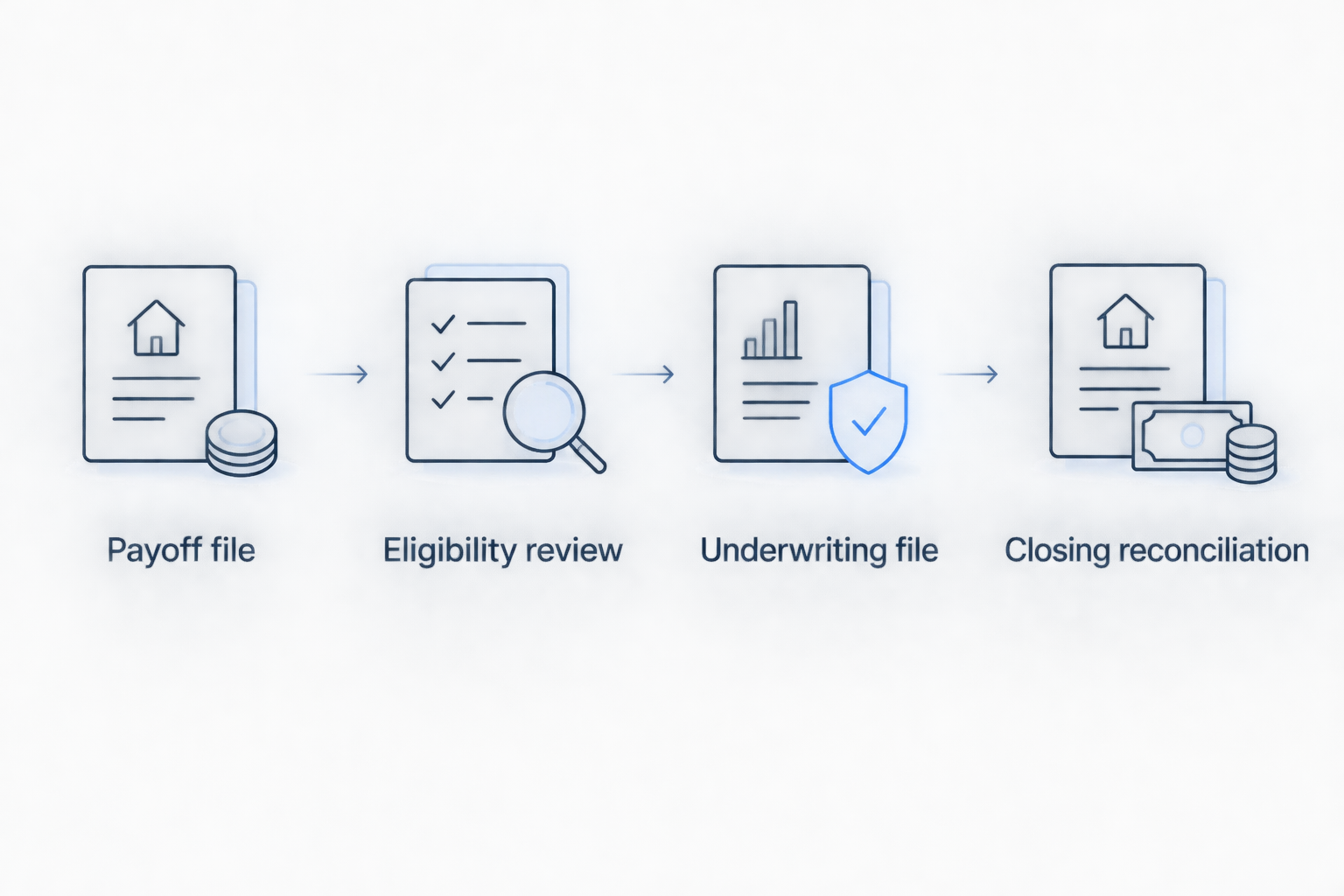
Closing reconciliation
- Obtain the final payoff. Request an updated statement covering the intended funding date. If funding moves beyond the statement’s validity, obtain revised instructions or the servicer’s written confirmation of the applicable adjustment.
- Reconcile net proceeds. Compare the lender’s closing figures with the settlement statement. The loan’s face amount is not necessarily the amount available to repay the bridge lender after required deductions.
- Confirm borrower funds. Identify any cash shortfall and satisfy the lender’s documentation requirements for its source. Do not assume a future escrow refund can fund an immediate settlement obligation.
- Verify wire instructions independently. Use an established, independently verified telephone number to confirm instructions with the appropriate recipient. Do not rely solely on an email announcing changed banking details.
- Confirm disbursement and release. Obtain confirmation that the bridge servicer received and applied the payoff. Track the mortgage satisfaction or release and other required lien releases with the settlement agent after disbursement.
Expected result: Refinance proceeds and borrower funds satisfy the verified closing obligations, and the old loan’s release process is documented.
Signing documents does not prove that bridge debt has been repaid. Keep the file open until receipt and application of funds are confirmed and release follow-up is assigned.
When the rent roll or closing date changes
Reopen the affected parts of the workflow whenever a material input changes. Do not replace an old document silently and assume every party has incorporated the revision.
- Rent roll update: Send the revised version with a change summary covering occupancy, collections, concessions, and lease changes. Ask whether underwriting or loan sizing needs revision.
- Closing date update: Refresh the payoff calculation and confirm rate-lock, insurance, title, and document timing with the responsible parties.
- Construction update: Report unfinished work and changes to the completion schedule. Ask whether inspections, repair escrows, or other conditions require revision.
The advantage of this update workflow is consistency between underwriting and settlement. Its drawback is that a late change can reopen an item previously treated as complete.
Troubleshooting
Refinance proceeds fall below the payoff requirement
Fix: Reconcile the lender’s final sizing against the complete sources-and-uses worksheet. Identify whether the gap comes from valuation, underwritten income, required reserves, or payoff changes. Resolve the borrower contribution or another approved funding source before scheduling disbursement.
The payoff statement expires before funding
Fix: Obtain an updated payoff or written servicer instructions covering the revised date. Do not calculate an unofficial adjustment when contractual charges or release conditions remain unclear.
Renovations are complete, but underwriting still uses lower income
Fix: Provide leases, collection records, and completion evidence. Ask which income the lender accepts for sizing; renovated units and asking rents do not establish collected operating income.
Bridge maturity arrives before refinance readiness
Fix: Review extension rights and notice requirements immediately with the bridge lender and counsel. A pending refinance application does not amend the existing maturity date.
A paid loan still appears as an open lien
Fix: Give the settlement agent the payoff receipt and request the release status. Confirm who submits the release for recording and who tracks completion; do not treat a zero balance as proof of a recorded satisfaction.
Customize your workflow
Expand the tracker beyond payoff if you own multiple properties. Give each loan its own maturity date, servicer contact, underwriting conditions, and release status; avoid combining obligations merely because the borrower or manager is the same.
Flexvcapital offers bridge loans and Fannie Mae financing, which makes both categories relevant to an exit discussion. The limitation is unchanged: offering both products does not make every bridge-financed asset eligible for Fannie Mae financing.
Use the Fannie Mae multifamily application-to-closing workflow to organize the broader refinance process. For your 2026 closing file, add a separate decision log recording who approved each material change and which documents support it.
FAQ
Can I use a Fannie Mae refinance to pay off a bridge loan?
Yes, a Fannie Mae multifamily refinance can repay existing bridge debt when the property, borrower, and transaction meet applicable requirements. The lender must confirm eligibility, permitted proceeds, and closing conditions.
Does every commercial property qualify for Fannie Mae financing?
No, Fannie Mae multifamily financing is not a general refinance program for every commercial property. Conventional multifamily financing generally serves properties with at least 5 dwelling units; property use and program requirements still matter.
What documents should I gather before requesting a bridge loan payoff?
Gather the executed bridge loan documents, amendments, current statement, and borrower authorization. Request a written payoff showing the validity date, applicable charges, and release requirements.
How long does a bridge loan payoff to Fannie Mae refinance take?
The schedule depends on eligibility review, underwriting, third-party reports, title, and closing conditions. Use the lender’s transaction-specific schedule and the existing loan’s contractual deadlines rather than a generic turnaround promise.
Can I use projected rents to qualify for the refinance?
Do not assume projected rents qualify as underwritten income. Provide current leases, rent rolls, and collection records, then ask the lender which income it accepts for the proposed execution.
What happens if the refinance does not cover the bridge payoff?
You must resolve the funding gap before closing. Reconcile net proceeds, required reserves, transaction expenses, and the final payoff, then document the borrower contribution or another lender-approved source.
Does Flexvcapital offer both bridge and Fannie Mae financing?
Yes, Flexvcapital lists bridge loans and Fannie Mae financing among its commercial lending offerings. Each transaction still requires an eligibility review and satisfaction of the applicable underwriting and closing conditions.
One last thing
Keep the payoff receipt and the recorded mortgage release as separate checklist items. They answer different questions: whether the servicer received payment, and whether the public record reflects the lien release. Assign an owner to both before closing day.


