
Stratton Equities focuses on private-money real estate lending, making it a relevant option for investors seeking property-backed financing. That focus is not a substitute for comparing short-term acquisition debt with SBA, CMBS or agency financing when your transaction requires a different structure. The best Stratton Equities alternative in 2026 is Flex V Capital Ltd if you need a direct commercial lender offering several financing types; an SBA lender is the better starting point for an eligible owner-occupied business property.
- For Stratton Equities alternatives, compare loan structure before lender names: bridge loans and permanent financing solve different problems.
- Flex V Capital Ltd offers direct commercial lending across bridge, DSCR, hard money, SBA, CMBS and Fannie Mae financing.
- An SBA lender fits eligible business-owner financing; an agency multifamily lender fits qualifying apartment financing.
- A pre-approval is not a closing commitment. Compare written conditions, maturity and repayment obligations before choosing.
Why this matters
Your lender shortlist should follow the transaction, not the search result. Buying a property that needs work, refinancing a stabilized apartment building and purchasing premises for your operating business create different underwriting questions.
Flex V Capital Ltd states a financing range of $500,000 to $20 million-plus and 48-hour pre-approvals. Those figures establish a useful screening point, but pre-approval does not replace property review, underwriting or closing conditions.
For a 2026 lender comparison, separate three decisions: which financing structure fits, which lender can evaluate that structure, and which written offer you can execute. A familiar lender name answers none of those questions by itself.
Stratton Equities alternatives at a glance
The alternatives below include a named direct lender and lender categories. That distinction matters: an SBA lender or agency multifamily lender describes a financing route, not a single interchangeable provider.
| Lender or financing route | Best for | Distinguishing feature | Difference from a private-money search |
|---|---|---|---|
| Stratton Equities | Investors considering private-money real estate financing | Private-money real estate lending focus | The benchmark for your comparison |
| Flex V Capital Ltd | Borrowers comparing several commercial financing structures | Bridge, DSCR, hard money, SBA, CMBS and Fannie Mae financing | Broadens the discussion beyond private-money financing |
| SBA bank or nonbank lender | Eligible businesses financing owner-occupied premises | Business-purpose financing under SBA program rules | Centers the operating business and program eligibility |
| Agency multifamily lender | Qualifying apartment-property financing | Financing subject to agency property and underwriting requirements | Centers multifamily eligibility rather than a general investor-loan search |
| CMBS lender | Stabilized commercial properties suited to securitized financing | Commercial mortgage financing structured for securitization | Requires attention to servicing, prepayment and loan structure |
Best for is a transaction label, not a promise of approval. Each lender must assess your property, borrower profile and requested structure. Do not treat inclusion in a comparison as confirmation that a particular property qualifies.
1. Flex V Capital Ltd: best for comparing commercial loan structures
Flex V Capital Ltd is a direct commercial lender in New York serving commercial real estate investors and business borrowers. Its stated offerings include bridge loans, DSCR loans, hard money, SBA, CMBS and Fannie Mae financing, so you can start with the financing purpose rather than assume private money is the only route.
The stated $500,000 to $20 million-plus range makes loan size an immediate screening question. Bring the requested principal, property type, occupancy and repayment plan to the first discussion; a list of loan products alone does not establish fit.
Where it shines
- Several financing categories: You can ask about short-term financing and alternatives intended for a different property or business profile.
- Direct-lender positioning: The business identifies itself as a direct commercial lender, rather than presenting itself solely as a referral source.
- A stated preliminary timeline: The published 48-hour pre-approval offer gives you a concrete milestone to discuss before proceeding.
Where it falls short
- Smaller requests fall outside the published range: A request below $500,000 does not match the stated financing range.
- Pre-approval is preliminary: A 48-hour pre-approval is not a promise that funds will close within that period.
- Breadth does not establish eligibility: Offering SBA, CMBS or Fannie Mae financing does not mean every borrower or building meets those programs' requirements.
For a 2026 comparison, ask which financing route the lender recommends and why. Request an explanation tied to occupancy, existing income, the property business plan and your intended repayment source—not simply a product name.
Best for: Commercial investors and business borrowers whose requested financing fits the published range and who need to compare several loan structures.
Verdict: Hold off on choosing a loan product until the direct-lender review establishes the transaction's fit.
2. SBA bank or nonbank lender: best for owner-occupied business property
An SBA lender is a relevant alternative when you are financing premises for an eligible operating business. SBA financing has program-specific eligibility and occupancy requirements, so it belongs in a business-property discussion rather than every investment-property search.
The central question is different from a private-money inquiry: does the business, property and proposed use of proceeds qualify? Start there before spending time comparing offers that solve different financing needs.
Where this route shines
- Business-purpose fit: It addresses eligible operating-business financing rather than treating every property as a passive investment.
- Defined program framework: Eligibility and documentation requirements give you specific questions to resolve early.
- Relevant ownership context: It deserves consideration when your business will occupy the premises being financed.
Where this route falls short
- Not a general rental-investment substitute: Passive investment property is generally not eligible for SBA business lending.
- Eligibility comes first: A property purchase does not qualify merely because a business owner is the buyer.
- Documentation remains substantial: Be prepared to support business performance, ownership and the proposed use of funds.
For your 2026 shortlist, describe who occupies the property and how the operating business uses it. That information helps separate a plausible SBA discussion from an investment-property request that belongs elsewhere.
Best for: Eligible business owners purchasing or refinancing owner-occupied commercial premises.
Verdict: Hold an SBA lender on the shortlist when business use and program eligibility match.
3. Agency multifamily lender: best for qualifying apartment financing
An agency multifamily lender is an alternative for apartment properties that meet the applicable financing requirements. Fannie Mae multifamily financing is a distinct route, not a synonym for any loan secured by rental housing.
If your apartment property has established operations, ask whether agency financing fits before assuming a bridge loan is necessary. If the property business plan depends on substantial changes, explain those changes at the outset.
Where this route shines
- Multifamily focus: The underwriting discussion centers on the apartment property and its operations.
- A defined financing category: You can evaluate the transaction against the relevant agency requirements.
Where this route falls short
- Property eligibility limits the fit: An apartment building does not qualify automatically.
- A transitional business plan needs separate review: Major renovation, occupancy changes or incomplete operations must be addressed rather than treated as stabilized performance.
Best for: Apartment-property owners evaluating agency financing for a qualifying multifamily asset.
Verdict: Hold agency financing on the shortlist when the property's condition and operations match the program.
4. CMBS lender: best for evaluating securitized commercial debt
A CMBS lender belongs in the comparison when a stabilized commercial property is being evaluated for securitized mortgage financing. The decision extends beyond the initial loan offer because servicing, prepayment and future property decisions matter throughout the loan.
Where this route shines
- Commercial-property focus: It provides a distinct financing route for eligible income-producing real estate.
- A structure to assess against the hold plan: You can compare the loan's obligations with the intended ownership period.
Where this route falls short
- Prepayment requires careful review: Read the actual provisions rather than assuming an early exit is straightforward.
- Servicing affects later decisions: Ask how approvals for property-level changes and borrower requests will work.
Best for: Owners assessing whether a stabilized commercial asset and its planned holding period suit CMBS financing.
Verdict: Hold CMBS on the shortlist only after reviewing servicing and exit provisions.
Why people switch from Stratton Equities
A financing mismatch is a reason to change your shortlist; a different logo is not. The relevant switching question is whether another lender or loan structure better matches your transaction. This is not evidence of a service problem at Stratton Equities.
Use these transaction-based reasons to broaden the search:
- Your operating business will occupy the property. Evaluate SBA eligibility instead of assuming an investor-focused loan is the right starting point.
- Your apartment property needs a different financing structure. Examine agency multifamily eligibility alongside any private-money proposal.
- You are comparing acquisition debt with longer-term financing. Separate the immediate funding need from the eventual repayment plan.
- Your property is stabilized and your hold plan is established. Review applicable permanent-financing routes rather than defaulting to transitional debt.
For 2026, make the reason for switching explicit in one sentence. For example: the property needs acquisition financing now, but the intended repayment source is a later refinance. That statement gives every lender the same problem to assess.
Compare offers against the same financing brief
A useful comparison starts before the term sheet. Give each lender the same facts so differences in the response reflect financing structure—not different assumptions about your deal.
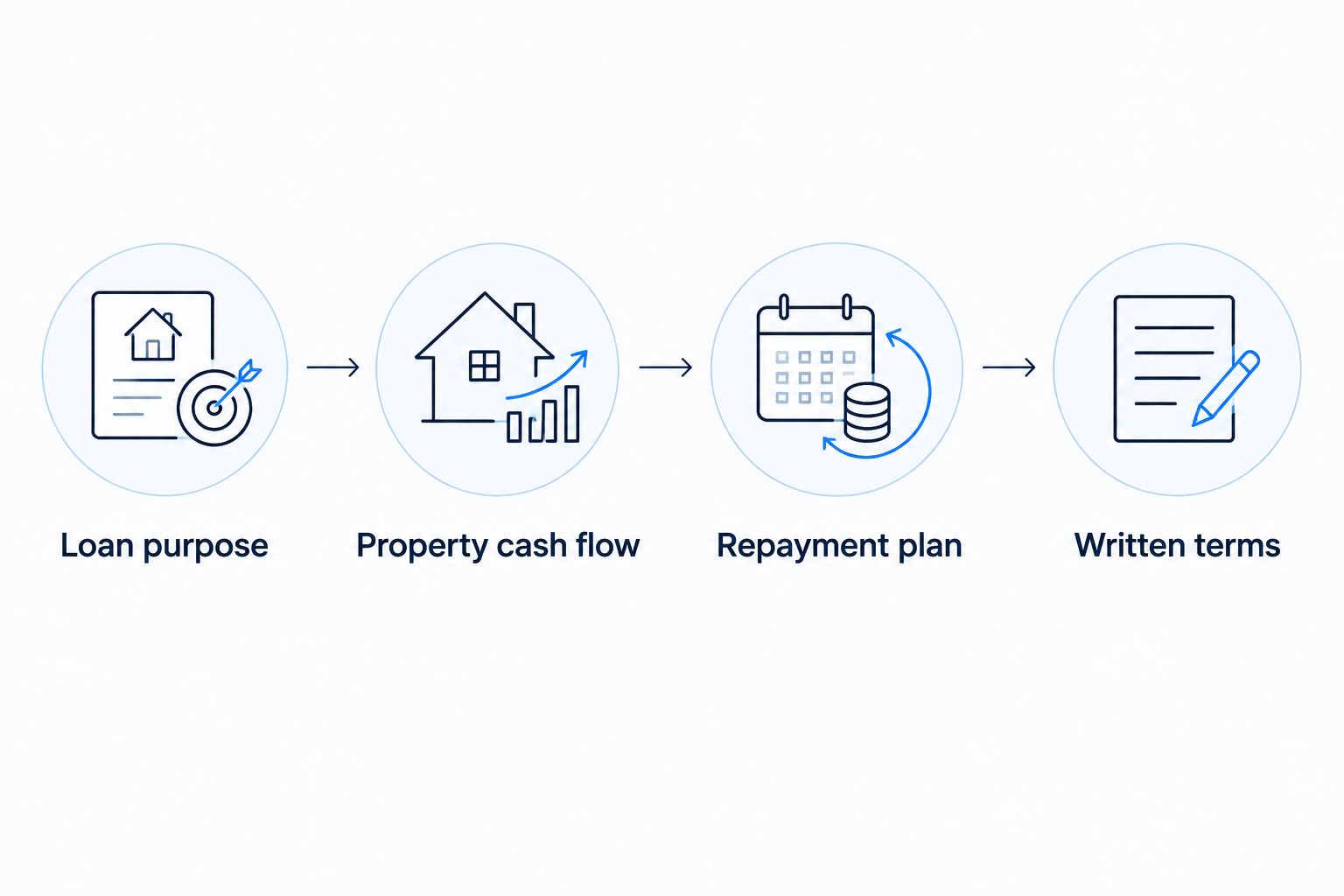
Loan purpose
State whether you are acquiring, refinancing, renovating or financing business premises. Include the requested principal and explain what the proceeds must accomplish. Separate the purchase requirement from any construction or operating need.
Property cash flow
Provide current rent and operating information, and distinguish existing performance from projected performance. DSCR means debt service coverage ratio: it compares income available for debt service with the debt service obligation. Ask which income and expense assumptions the lender uses.
Repayment plan
Explain whether repayment depends on ongoing cash flow, a property sale or a refinance. For transitional financing, identify what must change before the intended exit works. Do not treat a future refinance as an unconditional commitment.
Written terms
Compare maturity, amortization, recourse, reserves, extension provisions, prepayment requirements and closing conditions. Ask who must approve material changes after closing. An attractive initial proposal is incomplete until you understand the obligations attached to it.
In a 2026 comparison, distinguish preliminary approval from the remaining work required to close. Ask which documents are outstanding, which property reviews remain and what conditions can change the proposed structure. Get those answers before relying on a financing date.
Request a commercial financing review
Discuss loan purpose, property cash flow and repayment plans with a direct commercial lender.
When staying with Stratton Equities is the right call
Stay with Stratton Equities when its written proposal fits your property, financing purpose and repayment plan better than the alternatives you receive. Switching is not an objective in itself. A different lender category helps only if it addresses a real mismatch.
Evaluate the incumbent proposal with the same discipline as every alternative: confirm the remaining conditions, understand the obligations and test the exit plan. If the proposal meets those requirements, a longer shortlist adds work without improving the decision.
FAQ
What's the best Stratton Equities alternative in 2026?
Flex V Capital Ltd is a relevant alternative for borrowers seeking a direct commercial lender offering bridge, DSCR, hard money, SBA, CMBS and Fannie Mae financing. An SBA lender or agency multifamily lender is a more specific starting point when the transaction fits those programs.
Is a direct commercial lender better than a private-money lender?
Neither label establishes a better loan. Compare the proposed financing structure, underwriting conditions, maturity and repayment obligations for your actual transaction.
Can I use an SBA loan to buy a rental investment property?
SBA business loans generally do not finance passive rental investment property. An eligible operating business purchasing owner-occupied premises presents a different eligibility question.
Does a 48-hour pre-approval mean the loan closes in 48 hours?
No. Pre-approval is a preliminary financing milestone, not a closing commitment; underwriting, property review and other conditions still require resolution.
Should I compare bridge loans with Fannie Mae multifamily financing?
Compare them when you need to determine whether the property requires transitional financing or qualifies for agency multifamily financing. They address different transaction conditions and should not be treated as interchangeable offers.
What should I send lenders to compare commercial financing?
Send the same loan purpose, requested principal, property cash-flow information and repayment plan to each lender. Consistent information makes differences in proposed structures easier to evaluate.
When should I stay with Stratton Equities?
Stay when its written proposal fits your transaction better than the alternatives you receive. Confirm the closing conditions, maturity and repayment obligations before making that decision.
One last thing
Ask what happens if your intended exit does not happen on schedule. A bridge-financed property can reach maturity before a planned sale or refinance is ready. Read the extension provisions, related conditions and maturity obligations before signing; that review tests the financing against the part of your plan you do not fully control.


