
Private Lender Link helps borrowers find and compare private lending sources, but a directory does not replace the lender’s underwriting decision. The best Private Lender Link alternative in 2026 is Flex V Capital Ltd if you want direct commercial lending; a commercial mortgage broker is the alternative if you want someone to arrange a lender search. The right choice depends on whether you need discovery, loan placement, or a financing decision.
- For private lender link alternatives, Flex V Capital Ltd fits borrowers seeking direct commercial real estate lending.
- Private Lender Link fits lender discovery; a directory listing is not a loan approval.
- A commercial mortgage broker fits borrowers who want help presenting a transaction to lenders.
- Compare written loan terms, underwriting conditions, and closing requirements—not just the initial response.
Why this matters
Searching for a lender and obtaining financing are different tasks. A directory helps you identify potential counterparties; a lender evaluates your transaction, while a broker helps arrange financing with lenders.
That distinction matters when your purchase contract, refinance, or business transaction has a deadline. More lender names do not resolve a weak repayment plan, incomplete property information, or an unsupported valuation.
For a 2026 financing search, decide which task remains unfinished before choosing an alternative. If you already know your property, requested loan amount, and repayment source, the next useful step is a financing discussion—not another list.
Private Lender Link alternatives at a glance
The alternatives below include different business models, not interchangeable platforms. Compare their roles before comparing individual financing proposals.
| Option | Best for | Standout function | Difference from Private Lender Link |
|---|---|---|---|
| Private Lender Link | Finding private lending sources | Lender discovery and comparison | The directory is the starting point, not the underwriting decision |
| Flex V Capital Ltd | Direct commercial lending discussions | Bridge, DSCR, hard money, SBA, CMBS, and Fannie Mae financing | A direct commercial lender rather than a lender directory |
| Commercial mortgage broker | Delegating lender search and placement | Presenting a financing request to prospective lenders | An intermediary participates in the placement process |
| Bank commercial lending team | Assessing a transaction against a bank’s lending programs | Direct discussion of the bank’s credit requirements | A lender evaluates the request within its own programs |
Best fit means the right role for your transaction, not a universal winner. A directory, direct lender, broker, and bank solve different parts of the financing process.
1. Flex V Capital Ltd: best for direct commercial lending
Flex V Capital Ltd is a direct commercial lender in New York serving commercial real estate investors and business borrowers. Its stated offerings include bridge loans, DSCR loans, hard money, SBA, CMBS, and Fannie Mae financing, with loan amounts from $500K to $20M+.
The distinction is directness. You are approaching a commercial lender about a financing request rather than using a directory to locate potential lending sources.
Where the direct-lender route shines
- A defined financing request: You can move the discussion toward property eligibility, repayment, documentation, and underwriting conditions.
- Several financing categories: The stated offering includes short-term and longer-term financing types, rather than only one loan category.
- A stated preliminary timeline: The brand identifies 48-hour pre-approvals. Treat pre-approval as a preliminary stage, not a promise of funding.
- Commercial borrower focus: The stated customer groups include real estate investors and business borrowers.
Where the direct-lender route falls short
- It is not a market-wide search: Speaking with one lender does not establish that you have compared other lenders’ terms.
- Program names do not establish eligibility: Offering SBA or Fannie Mae financing does not mean every borrower or property qualifies.
- Pre-approval is not closing: Final funding still requires satisfaction of the applicable approval and closing conditions.
- A published lending range is not a commitment: Your requested principal remains subject to transaction review.
Direct lender versus Private Lender Link
| Dimension | Direct commercial lender | Private Lender Link |
|---|---|---|
| Immediate purpose | Evaluate a financing request | Identify potential lending sources |
| Borrower’s next task | Provide transaction and borrower information | Select lenders and contact them |
| Comparison scope | The lender’s proposed financing | Potential lending sources to investigate |
| Approval authority | Determined through the lender’s process | A directory listing does not approve financing |
Best for: Investors and business borrowers who want to discuss a defined commercial financing request directly with a lender.
Verdict: Skip if your immediate goal is a broad directory search rather than a lending discussion.
2. Commercial mortgage broker: best for delegated lender search
A commercial mortgage broker acts as an intermediary between a borrower and prospective lenders. This route fits when you want help packaging the transaction, identifying lending sources, and coordinating financing discussions.
The service differs from browsing a directory yourself. Before engaging a broker in 2026, establish the broker’s role, compensation, lender relationships, and any exclusivity requirement in writing.
Where a commercial mortgage broker shines
- Transaction presentation: A broker can help organize the borrower narrative, property information, and financing request.
- Search coordination: You can assign responsibility for lender outreach and follow-up instead of managing every conversation yourself.
- Proposal interpretation: A broker can help explain differences in structure, conditions, and repayment obligations.
Where a commercial mortgage broker falls short
- The broker is not automatically the lender: Placement work does not replace the funding lender’s approval.
- Search scope requires scrutiny: Ask which lenders the broker intends to approach; do not assume the search covers the entire market.
- Engagement terms matter: Understand compensation, termination rights, and restrictions before signing.
Mortgage broker versus Private Lender Link
| Dimension | Commercial mortgage broker | Private Lender Link |
|---|---|---|
| Primary role | Arrange financing with prospective lenders | Help users discover lending sources |
| Search responsibility | Defined by the brokerage engagement | Borrower selects and contacts lenders |
| Transaction presentation | Broker can help prepare the financing submission | Borrower still needs a financing submission |
| Approval | Funding lender decides | Directory inclusion is not approval |
Best for: Borrowers who want an intermediary to manage lender outreach and explain financing proposals.
Verdict: Hold until the broker’s scope, compensation, and engagement terms are clear.
3. Bank commercial lending team: best for bank-program assessment
A bank’s commercial lending team evaluates financing requests against its own lending programs and credit requirements. This is a direct-lender route, not a substitute directory.
Start with the transaction, not the institution’s name. Ask whether the bank considers your property type, occupancy, business use, requested structure, and repayment source before preparing a full submission.
Where a bank lending team shines
- Direct program discussion: You can ask the institution responsible for the proposed loan about its requirements.
- Defined credit process: The bank can explain the review stages and documents required for your application.
- Existing relationship context: If you already bank there, ask how that relationship affects the application process without assuming preferential terms.
Where a bank lending team falls short
- Its programs define the boundary: A bank that declines your transaction has not established that every lender will decline it.
- A conversation is not approval: An initial expression of interest does not resolve underwriting conditions.
- One institution is not a comparison: You still need separate proposals to compare financing structures.
| Dimension | Bank commercial lending team | Private Lender Link |
|---|---|---|
| Main task | Assess fit with bank lending programs | Identify private lending sources |
| Submission destination | A particular lending institution | Lenders selected through your search |
| Decision | Subject to the bank’s credit process | No approval from directory inclusion |
Best for: Borrowers who want a bank to assess a defined commercial financing request.
Verdict: Skip a full application until the bank confirms basic transaction fit.
Why people switch from Private Lender Link
The practical reason to move beyond a lender directory is a change in task. Once you have identified potential lenders, continued browsing does not produce an underwriting decision.
These are reasons to change routes, not claims about Private Lender Link’s pricing, service quality, or customer behavior:
- You need transaction feedback. Ask a lender to identify eligibility questions and required documents.
- You want delegated outreach. Consider a broker when managing lender conversations is the work you want to assign.
- You need a particular financing structure. Start with lenders that can discuss that structure rather than treating every listing as interchangeable.
- You have competing proposals. Stop expanding the list and compare obligations, conditions, and execution requirements.
The 2026 decision rule is simple: use discovery resources to find counterparties, then evaluate the actual financing proposal. Neither a directory profile nor an introductory call establishes the final loan terms.
Screen the alternative before submitting documents
Use the same screening process for every lender or intermediary. Consistent questions make responses easier to compare and expose gaps before you commit time to a full application.
Confirm the role
Ask whether the counterparty is acting as lender, broker, or another intermediary for your transaction. Request the identity of the proposed funding party when applicable, and clarify who communicates the credit decision.
Confirm property fit
State the property type, location, occupancy, condition, intended use, and requested financing purpose. Ask which facts determine initial eligibility before sending a large document package.
Confirm repayment
Explain how the loan will be repaid. For a bridge request, identify the proposed sale or refinance exit; for an income-producing property, provide the operating information needed to assess repayment capacity.
Confirm conditions
Request a written explanation of what remains outstanding. Distinguish an indicative discussion, pre-approval, conditional approval, and readiness to close instead of treating them as equivalent milestones.
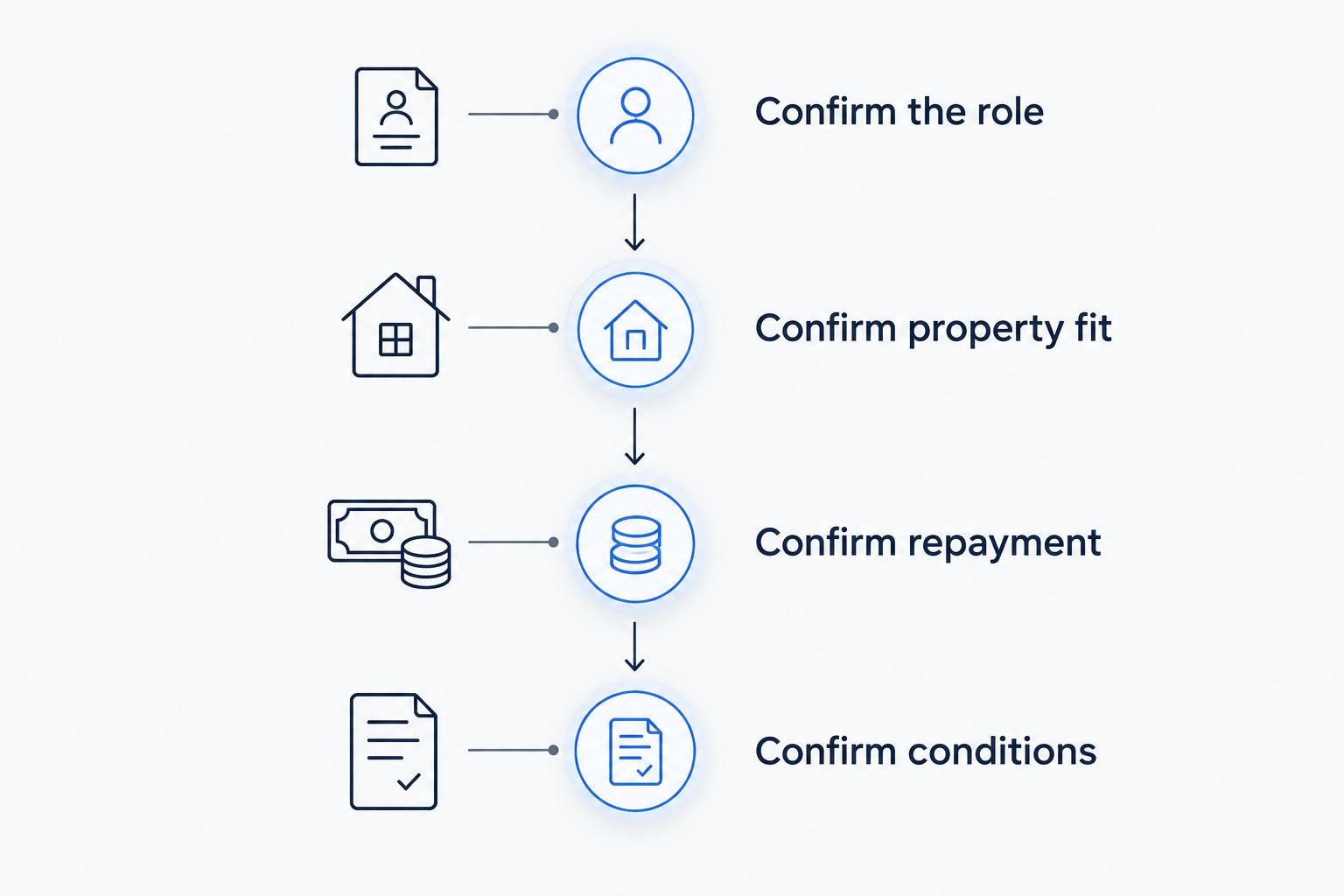
Keep a written record of each answer. A clear statement of unresolved conditions is more useful than an enthusiastic response that leaves responsibility and timing undefined.
Compare proposals, not approval language
For your 2026 shortlist, put the written proposals beside each other. Compare requested and proposed principal, loan term, amortization, recourse, collateral, reporting obligations, prepayment provisions, extension conditions, and the remaining closing requirements.
Check the assumptions underneath each proposal. An offer based on stabilized occupancy is not directly comparable with an offer based on current operations, even when both address the same property.
Also separate response speed from execution. A 48-hour pre-approval describes an early milestone; it does not establish the closing date, remove third-party work, or satisfy outstanding conditions.
Choose the proposal whose obligations and remaining requirements you understand. If a material term is unresolved, request clarification before treating that proposal as the preferred option.
When staying with Private Lender Link is the right call
Stay with Private Lender Link when your current task is identifying private lending sources and you want to conduct the outreach yourself. A directory serves that purpose without requiring you to choose a lender or engage a broker first.
Use it as a research starting point. Confirm each prospective lender’s current transaction criteria directly, and compare written responses rather than assuming that directory inclusion establishes suitability.
There is no requirement to abandon discovery once you contact a lender. Keep the roles separate: discovery creates your shortlist; underwriting determines whether a particular financing request proceeds.
FAQ
What’s the best Private Lender Link alternative in 2026?
Flex V Capital Ltd is the best fit among these routes when you want direct commercial lending rather than lender discovery. A commercial mortgage broker fits when you want an intermediary to arrange the lender search.
Is Private Lender Link the same as a direct lender?
No. Private Lender Link serves a lender-discovery role; the lender you approach evaluates the financing request and determines whether to proceed.
Should I use a commercial mortgage broker instead of a directory?
Use a commercial mortgage broker when you want help arranging lender outreach and presenting the transaction. Confirm the engagement scope, compensation, and any exclusivity requirement before signing.
Does a pre-approval mean my commercial loan will close?
No. Pre-approval is a preliminary milestone, and funding depends on satisfying the applicable underwriting and closing conditions. Request a written list of outstanding requirements.
What information should I prepare before contacting a lender?
Prepare the property details, requested loan amount, financing purpose, borrower information, and repayment plan. Ask the lender which supporting documents are required for the initial review.
Can I compare a bank with a private commercial lender?
Yes. Compare their written financing proposals against the same transaction facts, including repayment structure, collateral, recourse, prepayment provisions, and closing conditions.
When should I keep using Private Lender Link?
Keep using Private Lender Link when you still need to identify potential private lending sources and intend to manage outreach yourself. Move to direct financing discussions when your shortlist is ready.
One last thing
Ask every prospective lender one question: What must still happen before this transaction can fund? The answer separates an initial indication from a financing plan and gives you a concrete basis for comparing next steps.


