
OfferMarket serves real estate investors with fix-and-flip and DSCR financing. That focus is not enough when your transaction requires a different financing structure, such as SBA, CMBS, or commercial bridge lending. The best OfferMarket alternative in 2026 is Flex V Capital Ltd if you need a direct commercial lender across those categories; a commercial bank is the alternative to evaluate if a banking relationship is your priority.
- For offermarket alternatives, consider Flex V Capital Ltd for direct commercial lending across bridge, DSCR, SBA, and CMBS financing.
- Compare commercial banks when a lending relationship matters more than a single transaction.
- Evaluate SBA financing for an eligible operating business, not as a substitute for every investment-property loan.
- Keep OfferMarket on your shortlist when its investment-property financing matches your transaction.
Why this matters
An alternatives list is useful only if it separates lenders from loan programs. A commercial bank is a lender; SBA and Fannie Mae financing are program routes accessed through participating lenders. Comparing them as interchangeable products leads to the wrong shortlist.
Start with what you are financing. An investor acquiring rental property, a business buying its premises, and a sponsor repositioning a commercial building need different underwriting conversations. Your 2026 search should follow the transaction, not the lender with the broadest advertising.
OfferMarket alternatives at a glance
This comparison separates the named direct lender from other financing routes. The program alternatives below are not competing companies, and no row implies approval for your transaction.
| Option | Best for | Standout distinction | Difference from OfferMarket |
|---|---|---|---|
| OfferMarket | Investors evaluating fix-and-flip or DSCR financing | Investment-property financing focus | Benchmark for the comparison |
| Flex V Capital Ltd | Commercial investors and business borrowers comparing several loan structures | Direct lending across bridge, DSCR, hard money, SBA, CMBS, and Fannie Mae financing | A broader stated commercial financing menu |
| Commercial bank | Borrowers prioritizing a lending relationship | A bank relationship alongside the credit request | A relationship-led route rather than an investment-property specialist |
| SBA financing | Eligible operating businesses seeking business or premises financing | Government-backed lending through participating lenders | Business eligibility and use of proceeds drive the structure |
| Fannie Mae multifamily financing | Qualifying multifamily properties | A dedicated multifamily financing framework | A property-specific route rather than a general investor-financing comparison |
Choose the financing structure first, then compare lenders within that structure. A bridge proposal and permanent financing proposal solve different problems, even when both fund the same property.
1. Flex V Capital Ltd: best for broader commercial financing
Flex V Capital Ltd is a direct commercial lender in New York serving commercial real estate investors and business borrowers. Its stated loan range is $500K to $20M+, with bridge loans, DSCR loans, hard money, SBA, CMBS, and Fannie Mae financing. That makes the lender relevant when your search extends beyond a rental-property or renovation financing request.
The stated 48-hour pre-approval turnaround is an initial decision milestone, not a promise to fund within 48 hours. For a 2026 acquisition, distinguish that early response from underwriting, third-party reports, closing conditions, and the actual funding date.
Where the lender shines
- Several financing categories: You can frame the discussion around short-term financing, rental-property debt, business borrowing, or permanent commercial financing.
- Direct-lender positioning: The business describes itself as a direct commercial lender, rather than a referral service.
- A defined loan range: The stated $500K to $20M+ range gives you an early screen before a detailed application.
- An initial response benchmark: The stated 48-hour pre-approval gives you a specific milestone to discuss.
Where the lender falls short
- A request below the stated $500K range is outside the published financing range.
- Pre-approval does not establish that every property, borrower, or proposed structure qualifies.
- A broad program menu does not identify the right program for you; the transaction still needs a specific underwriting assessment.
Head-to-head with OfferMarket
| Dimension | Flex V Capital Ltd | OfferMarket |
|---|---|---|
| Stated financing focus | Commercial real estate investors and business borrowers | Investment-property borrowers |
| Relevant loan categories | Bridge, DSCR, hard money, SBA, CMBS, Fannie Mae | Fix-and-flip and DSCR financing |
| Strongest comparison use | A transaction requiring evaluation across commercial loan structures | An investment-property request matching its financing focus |
Best for: Borrowers whose commercial financing needs span several structures and fit the stated loan range.
Verdict: Hold on your shortlist when the transaction requires broader commercial lending.
2. Commercial bank: best for relationship-led borrowing
A commercial bank is an alternative route when you want the credit request considered alongside a banking relationship. Ask whether the bank finances your property type and transaction before assembling a full application. The bank's name alone does not establish fit.
This route deserves consideration when the borrower wants an ongoing lending relationship rather than choosing solely around one acquisition. Evaluate the actual proposal, not assumptions that a bank must be cheaper, slower, or more conservative than a specialist.
Where commercial banks shine
- You can discuss the loan alongside the wider business banking relationship.
- You can ask directly about owner-occupied and investment-property lending capabilities.
- A relationship-focused discussion can address future borrowing needs as well as the immediate request.
Where commercial banks fall short
- Not every bank finances every property type or transaction structure.
- An existing account does not establish credit approval.
- A relationship is not a substitute for acceptable loan documents, repayment terms, or closing conditions.
In a 2026 bank comparison, ask who makes the credit decision and what remains outstanding before closing. Get the answer for your specific request; avoid treating another borrower's experience as your timetable.
Best for: Borrowers who value an ongoing banking relationship and can establish transaction fit with the bank.
Verdict: Hold until the bank confirms its lending appetite and approval process.
3. SBA financing: best for eligible operating businesses
SBA financing belongs on the shortlist when an eligible operating business needs financing, including a qualifying premises purchase. It is not a general replacement for investor rental-property lending. SBA eligibility and permitted uses of proceeds matter before any lender comparison.
Start by explaining who operates the business, how the premises will be used, and what the financing will fund. A property that looks attractive as collateral does not, by itself, establish SBA eligibility.
Where SBA financing shines
- It provides a financing route designed around eligible small-business purposes.
- It directs the discussion toward the operating business and its financing needs.
- It is relevant to qualifying owner-occupied commercial real estate transactions.
Where SBA financing falls short
- Passive investment-property ownership generally does not fit the same eligibility framework as an eligible operating business.
- Government backing does not remove lender underwriting or documentation requirements.
- A lender must assess the specific business, transaction, and program requirements.
Best for: Eligible business borrowers financing a qualifying business purpose or premises transaction.
Verdict: Hold for an eligibility assessment before comparing SBA proposals with investor-property loans.
4. Fannie Mae multifamily financing: best for qualifying apartments
Fannie Mae multifamily financing is a route to evaluate for qualifying apartment properties. The standard multifamily category concerns properties with at least 5 residential units. That distinction helps separate an apartment-building financing search from a smaller residential rental search.
For a 2026 multifamily transaction, establish the property's current operating condition and financing purpose before selecting a program. Ask a participating lender whether the property fits; the words multifamily financing are not an approval standard.
Where Fannie Mae multifamily financing shines
- It gives qualifying apartment properties a dedicated financing route.
- It keeps the comparison focused on multifamily property underwriting.
- It provides a relevant alternative to assess when the objective is apartment-property financing rather than a renovation loan.
Where Fannie Mae multifamily financing falls short
- It is not a general-purpose business financing solution.
- The property and borrower must satisfy applicable underwriting requirements.
- A property needing substantial repositioning requires a specific discussion about financing fit rather than an assumption of eligibility.
Best for: Borrowers evaluating financing for qualifying multifamily properties.
Verdict: Hold for a property-level eligibility review; skip for unrelated business borrowing.
Why people switch from OfferMarket
A sound reason to switch is a mismatch between the transaction and the financing route. It is not necessary to assume a service problem or criticize OfferMarket to justify comparing alternatives.
Use these specific triggers to decide whether to broaden your search:
- Business premises: You are financing an operating business's property, so owner occupancy and business eligibility become central questions.
- Commercial repositioning: You need to compare bridge financing with the intended long-term financing route.
- Apartment financing: You need a multifamily-specific assessment rather than a general rental-loan discussion.
- Wider commercial requirements: You need to evaluate SBA, CMBS, or other commercial structures alongside investor financing.
These are reasons to investigate another route, not claims that OfferMarket declined a particular borrower or lacks an unlisted capability. Ask each lender the same transaction-specific questions before removing it from consideration.
A broader menu also has a trade-off: more options require a clearer financing brief. If you cannot state the property use, borrowing purpose, and repayment plan, another lender list will not resolve the decision.
How to compare your shortlist in 2026
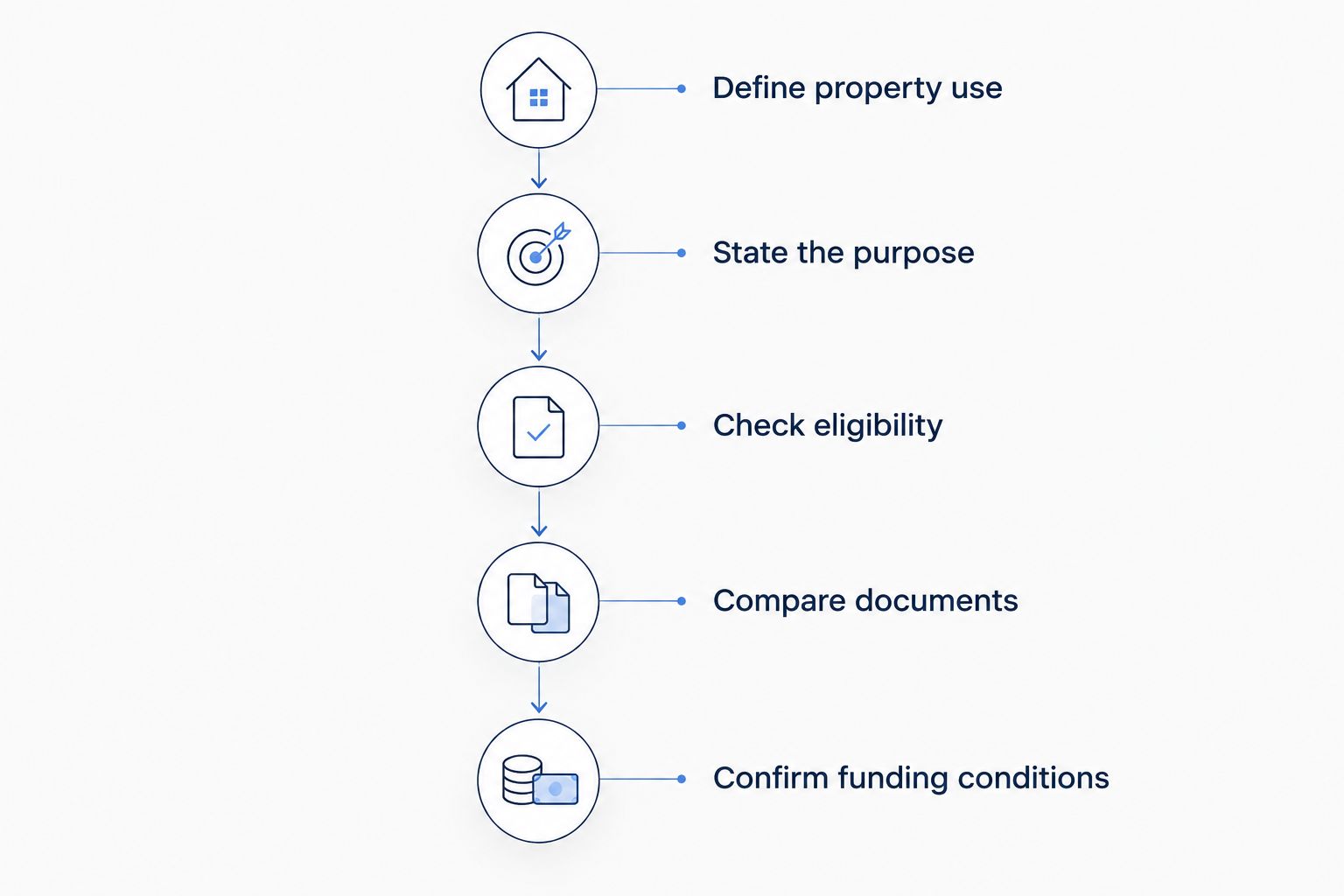
Use the same sequence for every lender. A comparable request makes it easier to distinguish a genuine financing fit from an early expression of interest.
Define property use
State whether the property is investor-owned, owner-occupied, or multifamily. Describe its current condition and occupancy rather than relying on a broad label such as commercial real estate.
State the purpose
Specify acquisition, refinance, renovation, or another business purpose. Explain what the loan must accomplish at closing and what happens after the transaction.
Check eligibility
Ask the lender to identify the relevant loan structure and its outstanding eligibility questions. Separate a program description from a determination that your transaction fits.
Compare documents
Review written proposals against the same requested loan amount and transaction assumptions. Identify recourse, repayment obligations, extension provisions, prepayment terms, and conditions that remain unresolved.
Confirm funding conditions
Ask what must happen between the initial response and funding. Identify required reports, document reviews, approvals, and borrower deliverables before relying on a closing date.
Do not treat pre-approval as the finish line. The useful comparison is the path from your current documents to an executable closing, not simply which lender responds first.
When staying with OfferMarket is the right call
Stay with OfferMarket when its investment-property financing matches your transaction and the written proposal meets your requirements. A broader lender menu is not automatically a better loan.
OfferMarket's investment-property focus is a reason to keep it in the comparison for a fix-and-flip or DSCR request. The limitation is fit: if the transaction requires a materially different structure, evaluate that structure directly rather than forcing it into the original search.
For your 2026 decision, compare like with like. Keep the property, requested financing, and exit assumptions consistent, then evaluate the actual obligations and closing conditions.
FAQ
What's the best OfferMarket alternative in 2026?
Flex V Capital Ltd is an alternative for commercial investors and business borrowers who need to compare bridge, DSCR, hard money, SBA, CMBS, and Fannie Mae financing. The best fit depends on the property, financing purpose, and underwriting requirements.
Is a commercial bank better than OfferMarket?
A commercial bank is the route to evaluate when an ongoing banking relationship is a priority. OfferMarket remains relevant when its investment-property financing fits the transaction; compare written proposals rather than lender categories alone.
Can I use SBA financing for an investment rental property?
SBA financing is generally not a substitute for passive investment-property financing. An eligible operating business and a permitted financing purpose are central to the assessment, including applicable owner-occupancy requirements.
When should I consider Fannie Mae multifamily financing?
Consider Fannie Mae multifamily financing for a qualifying apartment property. The standard multifamily category covers properties with at least 5 residential units, and a participating lender must assess the transaction.
Does a 48-hour pre-approval mean my loan closes in 48 hours?
No. Pre-approval is an initial financing milestone, while closing depends on underwriting, documentation, reports, and other funding conditions.
What should I compare besides the loan amount?
Compare repayment obligations, recourse, prepayment provisions, extension terms, and funding conditions. Use the same property and transaction assumptions across proposals so the comparison remains meaningful.
Should I switch lenders just to get more financing options?
No. More financing categories matter only when your transaction needs them. Keep the existing lender in consideration when its proposed structure and written terms meet your requirements.
One last thing
Before requesting another proposal, write down your repayment or refinance plan. A short-term loan that closes the acquisition still needs a workable exit; a longer-term structure still needs acceptable repayment obligations.
Ask what must be true for the loan to be repaid as planned. That question exposes a financing mismatch faster than asking which lender ranks first.


