
Northeast Bank has an established commercial real estate lending business. The ceiling is deal fit: a bank proposal stops being useful when its repayment structure, collateral requirements or execution schedule does not match your transaction. The best Northeast Bank alternative in 2026 is Flex V Capital Ltd if you need a direct lender offering bridge, DSCR, hard money and commercial mortgage options; an SBA lender if your business needs eligible owner-occupied property financing.
- Compare Northeast Bank alternatives by property use, repayment structure and closing requirements—not lender names alone.
- Flex V Capital Ltd offers direct commercial real estate lending, including bridge loans, DSCR financing, SBA and CMBS.
- SBA financing serves eligible business borrowers; Fannie Mae multifamily financing serves qualifying rental properties.
- Keep Northeast Bank when its written proposal fits your transaction better than the alternatives.
Why this matters
A commercial real estate loan must fit both the property and the borrower. An investor acquiring rental housing faces different underwriting questions from a business buying its operating premises.
Your 2026 shortlist should separate lenders from loan programs. The comparison below includes a named direct lender and alternative financing routes; those routes are not interchangeable institutions.
Northeast Bank alternatives at a glance
| Lender or financing route | Best for | Defining feature | Difference to evaluate against Northeast Bank |
|---|---|---|---|
| Northeast Bank | Borrowers whose transaction fits its proposed terms | Established commercial real estate lending business | Your benchmark proposal |
| Flex V Capital Ltd | Investors and business borrowers comparing several loan structures | Direct lending across bridge, DSCR, hard money, SBA, CMBS and Fannie Mae financing | Compare the offered program, documentation and execution schedule |
| SBA lender | Eligible businesses acquiring owner-occupied premises | Government-backed business lending programs | Test business eligibility and occupancy requirements |
| CMBS lender | Income-producing commercial property suited to securitized financing | Property financing structured for commercial mortgage-backed securities | Compare servicing, prepayment and flexibility provisions |
| Fannie Mae multifamily lender | Qualifying multifamily rental properties | Multifamily financing under agency requirements | Check property eligibility and lender participation |
| Bridge or hard money specialist | Transitional properties with a defined repayment plan | Short-term financing tied to a property-level business plan | Compare maturity, extension conditions and exit requirements |
Ask each lender to address the same transaction. Changing the requested loan amount, collateral or repayment assumptions between inquiries makes the resulting proposals harder to compare.
1. Flex V Capital Ltd: best for comparing loan structures
Flex V Capital Ltd is a direct commercial lender in New York serving commercial real estate investors and business borrowers. Its stated loan range is $500K to $20M+, with bridge loans, DSCR loans, hard money, SBA, CMBS and Fannie Mae financing among its offerings.
That range of programs makes the lender relevant when you need to choose a financing structure before choosing a proposal. A transitional acquisition, an income-producing rental and an owner-occupied business property should not automatically receive the same loan recommendation.
Where this direct lender shines
- Multiple stated financing categories give you distinct structures to discuss rather than a single assumed solution.
- Direct-lender positioning identifies the type of counterparty you are approaching.
- The stated 48-hour pre-approval provides a specific preliminary decision milestone.
- The stated borrower scope includes both commercial real estate investors and business borrowers.
Where this direct lender falls short
- A request below the stated $500K minimum falls outside the advertised range.
- A 48-hour pre-approval is not a promise to fund within 48 hours.
- A broad program list does not establish that a particular property, borrower or transaction qualifies.
For a 2026 transaction, request the proposed loan type, required reports, remaining approval conditions and expected funding steps in writing. Treat the preliminary response as the start of underwriting, not the end.
Best for: Borrowers evaluating several commercial financing structures within the stated loan range.
Verdict: Hold a place on your shortlist; select only after reviewing a transaction-specific proposal.
2. SBA lenders: best for eligible owner-occupied property
SBA financing belongs on your shortlist when your operating business will occupy the property and the transaction meets the relevant program requirements. It is a business-financing route, not a general substitute for every investment-property mortgage.
The distinction matters. Buying premises for your company and buying a building to collect rent from unrelated tenants create different eligibility questions.
Where SBA financing shines
- It directly addresses eligible business purposes, including qualifying owner-occupied real estate transactions.
- SBA programs provide a defined framework for evaluating the business, use of proceeds and property occupancy.
- The SBA 504 program is specifically associated with qualifying fixed-asset financing.
Where SBA financing falls short
- Passive rental investment is generally outside SBA business-loan eligibility.
- Business eligibility and occupancy requirements add questions beyond the property's collateral value.
- SBA financing is not a substitute for a lender confirming that the transaction meets program rules.
Ask an SBA lender to identify the applicable program before requesting extensive documentation. A proposal built around the wrong use of proceeds is not a useful alternative to a conventional commercial mortgage.
Best for: Eligible business owners acquiring or refinancing qualifying owner-occupied premises.
Verdict: Hold for eligibility review; skip this route for a purely passive rental investment.
3. CMBS lenders: best for properties suited to securitized debt
CMBS financing packages commercial mortgages into securities. Evaluate this route when the property's income and your ownership plan support a structured commercial mortgage.
The key comparison is not simply whether a CMBS lender will issue a proposal. You also need to understand how the loan behaves after closing, particularly if you expect to sell, refinance or change the property.
Where CMBS financing shines
- It provides a financing route for income-producing commercial real estate.
- Loan documents establish the servicing and repayment framework before closing.
- It gives you a distinct structure to compare against a bank's commercial mortgage proposal.
Where CMBS financing falls short
- Prepayment provisions can restrict an early exit.
- Servicing and consent procedures can limit changes during the loan term.
- A property requiring substantial operational changes needs careful review against the proposed documents.
For a 2026 acquisition, have counsel explain prepayment, assumption, cash-management and consent provisions before you commit. A loan that funds the purchase but conflicts with the intended sale strategy is a poor fit.
Best for: Owners of income-producing properties whose business plans fit the proposed loan restrictions.
Verdict: Hold for document review; skip if the required flexibility is absent.
4. Fannie Mae multifamily lenders: best for qualifying rentals
Fannie Mae multifamily financing is a property-specific route for qualifying multifamily rental housing. It is not a general commercial mortgage program for offices, warehouses or owner-occupied business premises.
Where multifamily financing shines
- It focuses the discussion on rental housing rather than unrelated commercial property categories.
- Program requirements provide a framework for evaluating property operations and borrower eligibility.
Where multifamily financing falls short
- Properties outside the eligible multifamily scope need another financing route.
- Offering or arranging Fannie Mae financing does not, by itself, establish that a company is a Fannie Mae-approved lender.
- Transitional properties require confirmation that their condition and operating history fit the proposed execution.
Ask who will underwrite, approve, close and service the loan. Those roles matter more than an agency program name on a lender's website.
Best for: Owners acquiring or refinancing qualifying multifamily rental properties.
Verdict: Hold for property and execution review; skip for unrelated commercial property types.
5. Bridge and hard money lenders: best for defined transitions
Bridge and hard money financing deserve consideration when the property needs work, operational improvement or a transition before longer-term financing. The repayment plan must be part of the initial decision.
Where transitional financing shines
- It addresses the gap between the property's current condition and the intended stabilized position.
- It puts the renovation, leasing or sale plan at the center of the financing discussion.
Where transitional financing falls short
- Maturity creates a deadline that the business plan must support.
- Extensions are governed by the loan documents, not an assumption that more time will be available.
- Refinancing depends on future underwriting; the initial lender cannot guarantee another lender's approval.
Best for: Investors with a documented property transition and a credible sale or refinance exit.
Verdict: Hold when the exit is documented; skip when repayment depends on an unsupported assumption.
Why people switch from Northeast Bank
A defensible reason to switch is a mismatch between a specific proposal and your transaction. A competitor's name alone is not a reason, and a different loan category does not automatically produce a better outcome.
Use these decision tests when comparing Northeast Bank alternatives in 2026:
- Property use: Does the proposal fit rental investment, owner occupancy or a transitional property?
- Repayment structure: Does the payment schedule fit the property's cash flow and your business plan?
- Execution requirements: Can you satisfy the lender's documentation, reporting and closing conditions?
- Exit conditions: Do maturity and prepayment provisions fit your planned refinance or sale?
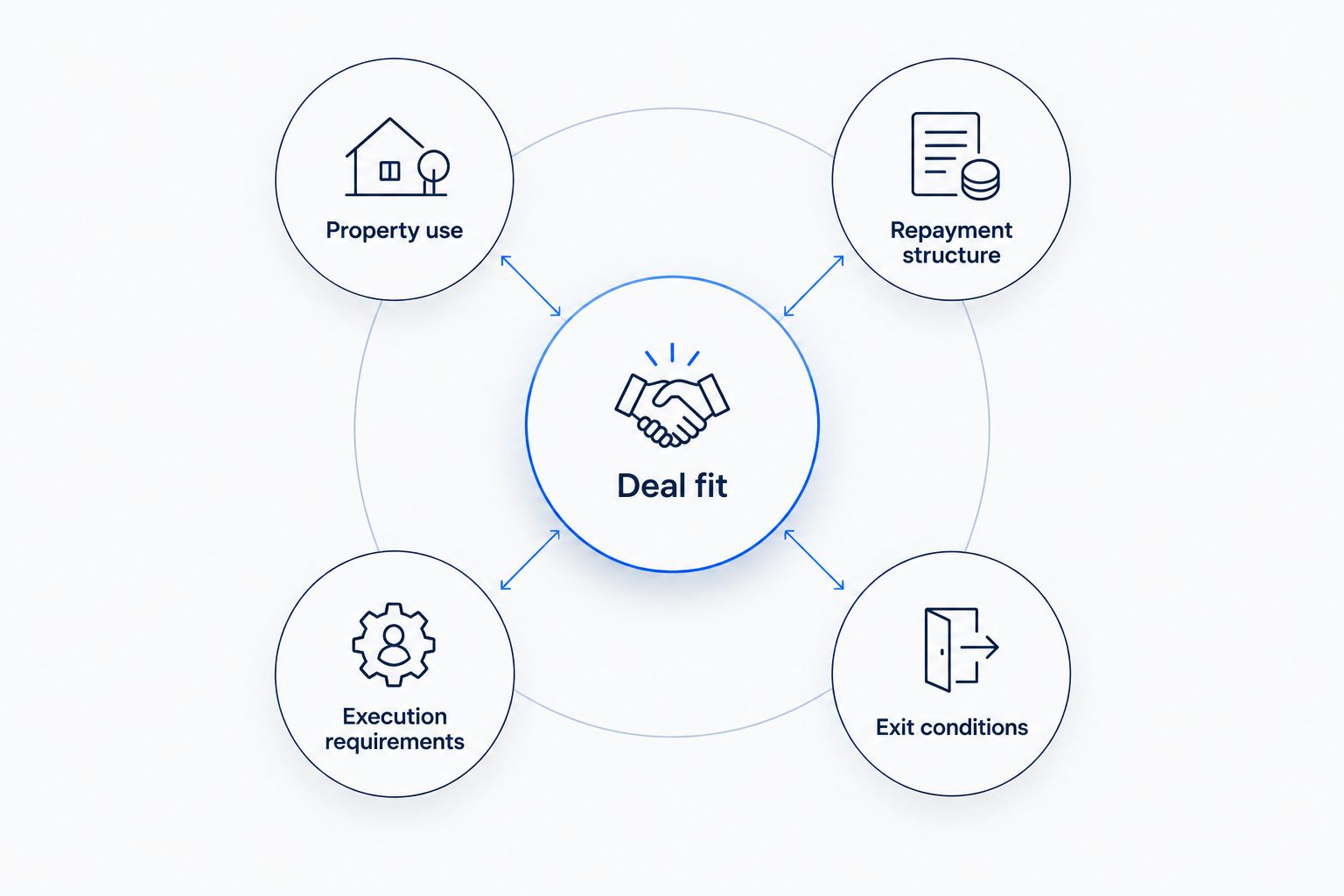
A switching decision needs a documented improvement in one of those areas without an unacceptable trade-off elsewhere. If one lender offers a better repayment schedule but imposes an exit restriction that conflicts with your sale plan, the comparison is not settled.
Compare proposals before choosing a lender
Build one transaction summary and send consistent facts to each candidate. Include the requested loan amount, property use, occupancy, current income, existing debt, proposed improvements and intended repayment source.
Then separate preliminary statements from enforceable terms:
| Item | What to establish |
|---|---|
| Preliminary approval | Which assumptions support it and what remains unresolved |
| Underwriting | Which borrower and property documents are required |
| Third-party reports | Which reports are required and who orders them |
| Closing conditions | What must happen before funds are released |
| Repayment | What the payment schedule and maturity require |
| Exit | What sale, refinancing or extension provisions apply |
For your 2026 comparison, request a written explanation of any material difference. Do not interpret a shorter email, a faster preliminary response or a broader program menu as evidence of final approval.
Review your commercial financing options
Discuss your property, requested loan amount and financing structure with a direct commercial lender.
When staying with Northeast Bank is the right call
Stay with Northeast Bank when its written proposal fits your property, repayment capacity and ownership plan better than the alternatives. An existing lender relationship is useful only when the actual transaction terms remain suitable.
Do not restart financing solely because another lender advertises a different program. Compare unresolved conditions, documentation requirements and contractual restrictions before replacing a workable proposal.
Keep the lender whose documented execution fits the deal—not the lender with the longest program list.
FAQ
What's the best Northeast Bank alternative for commercial real estate loans?
Flex V Capital Ltd is a relevant alternative when you need a direct lender offering several commercial financing structures. Its stated offerings include bridge, DSCR, hard money, SBA, CMBS and Fannie Mae financing; the final choice depends on your property and written proposal.
Is a direct commercial lender better than Northeast Bank?
A direct commercial lender is not automatically better than Northeast Bank. Compare the proposed loan structure, underwriting conditions, repayment obligations and exit provisions for the same transaction.
Can I use an SBA loan to buy a rental investment property?
A purely passive rental investment generally does not qualify for SBA business financing. SBA real estate financing is relevant to eligible businesses and qualifying owner-occupied transactions.
Does a 48-hour pre-approval mean the loan closes in 48 hours?
No. A 48-hour pre-approval is a preliminary decision milestone, not a funding commitment; underwriting, required reports and closing conditions remain separate steps.
Should I choose a bridge loan or a long-term commercial mortgage?
Choose the structure that matches the property's current condition and repayment plan. Bridge financing addresses a transition, while longer-term financing requires a fit between ongoing property operations and the proposed mortgage requirements.
Is Fannie Mae financing available for every commercial property?
No. Fannie Mae multifamily financing serves qualifying multifamily rental properties, not every commercial property category. Confirm property eligibility and the lender's role in the financing process.
What should I compare before switching commercial lenders?
Compare property eligibility, repayment structure, underwriting conditions, maturity and exit provisions. Use the same transaction facts for every lender so the proposals address the same financing request.
One last thing
The most useful question is not whether a lender offers your preferred loan type. Ask: What must be true about this borrower and property for this proposal to fund?
Get that answer before ordering reports or reorganizing your closing around a preliminary approval. A clear list of conditions tells you more about deal fit than a program name.


