
LendersA helps borrowers find lenders, making it useful when you want to explore financing sources. That search function stops short of replacing a lender’s underwriting decision or a written loan commitment. The best choice among lendersa alternatives in 2026 is Flexvcapital for direct commercial lending; a local bank for borrowers who prioritize an existing banking relationship.
- For lendersa alternatives, choose Flexvcapital for direct commercial lending rather than lender discovery.
- A local bank fits borrowers who want commercial financing through an existing banking relationship.
- An SBA-participating lender fits eligible business borrowers seeking SBA financing.
- Compare written conditions, required documents, and closing responsibilities before choosing a commercial real estate lender.
Why this matters
Choosing between a lender-search platform and a direct lender changes your next step. One helps you identify potential financing sources; the other evaluates whether a specific transaction fits its lending criteria.
For your 2026 search, separate finding a lender from obtaining an executable loan offer. A useful introduction does not establish proceeds, approval conditions, or a closing date. Your comparison should follow the transaction from initial inquiry through underwriting and funding.
LendersA alternatives at a glance
These options represent different financing routes, not interchangeable services. Compare the route first, then compare the lenders and loan structures available through it.
| Option | Best for | Standout feature | How it differs from LendersA |
|---|---|---|---|
| LendersA | Borrowers exploring potential lenders | Lender matching and discovery | The starting benchmark: helps you identify financing sources |
| Flexvcapital | Commercial real estate investors and business borrowers seeking direct lending | Bridge, DSCR, hard money, SBA, CMBS, and Fannie Mae financing | A direct commercial lender rather than a lender-search platform |
| A local bank | Borrowers who prioritize an existing banking relationship | A lending discussion connected to your banking relationship | You approach a specific institution instead of searching across lenders |
| An SBA-participating lender | Eligible businesses considering SBA financing | Evaluation within an SBA loan program | You focus on a defined financing program rather than a general lender search |
Keep the property, requested proceeds, and use of funds consistent across inquiries. Otherwise, you are comparing different transactions rather than different financing sources.
1. Flexvcapital: best for direct commercial lending
Flexvcapital is a direct commercial lender in New York serving commercial real estate investors and business borrowers. Its stated financing scope includes bridge loans, DSCR loans, hard money, SBA, CMBS, and Fannie Mae financing, with loan amounts from $500K to $20M+.
That range makes it a relevant alternative when you already know the transaction and want a direct lending conversation. The published 48-hour pre-approval timeline concerns pre-approval, not completed underwriting or a guaranteed closing date.
Where this direct lender shines
- Direct lending model: You can discuss the transaction with a commercial lender rather than treating lender discovery as the end goal.
- Multiple financing categories: The stated offering covers short-term property financing, income-based lending, and business financing programs.
- Defined financing range: The published loan range gives you an initial way to screen the size of your request.
- Specific pre-approval milestone: The stated timeline identifies an early decision point without substituting for final approval.
Where this direct lender falls short
- Not a substitute for comparing lenders: One direct lender’s assessment does not establish how other institutions would structure your transaction.
- Not a fit for every request: A published financing range and list of programs do not establish eligibility for your property, borrower entity, or intended use of proceeds.
- Pre-approval leaves work outstanding: You still need to review underwriting conditions, required third-party reports, and closing requirements.
Direct lender versus LendersA
| Dimension | Direct commercial lender | LendersA |
|---|---|---|
| Primary purpose | Evaluate a transaction for financing | Help borrowers identify potential lenders |
| Initial conversation | Loan fit and transaction requirements | Financing needs and potential lender matches |
| Financing scope | The lender’s stated loan programs | Depends on the lenders considered |
| Decision to verify | Approval authority and written conditions | Which matched lender makes the credit decision |
Best for: Investors and business borrowers who want direct commercial lending for a defined transaction.
For a 2026 acquisition or refinance, bring the property address, requested loan amount, occupancy information, existing debt, and intended exit to the first discussion. Ask which program fits those facts before requesting a timeline.
Verdict: Buy — choose the direct-lender route when you need transaction evaluation, not just lender introductions.
2. A local bank: best for an existing banking relationship
A local bank is a different starting point when you already maintain business accounts or have an established commercial banking relationship. You can ask a specific institution whether the proposed transaction fits its current lending criteria.
An existing relationship does not establish approval. Treat familiarity as a way to start the discussion, not as evidence that the bank will accept the property, loan structure, or borrower risk.
Where a local bank shines
- A defined institution: You know which bank you are asking to consider the loan.
- Relationship context: You can discuss the financing alongside your existing business banking needs.
- A focused fit check: Ask whether the bank lends against the property type and intended use before assembling the full application.
Where a local bank falls short
- One institution’s criteria: A rejection does not establish that the transaction is unfinanceable elsewhere.
- Relationship is not approval: Existing accounts do not replace credit review or property analysis.
- The loan structure still matters: Confirm amortization, maturity, guarantees, and any conditions tied to the relationship.
Best for: Borrowers who want to begin with a bank they already know and can obtain a clear transaction-fit answer from that institution.
Verdict: Hold — keep the bank in your comparison until its written structure matches your financing needs.
3. An SBA-participating lender: best for eligible business financing
An SBA-participating lender is a focused alternative when the borrowing purpose belongs within an SBA program. SBA financing is not interchangeable with every commercial property loan; program eligibility and the use of proceeds matter.
Start with the business and transaction, not the program name. Explain who operates the business, how the property will be used, and what the financing must accomplish.
Where an SBA-participating lender shines
- Program-specific assessment: You can ask directly whether the business and use of funds fit the proposed SBA program.
- Business-focused discussion: The application centers on the operating business as well as the transaction.
- A defined screening question: Establish eligibility before comparing an SBA structure with other commercial financing.
Where an SBA-participating lender falls short
- Eligibility limits: Not every borrower, business activity, or property use qualifies.
- Documentation requirements: You need to substantiate the business and transaction rather than rely on a property description alone.
- Not a universal investor substitute: A passive property investment and an owner-operated business present different financing questions.
Best for: Business borrowers whose intended use of funds meets the applicable SBA program requirements.
Verdict: Hold — confirm eligibility before making SBA financing your primary route.
Why people switch from LendersA
A lender-search platform serves a discovery need. The reason to move beyond that stage is specific: you need a named institution to evaluate the deal and state what must happen before funding.
These are practical reasons to consider another route, not claims about LendersA outages, borrower outcomes, or changes to its service.
You have identified the financing category
If your 2026 transaction already points toward a bridge loan, DSCR loan, or business financing program, focus the next conversation on that category. Ask the lender to explain why the structure fits your property and repayment plan.
Keep the alternatives open until the proposed structure is clear. A program label alone does not tell you whether the loan solves your actual funding requirement.
You need underwriting ownership
Ask who evaluates the application, who issues the approval, and who communicates outstanding conditions. Those responsibilities matter more than the number of introductions you receive.
Identify the decision-maker before treating an expression of interest as a financing solution. If several parties are involved, establish each party’s role in writing.
You need a closing plan
A closing target requires more than an initial response. Identify the documents, valuation work, legal review, and other conditions required for the proposed loan.
Ask what remains under your control and what depends on outside parties. A stated pre-approval milestone and a funded transaction are separate events.
How to compare your shortlist in 2026
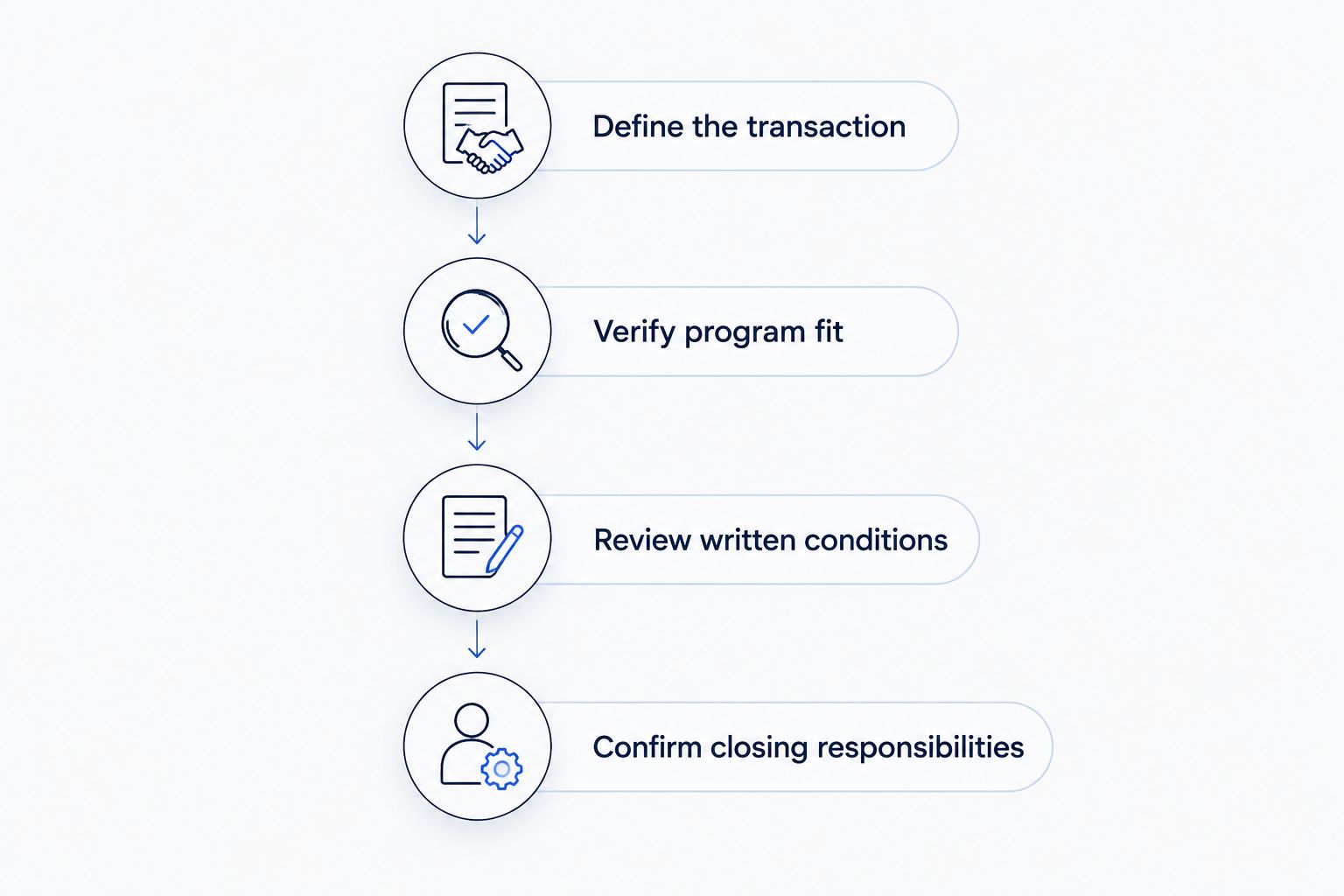
Use the same sequence for every lender. This keeps a fast initial response from outweighing unresolved conditions later in the process.
Define the transaction
State the property type, requested proceeds, purpose of the loan, borrower entity, and repayment plan. For an acquisition, distinguish the purchase from any planned rehabilitation or operating funding needs.
Verify program fit
Ask the lender to identify the proposed financing category and explain the eligibility requirements. Do not assume that every program listed by a lender applies to your transaction.
Review written conditions
Request the proposed structure and the conditions that remain outstanding. Review collateral requirements, guarantees, maturity, amortization, and any restrictions relevant to your business plan.
Confirm closing responsibilities
Identify who orders reports, reviews documents, resolves conditions, and authorizes funding. Assign ownership before relying on a target closing date.
When staying with LendersA is the right call
Stay with LendersA when lender discovery is still the task. If you have not identified a suitable financing source, a matching platform remains relevant to that search.
The platform’s role and the eventual lender’s role are different. Continue the discovery process while checking each proposed lender’s transaction fit, decision authority, and written requirements.
Best for: Borrowers who need to identify potential financing sources before selecting a lender.
- Pro: Lender discovery addresses the early question of whom to approach.
- Con: A potential match does not establish final approval or an executable closing plan.
Verdict: Hold — stay with lender discovery until you have a suitable lender to evaluate, then compare the actual financing structure.
FAQ
What are the best LendersA alternatives in 2026?
Flexvcapital is a direct commercial lending alternative for commercial real estate investors and business borrowers. A local bank suits borrowers prioritizing an existing banking relationship, while an SBA-participating lender suits eligible business financing needs.
Is LendersA the same as a direct lender?
No. LendersA helps borrowers identify potential lenders, while a direct lender evaluates financing under its lending criteria. Confirm which institution will make the credit decision and issue the loan documents.
Should I use a local bank instead of a lender-search platform?
Start with a local bank when an existing banking relationship is central to your financing search. Still verify property eligibility, the proposed structure, and approval conditions rather than assuming the relationship establishes loan approval.
Are SBA loans an alternative for every commercial property purchase?
No. SBA financing depends on program eligibility, business activity, and the intended use of funds. Establish whether the transaction qualifies before comparing it with other commercial property financing.
Does a pre-approval mean my commercial loan will close?
No. Pre-approval is an early assessment, not completed underwriting or guaranteed funding. Review the remaining conditions and confirm who is responsible for satisfying them.
What should I prepare before contacting a commercial lender?
Prepare the property details, requested proceeds, use of funds, borrower entity information, existing debt, and repayment plan. Ask the lender for its transaction-specific document requirements before submitting a full application.
How do I compare commercial lenders without choosing only by speed?
Compare program fit, written conditions, decision authority, and closing responsibilities. An early response is useful, but it does not replace a financing structure that supports your transaction.
One last thing
Your exit strategy is also an underwriting question. If you expect to refinance a short-term loan, ask what must be true about the property and borrower when that refinance occurs.
For a 2026 financing decision, write down the intended repayment source before choosing the lender. Then test the proposed structure against that plan. The strongest initial response is not enough if the loan matures before your repayment strategy is workable.


