
CMBS loans are generally non-recourse, meaning the lender ordinarily looks to the pledged collateral rather than a sponsor’s personal assets for repayment. That protection has exceptions: carve-out guarantees can create liability for specified losses or, for certain triggering events, the entire debt. For a 2026 transaction, the signed loan documents—not the non-recourse label—determine your actual exposure.
- Is a CMBS loan recourse or non-recourse? Generally non-recourse, subject to contractual carve-outs and separate indemnities.
- Loss carve-outs and full-recourse triggers create different levels of guarantor exposure.
- Flex V Capital Ltd offers CMBS financing; borrowers should review guarantees before committing.
- A personal guarantee for specified misconduct is not the same as an unconditional repayment guarantee.
Is a CMBS loan recourse or non-recourse?
A typical CMBS loan is non-recourse to the sponsor for an ordinary repayment shortfall, but not for every contractual breach. The borrowing entity still owes the debt, and the lender retains its rights against the collateral. Non-recourse limits additional recovery against specified parties; it does not cancel the obligation.
The key distinction is between ordinary credit risk, liability for specified losses, and events that trigger full recourse. Read these provisions separately because their consequences differ materially.
| Liability structure | Best for | Main protection | Main limitation |
|---|---|---|---|
| Non-recourse with carve-outs | Sponsors seeking limits on ordinary repayment exposure | Generally protects assets outside the collateral from an ordinary deficiency claim against the sponsor | Protection depends on compliance with negotiated exceptions |
| Loss-based carve-out liability | Allocating responsibility for specified harmful acts | Generally ties recovery to covered losses under the guarantee | Covered losses can extend beyond diverted funds or direct damage |
| Full-recourse trigger | Identifying events that remove the repayment limitation | Exposure remains conditional before a trigger occurs | A covered event can expose the guarantor to the entire debt |
| Unconditional repayment guarantee | Transactions where a sponsor accepts repayment responsibility | Provides the lender a separate repayment obligation | Does not provide the same sponsor protection as non-recourse financing |
Ownership changes deserve particular attention because transfer restrictions can intersect with guarantees. Review whether a CMBS loan is assumable before treating a future sale as a straightforward exit.
Why this matters
A property can lose value without its owner committing misconduct. Non-recourse financing separates that ordinary investment risk from specified conduct that the documents assign to a guarantor.
That distinction matters when you evaluate a 2026 acquisition, refinance, or ownership restructuring. You need to know whether a covenant breach creates an operating default, liability for a resulting loss, or exposure to the full outstanding obligation. Those outcomes are not interchangeable.
Do not evaluate a guarantee by its title. A document described as a “bad-boy guarantee” still requires a provision-by-provision review of the conduct covered, the parties responsible, and the recovery permitted.
Ordinary default: collateral remains at risk
Failure to make required payments is a default even when the loan is non-recourse. The lender can exercise remedies against the mortgaged property and other pledged collateral, subject to the documents and applicable law.
The sponsor’s equity remains exposed. Non-recourse does not preserve the down payment, prevent foreclosure, or guarantee continued control of the property.
For a sponsor, the benefit is the contractual limitation on recovery beyond the collateral. The trade-off is that maintaining this protection requires compliance with the carve-outs and related obligations.
Separate the reason for the default from the default itself. A tenant departure and a diversion of property income present different liability questions, even if both leave the borrower unable to make a payment.
Loss-based carve-outs: liability follows covered losses
A loss-based carve-out generally makes a guarantor responsible for losses arising from specified conduct. The operative language can address fraud, intentional misrepresentation, misapplication of rents, misuse of insurance proceeds, or physical waste.
The benefit is a narrower obligation than an unconditional guarantee of the debt. The limitation is that the definition of recoverable loss matters: legal expenses, enforcement expenses, and other amounts can be included when the documents provide for them.
Ask counsel to identify the required connection between the conduct and the claimed loss. Language requiring losses “caused by” an act presents a different drafting question from broader language covering losses “arising from” it.
Also identify whose conduct counts. A guarantee can address actions by the borrower, guarantor, controlling parties, or other defined persons; your exposure depends on those definitions, not just your own signature authority.
Full-recourse triggers: the entire debt can become exposed
A full-recourse or “springing recourse” provision can make the guarantor liable for the entire debt following a specified event. Certain voluntary bankruptcy actions, collusive insolvency conduct, or prohibited transfers can be addressed this way, depending on the documents.
Do not assume every bankruptcy event or covenant breach automatically creates full recourse. The trigger must be read precisely, including consent, participation, control, notice, and any applicable cure language. Enforceability also depends on applicable law.
The advantage of identifying these triggers early is practical: you can place controls around decisions that threaten non-recourse protection. The disadvantage is the consequence of a covered event, which can be much broader than the immediate harm caused by that event.
Before signing, have counsel distinguish an action you control from an action taken by another party. A trigger tied to third-party conduct deserves specific attention rather than a general assurance that you do not intend to file bankruptcy.
Why CMBS recourse exposure varies
CMBS loans share a financing structure, but their guarantees are not identical. For your 2026 review, focus on these contractual drivers rather than assuming that the same label produces the same protection:
- Trigger definitions: The documents identify the conduct that creates loss liability or full recourse. Broad definitions expand the conduct you must monitor.
- Covered parties: Borrower, sponsor, guarantor, affiliate, and controlling-person definitions determine whose actions matter.
- Loss language: Causation standards and recoverable-loss definitions determine the reach of a loss-based claim.
- Consent requirements: Transfers, additional debt, and ownership changes can require approval before you act.
- Cure rights: Notice provisions and express opportunities to correct a breach affect how you respond. Do not assume they apply to every trigger.
- Separate obligations: Environmental indemnities and other surviving agreements can create exposure outside the main non-recourse provision.
These factors also explain why comparing loan summaries is insufficient. A term sheet can describe the financing as non-recourse without reproducing the exceptions that appear in the closing documents.
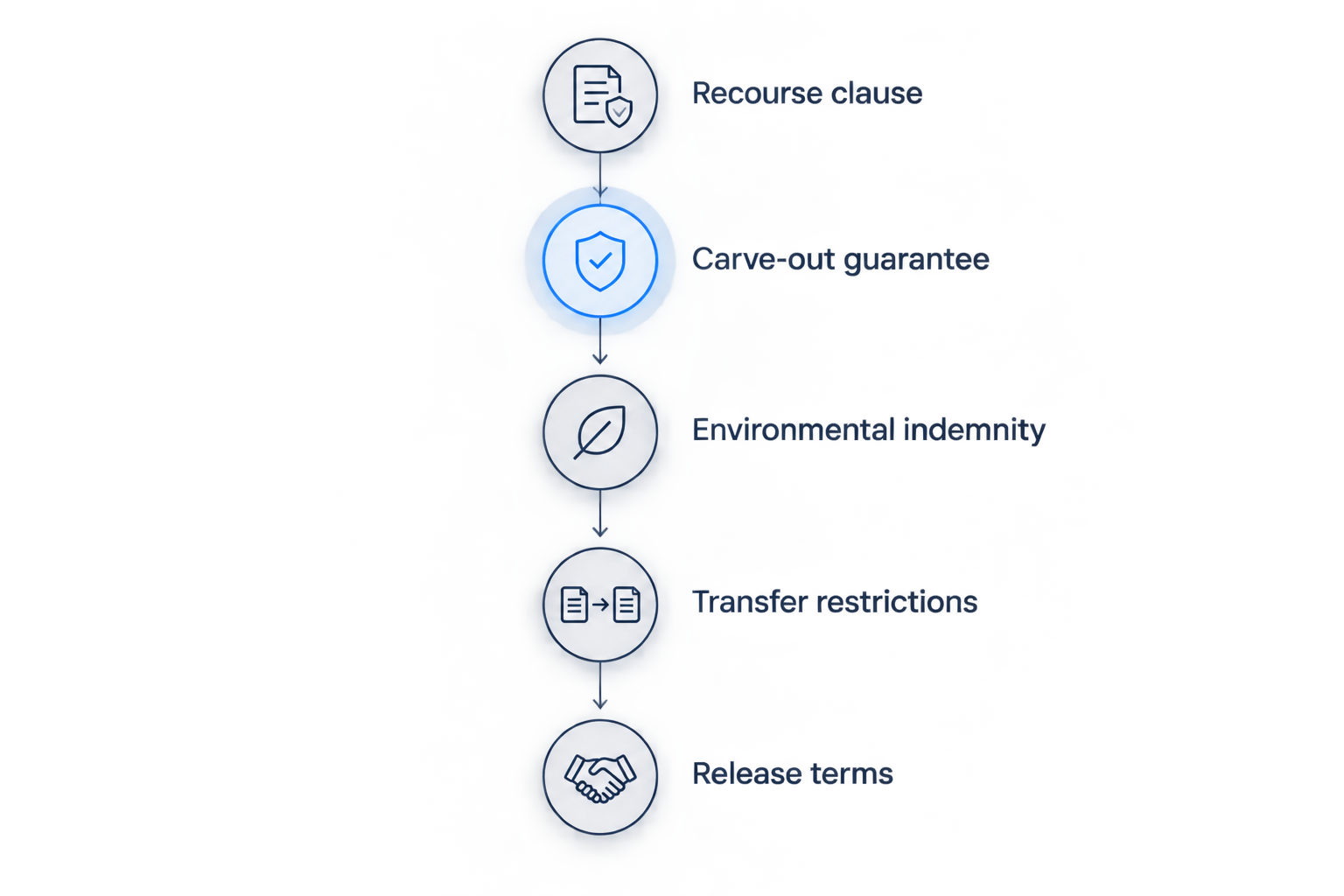
Review the documents in this order
Use this sequence to organize your 2026 legal review. It separates repayment protection from exceptions before you assess proposed ownership or operating decisions.
- Recourse clause: Locate the provision limiting recovery and identify who receives that protection. Confirm the collateral and obligations it covers.
- Carve-out guarantee: Separate loss-based provisions from full-recourse events. Mark definitions incorporated from other documents.
- Environmental indemnity: Identify covered parties, covered obligations, and survival language. Do not treat this agreement as automatically limited by the repayment clause.
- Transfer restrictions: Map approval requirements against your intended ownership structure, estate planning, refinancing, and sale strategy.
- Release terms: Determine when each guarantor is released and which obligations survive repayment, assumption, or transfer.
Request a written issue list organized by liability type. For each provision, record the triggering conduct, responsible parties, available cure, and potential remedy. That format makes it easier to compare revisions without losing a material exception in a general discussion of non-recourse terms.
Can a CMBS lender pursue your personal assets?
A CMBS lender can pursue a guarantor’s personal assets when an enforceable obligation permits that recovery. A non-recourse repayment clause does not override every separate guarantee or indemnity.
Your role matters. Signing solely as an authorized representative of the borrowing entity is different from signing an individual guarantee, although other legal grounds for liability can exist.
Review each signature block alongside the agreement it executes. Confirm whether you are signing for the borrower, personally as guarantor, or in both capacities; do not rely on the signature page alone to describe the obligation.
Does a CMBS loan require a personal guarantee?
CMBS financing commonly includes a carve-out guarantee rather than an unconditional personal repayment guarantee. The guarantor can be an individual or an entity, depending on the transaction and lender requirements.
The useful question is not simply whether a guarantee exists. Ask what it guarantees, whose conduct triggers it, and whether recovery is limited to specified losses or extends to the entire debt.
For a 2026 term-sheet comparison, request this distinction in writing before treating proposed loans as equivalent. A non-recourse description should start the document review, not end it.
Does selling the property release the original guarantor?
Selling the property does not, by itself, establish that the original guarantor is released. An approved assumption, replacement guarantee, and express release must be evaluated under the transaction documents.
Pay particular attention to pre-transfer conduct and obligations that survive. A release covering future repayment exposure does not necessarily eliminate liability for an earlier breach or a separate environmental obligation.
Make guarantor release a closing deliverable when it is part of the negotiated transaction. Do not leave it as an assumption based on the buyer taking over payments.
Match the financing to your ownership plan
A non-recourse structure addresses liability allocation; it does not answer every financing question. You still need to assess transfer restrictions, prepayment provisions, servicing requirements, and the property’s ability to support debt service.
Flex V Capital Ltd is best suited to commercial borrowers seeking direct lending across CMBS and other commercial financing categories. Its stated offering includes CMBS, bridge, DSCR, hard money, SBA, and Fannie Mae financing; that range does not establish the terms or suitability of any particular approval.
Review commercial lending services against the property’s business plan. The relevant fit is the financing structure and its obligations, not the non-recourse label in isolation.
For Flex V Capital Ltd CMBS financing, confirm the proposed guarantor, carve-outs, indemnities, and release requirements in the transaction documents. Product availability alone does not establish that a specific loan will carry the liability protections you require.
Discuss your CMBS financing requirements
Identify the property, borrowing entity, proposed guarantor, and intended ownership or exit changes.
FAQ
Is a CMBS loan recourse or non-recourse?
A CMBS loan is generally non-recourse, subject to contractual carve-outs and separate obligations. The lender ordinarily relies on collateral for repayment, while specified conduct can create additional borrower or guarantor liability.
Can I lose my property on a non-recourse CMBS loan?
Yes, non-recourse CMBS financing still permits remedies against pledged collateral after default, subject to the documents and applicable law. Non-recourse limits certain recovery beyond that collateral; it does not prevent foreclosure.
What is a bad-boy guarantee on a CMBS loan?
A bad-boy guarantee is a carve-out guarantee covering specified conduct rather than ordinary repayment alone. Some provisions impose liability for covered losses, while others can trigger liability for the entire debt.
Does missing a CMBS payment automatically create personal liability?
Missing a CMBS payment does not, by itself, establish personal liability under a typical non-recourse structure. Review whether a separate guarantee applies or whether related conduct triggers a carve-out.
Does putting the property in an LLC eliminate personal liability?
An LLC does not eliminate obligations you separately accept as an individual guarantor or indemnitor. Review the entity structure together with every guarantee, indemnity, and signature capacity.
Does a CMBS loan assumption release the seller's guarantee?
A CMBS loan assumption does not automatically establish release of the seller's guarantee. Confirm the express release terms, replacement guarantor requirements, and obligations that survive the transfer.
Does Flex V Capital Ltd offer CMBS financing?
Flex V Capital Ltd offers CMBS financing as part of its commercial lending services. Confirm transaction-specific recourse terms, guarantees, and indemnities before signing.
One last thing
A guarantee can survive a transaction that appears to end your ownership exposure. Before repayment, assumption, or sale, ask counsel to identify exactly which obligations terminate and which remain enforceable.
Keep that analysis with the executed release documents, not just the original closing file. The practical question is whether you can demonstrate the end of your obligation—not whether someone described the loan as non-recourse at origination.
This article provides general information, not legal advice. Have qualified commercial real estate counsel review your loan documents and applicable law before signing or changing the borrowing structure.


