
You do not need a universal minimum personal net worth to qualify for an SBA 7(a) or 504 loan in 2026; approval depends on business eligibility, repayment ability, your financial position, and lender underwriting. The often-cited $20 million tangible net worth threshold is a business-size ceiling under SBA’s alternative size standard, not a personal wealth minimum or a substitute for your required cash contribution.
- The SBA loan net worth requirement sets no universal personal minimum for 7(a) or 504 borrowers.
- The alternative size standard limits business tangible net worth to $20 million, including applicable affiliates.
- Average net income after federal income taxes cannot exceed $6.5 million over the preceding two completed fiscal years.
- Liquidity, repayment ability, equity injection, and personal guarantees remain separate underwriting questions.
- Flexvcapital offers SBA financing as a direct commercial lender in New York.
Why this matters
Confusing a business-size ceiling with a personal wealth requirement can make you abandon an eligible application. The opposite mistake is assuming that substantial personal wealth guarantees approval when the business cannot support its debt.
For a 2026 application, separate three questions: whether the business meets SBA size rules, whether you can fund the required contribution, and whether the proposed loan is repayable. Your SBA loan down payment is a separate issue from your balance-sheet net worth.
How much net worth do you need to qualify for an SBA loan?
SBA 7(a) and 504 rules do not establish one minimum personal net worth that every borrower must meet. A lender still evaluates your assets, liabilities, liquidity, credit history, and obligations alongside the business’s financial performance.
The following distinctions govern the answer. The business-size thresholds below come from the Small Business Administration’s alternative size standard in 13 CFR § 121.301(b), not a lender’s personal wealth policy.
| Requirement or measure | What it means | What it does not mean |
|---|---|---|
| Personal net worth | Your personal assets minus personal liabilities | A universal SBA minimum wealth requirement |
| Business tangible net worth | A business-size measure that excludes intangible assets | Cash available for your down payment |
| $20 million tangible net worth ceiling | The alternative size standard’s business net worth limit, including applicable affiliates | A requirement to personally own $20 million |
| $6.5 million average net income ceiling | The alternative size standard’s after-tax income limit over the preceding two completed fiscal years | A minimum income requirement |
| Liquidity | Funds accessible for the transaction and continuing obligations | The same thing as total net worth |
| Repayment ability | Support for paying proposed debt from acceptable repayment sources | Automatic approval because collateral exists |
For 2026 underwriting, ask which size standard applies before comparing your figures with a published threshold. A 7(a) applicant can qualify under an applicable industry size standard or the alternative size standard; the 504 business-size test uses the alternative standard.
SBA 7(a): No universal personal net worth minimum
Best for: eligible operating businesses seeking financing for permitted business purposes, including acquisitions, working capital, or owner-occupied real estate. The 7(a) program does not require every owner to have personal net worth equal to the requested loan amount.
Its advantage is the range of eligible business uses. Its limitation is that a flexible use of proceeds does not remove the need to establish repayment ability, satisfy eligibility rules, and meet the lender’s underwriting requirements.
A personal financial statement still matters. A borrower with substantial assets and substantial debt presents a different financial position from a borrower whose assets are largely unencumbered, even if the headline asset totals look similar.
Do not use the absence of a universal minimum as a reason to omit liabilities. The lender needs an accurate picture of mortgage obligations, installment debt, contingent obligations, and other commitments that affect your financial capacity.
SBA 504: $20 million business tangible net worth ceiling
Best for: eligible businesses financing qualifying major fixed assets, including owner-occupied commercial property. Under the alternative size standard, the applicant business, including applicable affiliates, cannot exceed $20 million in tangible net worth.
The same test limits average net income after federal income taxes, excluding carryover losses, to $6.5 million over the preceding two completed fiscal years. Both are ceilings used to determine business size, not personal wealth targets.
The 504 program’s advantage is its focus on qualifying fixed-asset projects. Its limitation is narrower use of proceeds: it is not a general working-capital facility, and owning an investment property does not by itself establish eligibility.
For a 2026 application, distinguish the operating business from any property-holding entity and disclose the ownership structure. Do not calculate size using only the entity that makes the application if affiliation rules require other businesses to be included.
How do 7(a) and 504 differ on this question?
| Program | Best for | Personal net worth rule | Business-size issue | Main limitation |
|---|---|---|---|---|
| SBA 7(a) | Eligible business acquisitions, working capital, and other permitted uses | No universal personal minimum | Applicable industry standard or alternative size standard | Repayment and lender underwriting still control approval |
| SBA 504 | Qualifying major fixed assets | No universal personal minimum | Alternative size standard applies | Not general working-capital financing |
Choose the program around the transaction, not around a supposed personal wealth cutoff. The same personal balance sheet can support different financing requests, but each request must satisfy its own program rules.
Why SBA financial requirements vary
The SBA loan net worth requirement is not a single approval formula. These separate factors explain why lenders request more than a personal balance sheet:
- Loan purpose: A business acquisition, working-capital request, and owner-occupied property purchase require different supporting information.
- Business performance: Existing cash flow, debt obligations, and supportable projections affect repayment analysis.
- Equity injection: Required borrower funds depend on the transaction and applicable program requirements, not simply total personal wealth.
- Liquidity: Property equity and retirement assets are not interchangeable with accessible closing funds.
- Ownership and affiliates: Ownership relationships affect size calculations and personal guarantee requirements.
- Lender underwriting: A lender’s credit policy can impose financial conditions beyond the absence of an SBA-wide personal minimum.
Ask the lender to identify whether a stated condition comes from an SBA rule, the transaction structure, or its own credit policy. That distinction tells you whether changing lenders addresses the issue or merely restarts the same eligibility problem.
How do you calculate the figures lenders need?
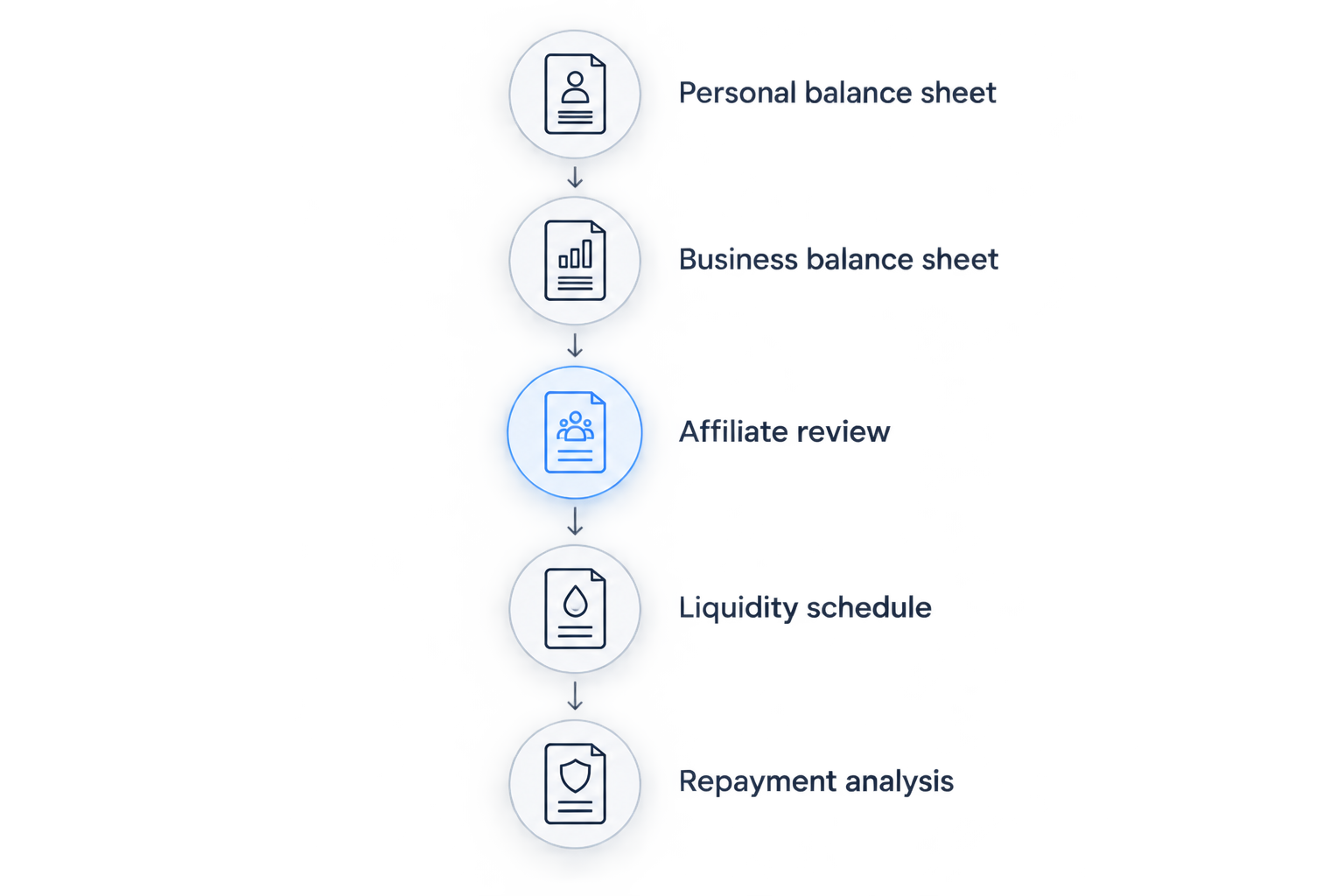
Start with separate schedules rather than one combined wealth estimate. Keep personal finances, business finances, and transaction funding distinct so the lender can evaluate each without double counting.
- Personal balance sheet: List personal assets and liabilities using supportable values. Show associated debt rather than presenting the gross value of a property as available wealth.
- Business balance sheet: Provide current business assets and liabilities. Identify intangible assets so the tangible net worth calculation is not confused with total book equity.
- Affiliate review: Disclose ownership interests and related entities. Let the lender determine which affiliates must be included under the applicable rules.
- Liquidity schedule: Identify accessible funds, account ownership, restrictions, and the proposed source of your contribution.
- Repayment analysis: Reconcile business earnings, existing debt payments, proposed debt, and relevant personal obligations.
These steps organize the application; they do not establish eligibility by themselves. An accountant can help reconcile the financial statements, while the lender determines how program rules apply to the request.
What should you prepare before applying?
For a 2026 application, assemble personal and business financial information that reconciles across statements and supporting records. Ask the lender whether SBA Form 413, Personal Financial Statement, or an accepted equivalent is required for your ownership position and transaction.
Prepare current business financial statements, relevant tax returns, a business debt schedule, evidence of your contribution’s source, and ownership information. Include explanations for material differences rather than leaving the lender to resolve conflicting balances.
Do not count the same money twice. Funds committed to your contribution are not also untouched post-closing liquidity, and equity tied up in an asset is not cash unless an acceptable transaction makes it available.
Can you qualify if most of your net worth is in real estate?
Real estate equity contributes to personal net worth, but it is not the same as liquid funds. You must separately demonstrate how you will fund any required contribution and meet the transaction’s other cash needs.
Provide property values, associated debt, ownership percentages, and supporting information requested by the lender. If your plan depends on selling or borrowing against property, disclose that dependency before treating the proceeds as available.
A large property portfolio also brings obligations. Evaluate the debt and guarantees attached to those assets instead of assuming the gross property value strengthens every part of the application.
Does a personal guarantee create a net worth minimum?
A personal guarantee does not create a universal minimum personal net worth requirement. Under 13 CFR § 120.160, SBA generally requires guarantees from owners holding at least 20% of the applicant, with additional guarantees possible under applicable requirements.
The guarantee creates a personal repayment obligation under its terms; it is not merely a statement that your business qualifies. Review the guarantee documents and distinguish the ownership trigger from any separate lender financial condition.
The SBA guarantee protects the lender, not the borrower from repayment. Do not assume SBA backing eliminates your exposure if the business defaults.
What should you ask a lender before submitting an application?
Ask for a clear response to the financial questions that control your transaction. A useful initial discussion separates eligibility from documentation and credit approval.
- Which business-size standard applies to this request?
- Does the lender impose a minimum personal net worth or liquidity condition?
- How will affiliates and related businesses affect the review?
- What contribution must come from acceptable borrower sources?
- Which owners or other parties must guarantee the loan?
- What evidence supports the proposed repayment source?
Flexvcapital is best for New York business borrowers seeking a direct commercial lender offering SBA financing. The relevant discussion is your business purpose, financial position, ownership, and proposed transaction—not whether you meet an invented universal wealth threshold.
A lender conversation is not an approval. Flexvcapital’s SBA financing still requires review of the actual request; the absence of a universal personal minimum does not establish that your application qualifies.
FAQ
What is the SBA loan net worth requirement in 2026?
There is no universal minimum personal net worth for SBA 7(a) or 504 loans in 2026. Lenders still assess your financial position, business repayment ability, liquidity, and applicable program requirements.
Do I need $20 million in net worth to get an SBA loan?
No. The $20 million figure is a business tangible net worth ceiling under SBA’s alternative size standard, including applicable affiliates, not a personal wealth minimum.
What does the $6.5 million SBA income limit mean?
The $6.5 million limit applies to average business net income after federal income taxes, excluding carryover losses, over the preceding two completed fiscal years under the alternative size standard. It is a maximum business-size measure, not required personal income.
Can I get an SBA loan with low personal net worth?
Low personal net worth does not automatically disqualify you under a universal SBA personal minimum. You must still satisfy applicable eligibility rules, demonstrate repayment ability, and meet the lender’s financial requirements.
Is my down payment the same as my net worth?
No. Your down payment is the contribution committed to the transaction, while personal net worth is your assets minus liabilities. A positive net worth does not establish that sufficient contribution funds are accessible.
Does owning 20% of a business mean I must guarantee its SBA loan?
SBA generally requires a personal guarantee from owners holding at least 20% of the applicant. Additional guarantees can also be required, so review the ownership structure and guarantee documents with the lender.
Can Flexvcapital assess whether my finances fit an SBA request?
Flexvcapital offers SBA financing as a direct commercial lender in New York. Present the business purpose, ownership structure, financial statements, liabilities, and source of contribution so the request can be evaluated.
One last thing
A wealthier borrower is not automatically a more liquid borrower. Before submitting your 2026 application, mark each asset as accessible cash, restricted funds, or noncash equity, and show the debt attached to it.
That single distinction prevents a common application error: presenting a strong net worth statement while leaving the actual source of your contribution unexplained.


