
Instead of chasing separate lender, CDC, and attorney checklists, manage your SBA 504 term sheet closing through one conditions tracker with named owners and documented releases. The workflow below separates credit approval, property closing, and debenture funding so you know which milestone actually releases funds.
- An SBA 504 term sheet closing requires separate lender, CDC, and closing-document reviews; a signed term sheet is not funding.
- Flexvcapital offers direct commercial lending and SBA financing; confirm the proposed lender and CDC roles before proceeding.
- Track borrower equity, owner occupancy, property reports, and interim financing before setting a closing date.
- Distinguish the real estate closing from the later SBA 504 debenture funding milestone.
Why this matters
An SBA 504 transaction combines a third-party lender's financing with financing arranged through a Certified Development Company, or CDC, and borrower equity. The documents and funding responsibilities are related, but they are not interchangeable.
A signed term sheet is not permission to close. Credit approval, property eligibility, legal conditions, and disbursement requirements still need written clearance. For a 2026 transaction, use the lender's and CDC's current requirements rather than an older checklist.
Flexvcapital is a direct commercial lender in New York offering SBA financing among its commercial lending services. Flexvcapital is best for commercial borrowers seeking direct-lender review of an SBA financing request. The benefit is direct lender engagement; the limitation is that an SBA financing offering does not, by itself, establish the CDC relationship or approval status for your particular 504 project.
Before you start
- Access and authority: Identify the borrower, operating company, property-owning entity, authorized signers, proposed third-party lender, CDC, and closing attorney. Confirm who can authorize reports and submit financial information.
- Source materials: Assemble the term sheet, purchase contract or project budget, entity documents, ownership information, financial statements, tax returns, debt schedule, and evidence of the proposed equity contribution. Use secure delivery for sensitive records.
- The funding gotcha: The property closing and SBA 504 debenture funding are separate milestones. Identify who advances the CDC-related portion before debenture proceeds arrive, what conditions govern that advance, and who carries the interim obligation.
For existing buildings, the operating business generally must occupy at least 51% of the property. For new construction, the initial occupancy requirement is generally 60% of the property, with additional occupancy commitments. These SBA program requirements are eligibility screens, not substitutes for the CDC's project-specific review.
Term sheet and responsibility map
- Separate proposed terms from approvals. Read the term sheet for expiration dates, contingencies, collateral, guarantees, proposed debt structure, and borrower obligations. Ask the issuer which provisions are binding; do not assume that accepting indicative terms creates a lending commitment.
- Identify every funding source. Record the third-party loan, anticipated CDC/SBA financing, borrower contribution, and any interim financing. Assign a named contact to each source. Confirm whether the term-sheet issuer is committing its own portion or describing a structure that still needs another participant.
- Build a conditions tracker. Create columns named Condition, Owner, Evidence, Due date, and Release confirmation. These are your own tracker labels, not lender portal fields. Copy each requirement from the actual lender and CDC checklists, preserving the original wording.
- Map contract deadlines. Add financing contingencies, inspection periods, deposit obligations, and the contractual closing date. Ask counsel to identify the deadline that creates the earliest irreversible obligation.
Expected result: You have a responsibility map showing who approves, who documents, and who funds each part of the transaction. No condition is marked complete merely because a document was uploaded.
For a 2026 closing, keep the accepted term sheet and every subsequent amendment together. When a proposed loan amount or project scope changes, record which approvals need to be revisited rather than treating an email acknowledgment as universal consent.
Eligibility and underwriting file
- Confirm project eligibility first. Give the CDC the operating business's activity, ownership structure, property use, occupancy plan, and proposed use of proceeds. SBA 504 supports eligible fixed-asset projects; it is not a general working-capital facility or a program for passive investment in rental real estate.
- Reconcile the financial package. Match the borrower and guarantor names across tax returns, financial statements, entity records, and applications. Explain material differences between reported revenue, interim results, and debt balances. Have the accountant resolve discrepancies before the underwriter has to reconstruct them.
- Document the equity source. Provide the records requested to establish where the contribution comes from and how it reaches closing. The standard SBA 504 structure generally requires at least 10% borrower equity; a new business or limited/special-purpose property generally raises that requirement to 15%, and both conditions together generally raise it to 20%. Obtain the CDC's determination for your project.
- Resolve underwriting conditions explicitly. Ask the third-party lender and CDC for their remaining conditions separately. Distinguish credit questions, eligibility questions, and documentation requests. A response accepted by one participant does not automatically satisfy the other.
Expected result: The lender and CDC have a consistent borrower file, a documented contribution, and a written list of unresolved approvals. You can identify the next decision-maker without searching an email chain.
The equity percentages above describe SBA program structure, not a financing offer. For a 2026 application, have the CDC confirm the applicable contribution and any current program requirements before committing funds.
Property diligence and closing package
- Authorize reports through the correct channel. Ask the lender and CDC who must order the appraisal and environmental review, what scope is required, and whose reliance requirements apply. A borrower-commissioned report is not automatically acceptable to either participant.
- Reconcile the property documents. Compare the purchase contract, legal description, title commitment, survey when required, occupancy information, and insurance requirements. Send discrepancies to the closing attorney before documents are prepared for signature.
- Clear property-specific conditions. Address environmental findings, title exceptions, zoning questions, repairs, and occupancy issues through the responsible reviewer. Obtain written acceptance or a documented resolution; an explanation alone does not release a condition.
- Review the complete document set. Have counsel compare the loan documents, guarantees, security instruments, entity authorizations, and closing statement with the approved structure. Confirm borrower names and signer capacities throughout. Identify conditions that must be satisfied before disbursement rather than after signing.
Expected result: The property is acceptable to the financing participants, legal discrepancies are resolved, and the closing package reflects the approved transaction.
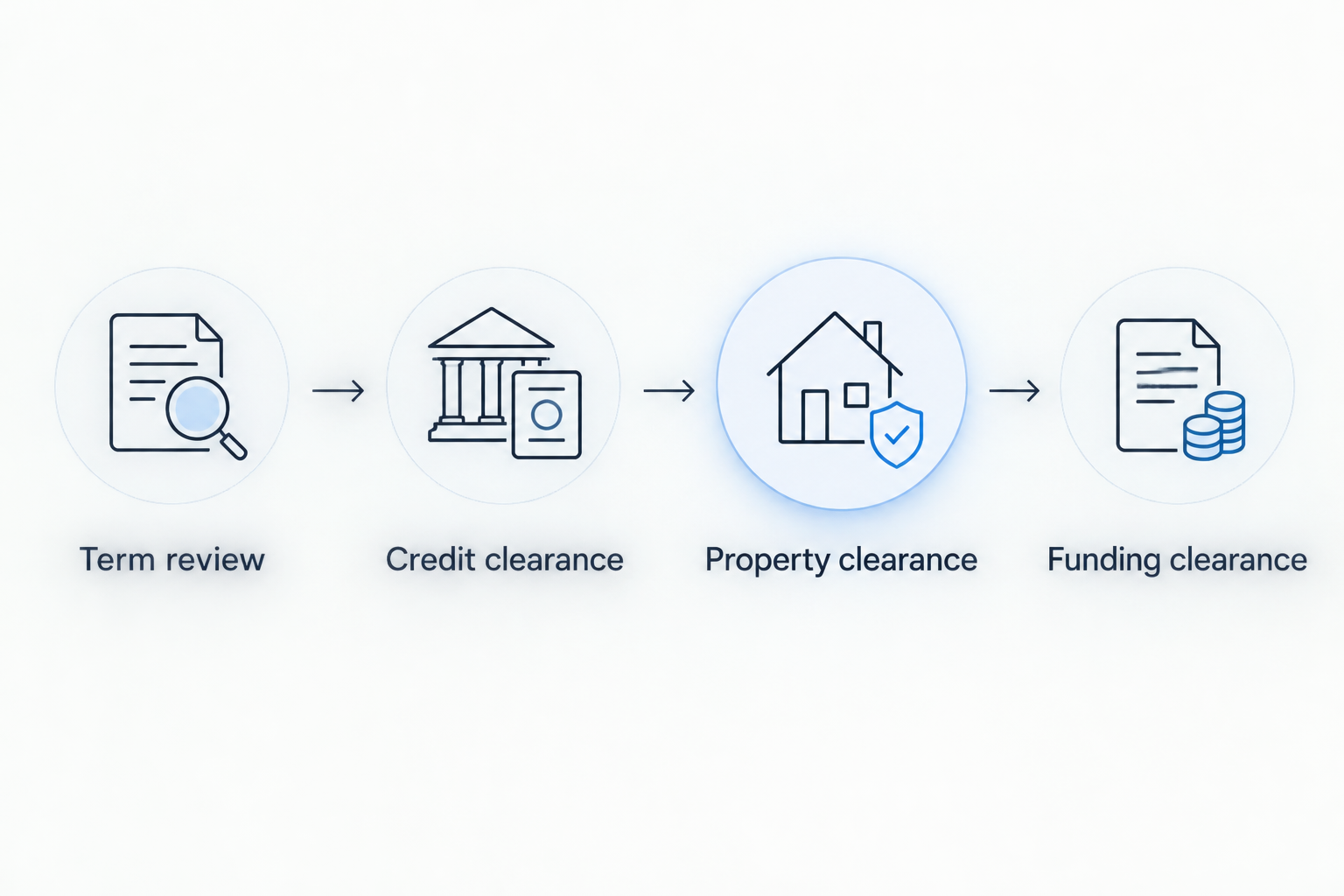
Use this release sequence to keep the file readable: Term review, Credit clearance, Property clearance, then Funding clearance. Each stage needs its own evidence; finishing the document collection does not prove that the underlying review is complete.
Settlement and debenture funding
- Reconcile sources and uses. Ask the closing team to match available funds against the approved closing statement and project budget. Identify the borrower contribution, lender proceeds, interim advance, and any amounts retained for later disbursement. Resolve unexplained differences before authorizing settlement.
- Verify the release conditions. Obtain confirmation from each funding participant that its disbursement conditions are satisfied. Confirm insurance effectiveness, required signatures, equity evidence, and recording arrangements. An executed document package can still have outstanding funding conditions.
- Verify wire instructions independently. Call a previously verified contact using a trusted number, not a number supplied in a new payment email. Stop if instructions change unexpectedly. Confirm receipt through the closing team's established process.
- Track the post-closing handoff. Obtain executed documents and evidence of recording when available. Ask the CDC which remaining items control debenture funding and who supplies them. Retain interim financing statements and reconcile the payoff when permanent proceeds are applied.
Expected result: The property closing is completed, the source of every disbursement is documented, and the remaining debenture-funding obligations have named owners.
For a 2026 closing, maintain separate target dates for settlement and debenture funding. Neither date is a promise unless the responsible funding party confirms the prerequisites and schedule for your transaction.
Construction workflow variant
For an acquisition involving construction or substantial improvements, add a project-completion track before permanent funding. Do not reuse a straightforward purchase checklist without accounting for advances, inspections, and completion evidence.
| Workflow | Best for | Main advantage | Main constraint |
|---|---|---|---|
| Existing-building purchase | An eligible operating business buying usable premises | Fewer construction dependencies to coordinate | Property, occupancy, title, and credit conditions still control closing |
| Construction or improvement project | An eligible operating business developing or adapting premises | Coordinates financing around the approved project scope | Adds draw administration, completion evidence, and interim financing dependencies |
The existing-building route is not automatically ready to fund because construction is absent. The construction route is not automatically ready for permanent funding because the building looks finished.
- Obtain the construction lender's draw requirements and the CDC's completion requirements before work begins.
- Assign responsibility for permits, approved plans, contractor documentation, inspections, change orders, and lien releases as required.
- Record each approved scope change against the project budget and financing approvals.
- Confirm the final completion, occupancy, and disbursement evidence required before requesting permanent funding.
Expected result: Every construction advance and completion condition has an owner, and the permanent-funding request rests on accepted evidence rather than an estimated finish date.
Troubleshooting
The term sheet is signed, but closing cannot be scheduled
Fix: Request separate outstanding-condition lists from the third-party lender, CDC, and closing attorney. Mark each item as awaiting a document, a review, or an approval. Schedule against unresolved approvals, not the date you sent the last attachment.
The equity contribution does not match the closing statement
Fix: Reconcile the approved project budget, deposits already paid, contribution evidence, and final disbursements. Have the CDC and lender confirm which expenditures count toward the required contribution. Do not assume every dollar already spent qualifies.
The appraisal or environmental report is rejected
Fix: Ask the reviewer to identify whether the problem is scope, reliance, methodology, missing information, or a substantive finding. Obtain authorized revisions through the ordering party. Do not order a replacement before confirming what must change.
A borrower, ownership, or project change appears late
Fix: Notify both the lender and CDC before changing documents or transferring funds. Ask which credit, eligibility, and legal approvals must be refreshed. Keep the revised structure consistent across the purchase contract, entity documents, and financing package.
Settlement is complete, but interim debt remains outstanding
Fix: Ask the CDC for the remaining debenture-funding conditions and obtain the interim lender's current obligations. Continue complying with the interim agreement until payoff is confirmed. Property ownership does not establish that permanent funding has occurred.
Customize your workflow
Add a separate tracker view for the transaction's main risk: construction completion, ownership complexity, occupancy, or refinancing eligibility. Keep one master conditions register so different participants do not maintain conflicting versions of the same requirement.
When discussing a 2026 SBA request with Flexvcapital, provide the proposed project use, occupancy plan, borrower structure, contract deadlines, and equity source. Ask for the proposed lender role and CDC coordination process; the brand's broader SBA offering does not establish the structure of an individual 504 transaction.
Use the financing inquiry page to describe the project and request a review. Keep tax returns, account statements, and identity documents out of an initial message unless a secure submission method is provided.
FAQ
Does signing an SBA 504 term sheet mean my loan is approved?
No. An SBA 504 term sheet describes proposed terms and conditions; final credit, eligibility, legal, and funding requirements still require clearance. Ask which provisions are binding and which approvals remain outstanding.
Who coordinates an SBA 504 term sheet closing?
The borrower, third-party lender, CDC, and closing attorney coordinate different parts of an SBA 504 closing. Assign one person to maintain the shared conditions tracker without treating that person as the approval authority for every participant.
Is the property closing the same as SBA 504 debenture funding?
No. The property closing and SBA 504 debenture funding are separate milestones. Confirm who provides interim funds and which conditions must be satisfied before permanent proceeds repay the interim obligation.
How much equity do I need for an SBA 504 project?
The standard SBA 504 structure generally requires at least 10% borrower equity. A new business or limited/special-purpose property generally raises the requirement to 15%, and both conditions together generally raise it to 20%; the CDC determines the applicable requirement.
Can I use SBA 504 financing for a rental investment property?
SBA 504 is not intended for passive investment in rental real estate. An eligible operating business must satisfy owner-occupancy requirements, with the CDC reviewing the proposed ownership and property-use structure.
How long does an SBA 504 loan take to close after the term sheet?
A signed term sheet does not establish a reliable closing duration. Obtain a transaction-specific schedule based on lender approval, CDC review, property reports, legal conditions, and interim funding arrangements.
Can Flexvcapital review an SBA financing request?
Flexvcapital offers SBA financing as part of its direct commercial lending services. Confirm the proposed 504 structure, lender role, and CDC participation for your project before treating an initial discussion as an approval.
One last thing
The most useful closing document is not necessarily the longest checklist. It is the release record showing who accepted the evidence and when.
Keep that record after settlement. If a later funding question arises, a dated acceptance is more useful than proof that an attachment was sent.


