
Childcare center SBA 504 financing is long-term funding for eligible fixed assets, designed to help operators buy, build, or improve the premises their businesses occupy. This 2026 guide separates facility financing from operating capital and explains how licensing, special-purpose property rules, and enrollment-based cash flow affect your application.
- An SBA 504 loan for childcare centers funds eligible fixed assets, not routine payroll or working capital.
- Childcare properties require special-purpose property review; do not assume the standard minimum borrower contribution applies.
- Match owner occupancy, licensing, and enrollment projections before committing to a property.
- Flexvcapital offers SBA financing; confirm the specific 504 structure and participating Certified Development Company before proceeding.
Why SBA 504 financing matters for childcare center owners
A childcare building must work as both collateral and a licensed operating facility. A property that supports the purchase price still fails your business plan if zoning, classroom configuration, outdoor space, or licensing prevents the intended enrollment.
SBA 504 financing separates the real estate investment from ordinary operating expenses. That distinction matters when you need to fund a building purchase and keep enough cash available for teachers, insurance, supplies, and the period before classrooms reach planned enrollment.
Flexvcapital offers SBA financing as a direct commercial lender in New York. Compare the financing structure against your project rather than treating every commercial mortgage as interchangeable.
For your 2026 application, use the SBA’s 504 Loans program guidance for eligible uses and the applicable SBA SOP 50 10 for origination requirements. These are the program references for the occupancy and contribution rules discussed below; your lender and Certified Development Company, or CDC, must apply the requirements governing your transaction.
A CDC is the nonprofit organization that works with the SBA and participating lenders on 504 financing. The usual structure combines a first mortgage from a third-party lender, a CDC/SBA-backed second mortgage, and your equity contribution. The fixed-rate feature applies to the SBA-backed portion, not automatically to both loans.
How to prepare a childcare center SBA 504 application
Start with a project worksheet and your existing accounting records. You can assemble the initial screening package yourself before paying for transaction-specific professional work or authorizing third-party reports.
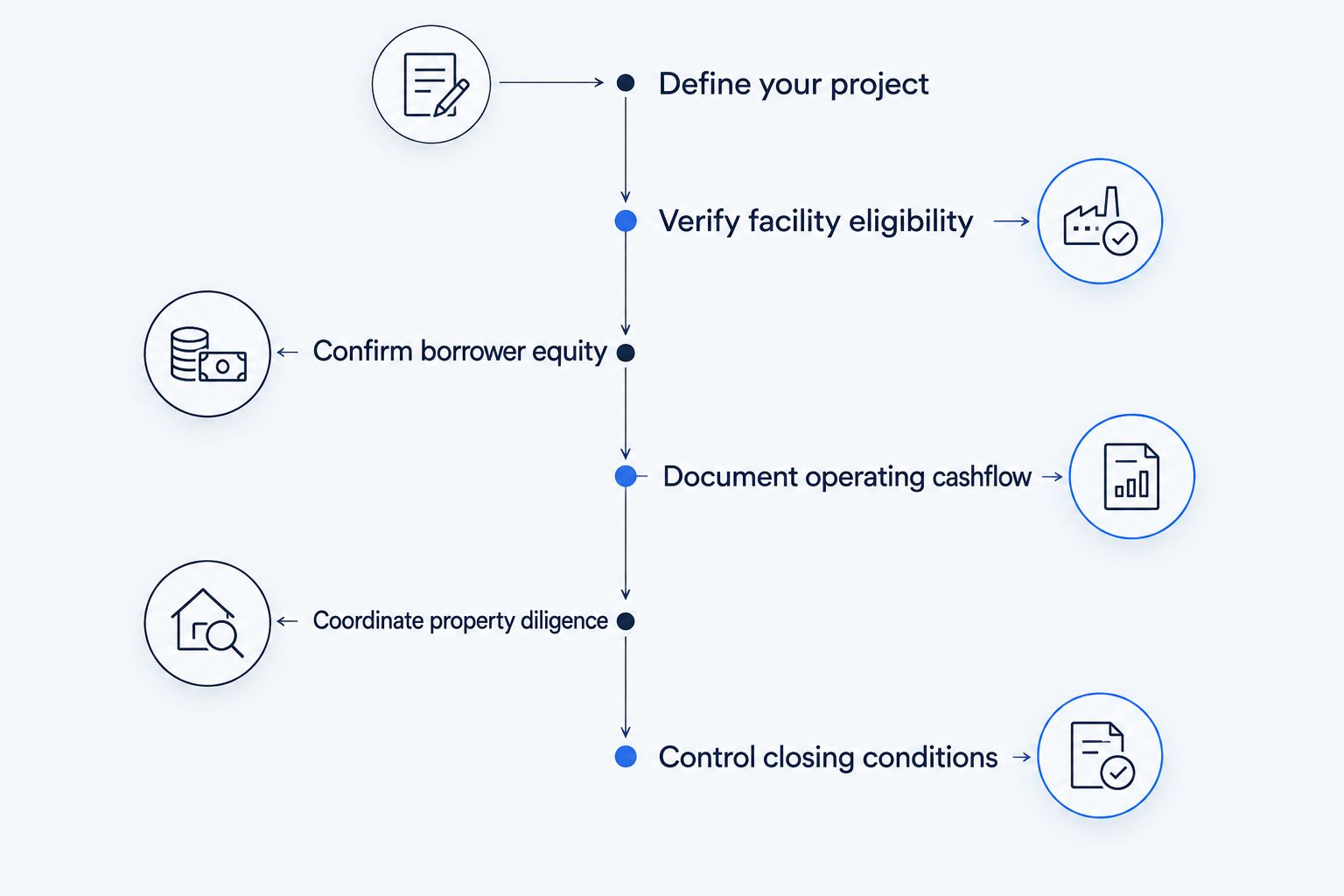
Define your project
Create a written sources-and-uses schedule: where the money comes from and what each funding source pays for. Separate the building, eligible improvements, and qualifying equipment from operating expenses and any business acquisition components.
SBA 504 financing supports eligible fixed assets. It is not a general-purpose account for payroll, inventory, or goodwill. Certain refinancing transactions qualify under separate requirements, so an existing mortgage needs its own eligibility review rather than an assumption that every refinance fits.
If you are buying an operating childcare business together with its building, allocate the transaction components before selecting financing. The real estate and the business purchase do not automatically belong in the same 504 project.
- Identify the property-owning entity and childcare operating entity.
- Separate real estate, construction, equipment, and business acquisition uses.
- List payroll, supplies, and other operating needs outside the fixed-asset budget.
- Record the purchase agreement’s financing and inspection deadlines.
- Identify the source of funds for every excluded expense.
Verify facility eligibility
Check the property against both SBA occupancy rules and local childcare requirements. For an existing building, the operating business generally must occupy at least 51% of the rentable property. For new construction, initial occupancy generally must reach 60%, with additional requirements for future occupancy.
Do not substitute licensed capacity for occupied floor area. They answer different questions: licensing determines permitted operations, while SBA occupancy tests whether the project qualifies as owner-occupied business financing.
For a 2026 purchase, obtain a written site-specific assessment from the relevant authorities and qualified professionals. A seller’s history of childcare use does not establish that your proposed ownership, age groups, layout, or expansion plan will receive approval.
- Obtain a floor plan showing operating space and any tenant areas.
- Confirm permitted childcare use with the zoning authority.
- Identify licensing requirements for your intended age groups.
- Review fire, accessibility, sanitation, and outdoor-space requirements.
- Confirm the applicable occupancy calculation with the CDC.
Confirm borrower equity
Calculate your required contribution before negotiating a nonrefundable deposit. Under standard SBA 504 structures, the minimum borrower contribution starts at 10% of eligible project costs; it generally increases to 15% for a new business or a limited/special-purpose property, and 20% when both conditions apply.
Childcare centers fall within SBA special-purpose property considerations. Ask the CDC to confirm the property classification and whether the business also meets the program’s definition of a new business. Do not build your purchase plan around the standard contribution without that review.
Flexvcapital is best for borrowers seeking SBA financing from a direct New York commercial lender. Its commercial lending services include SBA financing; confirm the specific 504 arrangement, CDC participation, and responsibility for each financing component before proceeding.
Your contribution is not the entire cash requirement. Keep funds for excluded expenses and operating needs separate from the amount committed to the project.
- Obtain the CDC’s project-specific equity calculation.
- Document the source and transfer history of contribution funds.
- Disclose proposed borrowed contribution funds for eligibility review.
- Separate project equity from operating reserves.
- Confirm whether new-business and special-purpose rules both apply.
Document operating cashflow
Build the repayment case from actual collections and supportable enrollment assumptions. Start with your accounting system, bank statements, payroll records, and enrollment roster; reconcile them before creating a lender presentation.
Licensed capacity is a ceiling, not revenue. Distinguish enrolled children, available places, attendance patterns, tuition arrangements, and collected receipts. For a new location, explain the enrollment ramp instead of assuming every classroom opens fully occupied.
Debt service coverage ratio, or DSCR, compares cash available for debt service with required debt payments. Ask the lender which adjustments, obligations, and coverage requirements apply rather than adopting a universal threshold from an unrelated loan product.
Your 2026 forecast should also show whether staffing costs increase before tuition collections do. That timing difference belongs in the operating plan, even when the building itself qualifies for financing.
- Reconcile tax returns, financial statements, and bank deposits.
- Separate private-pay tuition from subsidy or contract receipts.
- Show enrollment and collections by classroom or age group.
- Explain staffing assumptions and required staff-to-child ratios.
- Include existing debt and proposed property debt in repayment analysis.
- Stress-test lower enrollment and delayed opening scenarios.
Coordinate property diligence
Use a shared checklist to coordinate the lender, CDC, attorney, accountant, and relevant property professionals. Assign each open issue an owner and a deadline so that licensing, title, construction, and underwriting do not proceed on conflicting assumptions.
An appraisal addresses collateral valuation; it does not replace a building inspection or confirm childcare licensing. Likewise, an environmental review does not establish that a classroom layout meets the operating requirements for your intended program.
If improvements are necessary, connect the construction scope to the licensing plan. A renovation budget that omits required exits, accessible facilities, or other mandated work leaves a funding gap even when the purchase itself is fully documented.
- Obtain the lender’s instructions before commissioning required reports.
- Coordinate appraisal, environmental, title, and survey requirements.
- Match construction plans to licensing and occupancy requirements.
- Identify responsibility for overruns and change orders.
- Document the relationship between any property and operating entities.
- Track unresolved conditions in one shared closing checklist.
Control closing conditions
Read the written financing terms as a set of obligations, not an approval headline. Identify what remains conditional, who must satisfy each requirement, and which events trigger funding.
SBA 504 projects involve separate financing components. Ask whether interim financing is required, how construction disbursements work, and when the SBA-backed portion funds. A preliminary indication is not the same as a completed closing or an unconditional commitment.
Match your purchase agreement and opening plan to the actual financing sequence. Do not schedule staffing commitments or promise an opening date solely from a preliminary financing discussion.
- Review the first mortgage and CDC/SBA-backed terms separately.
- Confirm guarantees, collateral, covenants, and reporting obligations.
- Identify interim financing and construction-draw responsibilities.
- Review prepayment provisions for each loan component.
- Confirm the remaining licensing, insurance, and property conditions.
- Obtain a written funding sequence before setting closing expectations.
Discuss your childcare property financing
Review your property, business financials, intended use of funds, and proposed SBA financing structure.
Compare financing options for your childcare center
Choose financing by use of funds first, then compare its obligations. A facility-only purchase and a combined business acquisition with operating capital are different borrowing requests.
The table identifies the strongest use case and the main limitation for each option. It is a screening framework, not a statement that every borrower or property qualifies.
| Option | Best for | Main advantage | Key limitation |
|---|---|---|---|
| SBA 504 financing | Eligible owner-occupied facility purchases, construction, and improvements | Long-term fixed-asset financing with a fixed-rate SBA-backed component | Excludes routine working capital; occupancy and project rules apply |
| SBA 7(a) financing | Eligible transactions combining real estate, business acquisition, and working capital | Broader permitted uses than 504 | Separate eligibility, underwriting, and loan terms require review |
| Conventional commercial mortgage | Established operators seeking property financing outside SBA program rules | Avoids SBA-specific project requirements | Equity, amortization, maturity, and covenants depend on the lender |
| Bridge financing | Transitional property projects with a documented repayment or refinance plan | Addresses a temporary financing need | Creates a maturity deadline and refinancing risk |
| Leasing | Operators prioritizing premises access without buying the building | Avoids financing a property purchase | Leaves occupancy rights, improvements, and renewal terms dependent on the lease |
Do not assume bridge financing will automatically refinance into SBA 504 financing. Check the proposed takeout structure before accepting a short-term obligation. If you lease instead, review who pays for required improvements and what happens to those improvements when the lease ends.
Common mistakes childcare center owners make
Treating licensed capacity as collected revenue
A license authorizing enrollment does not prove that families have enrolled or paid. Show actual collections for an existing center and explain the evidence behind each enrollment assumption for a new location.
Keep subsidy timing and private-pay collections visible. Combining all receipts into one forecast line hides the timing differences your repayment analysis needs to address.
Assuming the standard equity contribution applies
Childcare property classification changes the financing calculation. Confirm special-purpose treatment and new-business status before deciding how much cash remains available after closing.
A larger contribution also reduces the cash available for opening expenses. Solve both requirements together rather than funding the property and discovering an operating shortfall afterward.
Buying the building before resolving permitted use
A workable purchase agreement needs room to investigate zoning, licensing, property condition, and financing. Resolve the conditions that determine whether you can operate the intended childcare program before making commitments you cannot reverse.
Existing childcare use is relevant evidence, not a substitute for approval of your specific plan.
Confusing the SBA-backed rate with the whole loan
The 504 structure includes distinct financing components. Review the first mortgage’s rate structure, maturity, and adjustment provisions separately from the CDC/SBA-backed portion.
For your 2026 comparison, request a combined debt-service schedule. That schedule shows the property’s full repayment obligation more clearly than either component viewed alone.
Funding the property but not the opening period
The facility budget and operating budget must reconcile without treating 504 proceeds as unrestricted cash. Identify how you will cover staffing, supplies, and other operating expenses before the center produces the collections assumed in underwriting.
A permitted project expense and a necessary business expense are not always the same thing. Your funding plan must address both.
FAQ
Can I use an SBA 504 loan to buy a childcare center building?
Yes, an eligible childcare business can use SBA 504 financing to purchase an owner-occupied building. The borrower, property, use of proceeds, occupancy, and repayment ability must satisfy program requirements.
How much equity do childcare center owners need for SBA 504 financing?
The required contribution depends on the project’s classification and whether the business is new. Standard contributions generally start at 10%, increase to 15% for a new business or special-purpose property, and reach 20% when both conditions apply; obtain the CDC’s transaction-specific calculation.
Can an SBA 504 loan cover childcare payroll and supplies?
No, SBA 504 financing does not cover routine payroll, supplies, or general working capital. Fund those needs separately and keep them outside the eligible fixed-asset project budget.
Is SBA 504 better than SBA 7(a) for a daycare purchase?
SBA 504 fits eligible fixed-asset projects, while SBA 7(a) permits a broader range of eligible business uses. A transaction involving goodwill, business acquisition, and working capital needs a different review from a building-only purchase.
Can a new childcare business qualify for SBA 504 financing?
A new childcare business can qualify if it meets program and lender requirements. New-business status affects the borrower contribution, and the application must support repayment through credible operating projections and documented assumptions.
Does my childcare business have to occupy the whole building?
No, but SBA owner-occupancy requirements apply. Existing buildings generally require at least 51% business occupancy, while new construction generally requires at least 60% initially plus additional future-occupancy requirements.
Does Flexvcapital offer SBA financing for commercial borrowers?
Flexvcapital offers SBA financing as a direct commercial lender in New York. Confirm the specific 504 structure, participating CDC, property eligibility, and underwriting requirements for your childcare project.
One last thing
For a childcare property, permitted enrollment can matter as much as square footage. Before you commit to a building in 2026, reconcile the floor plan, licensing assumptions, staffing plan, and revenue forecast in one document. Every proposed classroom should connect to a supportable operating assumption.
Bring that document to Flexvcapital with your purchase terms and financial records. A clearly defined property project and a separate operating funding plan make the financing discussion specific: what qualifies, what requires separate funding, and what must happen before closing.


