
A hard money loan in New York closes when the lender’s conditions, title work, legal documents and funding requirements are satisfied—not when you receive pre-approval. For a 2026 transaction, distinguish the initial credit decision from the date funds become available: a 48-hour pre-approval does not establish a 48-hour closing. Get a transaction-specific funding date tied to outstanding conditions before committing to a purchase deadline.
- Hard money loan closing time New York: confirm the funding date, not just the approval date.
- Flexvcapital offers direct commercial lending in New York; its 48-hour pre-approval is not a closing commitment.
- Title clearance, property valuation, borrower documents and funding authorization determine whether a closing date is executable.
- Ask who owns each outstanding condition and what must happen before funds can be released.
Why this matters
A seller’s deadline applies to your transaction, not the lender’s application process. An encouraging conversation or preliminary approval does not resolve a title exception, establish signing authority or authorize a wire.
Flexvcapital states a 48-hour pre-approval turnaround. Treat that as an initial milestone, then ask for the remaining conditions and the proposed funding schedule. For your 2026 purchase or refinance, the useful question is not simply whether the lender moves quickly; it is whether the transaction can fund by the date your contract requires.
Separate approval, closing and funding before you rely on a timeline. Those terms describe different events, and a schedule that leaves them undefined gives you little protection against a missed deadline.
How long does a hard money loan take to close in New York?
The closing time depends on completing the transaction’s required reviews and releasing the funds. Establish the schedule through the following steps rather than treating an advertised approval time as the full process.
- Confirm eligibility. Give the lender the property address, requested loan amount, transaction purpose, borrowing entity and contractual deadline. Ask whether the proposed structure fits before commissioning additional work.
- Complete underwriting. Submit the requested borrower and property records. Resolve questions about the collateral, repayment plan and funds needed from you.
- Clear title. Have counsel and the title company identify liens, exceptions and ownership issues that require resolution. Assign responsibility for obtaining any releases or corrective documents.
- Finalize documents. Confirm that the loan documents reflect the agreed terms and that the correct parties have authority to sign. Resolve insurance and entity-document conditions.
- Authorize funding. Confirm that signatures, closing funds and lender conditions are complete. Obtain confirmation of disbursement rather than assuming that signing means the seller has been paid.
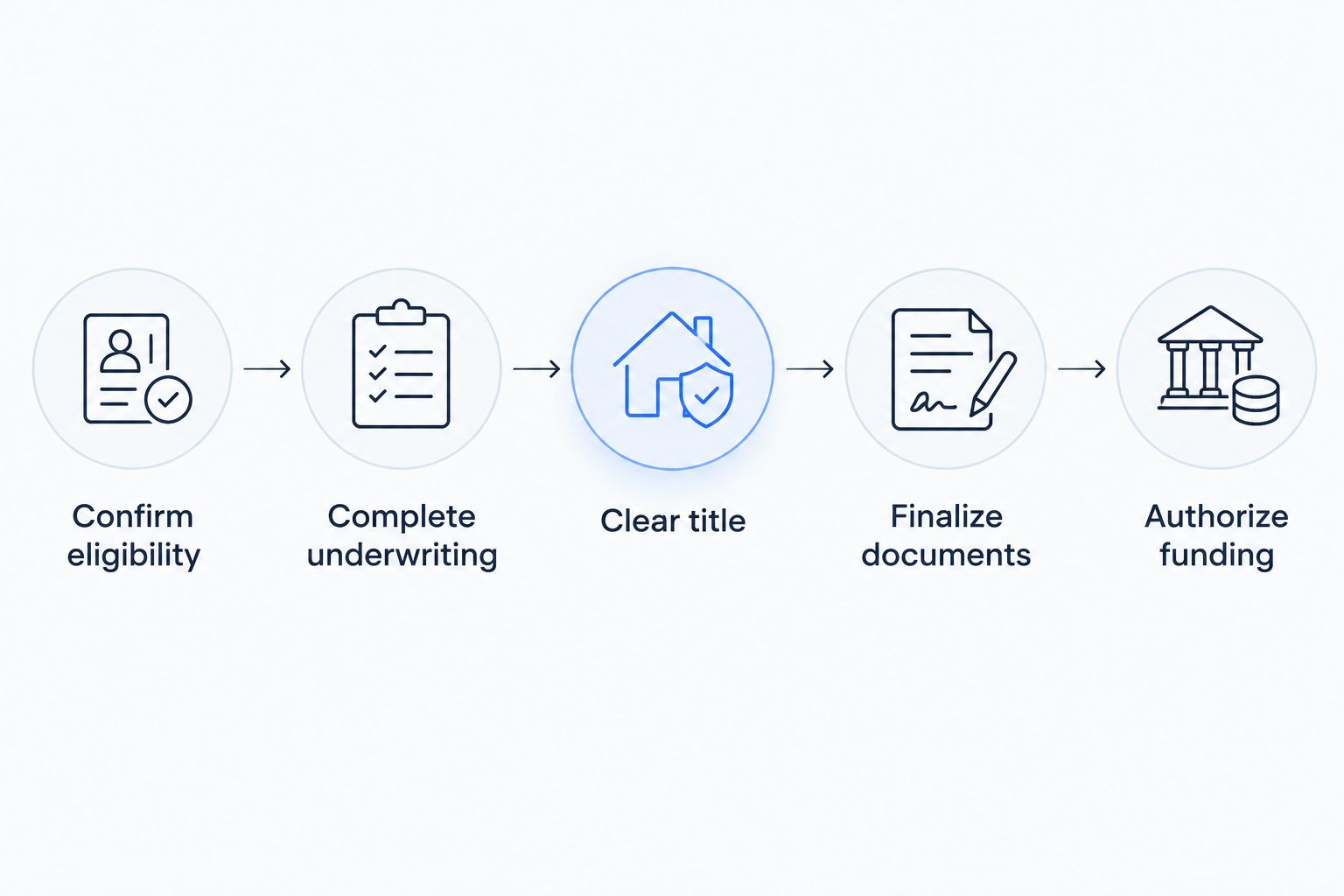
Some work proceeds at the same time. Your attorney can review title while the lender reviews borrower documents, but parallel work does not eliminate unresolved conditions. Ask which item currently controls the funding date.
What does each milestone actually establish?
Use this distinction when a lender, broker, seller or attorney gives you a projected date. Ask what has been completed and what remains conditional.
| Milestone | What it establishes | What you still need to verify |
|---|---|---|
| Pre-approval | Preliminary willingness to consider the transaction | Remaining underwriting and collateral conditions |
| Conditional approval | Approval subject to specified requirements | Which conditions must clear before documents or funding |
| Document signing | Execution of the applicable closing documents | Whether every funding condition is satisfied |
| Funding authorization | Permission to release funds under closing instructions | Whether funds have actually been disbursed |
| Disbursement | Release of funds to the designated recipients | Receipt and any remaining closing obligations |
The date you need is the date that satisfies your contract—not an undefined approval milestone. Have your attorney identify what the contract requires and align the lender’s schedule with that obligation.
Why hard money loan closing time varies
The controlling factors are the condition of the file and the work still required. A deadline becomes credible when each open item has an owner and a completion plan.
- Application completeness. Missing signatures, inconsistent entity names or incomplete financial records create questions that must be answered. Submit one consistent package and identify the person responsible for follow-up.
- Property valuation. Ask what valuation the lender requires, whether it has been ordered and whether access is arranged. Do not assume an existing report satisfies the lender’s requirements.
- Title and existing debt. Liens, ownership discrepancies and outstanding mortgages require review. A refinance also needs payoff information that matches the intended disbursement date.
- Borrowing entity and authority. The lender and closing counsel need to establish who owns the borrowing entity and who can bind it. Resolve differences between the application, entity records and proposed loan documents.
- Insurance and legal conditions. Confirm the required coverage and document endorsements with the relevant parties. Have counsel address outstanding legal conditions before the scheduled signing.
- Funding coordination. Borrower funds, lender authorization, wire instructions and closing-party availability must align. Verify instructions through a trusted contact before sending money.
New York is the location, not a substitute for a transaction checklist. Ask counsel which property-specific and transaction-specific requirements apply instead of assuming that every New York hard money closing follows an identical schedule.
What should you prepare before requesting a closing date?
For a 2026 application, organize the file around questions the lender must answer: what secures the loan, who is borrowing, how the transaction works and how the loan will be repaid. Confirm the actual document list with the lender; requirements depend on the deal.
Property and transaction records
Prepare the signed purchase contract for an acquisition, or current debt information for a refinance. Include amendments that affect the closing date or transaction structure. Supply available property records, leases and operating information relevant to the lender’s review.
Identify access restrictions immediately. If a valuation professional or other required reviewer cannot enter the property, an otherwise complete application does not solve that problem.
Borrower and entity records
Gather the borrowing entity’s formation documents, ownership information and authorization records requested by counsel. Use the same legal names throughout the application and supporting documents. Explain ownership changes rather than leaving the closing team to reconcile inconsistent records.
Provide requested identification and evidence of the funds you will contribute. Distinguish money already available from money that depends on another transaction closing.
Repayment and exit information
Explain whether repayment depends on a sale, refinancing or another identified source. Support the plan with relevant documents rather than relying on an expected future outcome. An intended refinance is not an approved refinance.
For the broader sequence, review the purchase contract to CRE loan closing workflow. Use the workflow to organize responsibilities, not as a guaranteed timetable for your property.
How should you assess a lender’s speed claim?
Ask the lender to define the start and finish of the stated turnaround. A clock beginning with a complete application is different from one beginning with an initial inquiry. Approval and disbursement are also different endpoints.
For your 2026 transaction, request written answers to these questions:
- What starts the quoted turnaround period?
- Does the quoted milestone mean preliminary approval, final approval, signing or disbursement?
- Which property reviews remain outstanding?
- Has counsel identified unresolved title or entity issues?
- What must you provide before the proposed date becomes actionable?
- Who confirms that the lender has authorized release of funds?
Flexvcapital is best for commercial real estate investors and business borrowers seeking a direct lender in New York. Its stated commercial financing scope runs from $500K to $20M+, with 48-hour pre-approvals. Those figures describe financing scope and an initial decision milestone; they do not establish hard money eligibility or a funding date for your property.
The benefit of an early pre-approval is an initial decision before the remaining closing work is complete. Its limitation is equally important: you still need transaction-specific underwriting, legal clearance and funding confirmation. Ask for both the decision milestone and the closing conditions.
Confirm your transaction timeline
Provide the property, requested loan amount and contractual deadline for a transaction-specific discussion.
Does a 48-hour pre-approval mean the loan closes in 48 hours?
A 48-hour pre-approval does not mean the loan closes in 48 hours. It describes the preliminary approval milestone, not completion of title work, final documents or disbursement. Ask what remains outstanding before treating any proposed date as reliable.
Have the lender distinguish conditions needed for document preparation from conditions needed for funding. That distinction tells you whether signing is the next step or whether substantive review remains.
Can a hard money loan close before an existing lien is resolved?
An existing lien needs a resolution acceptable to the lender and title insurer. That resolution can include a payoff through closing, a release or another approved arrangement; do not assume that identifying the lien clears it.
Ask your attorney who is obtaining the required documents and whether the arrangement is reflected in the closing instructions. An unresolved responsibility is a scheduling problem even when everyone knows the lien exists.
Can you speed up a hard money closing without skipping review?
You can reduce avoidable delay by submitting consistent documents, arranging property access and answering questions promptly. You cannot replace required underwriting or title clearance with a tighter deadline.
Ask the lender and attorney to identify work that can proceed concurrently. Then focus your effort on the outstanding condition that controls the next milestone, rather than repeatedly requesting a faster overall closing.
FAQ
What determines hard money loan closing time in New York?
Hard money loan closing time in New York depends on underwriting, property review, title clearance, legal documents and funding requirements. Ask for a schedule tied to the outstanding conditions on your transaction.
Does Flexvcapital’s 48-hour pre-approval mean funding in 48 hours?
Flexvcapital’s 48-hour pre-approval does not establish funding in 48 hours. Confirm the remaining underwriting, title, document and disbursement requirements before relying on a closing date.
When should I tell the lender about my purchase deadline?
Tell the lender about your purchase deadline at the initial inquiry. Provide the relevant contract and amendments so the proposed funding schedule addresses the actual obligation.
Can I sign loan documents before the lender releases the money?
Signing loan documents and releasing funds are separate milestones. Ask the closing attorney what conditions remain after signing and who confirms disbursement.
Will an existing appraisal make my hard money loan close faster?
An existing appraisal does not automatically satisfy a lender’s valuation requirements. Ask whether the lender accepts the report before building your closing schedule around it.
What documents should my LLC prepare for a hard money closing?
Your LLC should prepare the formation, ownership and signing-authority documents requested by the lender and counsel. Confirm the required list early and use consistent legal names throughout the file.
What should I do if the proposed funding date changes?
Ask which unresolved condition changed the funding date and who is responsible for clearing it. Have your attorney address any resulting contract deadline or extension issue with the appropriate parties.
One last thing
A signed loan package is not proof that the purchase funds reached the seller. Before your 2026 closing, ask the closing attorney to define the final confirmation you should expect and who will provide it.
Keep a shared closing checklist with an owner, status and next action for every open condition. Mark items complete only when the responsible party confirms completion. A documented outstanding condition gives you something to resolve; a general assurance that the file is progressing does not.


