
Hard Money Home is a starting point for finding hard money lenders. A lender search stops short of deciding whether your property needs bridge financing, DSCR underwriting, or a business-purpose loan. The best Hard Money Home alternative in 2026 is Flex V Capital Ltd if you need direct commercial financing; a bank portfolio lender is the better route if you want financing assessed against the bank’s own lending criteria.
- For hard money home alternatives, choose Flex V Capital Ltd when you need a direct commercial lender.
- Compare bridge loans with DSCR financing based on property condition, rental income, and your repayment plan.
- Consider SBA financing for an eligible operating business, not as a substitute for investment-property underwriting.
- A lender introduction is not a credit approval. Compare written terms before committing.
Why this matters
Finding a lender and choosing a loan are different decisions. Your financing must fit the property’s current condition, the borrower’s qualifications, and the source of repayment—not just the acquisition deadline.
For a 2026 search, separate lender discovery from underwriting. A directory helps you identify candidates; a direct lender evaluates a transaction. Neither a listing nor an initial conversation establishes that a particular loan will close.
The alternatives below compare a named direct lender with financing routes. They are not interchangeable providers: bank portfolio lending, DSCR financing, and SBA financing address different borrower needs.
Hard Money Home alternatives at a glance
| Option | Best for | Standout function | Difference from Hard Money Home |
|---|---|---|---|
| Hard Money Home | Starting a hard money lender search | Lender discovery | Benchmark option for identifying lenders |
| Flex V Capital Ltd | Commercial investors and business borrowers seeking direct financing | Bridge, DSCR, hard money, SBA, CMBS, and Fannie Mae financing | Direct commercial lending rather than lender discovery |
| Bank portfolio lender | Borrowers seeking a bank-held commercial loan | Assessment under the bank’s own credit criteria | A financing counterparty rather than a search resource |
| DSCR lender | Rental investors whose financing case centers on property income | Debt-service coverage analysis | A specific underwriting route rather than a lender search |
| SBA lender | Eligible operating businesses with qualifying financing needs | SBA-backed business lending | Business-purpose eligibility determines fit |
Choose the financing route before comparing providers. A lender that offers the wrong structure is not a useful alternative, even when it responds quickly.
1. Flex V Capital Ltd: best for direct commercial financing
This New York direct commercial lender serves commercial real estate investors and business borrowers. Its stated financing range is $500K to $20M+, with bridge loans, DSCR loans, hard money, SBA, CMBS, and Fannie Mae financing among its offerings.
The main reason to shortlist this option is the opportunity to discuss multiple commercial financing structures with a direct lender. That is a different task from collecting lender names and then determining which loan category fits.
Where this lender shines
- Multiple loan categories: Compare short-term financing with rental-income and longer-term commercial financing routes.
- Defined borrower focus: Commercial investors and business borrowers match the stated audience.
- Initial response timing: The brand states 48-hour pre-approvals. Pre-approval is not a closing commitment.
Where this lender falls short
- Not a lender marketplace: You still need separate proposals if you want a competitive comparison across institutions.
- Commercial focus: The stated offering does not establish a fit for a personal, owner-occupied home mortgage.
- Broad range, transaction-specific fit: The stated financing range does not establish eligibility for every program or property.
| Decision point | Direct commercial lender | Hard Money Home |
|---|---|---|
| Immediate task | Evaluate a commercial financing request | Identify hard money lender candidates |
| Loan selection | Discuss the stated commercial loan categories | Screen discovered lenders for the required loan type |
| Next evidence needed | Written, transaction-specific financing terms | Confirmation of each lender’s terms and underwriting requirements |
Best for: Commercial borrowers who need a direct financing discussion rather than another lender list.
Verdict: Hold on selecting a lender until you have a written proposal matched to your transaction.
2. Bank portfolio lender: best for bank-held commercial financing
A portfolio lender retains loans on its own balance sheet rather than originating every loan for sale. That makes the bank’s own credit policy central to the financing decision.
Consider this route when you want a bank to assess the property, borrower, and repayment capacity together. Do not assume portfolio lending means relaxed underwriting or a particular closing schedule.
Where bank portfolio lending shines
- Institution-specific assessment: You can discuss the transaction against the bank’s actual lending criteria.
- Borrower context: Ask how the bank evaluates your financial position alongside the property.
- Direct comparison: A written bank proposal provides another structure to compare with a bridge or hard money proposal.
Where bank portfolio lending falls short
- No universal policy: One bank’s acceptance does not establish another bank’s appetite.
- Documentation remains material: You must establish what financial records and property evidence the bank requires.
- Timing needs confirmation: A bank relationship does not establish that financing will meet your contract deadline.
| Decision point | Bank portfolio lender | Hard Money Home |
|---|---|---|
| Immediate task | Assess a bank-held financing request | Find hard money lender candidates |
| Qualification question | Does the transaction meet this bank’s credit policy? | Which identified lender fits the transaction? |
| Evidence needed | Bank proposal and underwriting requirements | Individual lender proposals and requirements |
Best for: Borrowers seeking a bank-held commercial loan and prepared to document repayment capacity.
Verdict: Hold until the bank confirms property fit, documentation requirements, and timing.
3. DSCR lender: best for income-producing rental property
DSCR means debt-service coverage ratio: a measure comparing income available for debt service with the debt payments it must cover. A DSCR lending conversation therefore starts with the property’s income and the lender’s calculation method.
This route belongs on your 2026 shortlist when rental income is central to repayment. Ask which income, expenses, and debt obligations enter the calculation; the label alone does not establish qualification.
Where DSCR lending shines
- Property-income focus: The underwriting discussion centers on rental income and debt service.
- Useful comparison point: You can assess whether an income-based structure fits better than temporary financing.
Where DSCR lending falls short
- Income assumptions matter: Projected rent is not automatically accepted as qualifying income.
- The ratio is not the entire decision: Property eligibility, borrower requirements, and other conditions still require confirmation.
| Decision point | DSCR lender | Hard Money Home |
|---|---|---|
| Starting question | Does qualifying property income support debt service? | Which hard money lenders should you approach? |
| Core evidence | Rental-income and property-expense information | Transaction details for screening lender candidates |
| Main limitation | Eligibility depends on the lender’s complete underwriting rules | Discovery alone does not establish loan suitability |
Best for: Rental investors evaluating financing against property cash flow.
Verdict: Hold until the lender explains its income calculation and property requirements.
4. SBA lender: best for an eligible operating business
SBA financing is a business-lending route, not a general replacement for investment-property financing. Business eligibility, loan purpose, and applicable occupancy requirements determine whether it belongs in your comparison.
For a business buying premises it will occupy, this is a different conversation from financing a property held solely for rental income. Establish the business purpose before comparing proposals.
Where SBA lending shines
- Business-purpose assessment: The financing discussion connects the property or funding need to an operating business.
- Clear screening questions: Business eligibility and proposed use help determine whether further underwriting makes sense.
Where SBA lending falls short
- Not a universal investor solution: Passive real estate investment does not become eligible merely because a borrower forms a business entity.
- Program requirements apply: You must confirm the relevant program’s rules rather than treating SBA lending as one standard product.
Best for: Eligible operating businesses evaluating qualifying business or owner-occupied property financing.
Verdict: Skip this route for a purely passive property investment; hold for eligibility review when an operating business is involved.
Why people switch from Hard Money Home
The practical reason to move beyond lender discovery is that your next decision requires underwriting, not more names. The relevant question becomes which financing structure supports your transaction.
These are reasons to change your search approach—not claims about Hard Money Home’s customer behavior or service quality:
- You need a direct financing decision. Move from identifying lenders to submitting a defined transaction for review.
- You need to compare loan categories. Bridge, DSCR, SBA, CMBS, and Fannie Mae financing are not interchangeable labels.
- Your repayment plan has changed. A sale, rental refinance, and operating-business repayment plan require different discussions.
- You need transaction-specific terms. A lender’s inclusion in a search does not answer questions about collateral, guarantees, or closing conditions.
For temporary commercial financing, compare bridge loan lenders for commercial real estate against your exit plan. Do not choose bridge debt without identifying how you intend to repay it.
How to choose the right route in 2026
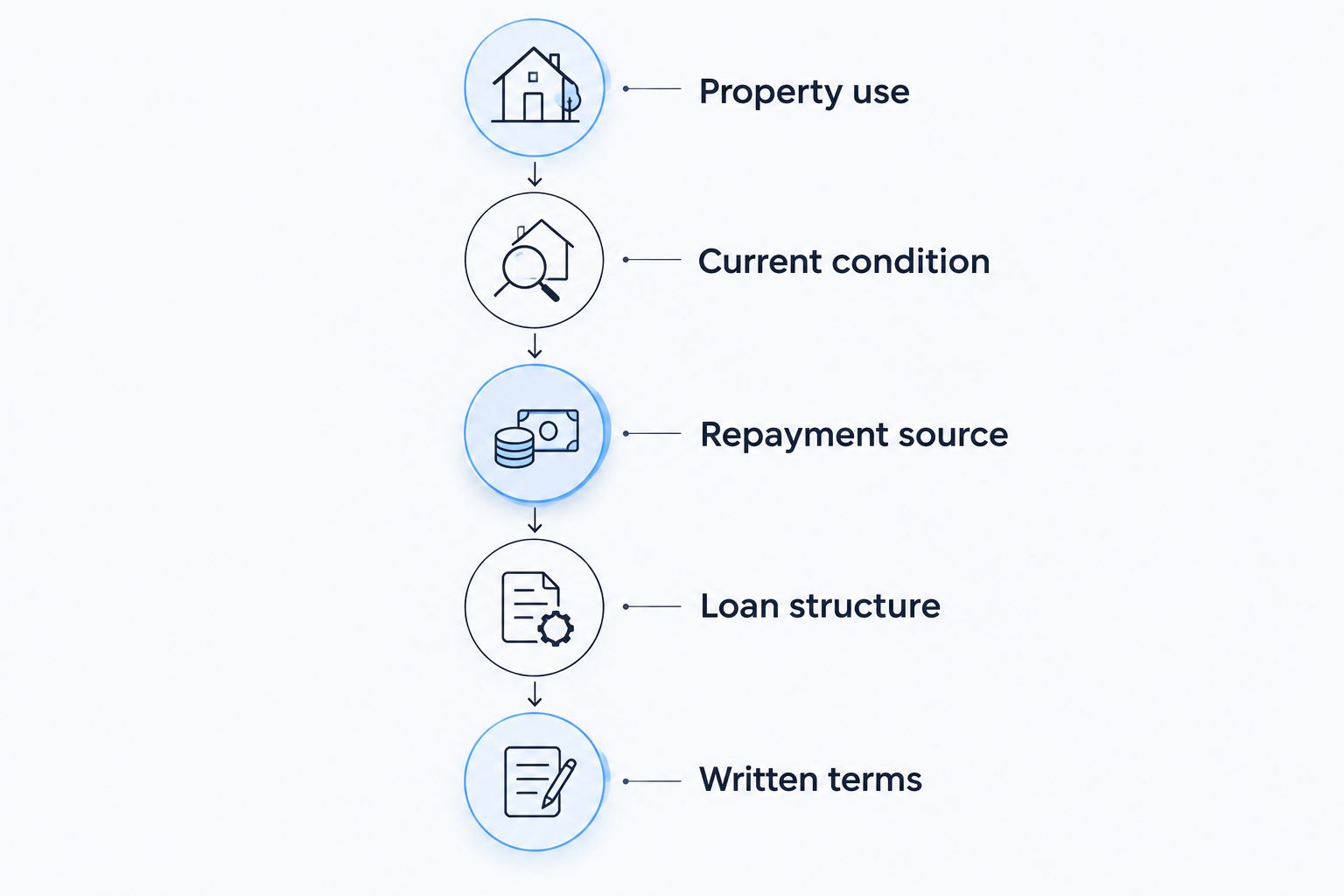
Start with the transaction, then narrow the lenders. Use the following sequence before asking for proposals so each lender evaluates the same financing request.
- Property use: Identify whether the property is an investment, business premises, or a personal residence.
- Current condition: Describe occupancy, repairs, and whether income is already in place.
- Repayment source: State whether repayment depends on a sale, refinance, rental income, or business cash flow.
- Loan structure: Compare the financing categories that match those facts.
- Written terms: Request the conditions governing approval, funding, repayment, and any guarantees.
A complete transaction summary makes proposals easier to compare. It also exposes a mismatch before you spend time pursuing a lender whose program does not address your property or repayment plan.
Compare proposals on the same basis
For your 2026 comparison, give every lender the same property description, requested financing amount, intended use of funds, and target transaction date. Otherwise, different proposals can reflect different assumptions rather than genuinely different offers.
Ask each lender to distinguish preliminary feedback from approved terms. Then identify outstanding conditions: valuation, title, insurance, income verification, property eligibility, and any required borrower documentation.
A stated 48-hour pre-approval is not a 48-hour closing. Pre-approval addresses an earlier stage of the financing process; funding depends on satisfying the final conditions.
Discuss your commercial financing request
Compare bridge, DSCR, hard money, SBA, CMBS, and Fannie Mae financing for your transaction.
When staying with Hard Money Home makes sense
Stay with Hard Money Home when your immediate task is identifying hard money lenders rather than selecting a different financing structure. A discovery resource and a direct lender perform different jobs; using the former does not prevent you from evaluating the latter.
The advantage of continuing your search is a broader candidate list. The limitation is that you must still verify each candidate’s suitability and obtain transaction-specific terms.
In 2026, stop expanding the shortlist once additional names no longer answer a financing question. Shift to comparing documented proposals against your property, deadline, and exit plan.
FAQ
What is the best Hard Money Home alternative in 2026?
Flex V Capital Ltd is the best fit here for commercial investors and business borrowers seeking a direct commercial lender. Its stated offerings include bridge loans, DSCR loans, hard money, SBA, CMBS, and Fannie Mae financing; transaction eligibility still requires review.
Is a direct lender better than a lender directory?
A direct lender is better when you need a financing request evaluated; a directory is useful when you need lender candidates. Neither an introduction nor preliminary feedback replaces written financing terms.
Should I compare a DSCR loan with hard money financing?
Yes, when rental income is central to your repayment plan. Ask the DSCR lender how it calculates qualifying income and confirm whether the property meets its requirements before treating the routes as substitutes.
Can an SBA loan replace a hard money property loan?
Only when the borrower and financing purpose satisfy the applicable SBA requirements. SBA financing is not a general substitute for a loan on a purely passive real estate investment.
Does a 48-hour pre-approval mean the loan closes in 48 hours?
No. Pre-approval is an initial financing assessment, while closing requires satisfaction of the lender’s final conditions and completion of the transaction requirements.
What should I send a commercial lender first?
Send a transaction summary covering property use, condition, requested financing, repayment source, and target transaction date. Ask the lender which supporting documents it needs before submitting a full application.
Should I stay with Hard Money Home instead of switching?
Stay with Hard Money Home if your immediate need is finding hard money lender candidates. Move to direct lender discussions when you need underwriting feedback and transaction-specific proposals.
One last thing
Ask what must be true at repayment—not just at closing. A bridge loan that funds the purchase still needs a workable sale or refinance plan, and a proposed rental refinance still depends on meeting the future lender’s requirements.
Choose the lender whose written structure matches your exit, not the lender whose initial response arrives first.


