
Choose Flex V Capital Ltd if you want to discuss a commercial loan directly with a lender; choose Private Lender Link if you want a directory-based search for financing sources. The distinction in 2026 is direct loan evaluation versus lender discovery—not a proven advantage on rates, approval, or closing speed.
- Flex V Capital vs Private Lender Link compares direct commercial lending with lender discovery.
- Flex V Capital Ltd is best for borrowers seeking a direct commercial lending conversation.
- Private Lender Link is best for borrowers researching potential private lenders.
- Compare written loan terms, underwriting conditions, and exit requirements before choosing a financing source.
Why this matters
A lender and a lender directory solve different problems. One is a counterparty for your financing request; the other helps you identify potential counterparties. Treating them as interchangeable hides the decision you actually need to make.
Flex V Capital Ltd describes its business as direct commercial lending in New York, with financing from $500K to $20M+. Its stated programs include bridge loans, DSCR loans, hard money, SBA, CMBS, and Fannie Mae financing. Those loan amounts describe financing scope, not borrowing costs or guaranteed eligibility.
For your 2026 search, start with a practical question: are you ready to submit a defined transaction, or are you still deciding which lenders to approach? That answer determines which route deserves your time first.
At a glance
| Dimension | Flex V Capital Ltd | Private Lender Link |
|---|---|---|
| Best for | Borrowers ready for a direct commercial lending conversation | Borrowers researching potential private lenders |
| Relationship | Direct commercial lender | Lender-discovery directory |
| Standout feature | Direct access to a lender offering several named financing programs | Directory-based lender research |
| Program comparison | Discuss the stated bridge, DSCR, hard money, SBA, CMBS, and Fannie Mae programs | Identify lenders, then confirm their current programs directly |
| Underwriting responsibility | Discuss requirements with the lending counterparty | Confirm requirements with each lender you approach |
| Timing | Advertises 48-hour pre-approvals; distinguish these from funding | Research time and lender processing are separate steps |
| Pricing model | Evaluate transaction-specific loan terms and charges | Separate any directory-related terms from the lender's loan terms |
| Exit planning | Assess the proposed loan against your repayment plan | Assess each shortlisted lender's proposal against that same plan |
Direct lending wins when your transaction is ready
The direct-lender route is the better starting point when you have a defined financing request. You can move the conversation toward property eligibility, borrower qualifications, documentation, and the proposed loan structure instead of first building a lender shortlist.
Bring a clear request. State the property type, location, intended use of proceeds, requested financing amount, current income, and repayment strategy. For a business loan, explain the operating business and how the financing supports it.
The benefit is a focused conversation with a potential financing counterparty. The limitation is equally important: speaking with one lender does not establish that its proposal is the best available fit.
Use this route when:
- You know what you are financing and why.
- You can provide supporting property or business documents.
- You want to establish whether the transaction fits a lender's requirements.
- You are prepared to compare an actual proposal rather than a general program description.
A direct conversation advances a defined transaction. It does not remove the need to examine conditions, costs, or alternatives.
Private Lender Link wins when you need a lender shortlist
Private Lender Link is the better starting point when lender discovery is the unfinished task. A directory serves a different purpose from a loan application: it helps you identify financing sources to investigate.
That approach suits a borrower who wants to research potential counterparties before deciding where to submit documents. It also supports a borrower who already has a proposal but wants to identify other lenders to contact.
The tradeoff is additional responsibility. You still need to confirm each lender's current geographic coverage, property eligibility, loan requirements, and ability to consider your transaction. A directory listing is not a credit decision.
Use the same transaction summary for every lender you approach. Otherwise, differences in the information you provide can produce proposals that are difficult to compare.
For a 2026 search, separate these tasks:
- Lender discovery: Identify potential financing sources.
- Loan application: Submit the transaction for evaluation.
- Proposal comparison: Review the resulting terms and conditions.
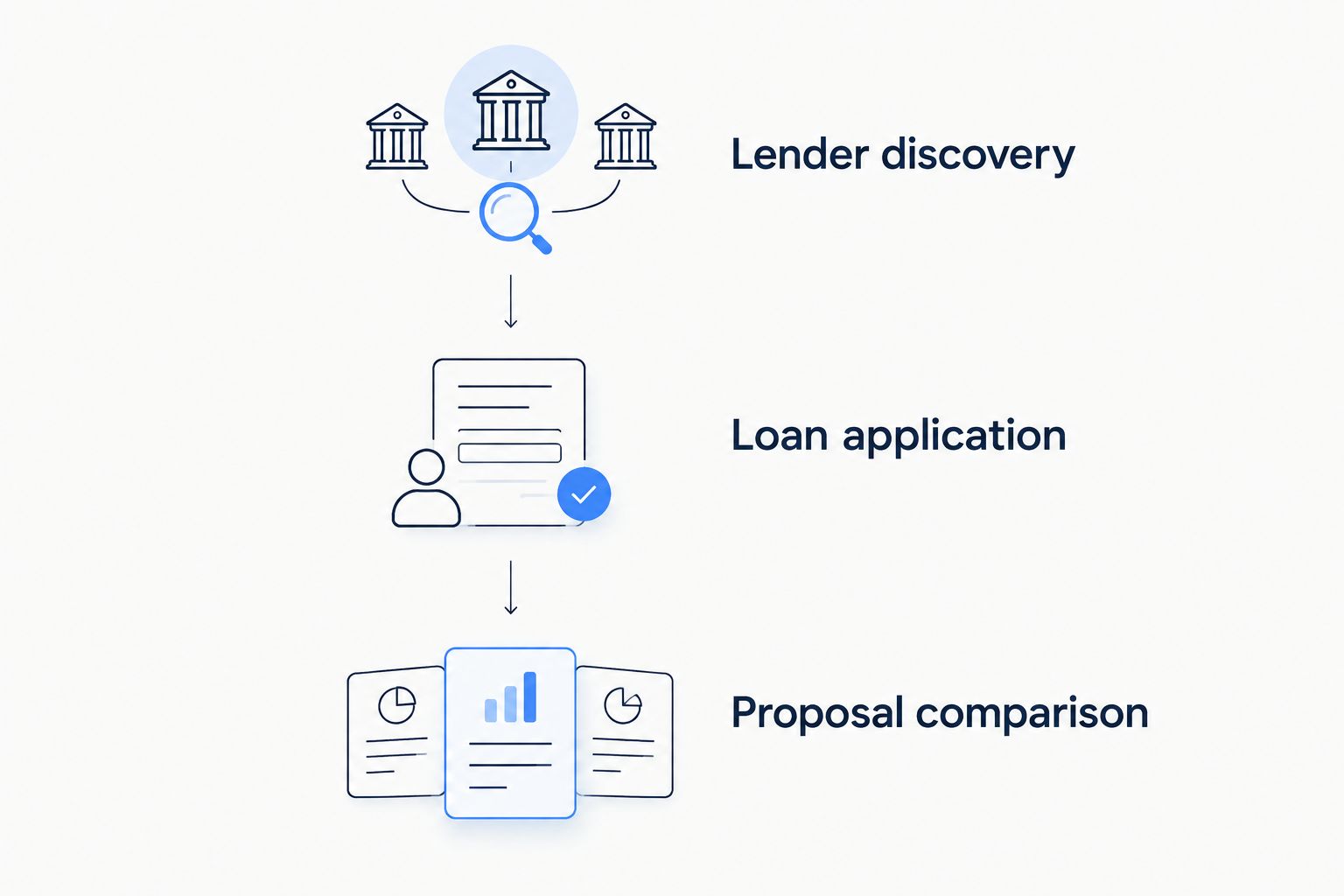
A directory helps with the first task. Your financing decision requires the other tasks as well.
Direct program discussions win for a defined financing need
The direct lender's stated program list gives you specific subjects to discuss: bridge loans, DSCR loans, hard money, SBA, CMBS, and Fannie Mae financing. That is useful when you need to establish which financing structure deserves further review.
A program name is a starting point, not an eligibility decision. Ask which program fits the property, borrower, use of proceeds, and repayment plan. Do not assume that a lender's advertised menu means every transaction qualifies for every listed option.
For an investment property, prepare the current rent roll, operating information, existing debt, and proposed business plan. For an operating business, prepare the financial information needed to explain repayment capacity and the purpose of the borrowing.
Private Lender Link serves the earlier research stage. Once you identify a potential lender, confirm its programs directly rather than treating a directory description as a commitment.
The practical advantage of a direct program conversation is focus. The limitation is that a menu of financing types does not establish the terms you will receive.
Private Lender Link wins for researching alternative counterparties
Choose the directory route when your goal is to identify other lenders to approach. This is a research advantage, not evidence of better loan terms.
Alternative counterparties matter when you want to test whether another lender will consider your property, business plan, or requested structure. Keep the search organized around the transaction rather than around broad claims about speed or flexibility.
Use a shortlist worksheet with these fields:
- Property and borrower eligibility.
- Requested documents.
- Proposed loan structure.
- Conditions before closing.
- Contact responsible for the application.
- Next action and responsible party.
The drawback is coordination. You are responsible for keeping submissions consistent, following up, and distinguishing preliminary statements from written terms.
A directory search does not replace diligence on the lender itself. Confirm the legal entity involved, who makes the credit decision, and who will appear in the financing documents before proceeding.
Both routes require underwriting clarity
Neither route eliminates the need to establish who approves the loan and under what conditions. A useful financing conversation identifies the decision-maker, the required documents, and the unresolved issues.
Ask these questions before treating a proposal as actionable:
- Which entity will make or arrange the loan?
- Who issues the credit decision?
- Which borrower and property conditions remain open?
- What third-party reports are required?
- What circumstances allow the proposed terms to change?
Direct lending gives you a defined starting counterparty. Directory research requires you to establish that relationship with each lender you contact.
This dimension is a tie because the standard should not change. Whether you arrive through a directory or contact a lender directly, require written clarity about the approval process. A confident conversation is not a substitute for documented conditions.
A stated pre-approval target is not a closing commitment
Flex V Capital Ltd advertises 48-hour pre-approvals. That is a specific preliminary milestone; it is not the same as a commitment to fund a transaction within 48 hours.
For your 2026 transaction, ask what starts the pre-approval clock, what documents must be complete, and what remains after the preliminary decision. Then build your transaction schedule around the remaining underwriting and closing requirements.
Private Lender Link belongs to the discovery stage. The lender you subsequently approach must explain its own application, underwriting, and closing process.
The direct route wins when your immediate objective is to seek a preliminary lending decision rather than research lenders. That does not establish a head-to-head funding-speed advantage.
Before relying on any timetable, separate:
- Initial response.
- Preliminary assessment.
- Underwriting decision.
- Closing readiness.
- Funding.
Ask which milestone a stated turnaround actually describes. This prevents a fast initial answer from being mistaken for a completed financing process.
Pricing: compare loan terms, not business models
Neither route wins on borrowing cost without comparable written proposals. A direct-lender relationship and a directory-based search describe how you reach financing sources, not what your final loan will cost.
For a direct loan, examine the proposed interest structure, lender charges, third-party expenses, payment obligations, and repayment provisions. For a directory-led search, evaluate the resulting lender proposals using the same fields. Review any separate directory-related agreement on its own terms.
Predictability comes from understanding the proposed obligations. Flexibility comes from identifying which provisions permit changes, extensions, or early repayment—and what conditions apply.
Use this comparison checklist for proposals received in 2026:
| Item to compare | What you need to establish |
|---|---|
| Proceeds | Funds available after deductions and required reserves |
| Payments | Payment structure and when principal becomes due |
| Closing charges | Which charges apply and who receives them |
| Third-party expenses | Required reports, legal work, and other external services |
| Early repayment | Restrictions or obligations triggered by paying off the loan |
| Extensions | Conditions for extending the maturity date |
| Recourse | Borrower or guarantor obligations under the documents |
Do not assume the direct route is cheaper. Do not assume a broader search produces a better proposal. Compare the actual obligations attached to the financing you can obtain.
Both routes need a credible repayment plan
Exit planning is a tie: the loan must fit how you intend to repay it. Your source of introduction does not change that requirement.
For a bridge request, explain the event expected to support repayment, such as a sale or refinancing. For longer-term financing, explain the income supporting the debt and the obligations that continue through maturity.
Test the proposed structure against your business plan. Ask what happens if stabilization takes longer, a sale is delayed, or refinancing is unavailable on the expected terms.
Avoid selecting financing solely because the initial process is convenient. A loan that closes does not automatically fit the property's operating needs or your repayment schedule.
Before accepting terms, identify the primary repayment source, the conditions it depends on, and the alternative if it fails. Then compare the loan documents against that plan.
Final verdict: choose the route that matches your next task
Choose Flex V Capital Ltd if you are application-ready
Best for: commercial real estate investors and business borrowers seeking direct loan evaluation. Choose this route when you have a defined transaction and want to discuss the lender's stated financing programs, documentation requirements, and preliminary decision process.
The advantage is direct engagement. The limitation is that you still need to establish transaction fit and compare the proposed obligations.
Choose Private Lender Link if you are building a shortlist
Best for: borrowers researching potential private lenders before applying. Choose this route when identifying financing counterparties is your immediate task or when you want other lenders to approach for comparison.
The advantage is lender discovery. The limitation is that discovery does not complete underwriting, establish eligibility, or produce a financing commitment.
One-glance scorecard
| Dimension | Winner |
|---|---|
| Application-ready transaction | Direct lender |
| Lender shortlist | Private Lender Link |
| Defined program discussion | Direct lender |
| Alternative-counterparty research | Private Lender Link |
| Underwriting clarity | Tie: require written conditions |
| Seeking a preliminary decision | Direct lender |
| Borrowing cost | Tie: compare written proposals |
| Repayment planning | Tie: evaluate the loan structure |
FAQ
Is Flex V Capital Ltd better than Private Lender Link?
Flex V Capital Ltd is the better starting point for a direct commercial lending conversation; Private Lender Link is the better starting point for researching potential private lenders. Choose according to whether your next task is loan evaluation or lender discovery.
Is Private Lender Link the same as applying to a lender?
No. Private Lender Link serves lender discovery, while the lender you contact evaluates your financing request. Confirm that lender's requirements and approval process directly.
What financing programs does the direct lender offer?
The stated programs are bridge loans, DSCR loans, hard money, SBA, CMBS, and Fannie Mae financing. Discuss transaction eligibility and proposed terms before selecting a program.
Does a 48-hour pre-approval mean the loan funds in 48 hours?
No. A 48-hour pre-approval describes a preliminary milestone, not a funding commitment. Ask which underwriting and closing conditions remain.
Which route offers better loan terms in 2026?
Neither route establishes better loan terms by itself. Compare written proposals for the same transaction, including payment obligations, charges, recourse, and repayment restrictions.
What should I prepare before contacting a commercial lender?
Prepare a transaction summary covering the property or business, requested financing, use of proceeds, current income, and repayment plan. Ask the lender for its required supporting documents.
One last thing
Ask what remains unresolved after the preliminary approval. The answer separates an initial indication from a transaction that is ready to close. In 2026, make that question part of every lender conversation—not just the first one.


