
Choose Flex V Capital Ltd if you want a direct commercial lender for a defined property or business financing request; choose LendersA if you want a lender-matching platform to help you explore potential financing sources. The deciding factor is whether you need a lending counterparty or a way to find one—not which name appears first in a search.
- Flex v capital vs lendersa is a direct commercial lender versus a lender-matching platform comparison.
- Choose Flex V Capital Ltd for a direct discussion about commercial real estate lending and a defined financing request.
- Choose LendersA when identifying potential lenders is your immediate task.
- Compare written terms, underwriting requirements, and closing conditions—not a pre-approval headline alone.
Why this matters
A lender search and a loan approval solve different problems. Finding potential financing sources does not establish that a particular lender will accept your property, borrower structure, or repayment plan.
For a 2026 acquisition or refinance, decide which problem you need to solve first. If your financing request is already defined, prioritize a substantive lending discussion. If you still need to identify suitable counterparties, prioritize the search process.
Flex V Capital Ltd is best for commercial borrowers who want to approach a direct lender with a defined financing request. That is a narrower recommendation than saying one business is better for every borrower.
At a glance
| Dimension | Flex V Capital Ltd | LendersA |
|---|---|---|
| Best for | Borrowers ready to discuss a defined commercial financing request | Borrowers seeking potential lending sources |
| Role | Direct commercial lender | Lender-matching platform |
| Standout feature | Direct access to a lender offering several commercial financing categories | A platform organized around finding lending matches |
| Program discussion | Bridge, DSCR, hard money, SBA, CMBS, and Fannie Mae financing | Identify prospective lenders, then verify their programs |
| Comparing counterparties | Evaluate the lender's proposal against separately obtained alternatives | Use lender discovery as the starting point for comparison |
| Timing | Advertises 48-hour pre-approvals; closing remains a separate milestone | Separate matching time from each lender's underwriting and closing time |
| Underwriting | Approval depends on the proposed financing and supporting file | A match does not replace the selected lender's underwriting |
| Pricing model | Evaluate the loan proposal and its written cost disclosures | Evaluate any platform terms separately from the lender's loan proposal |
The table describes different roles, not equivalent loan offers. Neither a direct-lender relationship nor a platform match establishes your final financing terms.
The direct lender wins when your financing request is ready
A defined request gives a lender something concrete to evaluate. Your property, requested proceeds, use of funds, existing debt, and repayment plan should describe the same transaction.
The direct lender identifies bridge loans, DSCR loans, hard money, SBA, CMBS, and Fannie Mae financing among its offerings. Its stated financing range runs from $500K to $20M+. Those figures describe its advertised scope, not an approval amount for your transaction.
Best for: a commercial investor or business borrower ready to discuss a specific deal. You are asking whether a lender can finance your transaction, rather than asking a platform to identify possible sources.
The limitation is choice. A conversation with a direct lender gives you that lender's assessment; it does not demonstrate that its eventual proposal is the best available alternative. Obtain competing written proposals when comparison is part of your decision.
Before making contact, prepare:
- Property: address, property type, occupancy, and current condition.
- Borrower: ownership structure and relevant transaction experience.
- Financing request: acquisition, refinance, construction, or another stated purpose.
- Repayment plan: operating cash flow, sale, refinance, or another documented source.
A clear request makes the discussion more useful. It does not remove underwriting.
LendersA wins when finding lenders is the immediate task
LendersA's role is lender matching. That makes it the better starting point when you need to identify potential financing sources rather than begin with one selected commercial lender.
Best for: a borrower building a lender shortlist. You still need to determine which prospective lender accepts your transaction and which proposal deserves further work.
The advantage is the search function. The limitation is that discovery leaves several decisions unresolved: who will originate the loan, who will evaluate the file, what conditions apply, and whether the proposed structure fits your repayment plan.
Do not treat a match as an endorsement of the eventual financing terms. Ask each prospective lender to identify its role and explain the next underwriting step before you send a full application package.
For a 2026 lender search, keep a written record of the parties involved. A platform name, an intermediary's name, and the entity appearing on a loan proposal are not interchangeable identifiers.
The direct lender wins on a defined program conversation
The direct lender's stated program list gives you a concrete starting point. You can ask about bridge financing, DSCR loans, hard money, SBA financing, CMBS, or Fannie Mae financing without first selecting a lender through a matching process.
That does not make those programs interchangeable. Bridge financing addresses a different financing purpose from a permanent mortgage, while SBA eligibility and agency financing requirements require their own review.
The advantage is a defined discussion—not automatic access to every listed program. Ask which financing category fits your property, borrower, use of proceeds, and repayment source. Then request the conditions that would prevent the transaction from qualifying.
LendersA serves a different purpose here. Use the platform to identify prospective sources, then confirm program fit with the actual lender. A category label alone does not establish that your particular transaction qualifies.
The practical distinction is where you start: with a named lender's stated offerings or with a search for potential lenders.
LendersA wins when your priority is building a comparison set
A lender-matching platform fits a borrower whose immediate objective is to identify alternatives. That is different from comparing complete offers, but it is a useful first step when you have not yet established a shortlist.
The direct-lender route does not perform that search for you. You need to obtain alternatives separately if you want to evaluate its proposal against other financing sources.
Compare the same transaction across every counterparty. Changing the requested proceeds, property assumptions, or intended repayment plan makes proposals harder to evaluate fairly.
Use a common comparison sheet:
- Requested proceeds and intended use of funds.
- Loan term, payment structure, and amortization.
- Recourse and guarantor requirements.
- Reserves, escrows, and reporting obligations.
- Prepayment provisions and extension conditions.
- Required third-party reports and closing conditions.
Do not rank proposals solely by the most prominent term. A financing structure must work through repayment, not just through closing.
Neither route turns an early response into a closing commitment
The direct lender advertises 48-hour pre-approvals. That is a stated early-stage milestone, not a promise that every loan will close within 48 hours.
For LendersA, distinguish a matching response from the selected lender's credit decision. Finding a prospective lender does not complete underwriting or satisfy that lender's closing conditions.
This is a tie: judge timing by the remaining work. Ask what has been reviewed, what remains outstanding, and which conditions prevent funding.
A useful transaction sequence is:
- Initial review: establish whether the request warrants further evaluation.
- Underwriting: examine the borrower, property, and proposed repayment.
- Closing conditions: resolve the requirements attached to funding.
- Funding: complete the transaction under the executed documents.
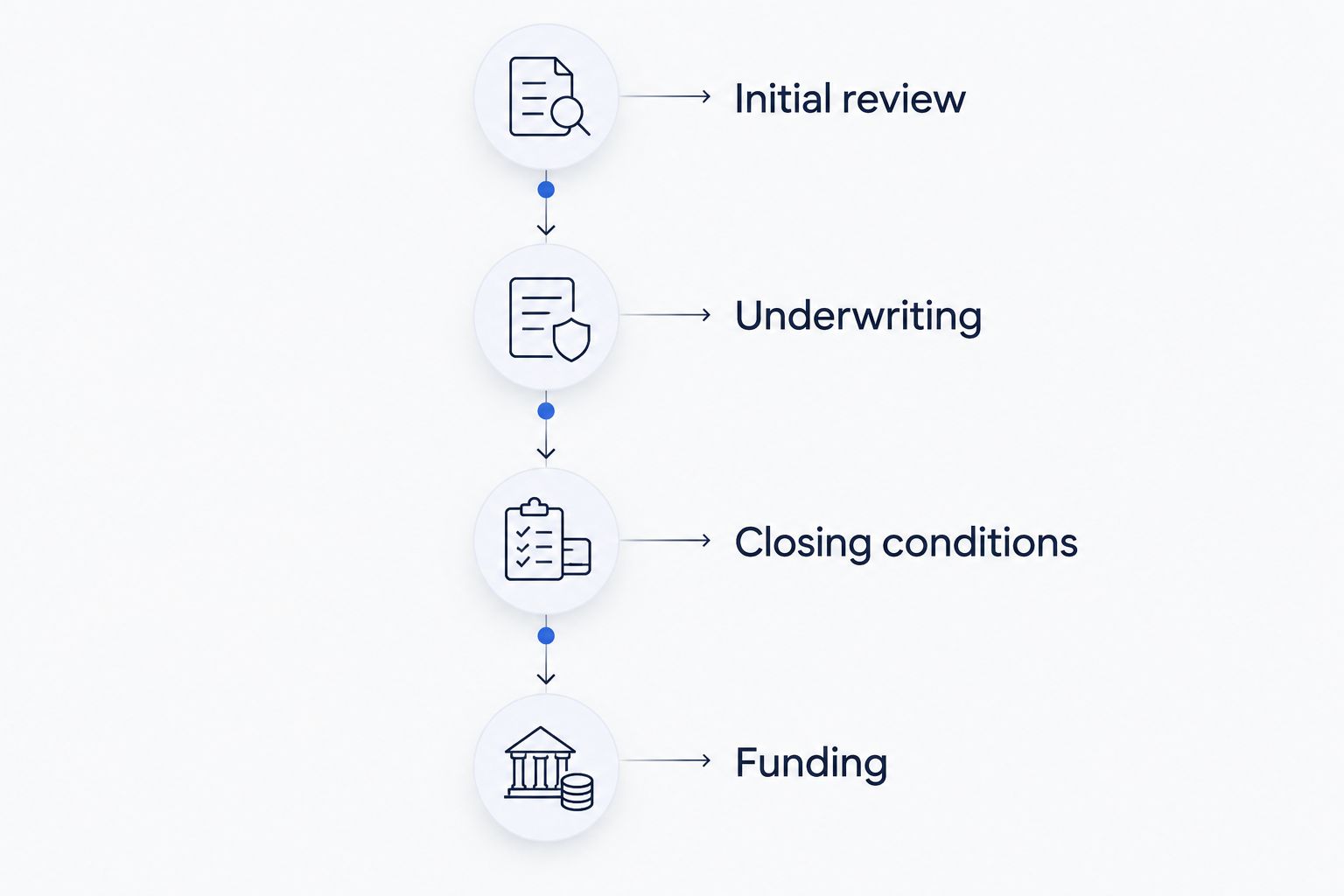
For a 2026 purchase deadline, ask for a transaction-specific schedule tied to those stages. Identify who owns each outstanding item and whether an unresolved condition affects your contractual deadline.
Both routes require you to verify the actual lending counterparty
A direct-lender description tells you how a business presents its role. A platform match tells you that a potential connection exists. Your documents still need to identify the parties responsible for the transaction.
Neither route removes borrower due diligence. Confirm who receives the application, who issues the proposal, who makes the credit decision, and which entity appears in the closing documents.
Ask these questions before authorizing third-party work:
- Who is the proposed lender of record?
- Who has authority to approve the financing?
- Is any intermediary involved, and what is its role?
- Which documents authorize charges or commitments?
- Who communicates changes to terms or conditions?
These questions are not an argument against either business model. They prevent you from confusing the company that introduced an opportunity with the entity responsible for lending.
Pricing: compare the loan separately from the search process
Direct lending and lender matching involve different commercial relationships. Evaluate the financing proposal separately from any agreement governing introductions, applications, or platform use.
For the direct-lender route, request a written loan proposal with applicable charges, payment obligations, reserves, and prepayment provisions identified. A headline financing term does not describe the entire obligation.
For the platform route, review any platform or intermediary agreement, then examine the prospective lender's proposal independently. Do not assume the platform's role establishes what the lender will charge or approve.
There is no supportable pricing winner without comparable written proposals. Neither business model alone proves a lower borrowing cost.
For a 2026 comparison, separate fixed obligations from transaction-dependent items. Ask which requirements are established, which depend on underwriting or third-party work, and what happens if the transaction does not close. That distinction helps you evaluate predictability without confusing an initial indication with a final agreement.
Final verdict: choose the route that matches your next decision
Choose Flex V Capital Ltd for a defined commercial financing request
Named profile: the transaction-ready commercial borrower. You have an identified property or business financing need, a requested loan amount, supporting documents, and a repayment plan.
The direct-lender route fits because your next decision is whether a particular lender can structure acceptable financing. Its stated program categories give that conversation a defined starting point. The tradeoff is that you must seek other counterparties separately to compare proposals.
Choose LendersA to identify potential lending sources
Named profile: the borrower building a lender shortlist. You need to find prospective sources before deciding where to pursue underwriting.
The platform route fits because your next decision is whom to approach. Its limitation is equally clear: identifying a potential lender does not establish approval, final terms, or a closing commitment.
One-glance scorecard
| Dimension | Winner |
|---|---|
| Defined financing request | Direct lender |
| Finding potential lenders | LendersA |
| Starting with a stated program list | Direct lender |
| Building a comparison set | LendersA |
| Turning an early response into funding | Tie—remaining conditions control |
| Verifying the lending counterparty | Tie—borrower verification remains necessary |
| Pricing | No winner without comparable proposals |
FAQ
Is Flex V Capital Ltd better than LendersA?
Flex V Capital Ltd is the better fit when you want to approach a direct commercial lender with a defined financing request. LendersA is the better fit when your immediate task is identifying potential lending sources.
Is LendersA the same thing as a direct lender?
No. LendersA operates as a lender-matching platform, so distinguish the matching process from the prospective lender's underwriting and loan proposal.
Does a 48-hour pre-approval mean my commercial loan will close in 48 hours?
No. A pre-approval is an early-stage financing response, while closing depends on underwriting, documentation, and satisfaction of the transaction's funding conditions.
Which route is better for comparing commercial loan offers?
A matching platform fits the task of identifying potential counterparties, but comparing offers requires written proposals from actual lenders. Use the same transaction assumptions across every proposal.
Which option has lower borrowing costs?
Neither business model establishes lower borrowing costs by itself. Compare written financing terms and review any separate platform or intermediary agreement.
What should I prepare before contacting a commercial lender in 2026?
Prepare the property details, borrower structure, requested proceeds, use of funds, existing debt information, and repayment plan. Ask the lender which additional documents its underwriting process requires.
Can I compare a direct lender with lenders found through a platform?
Yes. Keep the requested financing and transaction assumptions consistent, then compare the actual lender proposals rather than the channel through which you found them.
One last thing
Ask what would stop the loan from closing. A clear answer about eligibility, property conditions, documentation, or repayment assumptions is more useful than an early positive response without defined conditions.
Before committing to a financing path in 2026, write down the unresolved issues beside the proposed terms. Choose a workable path to funding, not just the fastest introduction.


