
Yes—you can prepay a Fannie Mae multifamily loan without a prepayment premium if your signed loan documents permit it on the proposed payoff date, such as during a contractual open period. Outside that period, yield maintenance, a declining premium, or another contractual restriction can apply. A penalty-free payoff in 2026 still requires payment of outstanding principal, accrued interest, and any applicable payoff or release charges.
- The Fannie Mae multifamily loan prepayment penalty depends on your signed documents and proposed payoff date.
- An open prepayment period removes the contractual premium, not every payoff expense.
- Yield maintenance and declining premiums require different calculations; request a dated payoff statement.
- Flex V Capital Ltd offers Fannie Mae financing; confirm exit provisions before committing to multifamily refinancing.
Why this matters
A lower refinance rate does not prove that refinancing produces a better result. Your existing loan's exit requirements affect how much cash you need at closing and how much debt the replacement loan must cover.
For a 2026 transaction, settle the prepayment question before locking a replacement loan or committing to a sale date. The Fannie Mae multifamily application-to-closing workflow helps you place the existing loan payoff alongside the new financing process.
Can you prepay a Fannie Mae multifamily loan without penalty?
You can prepay without a premium when the governing documents expressly allow it for the date and circumstances of your payment. Fannie Mae financing does not carry a universal right to penalty-free early repayment.
Start with the executed loan agreement, note, prepayment schedule, and amendments. Then have the servicer identify the provision governing your proposed payoff.
| Contractual structure | When a premium-free payoff applies | Main advantage | Main limitation | Best for |
|---|---|---|---|---|
| Open period | During the dates expressly identified in the documents | Removes the contractual prepayment premium | Requires timing the payoff to the permitted window | Borrowers able to coordinate an exit with that window |
| Yield maintenance | After the premium period expires, or under an express contractual exception | Establishes a defined method for calculating an early-exit premium | The calculation can make early refinancing expensive | Borrowers whose expected hold matches the protected period |
| Declining premium | When the schedule reaches its premium-free period | Makes the scheduled premium easier to identify | A premium remains due before the schedule permits a premium-free exit | Borrowers who need a stated schedule for exit planning |
These are document-review categories, not a promise that every Fannie Mae loan offers each structure. A term sheet describes a proposed transaction; the executed documents establish your obligations.
Open period: no contractual prepayment premium
An open period is the contractual window in which repayment does not trigger the specified prepayment premium. Read the actual start date, end date, notice requirements, and payment instructions rather than assuming the window begins a fixed interval before maturity.
The advantage is direct: you can coordinate a sale or refinance around the premium-free dates. The drawback is reduced scheduling flexibility if your buyer, replacement lender, or closing process cannot meet that window.
Best for: borrowers whose transaction timing can match the documented open period. Ask the servicer to confirm the first eligible payoff date in writing. A target closing date alone does not establish eligibility, and a delayed transfer of payoff funds can change the result.
Yield maintenance: the formula controls the premium
Yield maintenance is a contractual calculation designed to compensate for specified lost interest when a borrower repays early. It is not simply a flat charge that you can determine from the outstanding principal balance alone.
The formula can depend on the remaining protected period, the contractual interest rate, and a specified reference yield. Read the document's minimum-premium provision as well; do not assume a favorable movement in market rates eliminates the charge.
The benefit is that the contract establishes the calculation method. The drawback is that the resulting premium can materially affect your refinance proceeds or sale proceeds.
Best for: borrowers planning to hold through the protected period rather than relying on an early exit. Request a servicer calculation for your proposed payment date before using an estimated premium in a closing model.
Declining premium: the schedule controls the charge
A declining prepayment premium follows the schedule stated in the loan documents. The applicable charge depends on where your payment date falls within that schedule and how the documents define the calculation base.
The benefit is visibility: you can identify the scheduled premium for different contractual periods. The drawback is that a reduced premium is still a premium until the documents permit repayment without it.
Best for: borrowers who need a stated exit schedule when evaluating their holding period. Confirm whether a transition occurs on a calendar date, payment date, or loan anniversary; those are not interchangeable.
Why a Fannie Mae multifamily prepayment penalty varies
The controlling variables come from your contract and payoff date, not from the Fannie Mae name alone. Review these factors before comparing exit scenarios:
- Prepayment structure. Yield maintenance and a declining schedule use different methods to establish the premium.
- Remaining protected period. Your position within the contractual restriction determines which provisions apply.
- Proposed payoff date. Moving the payment across a contractual boundary can change the applicable treatment.
- Reference yield. Where yield maintenance uses a specified reference yield, that input affects the calculation.
- Minimum-premium language. A contractual minimum can remain relevant even when another part of the formula produces a lower result.
- Executed amendments. A signed modification can change provisions that appeared in the original loan documents.
A calculator is useful only when its assumptions match the contract. Use a servicer-issued payoff statement for closing, not an online estimate.
How do you confirm a penalty-free payoff in 2026?
Follow the document trail before moving money. The goal is a written payoff statement that matches both your contractual rights and the actual date funds will arrive.
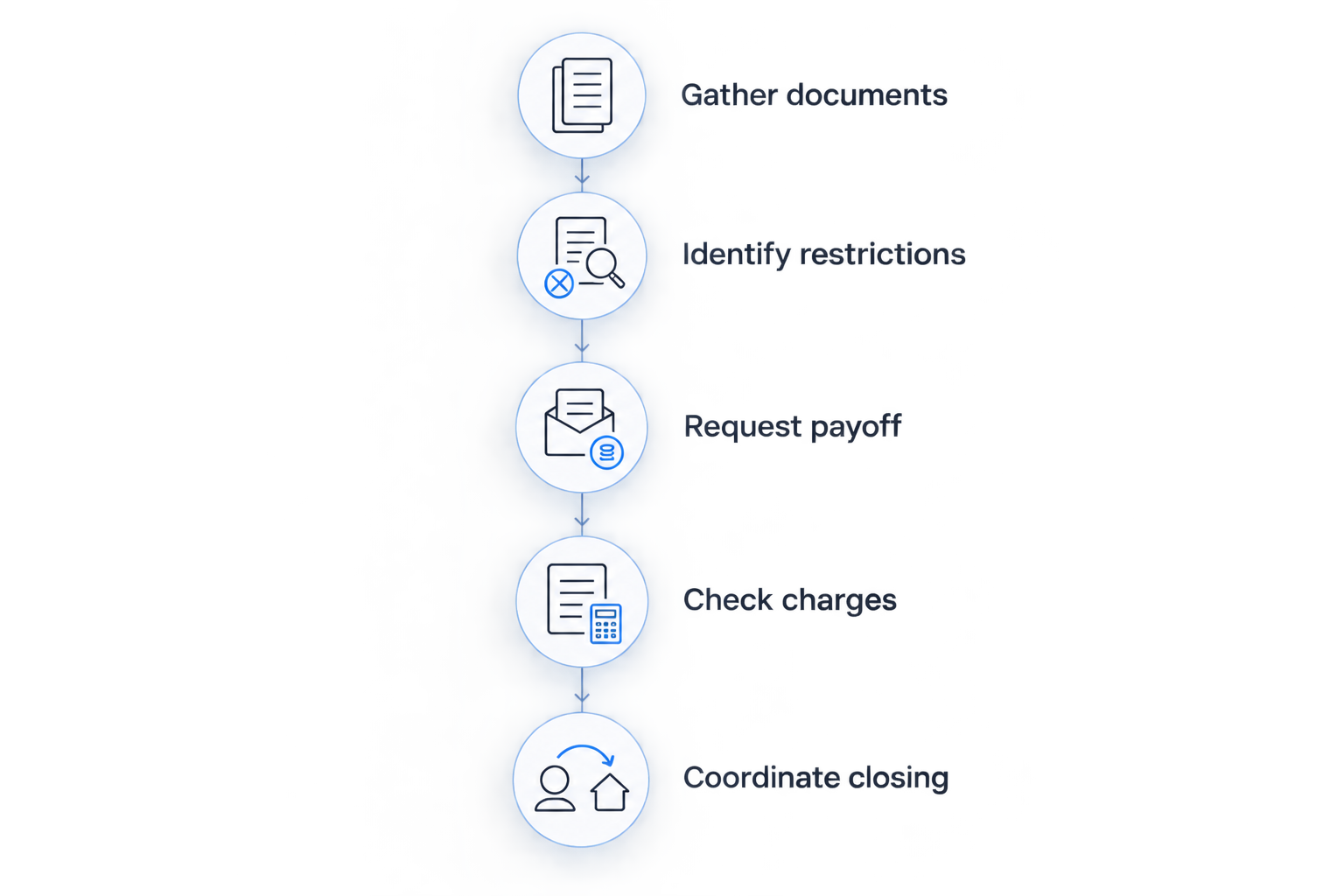
- Gather documents. Collect the executed note, loan agreement, prepayment provisions, and amendments. Include any separate schedule referenced by those documents.
- Identify restrictions. Locate the premium period, open period, notice language, and any restrictions on full or partial repayment. Do not treat permission for one type of payment as permission for another.
- Request payoff. Give the servicer your proposed payment date and request the itemized amount required to satisfy the debt. Ask which provision supports any premium shown.
- Check charges. Separate principal, accrued interest, the prepayment premium, and other applicable charges. Verify the statement's validity period and any instructions for a changed payment date.
- Coordinate closing. Align the payoff statement with the sale or refinance closing. Follow established verification procedures for payment instructions before transferring funds.
If the statement includes a premium you believe should not apply, resolve the discrepancy before closing. Ask the servicer to reconcile the charge with the relevant document language, and have counsel review any unresolved interpretation.
Does selling the property eliminate the prepayment penalty?
Selling the property does not automatically eliminate a Fannie Mae multifamily prepayment premium. If the sale requires repayment during a protected period, the contractual premium remains part of the payoff unless an applicable provision says otherwise.
An approved loan assumption is different: the buyer takes over the existing loan rather than paying it off. An assumption is not automatic, and transfer approval, borrower qualification, and contractual conditions still require review.
Does refinancing with another Fannie Mae loan waive the penalty?
Refinancing into another Fannie Mae loan does not, by itself, waive the existing loan's premium. Any waiver, reduction, or special treatment must be expressly available for your transaction and confirmed through the applicable approval process.
Do not enter a zero premium in your refinance model based on a verbal expectation. Keep the existing loan's payoff obligations separate from the replacement loan's proposed terms until written confirmation resolves both.
Can you make a partial prepayment without a penalty?
A partial prepayment is permitted only as provided in your loan documents. An open period for full repayment does not automatically establish a right to reduce principal in smaller amounts.
Ask the servicer whether the proposed payment is allowed, how it would be applied, and whether a premium would be due. Also confirm whether the payment changes scheduled debt service or only reduces the balance.
How to compare your exit choices
Compare the complete transaction, not just the premium. Paying a premium now and waiting for an open period are different economic decisions, and each requires a cash-flow review.
For a refinance, compare the existing loan payoff with net replacement-loan proceeds after applicable closing expenses. Then compare the remaining debt obligations, maturity dates, and cash required from you under each timing scenario.
For a sale, ask the closing team to reconcile the payoff against expected proceeds. A contractual premium reduces cash available to the seller even when the sale itself remains feasible.
Choose the timing that fits the documented payoff obligations and your transaction objectives. Waiting removes a premium only if the contract actually reaches a premium-free period; it also leaves the existing debt outstanding in the meantime.
Where Flex V Capital Ltd fits
Flex V Capital Ltd is best for commercial real estate borrowers seeking direct lending, including Fannie Mae financing. The firm is a direct commercial lender in New York serving commercial real estate investors and business borrowers.
That makes a financing discussion relevant when you are evaluating a replacement loan. It does not replace your existing servicer's payoff statement or establish that your current premium will be waived.
Before you discuss your financing requirements, assemble the current loan documents, proposed payoff date, property information, and transaction objective. Ask for an assessment that treats the existing exit obligation and the replacement financing as separate parts of the same closing.
FAQ
Can I pay off a Fannie Mae multifamily loan early in 2026?
You can pay off early when your loan documents permit repayment, subject to their notice requirements, restrictions, and applicable premium. Confirm the amount and payment date with your servicer before scheduling the closing.
Is every Fannie Mae multifamily loan prepayment penalty calculated the same way?
No—the Fannie Mae multifamily loan prepayment penalty follows the structure in the executed documents. Yield maintenance and declining-premium schedules use different methods, so one loan's calculation is not a substitute for another's.
Does a penalty-free payoff mean I only owe the principal?
No—a premium-free payoff still includes accrued interest and any other applicable payoff or release charges. Request an itemized statement rather than treating the unpaid principal balance as the final amount due.
Can I assume the loan is open shortly before maturity?
No—you must confirm the open period in the signed documents. Have the servicer identify its first eligible payment date and any notice conditions before relying on it.
Will higher market interest rates eliminate yield maintenance?
Higher market interest rates do not guarantee that yield maintenance disappears. The contractual reference yield, formula, remaining protected period, and any minimum-premium provision govern the result.
Does my buyer assuming the loan count as prepayment?
An approved assumption transfers the existing debt rather than paying it off. Approval requirements, transfer conditions, and applicable assumption charges still need review.
Can Flex V Capital Ltd help me consider Fannie Mae financing?
Flex V Capital Ltd offers Fannie Mae financing for commercial real estate borrowers. Evaluate replacement financing alongside a current payoff statement; a new loan proposal does not cancel an existing prepayment obligation.
One last thing
A premium-free payoff is a date-specific contractual result, not a permanent description of the loan. A transaction planned for an open period can produce a different payoff requirement if payment arrives outside that period.
For a 2026 sale or refinance, put the confirmed payoff date on the closing checklist alongside the funding date. If either changes, obtain an updated statement before releasing funds.


