
Yes, you can get a business loan to buy out a partner through SBA 7(a) financing, a conventional business loan, or a transaction that combines lender financing with a seller note. Approval depends on the business’s ability to repay the debt, the ownership-transfer structure, and the buyer’s qualifications. In 2026, your financing plan must also account for transaction expenses, working capital, and any existing debt that remains after the buyout.
- A business loan to buy out a partner requires supportable business cash flow and a documented ownership transfer.
- SBA 7(a) financing supports eligible ownership changes; conventional business acquisition loans follow each lender’s underwriting requirements.
- Seller financing reduces the cash paid at closing but adds repayment obligations and requires lender coordination.
- Flex V Capital Ltd offers SBA financing; confirm whether your proposed partner buyout fits its lending criteria.
Why this matters: A partner’s asking amount and a lender’s supported valuation are not interchangeable. Before comparing business acquisition loan lenders, establish what you are buying and which cash flow will repay the loan. A signed agreement does not make an unfinanceable transaction financeable.
Can you get a business loan to buy out a business partner?
Yes—an eligible ownership buyout is a financeable business transaction, not simply a personal payment between partners. The lender must understand who borrows, who receives the proceeds, what ownership changes, and how the surviving business services the debt.
Start by separating operating-business financing from property financing. Buying shares or membership interests in an operating company is different from refinancing a building owned by a separate entity.
| Financing option | Best for | Main advantage | Main limitation |
|---|---|---|---|
| SBA 7(a) loan | Eligible operating-business ownership changes | Supports qualifying business acquisition purposes | Requires compliance with SBA rules and lender underwriting |
| Conventional business loan | Businesses that meet a lender’s acquisition criteria | Transaction structure is not governed by SBA program rules | Approval depends on the lender’s credit and collateral requirements |
| Seller financing | Buyouts where the departing partner accepts deferred payment | Reduces the amount paid to the seller at closing | Adds obligations and requires agreement on payment priority |
| Commercial property financing | Transactions with eligible real estate collateral | Provides a property-backed financing route | Does not automatically authorize funding an operating-company ownership purchase |
These options are not interchangeable. Choose financing based on the ownership interest and assets being transferred—not the loan name that sounds fastest.
SBA 7(a) financing: Best for eligible business ownership changes
SBA 7(a) financing permits eligible changes of ownership. A partner buyout still requires review of the business, borrower, valuation, financing structure, and permitted use of proceeds.
For a 2026 application, ask the lender to evaluate your proposed ownership chart before you finalize the purchase agreement. Explain whether the selling partner exits completely or retains an interest, and identify everyone who will own or manage the business afterward.
The advantage is a program that expressly accommodates qualifying business acquisitions. The limitation is that a transaction must meet both program requirements and the lender’s credit standards; an eligible purpose alone does not establish approval.
Ask these questions early:
- Does the proposed full or partial ownership transfer qualify?
- What borrower contribution applies to this transaction?
- How must any seller note be structured?
- Which owners must provide guarantees?
- What valuation support does the lender require?
Do not treat SBA financing as interchangeable with every SBA loan program. SBA 504 financing focuses on eligible fixed assets; it is not a general-purpose solution for purchasing a partner’s ownership interest.
Conventional business financing: Best for lender-qualified borrowers
A conventional business acquisition loan is another route when the lender accepts the ownership transfer and the business supports repayment. The lender evaluates the business’s financial performance alongside the buyer’s credit, experience, liquidity, and proposed collateral.
The advantage is the ability to assess the transaction outside SBA program requirements. The limitation is that the lender sets its own acquisition appetite and underwriting conditions.
Request written confirmation that the proposed use of proceeds includes the partner buyout. A working-capital facility or existing credit line does not automatically permit an ownership distribution or acquisition payment.
Review the entire obligation, not just the scheduled payment. Guarantees, collateral liens, financial covenants, and restrictions on future distributions can affect how you operate after the seller leaves.
Seller financing: Best for a negotiated deferred payout
Seller financing means the departing partner accepts a promissory note for part of the buyout instead of receiving the entire amount at closing. You can structure it as standalone financing or combine it with a lender-funded loan, subject to the lender’s approval.
The advantage is a smaller immediate payment to the seller. The limitation is that the seller remains a creditor, which creates an ongoing financial relationship after the ownership relationship ends.
A seller note does not erase the business’s repayment burden. Its payment schedule, maturity, security, default provisions, and priority relative to the senior lender all require documentation.
Disclose seller financing before underwriting, not immediately before closing. If the senior lender requires subordination or payment restrictions, the seller must accept those terms for the proposed structure to work.
Commercial property financing: Best for a separate real estate component
A buyout involving commercial real estate requires a separate collateral and ownership analysis. The operating company, property-owning entity, and individual partners can have different debts and contractual obligations.
Property-backed financing offers a way to evaluate the real estate component. Its limitation is equally important: a loan secured by property does not automatically permit proceeds to fund an operating-business buyout.
Check the existing mortgage before agreeing to an ownership transfer. Transfer restrictions, lender-consent provisions, guarantees, and refinancing requirements can affect the transaction even when the property itself does not change hands.
Keep the business acquisition and property financing coordinated. Do not assume approval of either component resolves the other.
Why partner-buyout loan approval varies
Your financing outcome depends on the transaction’s economics and documentation. These factors determine whether the proposed debt fits the business:
- Repayment capacity: The business must support existing obligations and the proposed acquisition debt after normal operating expenses.
- Business valuation: The lender needs support for the ownership interest’s value, not just an agreement between partners.
- Buyer qualifications: Credit, liquidity, operating experience, and the proposed management transition affect underwriting.
- Ownership structure: A complete exit, partial transfer, or company redemption creates different legal and financing questions.
- Collateral and existing debt: Current liens, guarantees, and creditor-consent requirements affect the available structure.
- Post-closing liquidity: A buyout that exhausts operating cash leaves less capacity for payroll, inventory, maintenance, and unexpected expenses.
There is no universal approval standard for every business loan to buy out a partner. In 2026, request a transaction-specific requirements list rather than applying a generic down-payment or credit-score rule to your deal.
How do you prepare a partner buyout for financing?
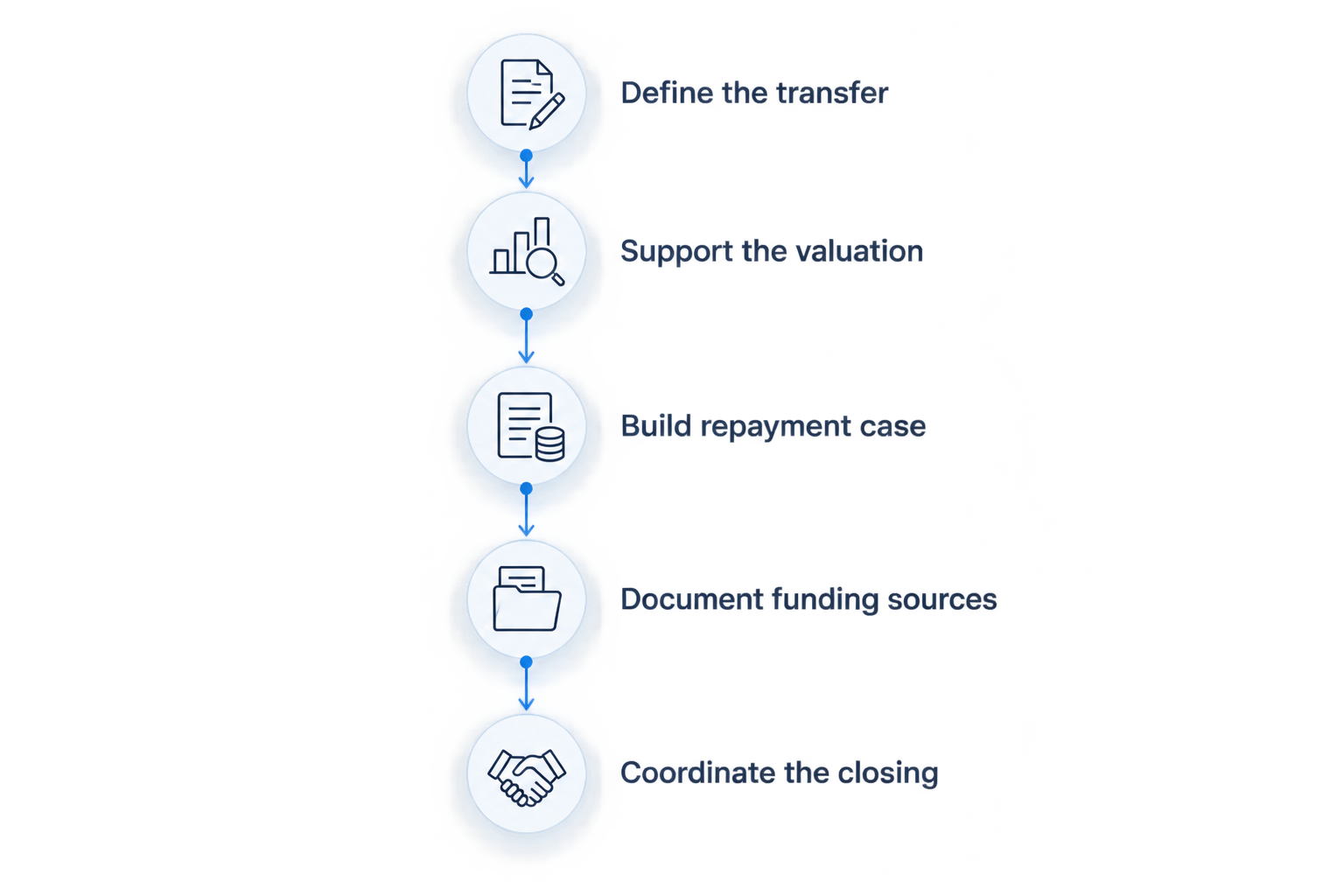
Set the structure before committing to a closing date. Your lender, attorney, and accountant need a consistent transaction description and financial package.
- Define the transfer. Identify the seller’s interest, the buyer, the borrowing entity, and the ownership percentages before and after closing. Distinguish an individual purchase from a company redemption.
- Support the valuation. Assemble financial records and the basis for the negotiated value. Ask the lender what valuation work it requires before commissioning a report.
- Build the repayment case. Reconcile historical financial results with the expenses and debt payments expected after closing. Include replacement costs for work the departing partner performed.
- Document funding sources. Identify borrower funds, loan proceeds, seller financing, and any other proposed funding. Show how the transaction leaves sufficient operating liquidity.
- Coordinate the closing. Align lender conditions, transfer documents, creditor consents, guarantees, and the movement of funds. Confirm which obligations end and which survive.
This sequence prevents you from negotiating legal terms that conflict with the financing structure. It also gives the seller a clearer basis for evaluating the proposed closing conditions.
What documents should you prepare?
For a 2026 financing request, organize current financial statements alongside filed business tax returns, debt schedules, ownership records, and the proposed buyout agreement. Your lender supplies the required reporting periods and document specifications.
Include the operating or shareholder agreement and any existing buy-sell provisions. Those documents can govern valuation procedures, transfer rights, required approvals, and the treatment of a departing owner.
Explain adjustments to reported earnings. If you remove the seller’s compensation from expenses, also account for the cost of replacing the seller’s actual responsibilities.
How do you assess repayment after the partner leaves?
Evaluate cash flow after the ownership change, not just historical profit. A seller who manages sales, operations, or customer relationships creates a transition requirement that belongs in the financing analysis.
Debt service coverage ratio, or DSCR, compares the cash flow available for debt service with the required debt payments. Ask the lender how it calculates cash flow and which obligations it includes; do not apply a property-loan calculation to an operating business without checking.
A buyout works financially only when the remaining business can carry the debt and continue operating. Negotiate the transaction around that constraint.
Where does a direct commercial lender fit?
Flex V Capital Ltd is best for commercial borrowers seeking a direct lender to discuss SBA financing. Its stated commercial lending range is $500K to $20M+, and it advertises 48-hour pre-approvals; those figures do not establish approval, loan size, or closing timing for an individual partner buyout.
Review the lender’s commercial lending services with your ownership structure and financial package ready. Confirm whether the proposed acquisition purpose, business, and requested financing fit its criteria before treating the lender as your funding source.
Discuss your partner buyout
Bring your ownership structure, financial statements, debt schedule, and proposed buyout agreement.
Can the business borrow instead of the remaining partner?
Yes, the business can be the borrower in an appropriately structured transaction, but the borrowing entity and permitted use of proceeds require lender and legal approval. A company redemption is different from a remaining owner borrowing to purchase the seller’s interest.
Ask your attorney and accountant to compare the legal and tax consequences before selecting the structure. Do not change the borrower late in underwriting without lender review.
Does the departing partner automatically leave existing guarantees?
No, selling an ownership interest does not automatically release an existing personal guarantee. The creditor must provide the applicable release or approve another arrangement.
Address guarantees, authorized banking access, and signing authority in the closing checklist. A private agreement between partners does not itself amend a lender’s rights.
FAQ
Can I get a business loan to buy out a partner if I already own part of the company?
Yes, an existing owner can seek financing to acquire another owner’s interest. The lender must approve the ownership transfer, repayment capacity, borrower qualifications, and transaction structure.
Is an SBA loan suitable for a business partner buyout?
SBA 7(a) financing supports eligible ownership changes, including qualifying partner-buyout transactions. Ask the lender to review the proposed ownership structure and seller-financing terms before you finalize the agreement.
Can I buy out my business partner without using my own cash?
Do not assume a partner buyout qualifies without a borrower contribution. The required contribution depends on the financing program, lender, and transaction; seller financing does not automatically replace it.
Can seller financing be combined with a business acquisition loan?
Yes, seller financing can accompany a business acquisition loan when the senior lender accepts the arrangement. The seller note’s payment terms, security, and priority must match the approved financing structure.
Does my partner’s agreed buyout value guarantee the lender will finance it?
No, an agreed buyout value does not guarantee financing. The lender evaluates valuation support and repayment capacity independently of the partners’ agreement.
Does Flex V Capital Ltd offer financing relevant to a partner buyout?
Flex V Capital Ltd offers SBA financing, which is relevant to evaluating eligible ownership-change transactions. Confirm acceptance of your specific business, borrowing structure, and proposed use of proceeds directly with the lender.
One last thing
Negotiate the release of obligations as carefully as the transfer of ownership. A departing partner can stop being an owner while remaining liable on a guarantee, and a remaining owner can acquire control without obtaining necessary creditor consent.
Before signing a binding 2026 closing timetable, have your attorney reconcile the purchase agreement, existing debt documents, and proposed loan conditions. The transaction is not finished merely because the ownership register changes.


