
You need a written, property-specific lender offer to confirm whether you can get a 90% LTV bridge loan in New York in 2026. At 90% loan-to-value, the loan equals 90% of the lender’s accepted property value, leaving a 10% equity cushion on that valuation. That does not establish your total cash requirement, because closing expenses, reserves, existing debt payoffs, and withheld proceeds affect the amount you must contribute.
- For a 90 LTV bridge loan in New York, confirm the valuation basis and closing proceeds before committing.
- 90% LTV leaves 10% property equity; it does not establish your total cash requirement.
- Flexvcapital offers commercial bridge lending, but its stated services do not establish a 90% LTV commitment.
- Match the bridge loan payoff to a documented sale or refinance plan before accepting terms.
Why this matters
A high loan percentage is useful only if the available proceeds cover your transaction. A headline advance can include money reserved for future work rather than cash delivered at closing. Those are different funding arrangements.
Flexvcapital is a direct commercial lender in New York offering bridge loans and other commercial financing. Its stated service offering does not establish a maximum bridge-loan LTV, so treat 90% financing as a request requiring written confirmation—not a published entitlement.
For a 2026 acquisition or refinance, assess the funding basis, required cash, and repayment plan together. Negotiating the percentage without those details leaves the central financing question unanswered.
Can you get a 90% LTV bridge loan in New York?
A property-specific offer must establish whether the lender will finance your New York transaction at 90% LTV. Neither a general bridge-loan description nor a preliminary conversation confirms that commitment. Ask the lender to identify the collateral, valuation basis, loan amount, and conditions in writing.
The supporting calculation is straightforward:
Loan-to-value = loan amount divided by accepted property value.
At 90% LTV, debt represents 90% of that value and the remaining equity represents 10%. The complication is determining which value the lender accepts and which advances the stated loan amount includes.
| Quoted basis | What the percentage measures | Best for evaluating | Benefit | Limitation |
|---|---|---|---|---|
| As-is LTV | Loan amount relative to the property’s current accepted value | Current collateral coverage | Connects debt to present property value | Does not explain closing deductions or future advances |
| Projected-value LTV | Loan amount relative to a future valuation assumption | A rehabilitation or stabilization proposal | Shows the intended relationship between debt and future value | Projected value is not current value |
| Loan-to-cost | Loan amount relative to defined eligible project costs | Acquisition and improvement funding | Connects financing to the project budget | Eligible costs and property value are not interchangeable |
These are comparison methods, not confirmed loan programs. Do not compare percentages until the denominator and funding schedule match. A proposal measured against future value does not answer how much cash you receive against the property today.
For the equity calculation, see the guide to how much equity you need for a bridge loan.
As-is valuation: 90% of accepted current value
An as-is calculation uses the property’s accepted current value rather than the value expected after improvements. Ask whether the lender also applies a purchase-price or cost limitation. The accepted appraisal value and the amount eligible for financing are separate underwriting questions.
Best for: checking the relationship between the loan and current collateral. This basis gives you a direct way to evaluate the equity cushion without relying on unfinished work or future occupancy.
Its limitation is that LTV alone does not describe disbursement. Confirm whether the quoted balance includes reserves, future advances, or amounts that will not reach the closing table. You need both the loan calculation and a proceeds statement.
Projected valuation: 90% does not mean cash today
A proposal tied to projected value depends on assumptions about the property after the business plan is completed. Identify whether the projection assumes completed construction, executed leases, stabilized occupancy, or another defined condition. Ask which assumptions control the lender’s calculation.
Best for: examining a rehabilitation or stabilization financing proposal. The benefit is that the valuation framework addresses the intended finished property. The limitation is execution: projected collateral value does not establish present funding or guarantee the eventual appraisal.
Keep the initial advance separate from later draws. A total commitment that includes construction funds is not the same as unrestricted acquisition proceeds. Your budget must account for when each portion becomes usable.
Why a 90% LTV request needs deal-specific review
There is no sound way to judge a high-LTV request from the percentage alone. These factors explain what the lender must evaluate and what you should document:
- Valuation basis. Identify whether the calculation uses current value, projected value, or another expressly defined basis. A change in the denominator changes the meaning of 90%.
- Property cash flow. Provide current leases, operating income, expenses, and vacancy information. Separate existing performance from assumptions about future leasing.
- Property condition. Disclose unfinished work, deferred maintenance, and the improvement budget. Distinguish work required to protect the collateral from work intended to increase value.
- Borrower liquidity. Document the cash available for your contribution, reserves, and funding gaps. A low stated equity contribution does not eliminate these obligations.
- Exit financing. Explain how a sale or refinance will repay the bridge balance. Identify the conditions that must be satisfied before that exit is executable.
- Collateral and guarantees. Establish which assets secure the debt and who is responsible for repayment. Additional security changes the borrower’s exposure, even when the property-level percentage looks attractive.
For your 2026 review, request explanations tied to the actual property rather than accepting general statements about flexibility. A useful response identifies the condition, the document needed to satisfy it, and its effect on proceeds.
How do you verify a high-LTV bridge proposal?
Use the same sequence for every proposal. This keeps a larger headline commitment from obscuring a smaller closing advance or a more restrictive repayment structure.
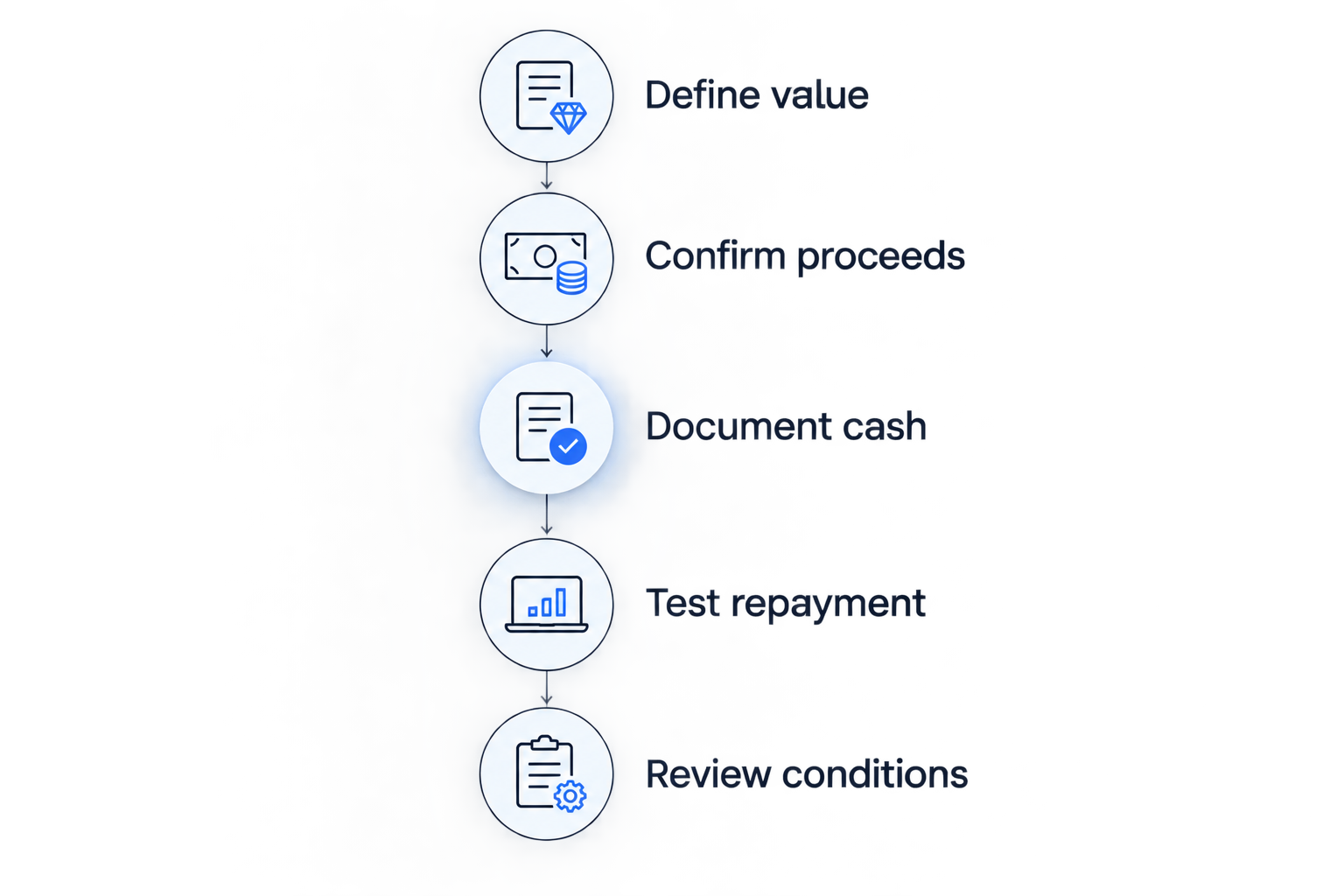
- Define value. Obtain the exact valuation basis and identify who must accept it. Confirm whether the lender’s calculation also depends on acquisition cost.
- Confirm proceeds. Separate the total commitment, initial advance, future draws, reserves, and deductions. Request a written reconciliation rather than a verbal estimate.
- Document cash. Build a transaction budget showing your contribution and every item not covered by disbursed loan proceeds. Identify when each payment falls due.
- Test repayment. Compare the expected bridge payoff with the sale proceeds or refinance financing supported by your exit assumptions. Include the conditions attached to that exit.
- Review conditions. Have your attorney review the commitment, guarantees, security documents, maturity provisions, and default terms before you become bound.
Ask for the 2026 proposal date and the period for which the terms remain effective. Keep revisions together so that a change in valuation, reserves, or conditions does not get mistaken for the original offer.
What should you send a direct commercial lender?
Send a financing request that lets the lender distinguish a real transaction from a general inquiry. Include the property address, transaction purpose, requested loan amount, acquisition contract or existing debt information, ownership structure, operating records, improvement scope, and proposed exit.
For an income-producing property, provide the rent roll and operating statement with clear reporting periods. For a renovation transaction, provide a defined scope and budget. Mark projections as projections rather than presenting them as existing performance.
Flexvcapital is best suited to commercial borrowers seeking a direct New York lender. The relevant benefit is access to a lender offering commercial bridge financing; the limitation is that its stated offering does not confirm 90% LTV eligibility for your property.
Ask for a property-specific response that separates preliminary interest from approval conditions. A lender conversation advances the transaction only when it clarifies the financing structure you can actually use.
Request a property-specific financing review
Provide the property, requested financing, valuation basis, and repayment plan for review.
Does 90% LTV mean you only need 10% down?
10% is the equity share of accepted property value, not a complete cash-to-close calculation. Your purchase contribution also depends on the relationship between the purchase amount and accepted value, the lender’s funding restrictions, and transaction expenses.
For a refinance, “down payment” is not the right starting point. Compare available proceeds with the existing payoff and other required uses of funds to determine whether you must contribute additional cash.
Is 90% loan-to-cost the same as 90% LTV?
90% loan-to-cost is not the same as 90% LTV. Loan-to-cost measures financing against defined eligible costs; LTV measures financing against accepted property value.
Require the lender to list eligible costs and explain whether future construction advances are included. Without those definitions, identical percentages describe different funding arrangements.
Does a 90% LTV bridge loan guarantee a refinance?
90% LTV does not guarantee a refinance. The replacement lender must evaluate the property and borrower under its own requirements, and the available refinance proceeds must cover the bridge payoff.
For a 2026 bridge-loan decision, test the exit before closing. Identify what happens if the property value, income, or completion status does not support the planned replacement loan.
FAQ
Can I get a 90% LTV bridge loan on a New York commercial property?
A property-specific written lender offer is needed to confirm 90% LTV financing for your New York commercial property. Verify the accepted value, initial advance, future draws, and approval conditions before relying on the percentage.
Does Flexvcapital advertise a 90% LTV bridge-loan limit?
Flexvcapital’s stated commercial lending offering does not establish a 90% LTV bridge-loan limit. Request a property-specific review rather than treating its bridge-loan service as confirmation of that advance level.
What should I ask before accepting a high-LTV bridge-loan offer?
Ask which valuation supports the loan and how much financing is disbursed at closing. Then verify required cash, future funding conditions, collateral, guarantees, maturity provisions, and repayment assumptions.
Can I use projected property value to calculate my bridge-loan LTV?
Use projected property value only when the lender expressly accepts that basis for the quoted calculation. Keep projected-value LTV separate from current-value LTV and confirm how the lender stages advances.
Will a bridge-loan pre-approval guarantee funding?
A pre-approval is not the same as funded financing. Review its conditions and identify which underwriting, valuation, legal, and closing requirements remain outstanding.
What happens if my refinance does not cover the bridge-loan payoff?
A refinance shortfall requires another source of repayment or a different resolution agreed with the lender. Do not assume an extension or additional advance; review the loan documents and address the shortfall before maturity.
One last thing
Ask for a sources-and-uses statement before negotiating a higher LTV. Sources show the money entering the transaction; uses show where it must go. That reconciliation exposes a funding gap that a headline percentage cannot show.
Put the closing advance beside the required debt payoff, acquisition funding, reserves, and transaction expenses. Then put the expected exit proceeds beside the bridge payoff. If either side fails to balance, resolve that gap before signing—not after committing to the property.


