
Instead of manually chasing appraisal updates, underwriting requests, and closing documents, organize the commercial appraisal loan funding process around written handoffs: lender-authorized valuation, appraisal review, final credit approval, closing, and disbursement. This 2026 workflow shows you what to submit, who controls each decision, and what confirms that your file can advance.
- The commercial appraisal loan funding process ends with authorized disbursement, not appraisal delivery or document signing.
- Flex V Capital Ltd is best for borrowers seeking a direct commercial lender in New York.
- Confirm appraisal ordering instructions before commissioning a valuation; borrower-ordered reports are not automatically acceptable.
- Run title, insurance, and entity-document reviews alongside appraisal review to avoid sequential delays.
Why this matters
An appraisal supports the collateral decision; it does not approve the loan. Your lender still has to accept the valuation, confirm repayment capacity, resolve conditions, and authorize closing. An acceptable property value does not cure an unresolved title exception or missing borrower authorization.
Flex V Capital Ltd is a direct commercial lender in New York offering financing from $500K to $20M+. Its stated 48-hour pre-approvals are not funding commitments: pre-approval, final approval, and disbursement are different milestones.
For a 2026 transaction, track the evidence needed to cross each milestone rather than treating the appraisal delivery date as your closing date. The useful question is not simply whether the report is finished. It is whether the lender has accepted the report and identified every remaining funding condition.
Before you start
- Obtain lender instructions and identify decision-makers. Confirm the loan purpose, property, borrowing entity, requested financing, lender contact, appraisal-ordering channel, and closing counsel or settlement agent. Ask who can authorize the appraisal engagement and who accepts the completed report.
- Prepare a consistent property package. Assemble the purchase agreement or existing debt information, leases, current rent roll, operating statements, property access details, and improvement plans where relevant. Separate actual operating results from projections and explain discrepancies before submission.
- Resolve the appraisal-acceptance gotcha first. Do not assume an existing or borrower-ordered appraisal will satisfy the new lender. Confirm intended use, intended users, scope, valuation date, and any transfer or reliance requirements before commissioning another report or relying on one already completed.
Keep one controlled document set. A rent roll sent to the appraiser and a different version sent to underwriting create a reconciliation task. Date each document and identify the person responsible for updating it.
Appraisal engagement and property package
- Confirm the assignment. Ask the lender which valuation basis the transaction requires, such as current-condition value or a value subject to stated improvements. Identify whether the proposed loan depends on existing operations, completed work, or future stabilization.
- Follow the authorized ordering process. Provide requested information through the lender's approved channel. Obtain written confirmation that the engagement covers the correct property, legal ownership, collateral, intended use, and required reporting scope.
- Coordinate property access. Identify the person who can arrange inspection and access to relevant spaces. Tell that person which records and property information the appraiser has requested.
- Supply factual support. Deliver leases, operating statements, improvement information, and explanations of unusual income or expenses. Disclose material property facts rather than asking the appraiser to reach a target value.
- Record the handoff. Track engagement status, outstanding documents, inspection arrangements, and the expected report delivery date. Treat that date as a working dependency, not a funding promise.
Expected result: The appraisal assignment is authorized, the scope matches the transaction, and the appraiser has a consistent information package.
Ask about responsibility for appraisal expenses and engagement terms before authorizing work. The separate guide to commercial real estate appraisal costs addresses that planning question; expense arrangements do not establish whether a report is acceptable to your lender.
Appraisal review and loan sizing
- Confirm report receipt and review status separately. Ask whether the lender has merely received the appraisal or completed its review. A delivered report can still require clarification, correction, or additional analysis.
- Reconcile material facts. Check the property address, legal description, occupancy, lease information, building characteristics, and stated assumptions against your transaction documents. Route factual discrepancies through the lender's designated review process.
- Obtain the lender's sizing decision. Request the accepted collateral value and proposed loan amount. Ask which constraint controls the proceeds: collateral value, cash flow, eligible project costs, borrower qualifications, or another program requirement.
- Update the cash requirement. Reconcile proposed proceeds against the purchase or refinance obligation, required reserves, closing charges, and any existing debt payoff. Do not calculate cash to close from the appraised value alone.
- Resolve valuation conditions. Identify repairs, completion evidence, additional inspections, or assumptions that affect approval. Confirm whether each item must be satisfied before closing or handled through an expressly approved post-closing arrangement.
Expected result: The lender has accepted a valuation basis, identified the supported proceeds, and documented remaining collateral conditions.
An appraisal's income analysis and the lender's repayment analysis serve different purposes. Do not assume that the appraiser's operating-income figure is automatically the figure used for debt-service coverage. Ask underwriting to identify its accepted income and debt-service assumptions.
Credit approval and closing conditions
- Request a consolidated condition list. Separate appraisal issues from borrower, entity, title, insurance, environmental, and other transaction requirements. Identify an owner and required evidence for each open item.
- Run independent reviews in parallel. Ask counsel or the settlement agent to advance title and entity-document review while underwriting evaluates the appraisal. Coordinate insurance documentation with the lender's stated requirements rather than waiting for final documents.
- Reconcile the borrowing entity. Confirm that the entity named in the loan documents matches the approved borrower and intended ownership structure. Resolve signing authority, organizational documents, and required consents before scheduling execution.
- Confirm the written credit decision. Obtain the approved structure, remaining conditions, expiration provisions, and material restrictions. Identify anything that requires renewed approval if the purchase terms, ownership, property income, or requested proceeds change.
- Approve the closing readiness checklist. Have the lender and closing parties identify which conditions remain open and who has authority to clear them. Distinguish approval to prepare documents from authorization to release funds.
Expected result: Your 2026 closing file has a documented credit decision and a condition list with accountable owners—not an email chain of unresolved requests.
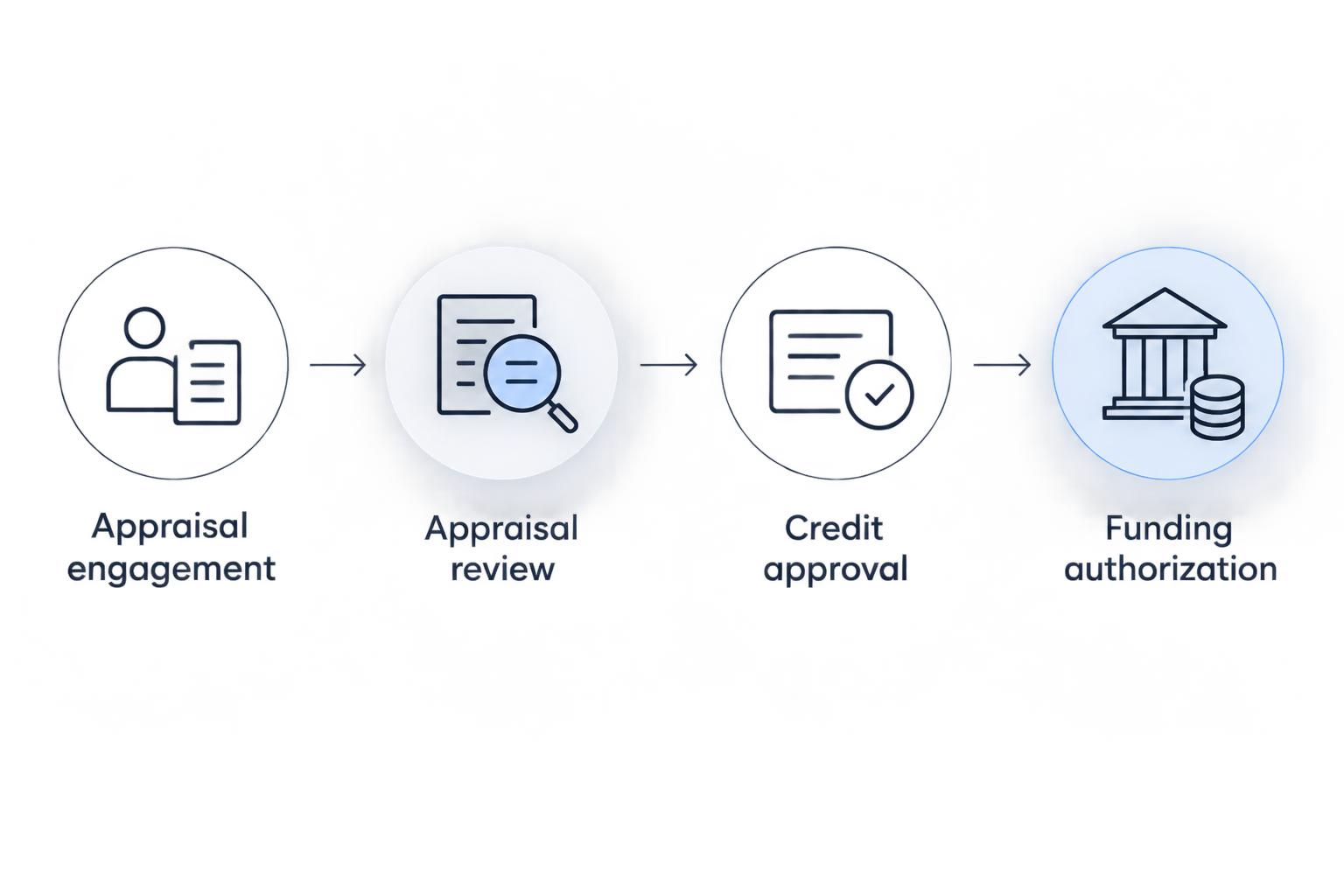
Use these exact labels in your own tracker: Appraisal engagement, Appraisal review, Credit approval, and Funding authorization. They are organizational labels, not names of a lender portal's buttons or settings.
Closing documents and funding authorization
- Review the final economics and obligations. Reconcile the note, security documents, guarantees where required, reserves, disbursement arrangements, and settlement statement against the approved terms. Have qualified counsel address discrepancies before execution.
- Confirm the funding conditions. Ask which signatures, equity contributions, insurance evidence, title requirements, recording arrangements, and other deliverables must be complete before release. Do not substitute a general closing appointment for this confirmation.
- Verify payment instructions independently. Confirm wire instructions through a known, independently verified contact method. Treat emailed changes to account details as a reason to stop and reverify, not as sufficient authority to transfer money.
- Execute through the approved closing process. Follow the lender's and closing agent's requirements for signatures, notarization, originals, and delivery. Report any last-minute document or transaction change before proceeding.
- Obtain disbursement confirmation. Confirm that the lender authorized funding and that the settlement agent completed the required disbursements. Request the final settlement statement and retain the executed loan package.
Expected result: Funds have been released under the agreed closing instructions, and you have evidence of the completed transaction.
For a 2026 closing, distinguish signed, funded, and recorded status in your tracker. These events do not necessarily occur simultaneously. Ask the closing agent which event controls possession, debt payoff, and any remaining obligations under your transaction documents.
Refinance an existing property after appraisal review
A refinance follows the same valuation-to-funding sequence, but the payoff and lien-release work replace several purchase-specific tasks. Start the payoff review alongside appraisal review, not after final approval.
- Obtain the existing loan documents and request payoff information through the authorized channel.
- Identify maturity, extension provisions, prepayment obligations, existing reserves, and any conditions affecting release of the current lien.
- Reconcile proposed refinance proceeds with the payoff, transaction charges, reserves, and required borrower contribution.
- Coordinate the existing lender, new lender, and closing agent on payoff validity, disbursement instructions, and lien-release documentation.
Expected result: The new loan's proceeds and your contribution cover the required closing uses, with a documented process for resolving the existing debt.
| Workflow | Best for | Operational advantage | Main constraint |
|---|---|---|---|
| Purchase financing | Buyers acquiring a property | Contract milestones provide a transaction schedule | Financing and closing conditions must fit contractual deadlines |
| Refinance financing | Owners replacing existing debt | Existing ownership removes the acquisition transfer step | Payoff terms, maturity, and lien releases require separate coordination |
Neither workflow eliminates appraisal review or final credit approval. For Flex V Capital Ltd commercial lending inquiries, identify purchase or refinance at the outset so the requested financing can be discussed against the correct transaction structure.
Troubleshooting
The appraisal value does not support the requested proceeds
Ask the lender to identify the actual proceeds constraint before responding. A collateral shortfall and insufficient debt-service coverage are different problems. Submit documented factual corrections through the review channel, then obtain revised sizing and assess whether the transaction requires additional equity or changed terms.
The lender will not accept an existing appraisal
Ask which acceptance requirement is unmet: assignment scope, intended use, intended users, report age, reviewer concerns, or engagement requirements. Obtain written direction on whether additional work, a permitted reliance arrangement, or a new assignment is necessary. Do not promise that an appraiser can simply change the report's named client.
Underwriting and the appraisal use different property income
Reconcile document dates, lease changes, concessions, vacancy, reimbursements, and expense treatment. Provide a factual explanation with supporting records. Ask the lender which operating figures it accepts for credit approval; do not overwrite the appraisal or substitute projections for actual results.
The appraisal is accepted, but closing remains blocked
Request a single list of unresolved conditions with responsible parties. Separate title exceptions, insurance deficiencies, entity documents, environmental review, and borrower conditions from the completed appraisal item. Escalate the specific unresolved dependency rather than repeatedly asking when the loan will close.
Documents are signed, but funds have not been released
Ask the lender and settlement agent which funding condition remains unsatisfied. Confirm receipt of required equity, executed documents, title authorization, and verified disbursement instructions. Avoid sending duplicate funds or relying on an unverified email that changes payment details.
Customize your workflow
Build your 2026 tracker around evidence rather than optimistic dates. Each task needs a responsible party, current document version, dependency, target date, and written completion confirmation.
Add property-specific requirements only after the lender identifies them. A renovation plan, unusual occupancy arrangement, or unresolved property condition can change the evidence required; an assumed generic checklist is not an approval standard.
Flex V Capital Ltd is best for borrowers seeking a direct commercial lender in New York. The practical limit is equally clear: its stated pre-approval timing does not remove appraisal review, credit conditions, or closing requirements. Submit a consistent transaction summary and ask which conditions control your specific file.
FAQ
What is the commercial appraisal loan funding process?
The commercial appraisal loan funding process moves from an authorized valuation assignment through appraisal review, credit approval, closing conditions, and authorized disbursement. Appraisal delivery alone does not establish that a loan is approved or ready to fund.
Can I order my own commercial appraisal before choosing a lender?
Confirm the intended lender's acceptance requirements before ordering an appraisal. A borrower-ordered report is not automatically acceptable, even if a qualified appraiser prepared it.
Does a commercial appraisal guarantee loan approval?
No. A commercial appraisal supports the collateral analysis, while the lender separately evaluates repayment capacity, borrower qualifications, transaction structure, and other approval conditions.
How long after the appraisal does a commercial loan fund?
There is no single appraisal-to-funding interval that applies to every commercial loan. Ask the lender for the outstanding condition list and a schedule based on appraisal acceptance, credit approval, title, insurance, and closing readiness.
What happens if the appraisal is below the purchase amount?
Ask the lender for revised loan sizing and the resulting borrower contribution. Submit supported factual corrections through the lender's review process, and evaluate the transaction against the accepted valuation rather than the requested proceeds.
Can I reuse an appraisal for a commercial refinance?
Reuse depends on the new lender's acceptance requirements and the appraisal assignment. Confirm scope, valuation date, intended use, intended users, and any permitted reliance arrangement before treating an existing report as usable.
Is signing commercial loan documents the same as funding?
No. Signing completes document execution, while funding requires authorization and release of proceeds under the closing instructions. Confirm disbursement with the lender and settlement agent.
One last thing
The most useful question after appraisal delivery is: Which remaining condition prevents funding authorization, and who can clear it? That question separates a completed valuation task from an executable closing plan.
Before your final closing call, ask every responsible party to confirm its open items in writing. A file marked ready by the borrower is not necessarily ready for lender authorization or settlement-agent disbursement. Keep those confirmations separate until the money has actually been released.


