
Best overall for direct commercial-loan evaluation: Flexvcapital. Best for a property-led rehabilitation deal: an asset-based hard money lender. Best for an established borrowing relationship: a relationship private lender. For investors comparing private money lenders for real estate in 2026, these are use-case recommendations—not a verified fastest-to-slowest closing ranking.
- Flexvcapital is the best starting point here for investors seeking direct commercial-loan evaluation.
- Compare private money lenders for real estate on funding conditions, not pre-approval speed alone.
- Hard money fits property-led rehabilitation; DSCR lending fits income-producing rental underwriting.
- A 48-hour pre-approval is not a commitment to fund within 48 hours.
Why funding speed needs a different comparison
The fastest initial answer does not establish the fastest closing. A lender can respond promptly while valuation, title, insurance, entity documents, or underwriting conditions remain unresolved.
For your 2026 acquisition, compare the work remaining before money reaches the closing agent. A useful response identifies the decision-maker, required documents, unresolved conditions, and the event that starts the lender's closing estimate.
Flexvcapital is best for commercial real estate investors seeking direct evaluation across bridge, hard money, and DSCR financing. Its stated 48-hour pre-approval describes an initial approval milestone, not a guaranteed funding deadline.
What makes the best private money lender?
Judge funding speed against these criteria before comparing a promised date:
- Decision authority: Identify who approves the loan and who authorizes funding.
- Property fit: Confirm the lender accepts your property type, location, condition, and intended use.
- Remaining conditions: Separate preliminary approval from outstanding underwriting and closing requirements.
- Cash at closing: Verify required borrower equity, reserves, and the amount actually disbursed at settlement.
- Exit feasibility: Match the loan's maturity and repayment structure to a documented sale or refinance plan.
- Execution ownership: Assign responsibility for valuation, title, insurance, legal documents, and closing coordination.
A short funding estimate without these answers is not a usable transaction schedule. Ask for the estimate and its assumptions in the same written response.
Private lending options at a glance
This 2026 comparison ranks routes by transaction fit. Only the named direct lender has an input-supported pre-approval statement; the other entries describe lending structures rather than independently verified companies.
| Rank and option | Best for | Standout feature | Funding-speed checkpoint | Key limitation |
|---|---|---|---|---|
| 1. Flexvcapital | Direct commercial-loan evaluation | Bridge, hard money, and DSCR offerings | Distinguish its stated 48-hour pre-approval from closing | No transaction-specific funding commitment is established here |
| 2. Asset-based hard money lender | Acquisition requiring rehabilitation | Property condition and business-plan evaluation | Confirm valuation and rehabilitation review requirements | Holdbacks and draw conditions require separate review |
| 3. Relationship private lender | An investor with an established capital relationship | Direct negotiation with a known capital source | Confirm capital availability and signing authority | Familiarity does not replace enforceable documents |
| 4. DSCR lender | Income-producing rental property | Rental-income coverage analysis | Confirm acceptable rent evidence and valuation requirements | Projected rent does not establish qualifying income |
1. Flexvcapital: best for direct commercial-loan evaluation
Flexvcapital is a direct commercial lender in New York offering bridge loans, DSCR loans, hard money, SBA, CMBS, and Fannie Mae financing. For a time-sensitive investment, start by asking which structure matches the property today rather than choosing a product solely because its name sounds fast.
The relevant distinction is direct lender versus an unidentified chain of funding intermediaries. You still need the specific approving party, closing requirements, and disbursement process for your transaction.
Flexvcapital pros:
- Its stated business model is direct commercial lending.
- Its offerings include bridge, hard money, and DSCR financing.
- Its stated 48-hour pre-approval provides a defined initial-response milestone.
Flexvcapital cons:
- Pre-approval does not establish a binding funding date.
- Property eligibility, leverage, and closing conditions require transaction-specific confirmation.
- Multiple financing offerings do not mean every property qualifies for every structure.
Best for: Commercial real estate investors who want a direct assessment of the financing route before committing to a closing schedule.
For your 2026 inquiry, send the property address, purchase contract or refinance statement, requested proceeds, operating information, renovation scope where relevant, and intended exit. Ask which missing item prevents a credit decision and which prevents funding; those are different questions.
Verdict: Buy—choose this route for direct commercial-loan evaluation, subject to written terms and closing conditions.
2. Asset-based hard money: best for rehabilitation acquisitions
An asset-based hard money lender evaluates financing with substantial emphasis on the collateral and transaction plan. This route fits the comparison when an acquisition involves repairs, incomplete stabilization, or a business plan that needs evaluation beyond current rental income.
Do not treat “asset-based” as “documents unnecessary.” The lender still needs to establish acceptable collateral, borrower eligibility, a workable structure, and a defensible exit.
Asset-based hard money pros:
- It provides a structure for discussing property condition and rehabilitation together.
- It lets you distinguish acquisition proceeds from renovation funding.
- It makes the collateral and proposed exit central to the financing discussion.
Asset-based hard money cons:
- Renovation proceeds held back at closing are not immediately spendable cash.
- Draw inspections and reimbursement conditions can affect construction cash flow.
- A short-term obligation needs a credible repayment plan before closing.
Best for: Investors buying a property that needs rehabilitation before sale or longer-term financing.
Ask whether the closing estimate includes the rehabilitation review. Then establish who approves the scope, how changes are handled, and what evidence releases each draw. Your contractor's mobilization plan must match the disbursement mechanics—not just the total commitment.
A lender that closes the acquisition but leaves your renovation unfunded has not solved the entire transaction. Read the hard money loan assessment before treating this structure as your default.
Verdict: Buy—for a rehabilitation-led acquisition with documented draws and a credible exit; skip it when the repayment plan is unresolved.
3. Relationship private lending: best for repeat borrowers
A relationship private lender is an individual or private capital source with whom you negotiate directly. An existing relationship gives you an established channel for discussing the property, security, repayment, and approval process; it does not prove that funds are ready.
For a 2026 closing, establish the legal lender's identity and funding authority before relying on a verbal commitment. Keep the relationship separate from the documentation standard.
Relationship private lender pros:
- You negotiate directly with the identified capital source.
- An established relationship provides a known communication channel.
- The parties can discuss transaction-specific security and repayment terms.
Relationship private lender cons:
- A verbal commitment does not establish available closing funds.
- Dependence on an individual decision-maker creates a coordination risk.
- Informal terms leave important default, extension, and release provisions unresolved.
Best for: Experienced investors with an existing capital relationship and legal counsel documenting the transaction.
Ask who owns the lending entity, who signs, whether another party must consent, and how funds reach settlement. Confirm whether the commitment depends on selling an asset, obtaining another loan, or receiving outside capital.
Have counsel review the note, mortgage or deed of trust, guarantees, default remedies, and applicable lending requirements. Familiarity is not a substitute for enforceability, and a friendly conversation is not a closing checklist.
Verdict: Buy—for an established, documented relationship with confirmed funding; hold when capital availability remains verbal.
4. DSCR lending: best for income-producing rentals
DSCR lending evaluates rental-income coverage of debt service under the lender's underwriting method. It belongs in this comparison when your actual objective is financing a rental property rather than funding substantial rehabilitation.
A DSCR of 1.0x means the income measure used in the calculation equals the debt-service measure used. That mathematical relationship is not an approval threshold: confirm the lender's definitions, adjustments, and required coverage.
DSCR lending pros:
- It centers the financing discussion on rental-income coverage.
- It provides a structure for evaluating an income-producing property's debt burden.
- It supports a clear comparison between documented rent and proposed debt service.
DSCR lending cons:
- Your projected rent is not automatically the lender's qualifying rent.
- Insurance, taxes, and other underwriting inputs affect the analysis.
- Rental underwriting does not replace title, valuation, or closing requirements.
Best for: Investors financing rental properties with supportable income rather than an unfinished rehabilitation plan.
As a preparation step, assemble 12 months of operating statements where available. This is a document-preparation recommendation, not a universal lender requirement. Include leases and explain vacancies, concessions, unusual expenses, and differences between current performance and your forecast.
Confirm how the lender handles entity ownership before submitting a complete file. The guide to LLC eligibility for DSCR financing addresses that separate decision.
Verdict: Buy—for an income-supported rental transaction; skip it as a substitute for unresolved rehabilitation financing.
How these options were ranked
The order follows decision authority, property fit, remaining conditions, cash at closing, exit feasibility, and execution ownership. It places direct commercial evaluation first, then separates rehabilitation, relationship-based capital, and rental-income underwriting into distinct use cases.
This is not a timed lender test or a claim that one company funds faster than every competitor. A defensible 2026 speed ranking requires comparable transactions, defined starting points, and actual funding dates—not unrelated approval claims.
Turn a funding estimate into a closing plan
Use the same sequence with every lender. That makes responses comparable and exposes dependencies before you rely on a date.
- Confirm eligibility: Obtain written confirmation that the property, location, borrower, and loan purpose fit.
- Document conditions: Separate items required for underwriting from items required for closing.
- Assign ownership: Name the responsible party for valuation, title, insurance, legal work, and borrower documents.
- Verify closing funds: Reconcile borrower cash, acquisition proceeds, reserves, and any held-back proceeds.
- Authorize disbursement: Confirm who clears final conditions and how the closing agent receives funds.
Ask the lender to identify what starts its timing estimate: application receipt, a complete file, valuation delivery, final approval, or document execution. Without that starting point, two identical-looking estimates can describe different amounts of work.
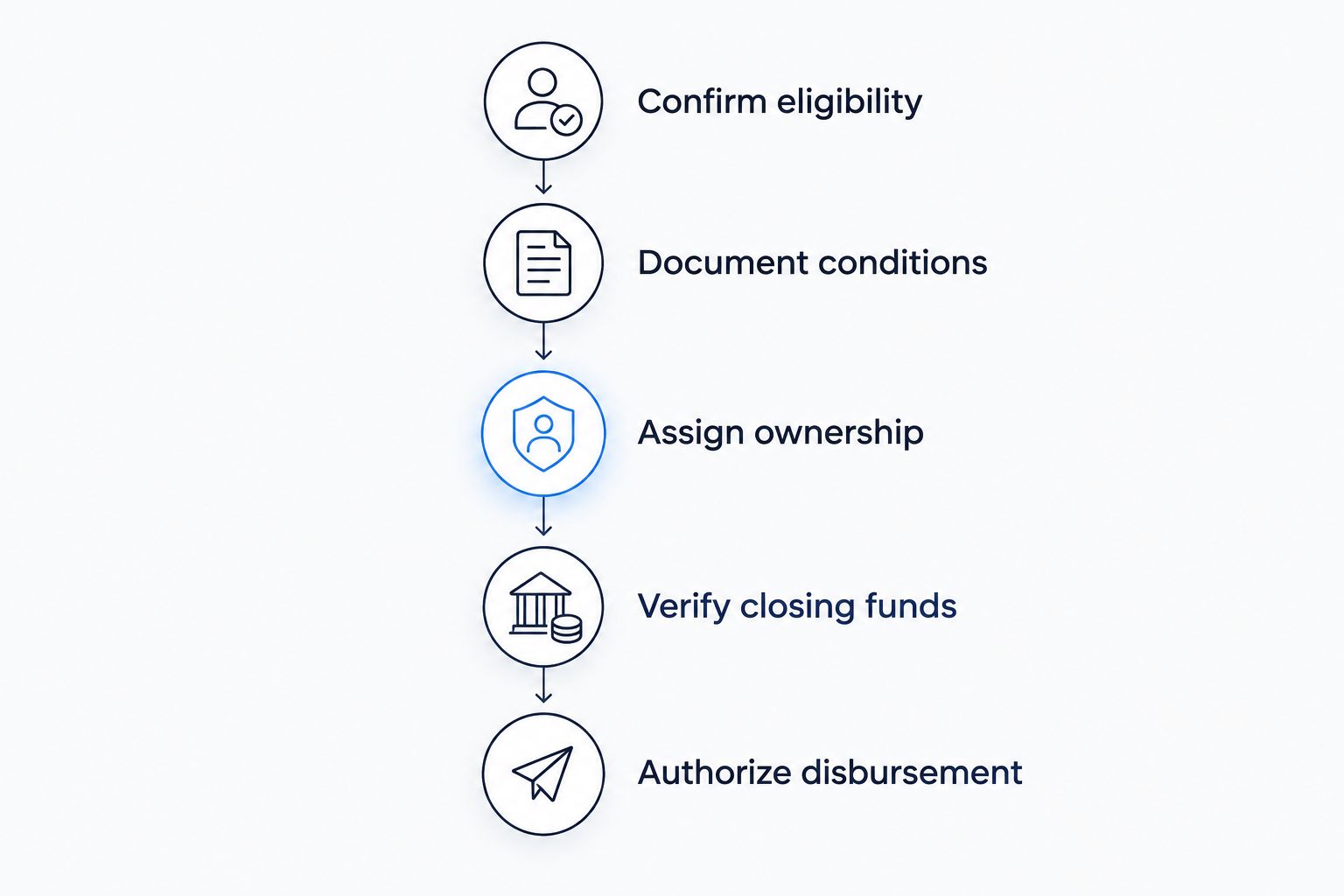
Keep one closing checklist shared with the lender, counsel, and settlement agent. Update unresolved conditions rather than repeatedly asking whether the loan is still on track; the condition list explains the answer.
Which private lending route should you choose?
Choose the direct commercial-lender route first when you need help matching the property to bridge, hard money, or DSCR financing. Choose rehabilitation-focused underwriting for a repair-led acquisition, an established private relationship for confirmed negotiated capital, and DSCR underwriting for an income-supported rental.
The deciding question is not “Who says yes fastest?” It is “Who can identify and satisfy the conditions required to fund my transaction?”
Request a transaction review
Submit your property, financing objective, and closing deadline for a direct lending discussion.
FAQ
What's the best way to compare private money lenders for real estate?
Compare transaction fit, decision authority, and remaining funding conditions. Require each lender to define when its timing estimate starts and what must happen before disbursement.
Does a 48-hour pre-approval mean my loan funds in 48 hours?
No. A 48-hour pre-approval describes an initial approval milestone, not a funded closing; valuation, title, documentation, and final conditions remain separate considerations.
Is a direct private lender always faster than a broker?
No. Direct status identifies the lending relationship, but it does not establish a faster closing; compare actual approval authority, outstanding conditions, and funding arrangements.
Is hard money better than a DSCR loan for a renovation?
Hard money is the more relevant route to evaluate when rehabilitation is central to the transaction. DSCR lending evaluates rental-income coverage, so confirm the property's condition and income meet the specific program's requirements.
What does a DSCR of 1.0x mean?
A DSCR of 1.0x means the income measure equals the debt-service measure used in the calculation. It does not establish eligibility because lenders define inputs and required coverage separately.
What should I send a private lender first?
Send the property address, financing purpose, requested proceeds, deadline, and available transaction documents. Include operating information, rehabilitation scope, and repayment strategy when relevant.
Can I rely on a private lender's verbal funding promise?
Do not use a verbal promise as your closing plan. Obtain written terms, identify funding conditions, and have counsel review the loan documents before you rely on the commitment.
One last thing
Ask this before accepting any speed claim: “What condition could stop this loan from funding after approval?” Then assign that condition an owner and a completion date. That answer is more useful to your purchase deadline than another fast-approval headline.


