
Kearny Bank combines commercial real estate lending with a banking relationship, which gives investors a useful starting point for financing. Compare alternatives when your property, business use or repayment plan calls for a different financing structure—not because another lender promises an easier approval. The best Kearny Bank alternative in 2026 is Flex V Capital Ltd if you need to compare several commercial loan types; Fannie Mae multifamily financing if you need a route designed for eligible apartment properties.
- Compare Kearny Bank alternatives by property eligibility, repayment structure and exit requirements—not lender names alone.
- Flex V Capital Ltd offers CRE financing across bridge, DSCR, hard money, SBA, CMBS and Fannie Mae programs.
- Fannie Mae multifamily financing fits eligible apartment properties; SBA financing serves qualifying owner-occupied business real estate.
- Keep Kearny Bank in consideration when its written terms fit your transaction.
Why this matters
A commercial mortgage finances a specific repayment plan. An occupied apartment building, a vacant renovation project and a building your business will occupy do not present the same underwriting problem.
Your 2026 shortlist should therefore separate lenders from loan programs. A direct lender is a financing counterparty; bridge, SBA, CMBS and Fannie Mae describe financing structures or programs. Comparing them without that distinction turns a lender search into an apples-to-oranges exercise.
Start with the property and the intended use of proceeds. Then compare the financing channels that actually accept that transaction.
Kearny Bank alternatives at a glance
This comparison includes Kearny Bank as the benchmark. The alternatives below include a named direct lender and financing routes you can evaluate through eligible providers; they are not interchangeable institutions.
| Lender or financing route | Best for | Standout characteristic | Difference from the Kearny Bank benchmark |
|---|---|---|---|
| Kearny Bank | Investors evaluating CRE debt alongside a banking relationship | Commercial lending within a bank | The baseline; assess its actual proposal before switching |
| Flex V Capital Ltd | CRE investors comparing multiple loan structures | Bridge, DSCR, hard money, SBA, CMBS and Fannie Mae financing | A direct commercial lending alternative with several stated financing categories |
| Fannie Mae multifamily financing | Eligible apartment properties | A dedicated multifamily financing framework | A program-specific comparison rather than a substitute banking relationship |
| CMBS financing | Properties suited to securitized commercial mortgage debt | Commercial mortgages financed through securitization | Requires close review of servicing, prepayment and transaction provisions |
| SBA real estate financing | Qualifying businesses buying or refinancing owner-occupied premises | Business-purpose financing subject to SBA eligibility | Occupancy and business eligibility drive the comparison |
Best does not mean easiest to approve. It means the financing structure matches your property, repayment capacity and ownership plan.
1. Flex V Capital Ltd: best for comparing commercial loan structures
Flex V Capital Ltd is a direct commercial lender in New York offering bridge loans, DSCR loans, hard money, SBA, CMBS and Fannie Mae financing. Its stated loan range is $500,000 to $20 million-plus, and its stated pre-approval turnaround is 48 hours.
That breadth makes the lender relevant when you need to decide between short-term execution and longer-term financing. Treat a pre-approval as an initial credit step, not a commitment to fund or a closing deadline.
Where this option shines
- Multiple financing categories: You can frame the conversation around the transaction rather than assume one mortgage structure fits.
- Defined loan scope: The stated lending range gives you an initial screen for financing needs.
- Direct commercial lending: The business explicitly serves commercial real estate investors and business borrowers.
Where this option falls short
- The stated financing range does not cover borrowing needs below $500,000.
- A broad program menu does not establish eligibility for a particular property or borrower.
- A 48-hour pre-approval does not resolve appraisal, title, legal review or final underwriting requirements.
The central trade-off is execution versus structure. A bridge loan can address a transitional financing need, but the borrower still needs a credible repayment or refinancing plan. A longer-term program introduces a different set of eligibility and documentation questions.
| Decision point | Direct-lender option | Kearny Bank benchmark |
|---|---|---|
| Financing scope | Multiple commercial loan categories explicitly offered | Request the bank's proposal for your specific transaction |
| Initial timing | Stated 48-hour pre-approval | Obtain a transaction-specific review schedule |
| Loan amount | Stated $500,000 to $20 million-plus range | Confirm the amount the bank will underwrite |
| Final decision | Compare the proposed structure and conditions | Apply the same written-term comparison |
Best for: Investors who need to assess more than one commercial financing structure with a direct lender.
Verdict: Hold both proposals until you can compare written conditions—not just preliminary proceeds.
2. Fannie Mae multifamily financing: best for eligible apartments
Fannie Mae multifamily financing is a program route, not a bank account or an unrestricted commercial mortgage. Its multifamily framework generally serves residential properties with at least 5 dwelling units, subject to the applicable program requirements.
For an apartment acquisition or refinance in 2026, this route belongs on the shortlist when the property and borrower meet the relevant criteria. Do not treat a multifamily label as automatic eligibility.
Where Fannie Mae multifamily financing shines
- Property-specific focus: The financing framework directly addresses multifamily rental housing.
- A useful comparison route: Apartment investors can compare an eligible program proposal against a bank mortgage.
- Clear screening priority: Property characteristics and program requirements determine whether further underwriting makes sense.
Where Fannie Mae multifamily financing falls short
- A commercial property without qualifying residential use is not a fit merely because it produces rent.
- Properties with fewer than 5 dwelling units fall outside the standard multifamily category described here.
- Program eligibility does not eliminate borrower, property-condition or cash-flow underwriting.
| Decision point | Fannie Mae multifamily route | Kearny Bank benchmark |
|---|---|---|
| Property screen | Eligible multifamily property | Ask whether the bank finances the exact asset |
| Financing framework | Applicable multifamily program requirements | Bank's proposed commercial loan structure |
| Relationship scope | Evaluate the financing transaction | Evaluate the loan and any banking requirements |
Best for: Apartment owners seeking a program-specific financing comparison for an eligible property.
Verdict: Hold until the property passes program screening; skip this route for an ineligible asset.
3. CMBS financing: best for evaluating securitized CRE debt
CMBS stands for commercial mortgage-backed securities. In this financing channel, commercial mortgage loans support securities sold to investors; that structure makes the loan documents and servicing arrangements central to your decision.
Consider CMBS when you want to compare a securitized financing proposal against a bank loan. Read the provisions governing the events you expect during ownership, not only the scheduled debt payments.
Where CMBS financing shines
- A distinct financing channel: It gives qualifying borrowers a route separate from a conventional bank-held mortgage.
- Documented transaction mechanics: You can assess the proposed rules for prepayment, transfers and servicing before committing.
Where CMBS financing falls short
- Servicing and modification processes follow the applicable documents and securitization structure.
- Prepayment provisions can conflict with a planned early sale or refinance.
- Loan assumptions, ownership changes and releases require careful document review.
| Decision point | CMBS route | Kearny Bank benchmark |
|---|---|---|
| Financing structure | Securitized commercial mortgage debt | Confirm the bank's proposed loan structure |
| Exit review | Examine prepayment and assumption provisions | Examine the corresponding bank provisions |
| Changes after closing | Review servicing and consent procedures | Ask how the bank handles requested changes |
Best for: Investors prepared to assess securitized debt against their intended ownership period.
Verdict: Hold until counsel reviews the exit and consent provisions; skip terms that conflict with your business plan.
4. SBA financing: best for qualifying owner-occupied business property
SBA real estate financing belongs in a business-property search, not an unrestricted passive-investment search. SBA eligibility rules distinguish operating businesses from ineligible passive activities, with specific rules for eligible ownership structures.
If your operating business will occupy the premises, assess the applicable SBA program before treating the transaction as a standard investment-property mortgage. Your business use matters as much as the building.
Where SBA financing shines
- Business-purpose fit: The financing route addresses eligible business borrowing, including qualifying real estate uses.
- Relevant ownership distinction: It creates a separate comparison for businesses acquiring their own premises.
Where SBA financing falls short
- A passive rental investment is not equivalent to an eligible owner-occupied business transaction.
- Business eligibility, use of proceeds and occupancy requirements need program-specific review.
- An SBA program label does not replace lender underwriting.
Best for: Qualifying operating businesses evaluating owner-occupied commercial property.
Verdict: Hold for an eligibility review; skip this route when the transaction does not satisfy the applicable business-use rules.
Why compare alternatives to Kearny Bank?
A sound reason to compare lenders is a mismatch between the proposed loan and your transaction. It is not evidence that Kearny Bank has changed its policies or that another provider will approve the same file.
Use these transaction-specific triggers for your 2026 comparison:
- Your property is transitional. A renovation or lease-up plan raises different questions from a stabilized-property refinance. Compare bridge financing against the actual work schedule and exit.
- You own qualifying apartments. A Fannie Mae multifamily proposal gives you a program-specific point of comparison.
- Your business will occupy the building. SBA eligibility deserves review before you settle on an investment-property structure.
- Your exit requires flexibility. A planned sale, ownership transfer or refinance makes the related loan provisions decisive.
These are reasons to request competing structures. None establishes that the bank cannot finance your deal.
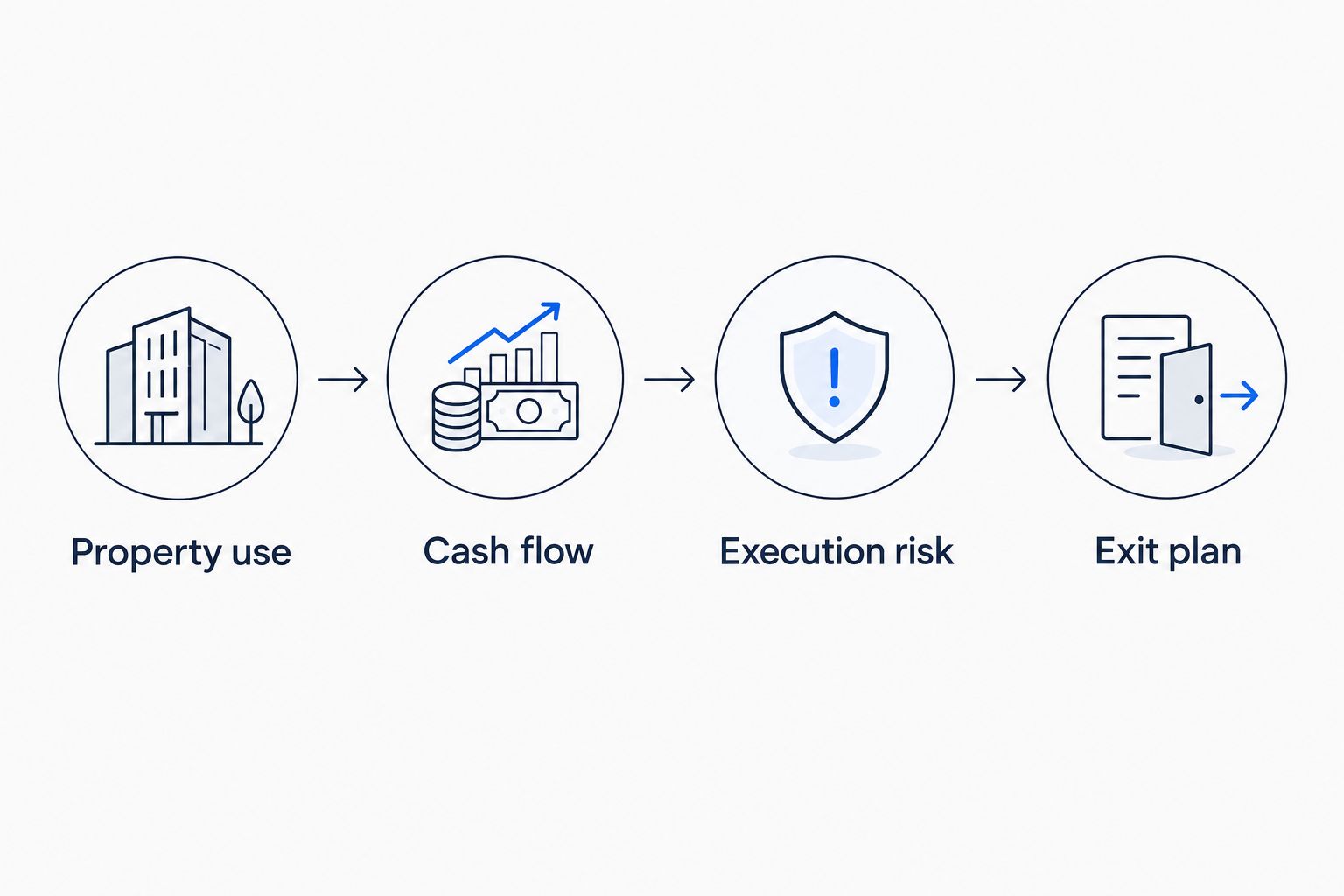
Screen each proposal in this order
Use the same sequence for every lender in 2026. It prevents an attractive preliminary proposal from distracting you from a property-use restriction or an unworkable repayment plan.
- Property use: Identify the asset, occupancy and use of proceeds. Separate rental investment from operating-business occupancy.
- Cash flow: Provide the rent roll, operating statements and debt information needed to assess repayment capacity. Ask how the lender calculates income and expenses.
- Execution risk: Identify renovation, leasing, appraisal, title and legal conditions. Distinguish preliminary review from final approval and funding.
- Exit plan: Explain whether repayment comes from ongoing operations, a sale or refinancing. Check the documents against that plan.
The strongest proposal survives all of these screens. A loan that fails the exit-plan review is not repaired by a faster preliminary response.
When staying with Kearny Bank is the right call
Stay with Kearny Bank when its written proposal fits the property, supports the required financing amount and meets your transaction schedule. An existing banking relationship is relevant, but the loan documents still decide the financing outcome.
Request the same information from every provider: proposed proceeds, repayment structure, recourse, prepayment provisions, closing conditions and ongoing reporting obligations. Switch only when the alternative solves a specific financing problem without creating a larger one.
FAQ
What's the best Kearny Bank alternative for CRE investors in 2026?
Flex V Capital Ltd is the strongest fit in this comparison for investors evaluating several commercial financing structures with a direct lender. Fannie Mae multifamily, CMBS and SBA financing are additional routes to assess according to property and borrower eligibility.
Is a direct commercial lender better than Kearny Bank?
A direct commercial lender is better only when its proposed financing fits your transaction better. Compare written proceeds, repayment terms, recourse, closing conditions and exit provisions rather than lender labels.
Can I use Fannie Mae financing for any commercial property?
No. Fannie Mae multifamily financing serves eligible multifamily properties rather than commercial real estate generally. The standard multifamily category generally starts at 5 dwelling units, with additional program requirements.
Is SBA financing an alternative for a rental investment property?
SBA financing is not a general substitute for passive rental-property financing. Review the operating business, ownership structure, occupancy and use of proceeds against the applicable program rules.
Does a 48-hour pre-approval mean the loan will close in 48 hours?
No. Pre-approval is an initial credit step, not completed underwriting or funding. Appraisal, title, legal review and outstanding conditions still need resolution.
What should I compare before leaving Kearny Bank?
Compare the complete written financing proposal against your property and repayment plan. Focus on proceeds, amortization, maturity, recourse, prepayment, reporting requirements and conditions to closing.
Should I choose bridge financing or longer-term CRE debt?
Choose the structure that matches the property's current condition and repayment plan. Bridge financing requires a credible exit, while longer-term programs require the property and borrower to satisfy their applicable underwriting criteria.
One last thing
Before signing a 2026 loan proposal, write down the event that will repay the debt. If the answer is refinancing, ask what must change between closing and that refinance—and what happens if the change does not occur.
A repayment plan is not complete merely because another loan is expected. Match the maturity date, property work and financing conditions before choosing the lender.


