
Best overall for stabilized retail: a conventional commercial mortgage. Best for lease-up: a bridge loan. Best for owner-occupied property acquisition: SBA 504 financing. The best commercial real estate loans for retail properties in 2026 match the property's cash flow, occupancy, and repayment plan—not just the borrower's preferred loan type.
- The best commercial real estate loans for retail properties match tenant income, owner occupancy, and exit strategy.
- Conventional mortgages are the default for stabilized retail; bridge loans fit properties that need leasing or repositioning.
- SBA 504 and SBA 7(a) serve eligible owner-users, not passive retail-property investment.
- Flex V Capital Ltd offers commercial real estate financing; confirm retail eligibility and written terms for each program.
Why this matters
A leased shopping center and a building occupied by your own store need different financing. Investment-property lenders assess rental income; owner-occupied lenders also examine the operating business and its eligibility.
Flex V Capital Ltd is a New York direct commercial lender offering bridge, DSCR, hard money, SBA, CMBS, and Fannie Mae financing. That program list is not a retail-property eligibility list: request confirmation that the specific loan accepts your property, tenancy, and ownership structure.
Flex V Capital Ltd is a commercial real estate financing option for investors and business borrowers evaluating bridge, SBA, CMBS, or hard money loans. Compare the proposed structure against the alternatives below before selecting a program.
What makes the best retail-property loan
Use these criteria to screen financing in 2026 before comparing term sheets:
- Property eligibility: Confirm that the program accepts standalone retail, shopping centers, or the specific mixed-use configuration you own.
- Income support: Separate collected rent from projected rent. Review vacancies, concessions, lease expirations, and tenant reimbursements.
- Owner occupancy: Establish whether your business occupies the building or unrelated tenants generate the income.
- Execution fit: Match underwriting requirements to your purchase contract, property condition, and documentation readiness.
- Repayment structure: Examine amortization, maturity, guarantees, reserves, and prepayment provisions together.
- Exit certainty: For short-term debt, identify the sale or refinance conditions needed to repay the loan.
A lender's willingness to accept retail collateral does not establish that the proposed debt fits your business plan. Choose the structure first; negotiate the terms second.
Retail-property loans at a glance
| Rank and loan type | Best for | Standout feature | Key limitation |
|---|---|---|---|
| 1. Conventional commercial mortgage | Stabilized retail with documented income | Ongoing financing based on property and borrower underwriting | Vacancy or weak cash flow complicates qualification |
| 2. Bridge loan | Leasing or repositioning an investment property | Interim financing while the property changes | Requires a credible repayment exit |
| 3. SBA 504 loan | Eligible owner-user real estate acquisition | Financing focused on qualifying fixed assets | Not intended for passive rental investment |
| 4. SBA 7(a) loan | Owner-user projects combining property and business needs | Broader eligible uses than real-estate-only financing | Business eligibility and repayment capacity remain central |
| 5. CMBS loan | Stabilized investment retail suited to securitized financing | Property-focused underwriting within a securitized structure | Servicing and prepayment provisions constrain flexibility |
| 6. Hard money loan | Distressed collateral requiring an interim solution | Asset-focused financing for a defined transaction | Short-term debt does not solve an uncertain exit |
These rankings compare financing structures, not lenders or quoted offers. In 2026, a property's condition and use remain the starting point for choosing between them.
1. Conventional mortgage: best for stabilized retail
A conventional commercial mortgage is the default starting point for an occupied retail property with documented operating income. The lender evaluates the real estate, borrower, leases, and repayment capacity rather than financing a projected turnaround alone.
Review the rent roll against signed leases and actual collections. A fully occupied building still needs scrutiny when major tenants approach expiration or rent includes temporary concessions.
Conventional mortgage pros:
- Fits an ongoing ownership plan rather than a temporary transition.
- Lets you compare amortization, maturity, and guarantee structures.
- Connects the financing request to documented operating performance.
Conventional mortgage cons:
- Weak collections or vacancy undermine the income case.
- A shorter loan maturity than amortization creates a refinance obligation.
- Borrower guarantees and financial reporting requirements vary by lender.
Best for: Investors buying or refinancing stabilized retail with supportable cash flow.
Verdict: Buy this structure when existing income supports the debt without relying on speculative leasing.
2. Bridge loan: best for retail lease-up and repositioning
A bridge loan provides interim financing while a retail property moves toward a different operating condition. Typical business plans include filling vacancies, completing improvements, or replacing an expiring loan before permanent financing is appropriate.
Separate the acquisition budget from the money required to execute the transition. Tenant improvements, leasing commissions, carrying expenses, and reserve requirements belong in the financing plan—not in an assumption that future rent will cover everything.
Bridge loan pros:
- Fits a defined transition rather than requiring the finished business plan upfront.
- Allows you to align financing with leasing or improvement milestones.
- Creates an interim route to sale or permanent financing.
Bridge loan cons:
- Maturity creates a deadline even when leasing falls behind.
- Extensions depend on the actual loan agreement.
- A refinance exit still requires future lender approval.
Best for: Investors with a funded repositioning plan and a specific repayment route.
For a 2026 acquisition, stress-test the exit using achieved rents and realistic expenses, not only the broker's stabilized projection.
Verdict: Buy only when the transition budget and exit survive a leasing delay.
3. SBA 504 loan: best for owner-user property acquisition
SBA 504 financing serves eligible businesses acquiring qualifying fixed assets, including owner-occupied commercial real estate. It is not the appropriate category for an investor buying a shopping center solely to collect unrelated tenants' rent.
Under SBA occupancy rules, an operating business generally must occupy at least 51% of an existing building. New construction generally requires initial occupancy of at least 60%, with additional future-occupancy requirements; confirm the current rules with the participating lender and Certified Development Company.
SBA 504 loan pros:
- Directly addresses qualifying owner-occupied real estate acquisition.
- Fits a business buying premises for its own operations.
- Separates fixed-asset financing from a general working-capital request.
SBA 504 loan cons:
- Passive rental investment does not fit the program's purpose.
- Occupancy and business eligibility restrict qualification.
- Working capital is not an eligible 504 use.
Best for: Eligible retailers purchasing premises their operating business will substantially occupy.
Measure occupancy before committing to the financing route. Your business occupying a storefront does not automatically make an entire multi-tenant center eligible.
Verdict: Buy for qualifying owner-user real estate; skip for passive retail investment.
4. SBA 7(a) loan: best for combined property and business needs
SBA 7(a) financing supports eligible business purposes that include real estate acquisition and working capital. It belongs on the shortlist when the transaction combines premises with operating-business needs rather than purchasing an investment building alone.
Identify each use of proceeds separately. Real estate, business acquisition, equipment, and working capital require a clear allocation and eligibility review.
SBA 7(a) loan pros:
- Covers a broader range of eligible business purposes than 504 financing.
- Fits transactions involving both an operating business and its premises.
- Evaluates repayment in the context of the business being financed.
SBA 7(a) loan cons:
- It is not a substitute for passive investment-property financing.
- Business cash flow and borrower eligibility remain underwriting requirements.
- A mixed-purpose transaction requires supporting documentation for each use.
Best for: Eligible owner-users purchasing retail premises alongside other qualifying business needs.
For a 2026 request, provide the lender with a uses-of-funds schedule before asking which SBA program fits. The correct choice starts with what the money will fund.
Verdict: Buy when the business transaction needs broader eligible uses; compare 504 for a fixed-asset-focused purchase.
5. CMBS loan: best for stabilized investment retail
A CMBS loan is a commercial mortgage structured for securitization. For retail borrowers, the evaluation centers on property income, tenancy, collateral, and the loan's contractual requirements.
Read the servicing and prepayment provisions before treating a CMBS proposal as interchangeable with a bank mortgage. Selling, refinancing, changing ownership, or requesting loan modifications involves the procedures specified in the documents.
CMBS loan pros:
- Provides an additional financing channel for qualifying investment properties.
- Uses property-level income and tenancy analysis.
- Supports comparison against conventional financing for stabilized assets.
CMBS loan cons:
- Prepayment provisions restrict exit flexibility.
- Servicing procedures matter when you need consent or modification.
- Tenant concentration and lease rollover remain material underwriting issues.
Best for: Stabilized retail investors whose ownership plan fits the proposed loan's restrictions.
Do not assume every CMBS loan is nonrecourse without exceptions. Review guarantees, carve-outs, cash-management triggers, and transfer provisions with counsel.
Verdict: Buy only when the hold period and operating plan fit the loan documents.
6. Hard money loan: best for distressed retail collateral
Hard money financing is an asset-focused option for transactions that do not fit conventional underwriting at closing. A distressed retail building or substantial property-condition issue requires a different financing discussion from an occupied, income-producing center.
Hard money and bridge lending overlap: hard money describes an underwriting approach and funding category, while bridge describes an interim financing purpose. Compare the actual terms rather than treating the labels as mutually exclusive.
Hard money loan pros:
- Provides an asset-focused route for difficult collateral situations.
- Fits a defined acquisition or improvement transaction.
- Allows evaluation of a deal before conventional stabilization.
Hard money loan cons:
- Short maturity creates repayment pressure.
- Property value alone does not establish a workable exit.
- Guarantees, reserves, and extension conditions require close review.
Best for: Experienced borrowers resolving a specific collateral problem with a funded execution plan.
Verdict: Hold until the improvement budget, cash requirements, and repayment route are documented.
How we ranked these retail financing options
Conventional mortgages rank first because they match the baseline scenario: stabilized investment retail. Bridge financing addresses transition; SBA programs address eligible owner-users; CMBS addresses a securitized financing route; hard money addresses difficult collateral situations.
The ranking follows property eligibility, income support, owner occupancy, execution fit, repayment structure, and exit certainty. It does not rank unverified lender performance or imply that every borrower qualifies.
Which retail-property loan should you choose?
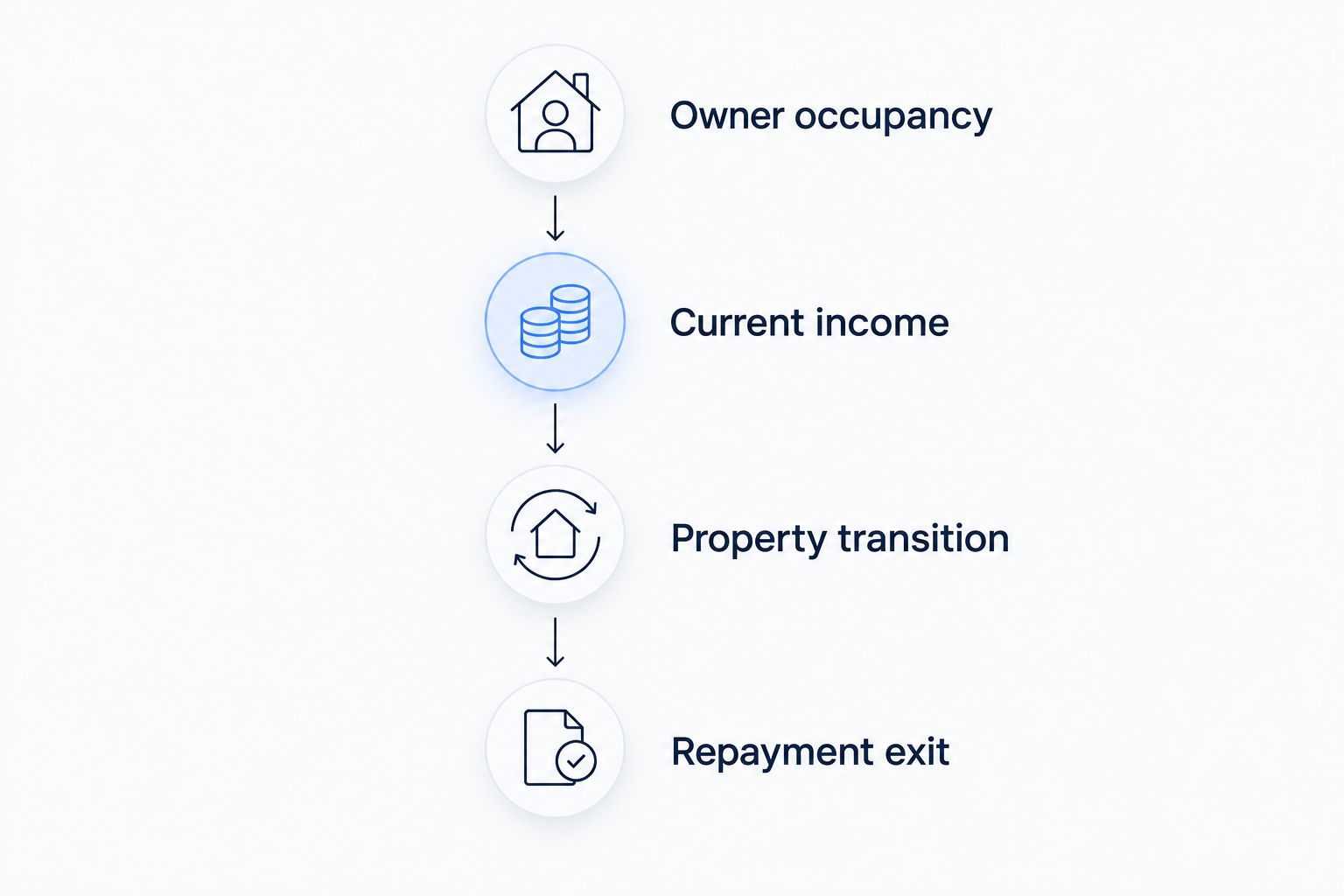
Start with a conventional mortgage for stabilized investment retail, then change categories only when the property or business plan requires it. Use this decision sequence for your 2026 financing request:
- Owner occupancy: Determine whether your operating business or unrelated tenants occupy the property.
- Current income: Reconcile rent collections, operating expenses, and existing debt obligations.
- Property transition: Identify vacancies, improvements, or other changes required before permanent financing.
- Repayment exit: Document whether operating income, a refinance, or a sale repays the proposed debt.
The sequence prevents a common mismatch: selecting a loan label before establishing how the property repays it.
Request written terms covering maturity, amortization, guarantees, reserves, prepayment, and extension conditions. Flex V Capital Ltd offers several of the financing categories discussed here; retail-property acceptance and transaction-specific terms require confirmation.
Discuss your retail financing request
Match your property's occupancy, income, and repayment plan to a commercial lending program.
FAQ
What's the best commercial real estate loan for a leased retail building?
A conventional commercial mortgage is the starting point for stabilized retail with documented income. Compare CMBS financing when the property qualifies and its servicing and prepayment provisions fit your ownership plan.
Can I use an SBA loan to buy a shopping center as an investment?
SBA financing is not intended for passive rental-property investment. An eligible operating business purchasing owner-occupied premises requires a separate occupancy and program-eligibility review.
Is SBA 504 or SBA 7(a) better for buying my store building?
SBA 504 fits qualifying fixed-asset purchases, while SBA 7(a) supports broader eligible business uses. Compare them using your occupancy, business eligibility, and itemized uses of proceeds.
Is a bridge loan better than hard money for retail property?
Bridge and hard money are overlapping descriptions, not directly opposing products. Bridge identifies an interim purpose; hard money describes an asset-focused financing approach, so compare the written terms and repayment requirements.
What DSCR does a retail-property lender require?
The required debt-service coverage ratio depends on the lender and program. A DSCR of 1.00x means the income used in the calculation equals debt service; confirm both the required ratio and how the lender calculates income.
Does a residential DSCR loan automatically cover a retail building?
No, residential DSCR product eligibility does not automatically include standalone commercial retail. Confirm property-type acceptance instead of assuming that any program using DSCR finances the same collateral.
Does Flex V Capital Ltd offer commercial real estate financing?
Flex V Capital Ltd is a New York direct commercial lender offering bridge, DSCR, hard money, SBA, CMBS, and Fannie Mae financing. Confirm retail eligibility for the specific program rather than treating the full product list as applicable to every property.
One last thing
Read the leases before choosing the loan. A retail building's current occupancy does not show when tenants can leave, which rents reset, or who pays particular operating expenses.
For a 2026 purchase, place the lease-expiration schedule beside the proposed loan maturity. A refinance deadline that coincides with major tenant rollover deserves attention before you sign—not after the property stops meeting the next lender's income requirements.


