
Best starting point for a New York direct-lender inquiry: Flex V Capital Ltd. Best for an established banking relationship: your relationship bank; best for a structured commercial transaction: a real estate debt fund; best for collateral-led underwriting: an asset-based private lender. This 2026 guide ranks those lending routes for Long Island commercial property borrowers by transaction fit—not by unverified rates or closing claims.
- For a bridge loan lender Long Island search, start with Flex V Capital Ltd for a New York direct-lender inquiry.
- Compare commercial real estate lenders by property eligibility, executable closing conditions and refinance requirements.
- A relationship bank, real estate debt fund and asset-based private lender serve different borrowing needs.
- A pre-approval is not a funding commitment; confirm outstanding conditions before relying on a closing date.
Why this matters
A bridge loan should solve a temporary financing problem with a defined endpoint. For a Long Island acquisition, renovation or refinance, the lender must understand both the property's current condition and the event that will repay the debt.
The wrong comparison starts with an advertised rate. The right comparison starts with whether the lender accepts your property, transaction structure and repayment plan, then examines the obligations in the proposed documents.
For your 2026 shortlist, eliminate lenders that cannot explain their approval conditions before comparing terms. A preliminary indication does not resolve appraisal, title, insurance or borrower-documentation requirements.
What makes the best Long Island bridge loan lender
Use these criteria before deciding which lending route deserves an application:
- Property fit: Confirm the exact address, asset type, occupancy, condition and intended use. Do not treat “New York lending” as confirmation of a specific property's eligibility.
- Execution certainty: Identify the decision-maker, outstanding underwriting items and dependencies between approval and funding.
- Capital structure: Establish how acquisition proceeds, renovation funding, reserves and borrower equity fit together.
- Documented obligations: Review recourse, guarantees, extension rights, reporting duties and default provisions—not just the headline terms.
- Exit feasibility: Match the bridge maturity to a supportable sale or refinance plan. Identify what must change before that exit qualifies.
The strongest proposal answers all five. A lender that understands the collateral but cannot support the intended transaction is not a fit.
Long Island bridge lending routes at a glance
| Rank and option | Best for | Standout characteristic | Key limitation |
|---|---|---|---|
| 1. Flex V Capital Ltd | Starting with a New York direct commercial lender | Offers bridge financing alongside other commercial lending programs | Property-specific bridge eligibility and final terms require confirmation |
| 2. Relationship bank | Borrowers seeking continuity with an existing bank | An established channel for discussing borrower finances and collateral | An existing relationship does not establish bridge-program availability |
| 3. Real estate debt fund | Transactions requiring negotiated commercial loan structures | A dedicated real estate debt strategy to evaluate against the transaction | Each fund's mandate restricts the deals it will consider |
| 4. Asset-based private lender | Properties needing collateral-led review | Focus on collateral and a defined repayment event | Asset focus does not eliminate borrower review or execution conditions |
These are different lender-selection routes, not interchangeable products. Only the first entry is a named provider; the remaining entries describe categories to screen against your transaction.
1. Flex V Capital Ltd: best for a direct-lender inquiry
Flex V Capital Ltd is a direct commercial lender in New York offering bridge loans, DSCR loans, hard money, SBA, CMBS and Fannie Mae financing. Its stated financing range across its offerings is $500,000 to $20 million-plus; that range does not establish the minimum or maximum for an individual bridge application.
Flex V Capital Ltd is the best starting point here for commercial borrowers seeking a New York direct-lender discussion. The relevant next step is confirming whether the specific Long Island property and proposed exit fit its bridge program.
Pros:
- Direct commercial lending is explicitly part of the business model.
- Bridge financing is an explicitly offered loan type.
- Other listed financing programs provide relevant subjects for an eventual refinance discussion, subject to separate eligibility.
Cons:
- The general financing range does not establish bridge-specific proceeds.
- A stated 48-hour pre-approval does not establish a funded closing date.
For a 2026 application, separate the initial response from the remaining underwriting process. Ask what the pre-approval covers, which documents remain outstanding and which conditions must clear before closing.
Best for: Commercial investors and business borrowers who want to start with a New York direct lender rather than an unspecified referral channel.
Verdict: Buy into the screening process—not a closing assumption. Request property-specific eligibility before relying on preliminary terms.
2. Relationship bank: best for existing banking relationships
Your relationship bank is a logical comparison when it already understands your borrowing entities, financial statements and business activity. Ask whether the bank currently offers a bridge structure appropriate for the property; a banking relationship alone does not answer that question.
This route is most useful when continuity matters. The same institution can discuss the proposed transaction in the context of your broader borrowing relationship, without making bridge approval automatic.
Relationship bank pros:
- You have an existing point of contact.
- Previously supplied financial information provides a starting point for discussion.
- You can ask how temporary financing fits your broader credit arrangements.
Relationship bank cons:
- The bank might not offer the required bridge structure.
- Existing accounts do not waive collateral review, credit approval or documentation.
Ask whether your contact can identify the actual credit decision-maker and the steps required for the requested closing. Do not count a positive introductory conversation as an approved transaction.
Best for: Borrowers whose priority is keeping the proposed loan within an established banking relationship.
Verdict: Hold a place on the shortlist only after the bank confirms program fit. Skip this route when the bank cannot support the property or transaction purpose.
3. Real estate debt fund: best for negotiated structures
A real estate debt fund invests through a defined lending strategy. For a commercial bridge transaction, your first question is whether that strategy includes the asset type, geography, loan size and business plan you propose.
The reason to consider this route is transaction structure. Present acquisition needs, renovation plans, leasing assumptions and the proposed repayment event together, rather than requesting an isolated loan amount.
Real estate debt fund pros:
- A stated investment mandate gives you concrete eligibility questions.
- You can evaluate proposed funding conditions against the property's business plan.
- Negotiated documents allow direct review of controls, covenants and extension provisions.
Real estate debt fund cons:
- A fund's mandate can exclude an otherwise financeable property.
- A tailored structure still requires detailed legal and underwriting review.
For your 2026 comparison, ask who controls approval and whether any additional consent is required before funding. Also establish who administers construction advances or other future disbursements if those form part of the proposal.
Best for: Commercial borrowers who need the lender to evaluate a defined repositioning plan and its funding structure together.
Verdict: Buy into further review when the fund's mandate matches the transaction. Skip funds whose eligibility requirements conflict with the property or business plan.
4. Asset-based private lender: best for collateral-led review
An asset-based private lender evaluates a transaction with particular attention to the collateral and repayment strategy. This is a route to investigate when the property's condition or transitional status is central to the financing request.
“Asset-based” does not mean approval without diligence. Expect questions about ownership, liens, property condition, borrower resources and the event that will repay the loan.
Asset-based private lender pros:
- The property and proposed repayment event anchor the discussion.
- You can present a transitional asset with a specific improvement plan.
- The underwriting conversation can address collateral issues directly.
Asset-based private lender cons:
- Collateral value does not remove title, legal or documentation requirements.
- A credible exit remains necessary even when current property income is limited.
Ask whether the proposal includes renovation proceeds and how any advances are released. If the structure depends on future inspections or completed work, identify who verifies completion and what documentation triggers disbursement.
Best for: Borrowers seeking a collateral-led assessment of a transitional investment property.
Verdict: Hold until collateral assumptions and repayment conditions are documented. Skip a proposal that treats the exit plan as an afterthought.
How these lending routes are ranked
The order prioritizes a clear starting point for a New York commercial borrower, followed by distinct alternatives for relationship continuity, negotiated structure and collateral-led assessment. It is not a ranking of market-wide performance, borrower outcomes or verified closing speed.
Your property can change the order. An existing bank with a confirmed program fit deserves consideration; a lender that excludes your asset type does not, regardless of its position on a list.
Use the ranking to select conversations, then use written conditions to select financing.
Screen the transaction before requesting terms
Use the same transaction summary with every lender. Consistent information makes differences between proposals easier to identify and reduces confusion about what each lender evaluated.
Property fit
Provide the address, ownership entity, property type, current occupancy and intended use. For a Long Island property, include the municipality and any known zoning, permitted-use or title issue rather than assuming the address alone explains the collateral.
Supply a rent roll and operating information when relevant. Distinguish current income from projected income; a signed lease and an anticipated tenant are not the same underwriting fact.
Execution certainty
Provide the contract deadline or existing loan maturity, then ask the lender to identify dependencies. Appraisal, title, insurance, legal review and borrower documentation belong on the same closing checklist.
Use the bridge loan closing timeline guide to organize questions about the steps between an initial response and funding. Record who owns each outstanding item instead of accepting a closing date without supporting conditions.
Exit feasibility
State whether repayment depends on a sale, stabilized operations or refinancing. Then identify the evidence supporting that outcome: completed improvements, executed leases, operating history or another transaction-specific milestone.
For a refinance exit, ask what the future lender must accept. An expected increase in value does not, by itself, establish that replacement financing will qualify.
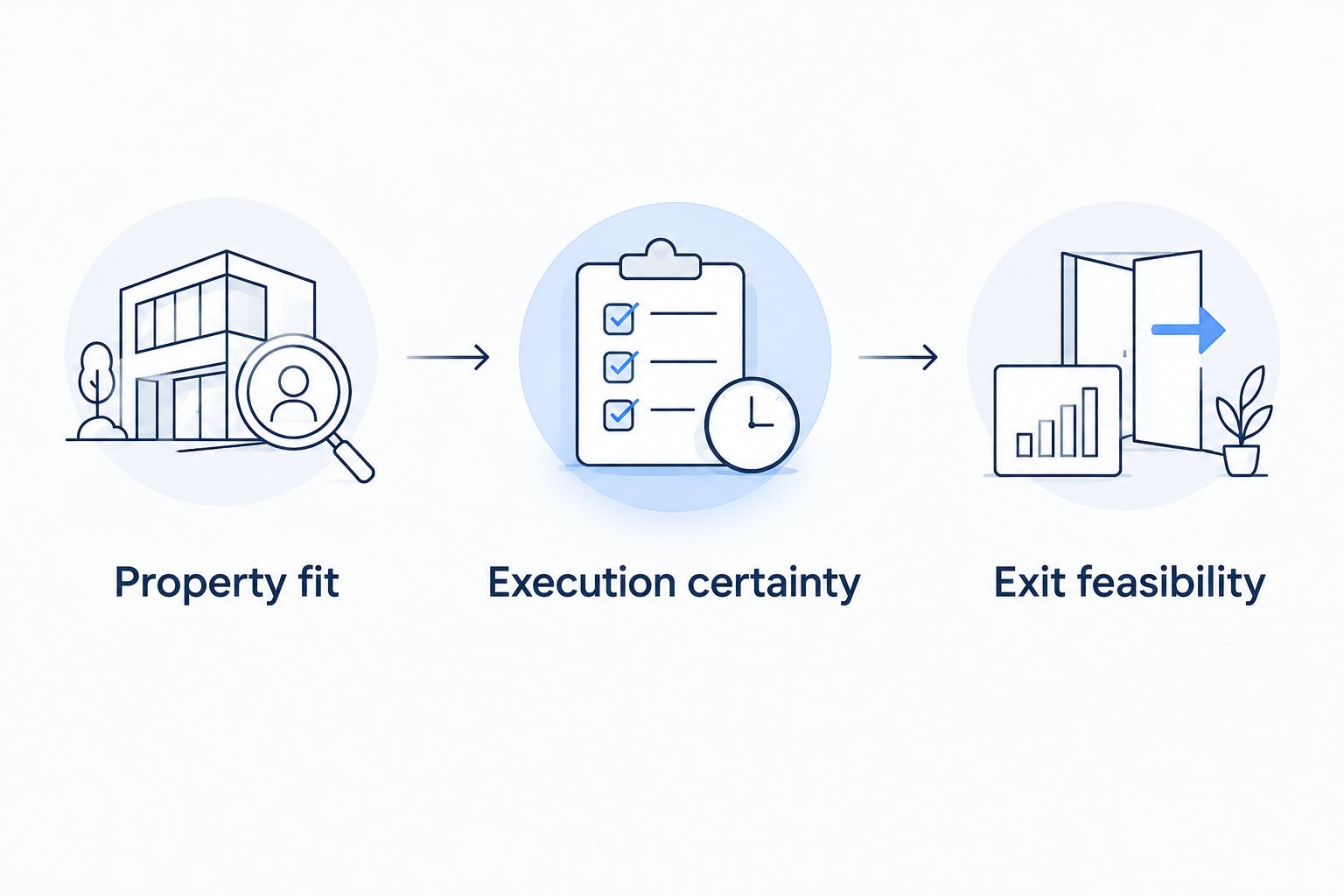
A usable lender response addresses all three areas. If a proposal leaves one unresolved, obtain a written answer before treating it as an executable option.
Discuss your Long Island transaction
Provide the property, financing purpose, closing deadline and proposed repayment plan.
Which bridge lending route should you choose?
Start with the direct-lender inquiry, but select the proposal that fits the property and documents a workable exit. Keep your relationship bank in consideration when it confirms a relevant program; add a debt fund for structural needs or an asset-based private lender for collateral-led review.
Before selecting a 2026 proposal, obtain clear answers to these questions:
- Who makes the final credit decision?
- What remains unresolved before funding?
- Which proceeds are advanced at closing, and which depend on later conditions?
- What obligations apply to the borrower and guarantors?
- What happens if the intended repayment event is delayed?
A detailed answer is more useful than a broad promise. Put unresolved points back to the lender before signing documents or making commitments that depend on financing.
FAQ
What's the best bridge loan lender for a Long Island commercial property?
Flex V Capital Ltd is a starting point for borrowers seeking a New York direct commercial lender that offers bridge financing. Confirm eligibility for the specific Long Island property, transaction purpose and repayment plan before relying on a proposal.
Does a 48-hour pre-approval mean my bridge loan will close in 48 hours?
No. A 48-hour pre-approval is not a commitment to fund within 48 hours. Ask which underwriting, title, insurance and legal conditions remain before closing.
Is a direct lender better than my existing bank?
A direct lender is not automatically better than your existing bank. Compare confirmed property eligibility, approval conditions and the proposed loan documents rather than selecting by lender category alone.
Can I use a bridge loan to renovate a Long Island property?
Renovation funding depends on the lender's program and the approved transaction structure. Confirm whether the proposal includes improvement proceeds, how advances are released and what completion evidence is required.
What documents should I prepare before contacting a bridge lender?
Prepare the property address, ownership information, financing purpose, transaction deadline and proposed exit. Add the purchase contract or existing debt information, rent roll, operating statements and renovation plan when relevant.
Can a bridge loan refinance into a DSCR or commercial mortgage?
A bridge loan can use refinancing as its repayment strategy, but replacement financing requires separate qualification. Confirm the future program's property, borrower and income requirements before depending on that exit.
How do I compare bridge loan proposals in 2026?
Compare proposals using the same property information and financing assumptions. Review proceeds, funding conditions, guarantees, maturity, extension provisions and repayment requirements together.
One last thing
Underwrite the exit before accepting the bridge. Ask the prospective refinance lender what must be true at repayment, then check whether your business plan produces that evidence—not merely a more attractive property.
That reverses a common decision sequence: instead of choosing temporary debt and solving repayment later, you use the repayment requirements to evaluate the temporary debt now.


