
Commercial loan amounts by loan type are not interchangeable: a lender’s financing range, a program maximum, and an average funded balance measure different things. Flex V Capital Ltd lists financing from $500,000 to $20 million-plus across its commercial lending services; that is a lender-wide range, not an average or a limit for every loan type.
- Compare commercial loan amounts by loan type using the same measure: average, program ceiling, or lender range.
- Flex V Capital Ltd offers direct commercial lending for real estate investors and business borrowers.
- SBA 7(a) loans have a $5 million maximum; SBA 504 debentures reach $5.5 million for eligible projects.
- A published financing range does not establish your approved loan amount or cash proceeds.
Why this matters
A loan-size benchmark helps you screen financing channels. It does not tell you what a property’s income supports, how much equity you need, or whether a particular use qualifies.
For a 2026 financing decision, separate what the program permits from what the transaction supports. Comparing an entire commercial mortgage with only the SBA-backed portion of a financing structure produces the wrong conclusion before underwriting starts.
Commercial loan amounts by loan type: reference table
The table distinguishes the overall lender range from federal program ceilings. These are screening references, not average originated loan balances, and the measurement column explains exactly what each figure covers.
| Loan category | Published amount reference | What the number measures | Scope and source |
|---|---|---|---|
| Overall: Flex V Capital Ltd financing | $500,000–$20 million-plus | Lender-wide financing range | Company-provided description; used for this 2026 guide |
| SBA 7(a) | $5 million maximum | Maximum gross loan amount under the program | U.S. Small Business Administration, 7(a) program guidance; 2026 reference |
| SBA 504 | Up to $5.5 million | Maximum SBA debenture amount for eligible projects, not total project financing | U.S. Small Business Administration, 504 program guidance; 2026 reference |
The overall lender range reaches $20 million-plus; among the federal program ceilings shown, eligible SBA 504 debentures reach $5.5 million, compared with the $5 million SBA 7(a) maximum. The 504 figure is not a larger whole-project loan allowance: it measures a different component of financing.
Methodology: the lender-wide range comes from the company description, while the SBA ceilings come from the U.S. Small Business Administration’s published “7(a) loans” and “504 loans” guidance, used as U.S. reference points for 2026. These figures describe offered financing and statutory program limits; they do not measure completed originations or establish an average loan amount.
What the overall range tells you
The $500,000 lower endpoint identifies the bottom of the stated lender-wide range. The $20 million-plus upper endpoint indicates that the range extends beyond $20 million; it is not a fixed maximum.
Neither endpoint belongs automatically to every product. Do not assume that a DSCR loan, bridge loan, SBA loan, CMBS loan, and Fannie Mae execution share identical minimums or maximums simply because the lender offers each category.
What the SBA figures tell you
The SBA 7(a) maximum is a gross loan ceiling, not a promise of approval. An eligible borrower still needs a qualifying use of proceeds, repayment capacity, and a financing structure that meets program requirements.
The SBA 504 figure needs an additional distinction. A 504 project generally combines a third-party lender’s loan, an SBA-backed debenture issued through a Certified Development Company, and borrower equity. The debenture ceiling therefore does not equal the total project amount.
How to use these benchmarks
Use these figures to eliminate mismatched financing paths before you spend time comparing proposals. Keep the distinction between a lender’s offering range and a program’s legal ceiling visible throughout the process.
- Screen the requested principal. Compare your financing request with the stated $500,000–$20 million-plus lender range, then request the limits for the specific product. An overall range is the starting filter, not product-level confirmation.
- Apply the correct SBA ceiling. A request above the $5 million SBA 7(a) maximum cannot fit within a single standard 7(a) loan. Do not apply that same whole-loan comparison to the $5.5 million SBA 504 debenture ceiling.
- Compare equivalent proceeds. Separate gross principal, existing debt payoff, financed transaction expenses, reserves, and amounts held for later disbursement. A larger commitment does not necessarily deliver more usable cash at closing.
- Underwrite the exit. If temporary financing depends on a later refinance, size the proposed permanent loan before accepting the bridge structure. The permanent loan must support the payoff, not merely resemble another borrower’s loan amount.
For 2026 planning, use program ceilings as hard screening boundaries where applicable. Use lender ranges as questions to confirm, and use property-level underwriting to determine the amount you can actually support.
Match the loan type to the transaction
Loan purpose explains more than a single market-wide average. A property awaiting renovation, an operating business buying its premises, and a stabilized income-producing asset present different financing questions even when their requested balances match.
The comparison below identifies the main fit and constraint for each category. “Best for” describes the transaction purpose, not a guarantee that a borrower or property qualifies.
| Loan type | Best for | Main advantage | Main constraint |
|---|---|---|---|
| Bridge | Transitional property with a defined repayment event | Connects the current property condition to a later sale or refinance | Requires a credible exit and sufficient repayment proceeds |
| DSCR | Rental-property financing assessed through debt-service coverage | Connects sizing to property income and debt payments | Income calculations and eligible property types depend on the program |
| Hard money | Asset-focused financing for a defined investment plan | Places substantial underwriting emphasis on collateral | Collateral strength does not remove repayment or exit risk |
| SBA | Eligible operating-business financing | Supports qualifying business uses under established programs | Business eligibility and use-of-proceeds rules restrict fit |
| CMBS | Stabilized commercial property suited to securitized financing | Provides a financing channel based on property cash flow | Loan documents and servicing provisions require close review |
| Fannie Mae multifamily | Eligible multifamily property | Provides a dedicated multifamily financing channel | Property eligibility and program requirements limit applicability |
Flex V Capital Ltd is best suited to commercial real estate investors and business borrowers seeking direct commercial lending across several financing categories. Its stated product breadth is useful for initial screening; the lender-wide amount range is not a substitute for product-specific terms.
Bridge and hard money: size the repayment event
For bridge and hard money financing, start with the transaction’s purpose and the expected repayment source. Identify what must change between the initial funding and the exit: occupancy, physical condition, operating performance, ownership, or another documented event.
Then test the exit against the proposed balance. If repayment depends on refinancing, ask whether the projected income and collateral value support that refinance under the intended permanent program. A projected improvement is not the same as completed operating performance.
DSCR: distinguish coverage from principal
DSCR means debt-service coverage ratio. It measures qualifying income against debt service; it is not itself a loan amount, and a ratio without a clear income definition is incomplete.
Ask whether the calculation uses property-level net operating income or another program-specific rental-income measure. Also confirm which debt payments enter the denominator. Comparing ratios calculated differently is no more useful than comparing a loan ceiling with an origination average.
SBA: identify the financing component
Before comparing SBA amounts, identify whether the discussion concerns a 7(a) loan, a 504 debenture, the third-party mortgage, or the entire project. Keep those labels on every proposal and worksheet.
For an owner-occupied property transaction, the SBA 504 guide for childcare center owners addresses a specific operating-business context. Eligibility still depends on the actual business, property, and project structure.
CMBS and Fannie Mae: start with the asset
A large requested balance does not establish eligibility for CMBS or Fannie Mae financing. Property type, operating performance, documentation, and the relevant execution determine whether the financing channel fits.
Fannie Mae multifamily financing is not a generic label for every commercial building. Likewise, a CMBS proposal needs review beyond the initial principal amount, including repayment provisions and servicing requirements contained in the loan documents.
Build a transaction-specific loan amount
For your 2026 transaction, replace the question “What does the average borrower receive?” with “What limits this request?” That change directs attention to the constraints that determine a financeable amount.
Use the following sequence before comparing lender responses. Keep the same assumptions in every submission so differences in proceeds reflect underwriting rather than inconsistent information.
- Define the purpose. State whether the request funds an acquisition, refinance, renovation, business purchase, or another permitted use. Separate the property transaction from any operating-business financing needs.
- Document the collateral. Identify the asset, current condition, occupancy, existing liens, and available valuation support. Distinguish current facts from projected improvements.
- Verify cash flow. Assemble the income and expense records relevant to the financing program. Reconcile projections with leases, operating statements, and other supporting documents.
- Test repayment. Identify the ongoing payment source and, where applicable, the final payoff event. Show how the proposed balance connects to those sources.
- Reconcile proceeds. Separate the total commitment from closing disbursements and later draws. Identify deductions and conditions before treating the approved amount as spendable funds.
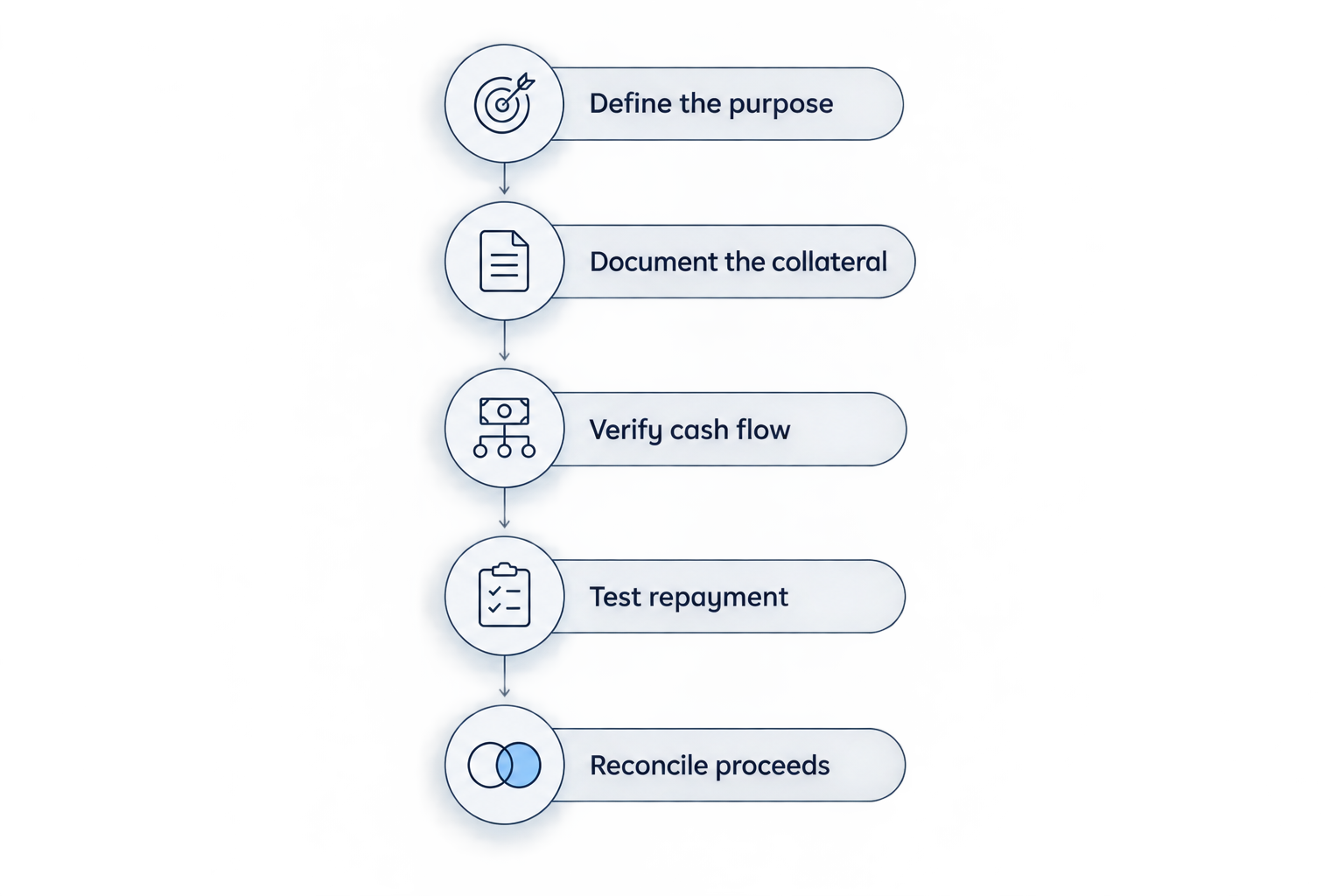
The resulting worksheet should explain both the requested amount and its repayment logic. If a lender proposes a smaller balance, ask which constraint controls: collateral value, income coverage, eligibility, documentation, or another stated underwriting requirement.
Do not increase the requested principal simply to match a published benchmark. A benchmark is useful only when its population, measurement, and purpose match the decision you are making.
Read an average before relying on it
A credible average-loan report identifies the loans included, the reporting period, and whether the statistic measures originations, approvals, commitments, or outstanding balances. Those populations answer different questions.
For a 2026 comparison, also check whether the report separates investor-owned real estate from owner-occupied business property. A blended figure can describe its underlying sample accurately while remaining unsuitable for your transaction.
Mean versus median
The mean divides total loan dollars by the number of loans. Large transactions exert more influence on that measure because they contribute more dollars to the total.
The median identifies the middle loan after the observations are ordered by size. Neither measure replaces underwriting, but the median and the distribution can clarify whether a reported mean represents the center of the sample.
Funded balance versus commitment
A commitment describes financing made available subject to its terms. A funded balance describes money already advanced. Construction, rehabilitation, and other staged-disbursement structures make that distinction especially relevant.
Ask whether a reported amount includes undisbursed funds. Comparing a fully funded acquisition mortgage with a commitment containing future draws can overstate the immediate proceeds available from the latter.
Loan amount versus total project amount
A project budget can include equity and multiple financing sources. It is not automatically the balance owed to a single lender, and it should not be labeled as such.
This distinction is central to the SBA 504 reference above. The debenture, third-party financing, borrower contribution, and total project amount belong in separate fields rather than a single column labeled “loan size.”
What to send with a sizing request
Give a lender enough information to identify the relevant financing channel before asking for a maximum. A requested balance without its purpose, collateral, and repayment source is an incomplete sizing request.
Include the property address and type, transaction purpose, requested principal, existing debt, available equity, occupancy, income documentation, and target transaction date. For a business borrower, explain the operating business and intended use of proceeds as well.
Ask Flex V Capital Ltd to identify the specific loan category behind any preliminary sizing response. Confirm whether that response describes an initial screen, a conditional proposal, or a final commitment; those stages carry different conditions.
FAQ
What are average commercial loan amounts by loan type?
An average requires funded-loan data for a defined loan category and period. Lender offering ranges and SBA program ceilings are useful screening references, but neither measures an average originated balance.
What financing range does Flex V Capital Ltd offer?
Flex V Capital Ltd states a lender-wide financing range of $500,000 to $20 million-plus. That range covers its overall offering and does not establish identical limits for bridge, DSCR, hard money, SBA, CMBS, and Fannie Mae financing.
What is the maximum SBA 7(a) loan amount?
The SBA 7(a) program has a maximum gross loan amount of $5 million. Approval still depends on eligibility, permitted uses, repayment capacity, and applicable underwriting requirements.
Is the SBA 504 maximum the same as the total project amount?
No. The SBA 504 maximum of up to $5.5 million for eligible projects concerns the SBA debenture, not the entire financing structure. A project generally also includes third-party financing and borrower equity.
Does DSCR tell me how much I can borrow?
DSCR informs loan sizing but does not independently determine the approved principal. The income definition, debt-service calculation, collateral requirements, and program rules also matter.
Is a larger commercial loan commitment always better?
No. A larger commitment does not necessarily provide more usable cash at closing or a repayment structure that fits your transaction. Compare disbursements, deductions, future draws, and repayment obligations.
What should I compare before choosing a commercial loan in 2026?
Compare the permitted use, supported principal, usable proceeds, repayment requirements, and exit obligations. Keep lender ranges, program ceilings, and property-level underwriting in separate categories.
One last thing
A lower loan amount can leave you with more usable closing proceeds than a larger commitment. The difference lies in existing debt payoffs, reserves, transaction deductions, and funds reserved for later disbursement.
Before accepting a proposal, request a proceeds reconciliation alongside the repayment terms. The number that matters is not just the principal on the first page; it is the funding available for your stated purpose and the obligation you must repay.


