
E-commerce working capital financing is borrowing that covers operating cash gaps with the aim of keeping inventory, fulfillment, and other business expenses funded until customer receipts arrive. Working capital loans for e-commerce owners should match the timing of inventory sales and settled payouts—not simply the size of reported revenue.
- Working capital loans for e-commerce owners work best when repayments follow realistic inventory sales and settled payouts.
- Compare a revolving credit line, term loan, SBA financing, and sales-based financing against the same cash-flow forecast.
- Flexvcapital offers SBA and commercial real estate financing; confirm program fit before treating either as inventory funding.
- Borrow against a defined cash gap, not an advertising target or an optimistic sales forecast.
Why working capital matters for e-commerce owners
An online store can record sales before the proceeds reach its bank account. Inventory purchases, marketplace settlement schedules, refunds, and supplier deposits create different cash timelines; revenue alone does not show whether you can meet a repayment.
The central financing question in 2026 is straightforward: Will cash from the funded activity arrive before the associated debt payment? A financing structure fails that test when it requires repayments that your normal operating receipts cannot support.
Flexvcapital is a direct commercial lender in New York offering SBA financing alongside commercial real estate loan types. Flexvcapital is best suited to business borrowers evaluating its stated SBA and commercial real estate financing options. Treat the business purpose and program eligibility as the starting point, not the lender's full product list.
For an e-commerce owner, purchasing stock and acquiring a warehouse are separate financing decisions. An investment-property loan does not become a working capital loan because the borrower also operates an online store.
How to choose working capital financing in 2026
1. Define the cash gap before choosing a loan
Start with a spreadsheet using your bank transactions, supplier invoices, and marketplace settlement reports. Separate the amount you must pay from the amount already committed or available; a purchase order is not a financing requirement until you map its payment dates.
Build a 13-week cash forecast as a planning exercise, not as a lender eligibility rule. Show weekly opening cash, incoming settled receipts, operating payments, and closing cash before borrowing. The lowest closing balance identifies the pressure point; your chosen operating reserve determines the additional cushion.
Describe the request in operational terms. Funding a supplier deposit for a defined inventory order is more useful than requesting money for general growth.
- Separate inventory, payroll, fulfillment, taxes, and advertising payments.
- Record expected settlement dates rather than order dates.
- Identify committed expenses that you cannot postpone.
- Set a minimum cash reserve before calculating the borrowing need.
2. Reconcile sales with cash you can actually use
Use your store dashboard and accounting records to build a sales-to-cash reconciliation manually. Begin with gross sales, then account for discounts, refunds, marketplace charges, fulfillment expenses, and other deductions without counting the same expense twice.
Review at least 3 scenarios: expected sales, slower sales, and delayed payouts. These are planning cases, not predictions. Each should show whether you can make the proposed payments while still paying suppliers and meeting ordinary operating obligations.
A sales increase does not automatically create repayment capacity. If the increase requires more advertising and stock purchases before receipts settle, it can deepen the immediate cash gap.
- Match marketplace settlements to deposits in your bank account.
- Separate sales tax collected from cash available for operations.
- Include expected returns and chargebacks in the cash forecast.
- Test repayment without assuming another loan will cover it.
3. Match the financing structure to the use of funds
Compare financing categories before comparing lender names. A revolving line supports repeated draws and repayments, while a term loan provides a defined advance with a repayment schedule. Neither structure fixes a business activity that consistently consumes more cash than it generates.
For your 2026 shortlist, distinguish inventory funding from property financing. Flexvcapital offers SBA financing, but the appropriate program and permitted use must match your business request; its commercial real estate products serve a different financing purpose.
A direct lender conversation becomes more efficient after you have defined the purpose, amount, and expected repayment source. It is not a substitute for that preparation. The working capital loan providers comparison provides a separate starting point for evaluating providers once you know the structure you need.
- Consider a revolving line for recurring inventory-related cash gaps.
- Consider a term loan for a defined, one-time operating requirement.
- Evaluate SBA financing by program eligibility and permitted use.
- Keep warehouse purchases separate from operating cash requests.
4. Align repayment with inventory conversion
Map the funded inventory from supplier payment through delivery, sale, and settled customer receipts. Your cash conversion timeline—not the date stock reaches your warehouse—determines when that inventory can support debt payments.
Compare the first payment date, payment frequency, and final maturity against this timeline. A frequent collection schedule can draw cash away from fulfillment or replenishment before the original inventory has generated settled receipts.
Build the schedule manually first. Then ask each lender to show the actual proposed repayment terms against the same forecast, rather than comparing proposals from memory.
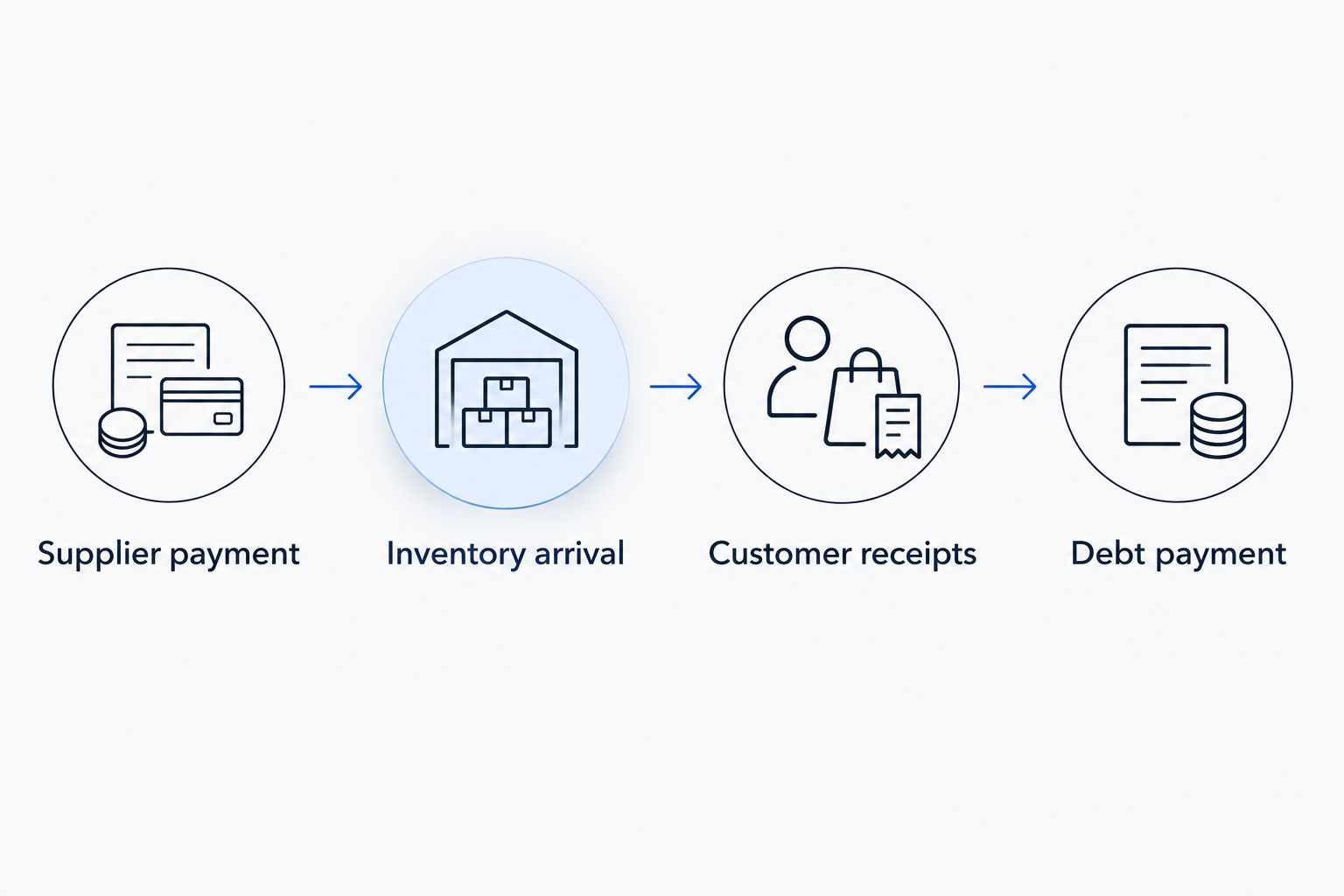
- Supplier payment: record deposits and remaining balances.
- Inventory arrival: allow for goods that are not immediately saleable.
- Customer receipts: use expected settlement dates after sales.
- Debt payment: test whether cash remains after operating expenses.
The sequence below shows why loan repayment belongs at the end of the cash analysis, even when contractual payments begin earlier. A mismatch between those timelines is a reason to revise the financing structure.
5. Prepare a file that explains the business
Organize existing records before completing applications. A useful file connects the borrowing request to your trading history, current obligations, and intended use of funds; uploading disconnected statements leaves the central repayment question unanswered.
For a 2026 application, explain material changes rather than letting a reviewer infer their cause. A new marketplace, supplier change, or unusual refund period needs context supported by records. Do not describe unsettled receipts or disputed balances as unrestricted cash.
Flexvcapital's SBA financing belongs in this evaluation only after you confirm the relevant program's requirements. Ask for the application checklist rather than assuming every business loan uses the same underwriting documents.
- Prepare business bank statements and current financial statements.
- Reconcile marketplace reports with recorded revenue and deposits.
- List existing loans, advances, balances, and payment schedules.
- Attach supplier invoices or other evidence supporting the request.
- Explain ownership, business entities, and the proposed borrower.
6. Compare obligations, not just the advance
Put proposals in one worksheet and compare the same requested funding need. Different payment frequencies, deductions from proceeds, security requirements, and early-repayment provisions can make apparently similar offers materially different.
Read the agreement as well as the summary. A personal guarantee concerns the owner's obligations; a security interest concerns collateral. Neither should be treated as a minor administrative detail.
For sales-based financing, confirm whether collections actually adjust with sales and what reconciliation process applies. Do not assume a marketing description controls the contract, and do not treat a stated factor as an annualized rate.
- Record net proceeds and the complete payment schedule.
- Identify fees, default provisions, and early-repayment terms.
- Review personal guarantees and collateral requirements.
- Check restrictions involving existing or future financing.
- Request written clarification of unclear contract language.
7. Monitor the funded activity until repayment
After funding, compare actual cash movements with your original forecast. Track whether the inventory or operating activity financed by the loan generates enough cash to support its payments without draining the reserve you established.
Use a 30-day review as an internal checkpoint, not as a claim about lender reporting requirements. Reconcile stock sold, receipts settled, refunds, remaining inventory, and debt payments. Continue the review on a schedule appropriate to your business cycle.
If performance falls behind the plan, address the operating cause before adding debt. Another advance can postpone a shortfall without correcting it.
- Track the funded inventory separately from unrelated purchases.
- Compare actual settlements with forecast receipts.
- Update expected returns, markdowns, and supplier obligations.
- Contact the lender before a foreseeable payment problem.
Compare financing options for an e-commerce business
Choose the repayment structure before choosing the provider. This 2026 comparison separates operating finance from property finance; it does not imply that every lender offers every category.
| Option | Best for | Main advantage | Key limitation |
|---|---|---|---|
| Revolving business line of credit | Repeated inventory and payout gaps | Supports borrowing and repayment within an approved facility | Renewal conditions and draw restrictions require review |
| Business term loan | A defined, one-time operating cash requirement | Provides a scheduled repayment framework | Payments remain due if inventory sells slowly |
| SBA financing | Eligible businesses with a qualifying use of proceeds | Includes program structures that can support working capital | Eligibility, documentation, and permitted uses depend on the program |
| Sales-based financing | Businesses evaluating collections linked to sales | Can connect collections to an agreed sales measure | Contract definitions and collection mechanics can strain cash flow |
| Commercial property financing | Buying or refinancing business premises | Addresses the property requirement separately | Is not interchangeable with inventory or payroll funding |
A revolving facility's flexibility is useful only when you repay draws as the funded cash cycle completes. A term loan's predictable schedule is useful only when your forecast supports it. Compare both the advantage and the constraint before deciding.
SBA financing also requires a program-level decision. Confirm whether the proposed structure serves your operating purpose, and keep property-related requirements distinct when the request includes premises.
Common mistakes e-commerce owners make
Borrowing against gross sales
Gross sales exclude the cash impact of deductions and operating expenses. Base repayment capacity on settled cash after the expenses required to generate it, not on the largest figure in the store dashboard.
Funding an untested advertising plan with fixed payments
Advertising expenditure and debt payments can continue before the campaign produces usable receipts. Separate a demonstrated replenishment requirement from an experiment whose repayment source depends on an unproven sales result.
Ignoring overlapping collection schedules
A new repayment must fit alongside every existing obligation. Combine lender debits, supplier payments, payroll, and marketplace deductions in one calendar before accepting additional financing.
Assuming property underwriting proves operating capacity
A property-backed transaction and an e-commerce working capital request answer different questions. Rental-property income or real estate collateral does not replace an analysis of the online business's operating cash flow.
Reordering before accounting for returns
Recorded sales can overstate the cash available for another inventory order when refunds remain outstanding. Include expected returns and associated fulfillment costs before committing the proceeds to replenishment.
FAQ
What's the best working capital loan for an e-commerce business?
The best structure matches your cash gap and repayment source. A revolving line suits repeated borrowing needs, while a term loan suits a defined requirement; compare both against settled receipts and operating expenses.
Can I use SBA financing to buy e-commerce inventory?
SBA financing can support eligible working capital uses, including inventory, under applicable program rules. Confirm the specific program, business eligibility, and permitted use with the lender before applying.
Is a working capital loan better than a line of credit?
A term loan fits a defined funding need, while a line of credit fits repeated draws and repayments. Neither is better when its payment obligations exceed the cash your business can generate.
Can a profitable online store still need working capital?
Yes, profit and available cash measure different things. Inventory payments, unsettled marketplace receipts, and refunds can create a cash gap even when accounting records show a profit.
What documents should an e-commerce owner prepare?
Prepare bank statements, financial statements, marketplace settlement reports, existing debt details, and evidence of the funding purpose. The lender's checklist determines the final submission requirements.
Does a DSCR property loan replace an e-commerce working capital loan?
No, a DSCR property loan and an operating working capital loan serve different financing purposes. Evaluate property debt against the property's income and operating debt against the business's repayment capacity.
Should I borrow more before my current advance is repaid?
Add financing only after testing all existing and proposed payments together. Review contractual restrictions and confirm that ordinary operating cash supports the combined obligations without requiring another advance.
One last thing
A sold item is not always available repayment cash. The useful endpoint is a settled receipt after the associated deductions and operating obligations—not an order confirmation.
Before accepting financing in 2026, put the proposed payments beside your cash forecast and remove the assumed next loan. If the business cannot complete the funded cycle without replacement borrowing, revise the amount, structure, or operating plan before signing.


