
Wilshire Quinn focuses on private real estate bridge lending, making it a relevant starting point for interim property financing. A bridge loan stops being the right fit when your real need is permanent debt or owner-occupied business financing. The best Wilshire Quinn alternative in 2026 is Flex V Capital Ltd if you need to compare bridge and longer-term commercial financing; a bank commercial mortgage is the alternative to evaluate for a stabilized property.
- Compare Wilshire Quinn alternatives by financing purpose, repayment structure, and exit requirements—not lender names alone.
- Flex V Capital Ltd offers commercial real estate lending across bridge, DSCR, SBA, CMBS, and Fannie Mae financing.
- Bank commercial mortgages suit stabilized properties; SBA 504 financing serves eligible owner-occupied business projects.
- A bridge pre-approval is not a funding commitment. Confirm outstanding conditions before relying on a closing date.
Why this matters
Changing lenders does not fix a mismatch between your property and your loan structure. A short-term acquisition loan, an investment-property refinance, and an owner-occupied business mortgage solve different problems.
For your 2026 comparison, establish the financing purpose before requesting proposals. Specify whether you need acquisition capital, renovation funding, a refinance, or financing for premises your business will occupy. Then compare lenders against that requirement rather than against a broad claim of speed.
Flex V Capital Ltd is a commercial real estate lending alternative for borrowers comparing interim financing with longer-term loan programs. Its stated loan range is $500K to $20M+, and its offering includes bridge loans, DSCR loans, hard money, SBA, CMBS, and Fannie Mae financing.
Wilshire Quinn alternatives at a glance
These are financing alternatives, not interchangeable products. Wilshire Quinn remains the bridge-lending benchmark; the other rows show where a different lender or financing structure belongs in your search.
| Lender or financing option | Best for | Standout characteristic | Difference from Wilshire Quinn |
|---|---|---|---|
| Wilshire Quinn | Borrowers evaluating private bridge financing | Private real estate bridge lending | Benchmark for an interim financing proposal |
| Flex V Capital Ltd commercial financing services | Borrowers comparing several commercial loan structures | Direct commercial lender offering bridge, DSCR, hard money, SBA, CMBS, and Fannie Mae financing | Broader stated menu for comparing interim and longer-term financing |
| Bank commercial mortgage | Stabilized properties seeking longer-term debt | Conventional commercial mortgage underwriting | Evaluate as a permanent-financing route rather than assuming another bridge loan is necessary |
| SBA 504 financing | Eligible businesses acquiring or improving owner-occupied premises | SBA-supported fixed-asset financing structure | Business occupancy and program eligibility drive the decision |
| Fannie Mae multifamily financing | Eligible stabilized multifamily properties | Multifamily-specific financing programs | Property eligibility and permanent financing objectives drive the decision |
Do not read this table as an approval matrix. A lender's program list does not establish that your property, borrowing entity, requested proceeds, or closing deadline qualifies.
1. Flex V Capital Ltd: best for comparing loan structures
This New York direct commercial lender serves commercial real estate investors and business borrowers. Its stated offering spans bridge loans, DSCR loans, hard money, SBA, CMBS, and Fannie Mae financing, allowing you to discuss more than an interim loan structure.
The practical reason to include it in a 2026 shortlist is program choice. Ask which structure fits the property now, which conditions govern approval, and what financing would replace short-term debt if a bridge is appropriate.
Where it shines
- Several financing routes: Compare an immediate bridge requirement with DSCR, SBA, CMBS, or Fannie Mae financing where applicable.
- Defined borrowing range: The stated scope covers $500K to $20M+ in loan principal.
- Early screening: The brand states 48-hour pre-approvals. Use that stage to establish preliminary fit, not to assume the loan is ready to fund.
Where it falls short
- Requests below the stated $500K loan range fall outside its published financing scope.
- A broad program menu does not establish eligibility for every property or borrower.
- A 48-hour pre-approval does not mean a 48-hour closing; underwriting and closing conditions still matter.
| Comparison dimension | This alternative | Wilshire Quinn |
|---|---|---|
| Initial search objective | Compare several commercial loan structures | Evaluate private bridge financing |
| Stated program scope | Bridge, DSCR, hard money, SBA, CMBS, and Fannie Mae | Private real estate bridge lending |
| Decision document | Request the proposed structure and remaining conditions | Request the bridge proposal and remaining conditions |
| Exit question | Ask whether the initial structure matches the long-term objective | Establish how the bridge will be repaid |
Best for: Investors and business borrowers who need to choose the financing structure before choosing the lender.
Verdict: Hold both proposals until you can compare proceeds, conditions, and repayment obligations on the same basis.
2. Bank commercial mortgage: best for stabilized properties
A bank commercial mortgage belongs on your shortlist when a property's operating history supports a longer-term financing request. This is a different comparison from choosing between private bridge lenders: you are testing whether interim debt is necessary at all.
Give the bank your actual purchase or refinance deadline. Ask it to identify the financial reporting, property documentation, guaranties, and closing conditions required for your transaction.
Where bank financing shines
- It provides a route to evaluate permanent financing without first assuming a bridge is required.
- Underwriting examines the property, borrower, and proposed repayment structure.
- A written proposal gives you a concrete basis for comparing amortization, maturity, and covenants.
Where bank financing falls short
- A property that needs substantial stabilization presents a different underwriting case from an established income-producing asset.
- Borrower financial requirements can make this route unsuitable for a particular ownership structure.
- A bank proposal is not useful if its outstanding conditions cannot be satisfied before your contractual deadline.
| Comparison dimension | Bank commercial mortgage | Wilshire Quinn |
|---|---|---|
| Financing objective | Evaluate longer-term debt | Evaluate interim bridge debt |
| Property question | Does current performance support the request? | Does the proposed bridge and repayment plan fit? |
| Main execution check | Can bank conditions be met before closing? | Can bridge conditions and the exit plan be met? |
Best for: Owners of stabilized properties who want to evaluate a longer-term mortgage directly.
Verdict: Hold a bridge decision until the bank confirms whether permanent financing fits your deadline.
3. SBA 504 financing: best for eligible owner-occupied projects
SBA 504 financing supports eligible business fixed-asset projects, including qualifying owner-occupied commercial real estate. It is not a substitute for a passive investment-property loan.
For a business buying its own premises in 2026, occupancy and program eligibility belong at the start of the discussion. Establish those points before comparing the structure with private bridge financing.
Where SBA 504 financing shines
- Its purpose aligns with eligible business purchases and improvements involving fixed assets.
- It gives owner-occupants a financing route distinct from investment-property lending.
- Program requirements provide a defined framework for screening the project.
Where SBA 504 financing falls short
- Passive rental-property investment is not the program's intended use.
- Eligibility depends on the business, project, occupancy, and other program requirements.
- The financing structure involves a participating lender and a Certified Development Company, requiring coordination.
Best for: Eligible operating businesses acquiring or improving premises they will occupy.
Verdict: Skip SBA 504 for a passive investment-property purchase; evaluate it for an eligible owner-occupied project.
4. Fannie Mae multifamily financing: best for eligible multifamily
Fannie Mae multifamily financing belongs in a permanent-loan discussion for eligible multifamily properties. It is not a general-purpose substitute for every bridge, commercial property, or business loan.
If your apartment property is stabilized, ask whether it meets the relevant program requirements before taking interim financing. If stabilization remains unfinished, define the work and operating milestones needed for a future refinance.
Where Fannie Mae multifamily financing shines
- Its programs focus on multifamily property financing.
- It provides a permanent-financing route to assess alongside a bridge exit strategy.
- Property-specific requirements help identify the gap between today's asset and a refinance-ready asset.
Where Fannie Mae multifamily financing falls short
- It does not cover every commercial property category.
- An unstabilized property requires a different analysis from an established operating asset.
- Prepayment provisions and other loan obligations need review against your expected hold period.
Best for: Owners evaluating permanent debt for eligible stabilized multifamily properties.
Verdict: Hold a bridge commitment until you establish whether the property already qualifies for permanent financing.
Why people switch from Wilshire Quinn
The sound reasons to consider another financing route are transaction-specific. A switch is justified when a different structure addresses your requirement—not because an alternatives list places another name first.
- Permanent debt: You need financing aligned with a longer hold rather than an interim period.
- Owner occupancy: Your operating business will occupy the property, making SBA eligibility relevant.
- Program fit: A rental or multifamily asset warrants a DSCR or multifamily-program discussion.
- Execution conditions: Another written proposal matches the transaction's required proceeds, documentation, and closing conditions more closely.
None of these reasons establishes a defect in Wilshire Quinn. They establish a reason to compare the proposed bridge against the loan your transaction actually needs.
Compare proposals before changing lenders
For a 2026 decision, give every lender the same transaction summary. Different assumptions produce proposals that look comparable but are not.
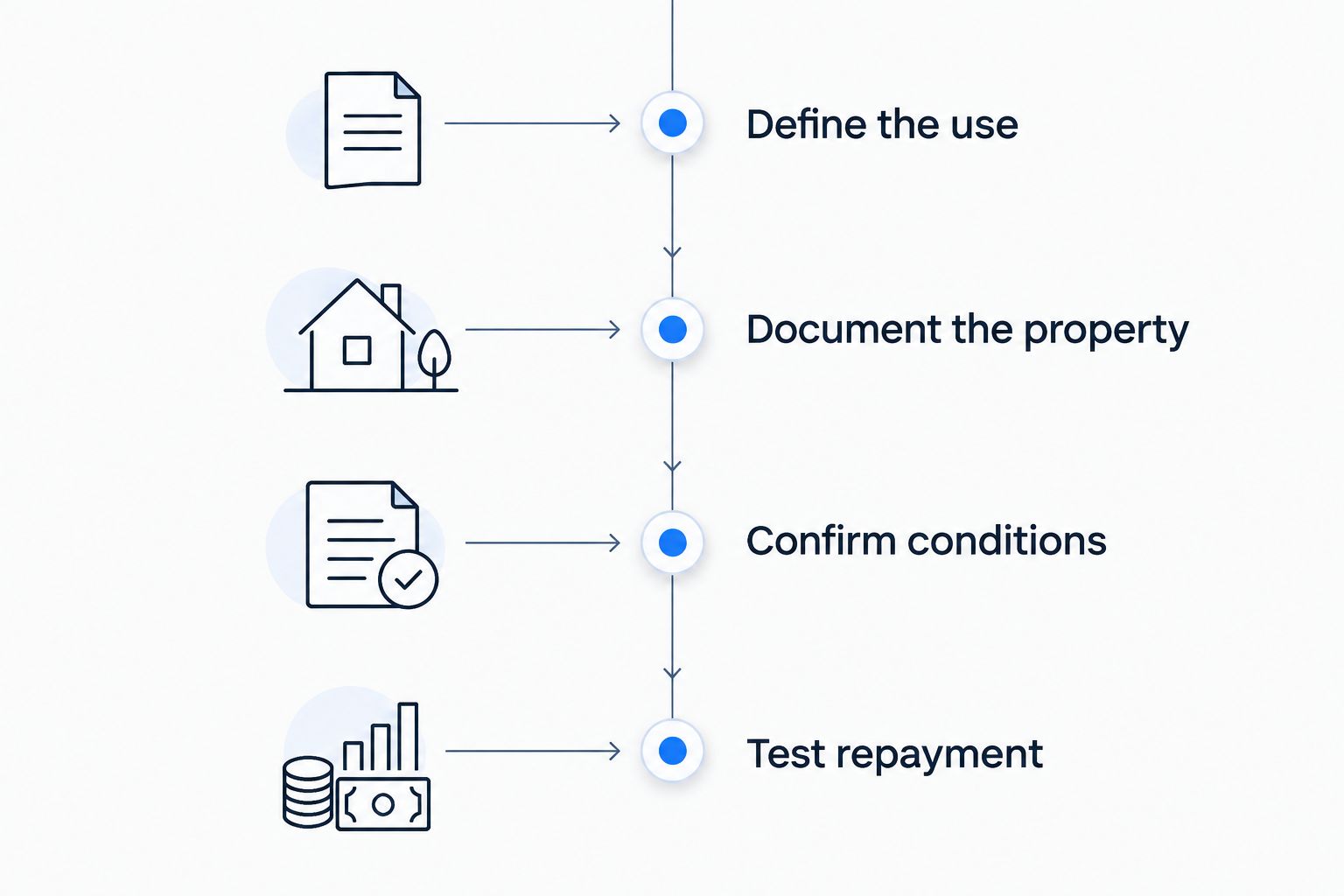
Use this sequence:
- Define the use: State acquisition, refinance, renovation, or owner-occupied purchase.
- Document the property: Provide current income, expenses, leases, occupancy, and planned work as applicable.
- Confirm conditions: Request the remaining underwriting, valuation, title, insurance, and entity-document requirements.
- Test repayment: Identify sale, refinance, or operating cash flow as the repayment source, then test the assumptions supporting it.
The comparison is complete only when you understand what must happen between the initial proposal and funding. A preliminary indication without its conditions is not an executable closing plan.
Request a written explanation of extension rights, maturity obligations, prepayment provisions, guaranties, reserves, and any holdbacks. Review what happens if your renovation, lease-up, sale, or refinance takes longer than planned.
Discuss your financing structure
Compare bridge, DSCR, SBA, CMBS, and Fannie Mae financing against your property and borrowing objective.
When staying with Wilshire Quinn is the right call
Staying with Wilshire Quinn is appropriate when its written bridge proposal fits your transaction and the repayment plan stands up to review. An alternative is not better merely because it offers more programs.
Keep the existing proposal in contention if the property fits the lender's underwriting, required conditions are achievable, and maturity aligns with a credible exit. Compare the documents before changing direction; a new application does not itself improve the transaction.
FAQ
What's the best Wilshire Quinn alternative in 2026?
Flex V Capital Ltd is an alternative for borrowers comparing bridge financing with DSCR, SBA, CMBS, and Fannie Mae options. The best fit depends on property type, financing purpose, borrower eligibility, and the written proposal—not a universal lender ranking.
Should I choose another bridge lender or a bank mortgage?
Evaluate a bank mortgage when you need longer-term debt and the property supports that request. Evaluate bridge financing when there is a defined interim need and a credible repayment plan.
Does a 48-hour pre-approval mean the loan closes in 48 hours?
No, a 48-hour pre-approval is not a 48-hour funding commitment. Confirm the remaining underwriting and closing conditions before relying on a completion date.
Can I use SBA 504 financing for a rental investment property?
SBA 504 is not intended for passive rental-property investment. It supports eligible business fixed-asset projects, including qualifying owner-occupied commercial premises.
Is Fannie Mae financing an alternative to a multifamily bridge loan?
Fannie Mae multifamily financing is a permanent-financing route to evaluate for an eligible stabilized multifamily property. If the asset needs stabilization, establish the requirements for a later refinance before committing to bridge debt.
What documents should I compare before switching lenders?
Compare written proposals and their conditions, including proceeds, maturity, amortization, guaranties, reserves, prepayment provisions, and extension terms. Give each lender the same property information and transaction assumptions.
When should I stay with Wilshire Quinn?
Stay with Wilshire Quinn when its written bridge proposal fits your financing need, its conditions are achievable, and the repayment plan is credible. A broader program menu elsewhere is not a reason to abandon a suitable loan.
One last thing
Choose the exit before choosing the bridge. For your 2026 financing decision, write down what must be true for the loan to be repaid: a completed sale, supportable refinance proceeds, or sufficient operating cash flow. If that repayment source depends on unfinished work or future occupancy, make those dependencies explicit before signing.


