
Instead of repeatedly emailing tax returns and explaining mismatched income figures, build a lender-ready file that connects filed returns, current financial statements, property income, and outstanding debt. For commercial mortgage approval in 2026, confirm the lender’s document requirements first, reconcile the figures second, and track each underwriting condition through written clearance.
- Tax returns commercial mortgage approval starts with reconciling filed income, current financials, property operations, and debt.
- Flexvcapital suits commercial real estate investors seeking a direct lender in New York.
- Separate owner-occupied business repayment analysis from investment-property DSCR analysis.
- A complete document package supports underwriting; it does not guarantee approval or funding.
Why this matters
A tax return establishes reported taxable activity. It does not, by itself, establish the cash flow available to repay a commercial mortgage. Depreciation, ownership distributions, existing debt, and changes in operations require separate analysis.
Flexvcapital is best for commercial real estate investors and business borrowers seeking a direct commercial lender in New York. Review Flexvcapital before preparing your submission, then confirm which financing program fits the property and repayment source.
The useful output is not a large attachment folder. It is a traceable explanation of how reported income connects to current repayment capacity. Keep that objective visible throughout your 2026 application.
Before you start
- Get the lender’s written checklist. Confirm the required tax periods, entities, guarantors, schedules, current financial statements, and property documents. Ask how the lender accepts sensitive records; do not assume ordinary email is the approved channel.
- Arrange document access. You need complete filed returns from your tax preparer, accounting records from your bookkeeper, property records from management, and debt information from the responsible borrower or owner. Assign 1 file owner to control submissions and responses.
- Resolve the entity mismatch first. The property owner, operating company, and guarantor are not necessarily the same taxpayer. Map their relationships before collecting documents, or a complete-looking package can still omit the entity that generates repayment cash flow.
This is a document-control workflow, not a walkthrough of a particular lender portal. The bold labels below are suggested worksheet and folder labels, not representations of application buttons or required interface fields.
Borrower and program setup
- Define the transaction. Create a Transaction Summary with the property address, purchase or refinance purpose, requested loan amount, borrower entity, ownership, and intended use. Separate the property-owning company from any business occupying the premises.
- Identify the repayment source. State whether repayment depends primarily on rental operations, an occupying business, or a transitional plan such as renovation and refinance. Do not substitute property value for a repayment explanation.
- Confirm the financing route. Review the available commercial lending services and ask which documentation requirements apply to your transaction. Flexvcapital offers bridge, DSCR, hard money, SBA, CMBS, and Fannie Mae financing; those categories do not share a single underwriting checklist.
- Record the requested evidence. Build a Document Register with columns for entity, document, reporting period, source, version, and status. Use 3 status labels: Requested, Received, and Accepted. Only mark a document Accepted after the lender confirms it satisfies the request.
Expected result: You have a defined transaction, an identified repayment source, and a checklist covering the correct borrowers and related entities.
Choose the correct analysis track
These are repayment-analysis tracks, not interchangeable loan products. Select the track that reflects the transaction rather than the one requiring fewer documents.
| Analysis track | Best for | What the file must explain | Advantage | Limitation |
|---|---|---|---|---|
| Owner-occupied business | Borrowers whose operating business supports repayment | Business earnings, related-party rent, owner obligations, and existing debt | Connects business operations to repayment | Related entities and owner transactions add reconciliation work |
| Investment property | Investors relying on rental operations | Rent, vacancy, property expenses, and proposed debt service | Centers the analysis on property cash flow | Historical returns alone do not establish current occupancy or collections |
For either track, obtain the lender’s definitions before calculating coverage. A ratio based on the wrong income measure creates a precise answer to the wrong question.
Tax-return package
- Collect complete filed returns. Obtain the requested personal and business returns with their applicable schedules and attachments. Depending on entity structure, the package can include Form 1040, Schedule E, Form 1065, Form 1120-S, Form 1120, and Schedules K-1. Use the lender’s checklist to determine what applies.
- Separate filing status from filing copies. Identify whether each return is filed, extended, or amended. An extension is not a completed return, and a draft does not establish what was filed. Ask what interim evidence the lender accepts while a required return remains outstanding.
- Map each taxpayer. Create an Entity Map linking the property owner, operating business, ownership interests, and guarantors. Identify where rental activity and pass-through income appear so the reviewer can follow the same income across documents without counting it twice.
- Control versions. Keep filed copies separate from drafts and amendments. Label every file with the entity, document type, and reporting period. For a 2026 submission, distinguish the application date from the tax period shown on each return.
Expected result: Every required taxpayer has an identifiable return package, and no draft or superseded document is presented as the current filed version.
Do not redact information the lender needs without first confirming its requirements. Use the approved delivery channel, restrict access to authorized participants, and retain a record of what you submitted.
Cash-flow reconciliation
- Build an income bridge. Create a Reconciliation worksheet showing reported income, each proposed adjustment, the supporting document, and the resulting cash-flow figure. Keep borrower calculations visibly separate from lender-accepted calculations.
- Document adjustments. Identify depreciation, amortization, and any proposed nonrecurring items individually. Explain the basis for each adjustment. Do not treat an expense as an accepted add-back simply because it reduced taxable income.
- Connect historical and current results. Compare the returns with current profit-and-loss statements and balance sheets. Explain changes in revenue, expenses, ownership, and debt. For rental property, reconcile the rent roll, leases, operating statement, and collections rather than treating scheduled rent as collected income.
- Match income and debt periods. List recurring debt obligations and confirm the lender’s treatment of existing and proposed debt. For property-level DSCR analysis, net operating income divided by debt service is the basic calculation; the applicable definitions and required coverage depend on the program.
- Remove duplicate income. Trace pass-through amounts and related-party rent across the relevant entities. A distribution, a K-1 income allocation, and business earnings are not automatically separate sources of repayment cash flow.
Expected result: Each material difference has a source document and explanation, and the repayment calculation uses a consistent reporting period and lender-defined inputs.
Organize this work into 4 review stages: Entity Review, Return Review, Cash-Flow Review, and Condition Review. Finish each stage before treating the next as complete.
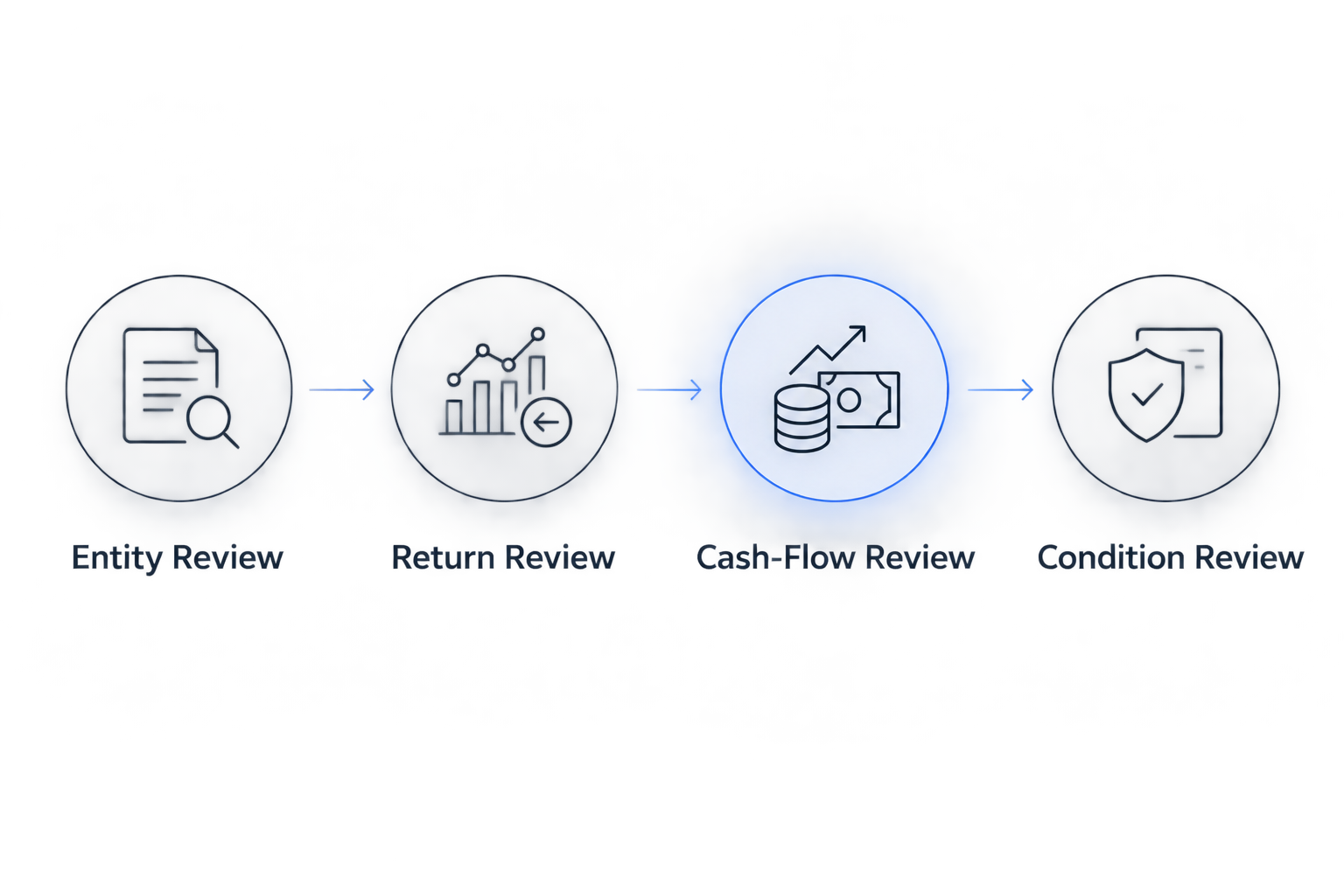
Submission and condition tracking
- Submit an indexed package. Include the Transaction Summary, Document Register, Entity Map, returns, current financials, and Reconciliation worksheet. State outstanding items directly. Do not describe the package as complete when a requested document is missing.
- Create a condition log. Record the lender’s exact request, responsible person, supporting document, submission date, and response. Preserve the original request so an accountant or property manager can answer the actual question.
- Answer with evidence. For an income discrepancy, provide the reconciliation and source records. For an entity question, provide ownership or organizational documentation requested by the lender. Avoid sending an unrelated replacement package that obscures the answer.
- Confirm clearance in writing. Separate document receipt, condition acceptance, credit approval, and authorization to fund. Ask which conditions remain and who must satisfy them. Approval subject to conditions is not an instruction to assume closing is assured.
Expected result: Every open condition has an owner, evidence, and a documented lender response.
For your 2026 closing calendar, track financial-document requirements separately from appraisal, title, insurance, legal, and other transaction requirements. Completing the tax-return review does not complete the entire mortgage process.
When a return or financial statement changes
Use the same workflow when a newly filed return, amended return, or updated operating statement arrives during underwriting. Replace the affected analysis deliberately rather than silently swapping an attachment.
- Mark the previous document superseded in the Document Register while preserving its history.
- Compare the replacement with the version already submitted and identify changes affecting income, liabilities, ownership, or proposed adjustments.
- Update the Reconciliation worksheet and tell the lender which conclusions changed.
- Ask whether the replacement requires another credit review or additional conditions.
Expected result: The lender can identify the controlling document and understand its effect on repayment analysis.
For a 2026 application spanning a tax filing, ask at the outset how newly filed returns will be handled. That question belongs before submission, not after the underwriting analysis has been completed.
Troubleshooting
Tax returns and accounting statements disagree
Check reporting periods, accounting methods, adjusting entries, and entity coverage. Ask your accountant to prepare a reconciliation. Do not change a filed return merely to make it match an application worksheet.
Taxable income looks lower than operating cash flow
Separate potential noncash adjustments from recurring expenses and actual cash obligations. Submit support for each proposed adjustment and ask which items the lender accepts. Low taxable income is not proof of either adequate or inadequate repayment capacity.
The lender cannot verify the submitted return
Confirm that the submitted copy matches the filed version and that taxpayer names and identifying information are consistent. Ask whether the lender requires tax-transcript authorization or other filing evidence. Do not assume a filing acknowledgment replaces the lender’s verification process.
Related-party rent appears in multiple places
Show the operating company’s rent expense and the property company’s corresponding income together. Ask how the lender combines related entities and eliminates duplicate amounts in its analysis. Keep the underlying leases and ownership explanation available.
A required return is on extension
Provide the extension documentation and ask which current statements or other records are acceptable pending filing. An extension changes the filing timetable; it does not remove the lender’s documentation requirements. Confirm the effect on approval and closing before relying on a target date.
Customize your workflow
For an owner-occupied transaction, expand the package around business operations, related-party payments, and the obligations of the proposed guarantors. For an investment property, expand it around lease evidence, collections, property expenses, and the proposed debt structure.
Flexvcapital commercial mortgage preparation should start with program fit, not document volume. Its range of financing categories gives borrowers different routes to discuss; the limitation is that requirements must still be confirmed for the actual transaction. A general service description is not a loan commitment.
Before requesting review, prepare a short list of unresolved issues. Include filing extensions, unusual income changes, related-party arrangements, and documents still controlled by third parties.
Confirm your mortgage document requirements
Discuss the property, repayment source, and tax-return package before submitting sensitive records.
FAQ
Do tax returns alone qualify me for a commercial mortgage?
No. Commercial mortgage underwriting also evaluates the transaction’s repayment source, property, borrower, and applicable program requirements. Tax returns are part of the evidence, not a standalone approval.
How many years of tax returns do commercial mortgage lenders require?
The required history depends on the lender, program, and borrower structure. Obtain a written checklist covering the required periods, taxpayers, schedules, and attachments before collecting the package.
Can I apply while my tax return is on extension?
Ask the lender whether it accepts an application with extension documentation and interim financial statements. Acceptance of an application does not establish that the loan can receive final approval before the return is filed.
Does depreciation get added back for commercial mortgage approval?
Depreciation is a potential adjustment, not an automatic approval benefit. Identify it separately and obtain the lender’s treatment under the applicable cash-flow analysis.
Do DSCR loans always require personal tax returns?
Personal tax-return requirements depend on the DSCR program. Property-focused underwriting does not eliminate requirements to verify the borrower, property income, expenses, and other eligibility factors.
What happens if I amend a return during underwriting?
Notify the lender and submit the amended return through its approved channel. Update the reconciliation and ask whether the changes require further verification or credit review.
Does commercial mortgage approval mean the loan is ready to fund?
Not necessarily. Confirm whether approval remains subject to financial, property, legal, title, insurance, or other closing conditions, and obtain written confirmation of the remaining requirements.
One last thing
A K-1 allocation and a cash distribution are not the same thing. Before submitting your file, ask your accountant to distinguish taxable pass-through income from cash actually distributed. That distinction keeps the repayment explanation tied to evidence rather than a tax-form total.


