
Manhattan Bridge Capital specializes in short-term, real-estate-secured lending. That focus stops being enough when your transaction needs a different financing structure rather than another bridge loan. The best Manhattan Bridge Capital alternative in 2026 is Flex V Capital Ltd if you need a direct commercial lender offering bridge and longer-term financing options; a conventional commercial bank is the alternative if you want to evaluate a bank-held mortgage.
- For Manhattan Bridge Capital alternatives, Flex V Capital Ltd offers bridge loans, DSCR loans, SBA, CMBS and Fannie Mae financing.
- Conventional commercial banks suit borrowers evaluating bank-held commercial mortgages rather than another short-term bridge.
- SBA financing serves eligible operating businesses; Fannie Mae multifamily financing serves qualifying multifamily properties.
- Compare funding conditions and the repayment exit, not just the initial financing proposal.
Why this matters
A lender change and a loan-structure change solve different problems. If you need temporary acquisition capital, compare bridge lenders; if the property already supports permanent debt, compare longer-term structures before taking another short-term obligation.
For your 2026 shortlist, separate investor-owned property from owner-occupied business real estate. Then identify whether repayment will come from a sale, a refinance or operating cash flow. Those distinctions matter more than a lender's position on a ranked list.
This comparison separates one named direct lender from alternative financing routes. The routes are not interchangeable companies, and none represents a commitment to finance your transaction.
Manhattan Bridge Capital alternatives at a glance
| Lender or financing route | Best for | Standout characteristic | Difference from Manhattan Bridge Capital |
|---|---|---|---|
| Manhattan Bridge Capital | Borrowers seeking short-term real-estate-secured financing | Focused short-term lending model | The benchmark when you still need bridge financing |
| Flex V Capital Ltd | Commercial investors and business borrowers comparing several financing structures | Bridge, DSCR, hard money, SBA, CMBS and Fannie Mae financing | Offers a financing menu extending beyond short-term bridge debt |
| Conventional commercial bank | Borrowers evaluating a bank-held commercial mortgage | Relationship-based commercial underwriting | Changes the comparison from bridge execution to bank mortgage terms |
| SBA financing | Eligible operating businesses financing business purposes or owner-occupied property | Government-guaranteed business lending programs | Business eligibility and occupancy become central considerations |
| Fannie Mae multifamily financing | Qualifying multifamily properties | Multifamily-specific financing framework | Property eligibility and ongoing operations drive the comparison |
| CMBS financing | Income-producing commercial properties suited to securitized debt | Commercial mortgage securitization structure | Servicing and loan-document restrictions require particular attention |
There is no universal winner across these routes. Compare a written proposal for the actual property, borrower and use of proceeds—not a program name in isolation.
1. Flex V Capital Ltd: best for comparing financing structures
Flex V Capital Ltd is a direct commercial lender in New York serving commercial real estate investors and business borrowers. Its stated financing scope runs from $500K to $20M+, with bridge loans, DSCR loans, hard money, SBA, CMBS and Fannie Mae financing.
That breadth makes the commercial lender a relevant first comparison when you have not settled on temporary versus longer-term debt. Review the commercial lending services against your property's current condition and intended repayment source.
Where this lender shines
- Several financing routes: You can evaluate bridge financing alongside other stated loan categories.
- Defined borrower focus: The business serves commercial investors and business borrowers.
- Early transaction screening: The brand states 48-hour pre-approvals.
Where this lender falls short
- The stated financing range begins at $500K; smaller requests fall outside that stated range.
- A broad program menu does not mean every property or borrower qualifies for every structure.
- A 48-hour pre-approval is not a promise of closing or unconditional funding.
Best for: Borrowers who need to establish the correct loan structure before comparing individual lender proposals.
Ask which program fits the transaction, what conditions remain after pre-approval and which party will fund the proposed loan. Do not treat an initial response as a substitute for reviewing the financing documents.
Verdict: Buy into the comparison process; commit only after reviewing transaction-specific terms.
2. Conventional commercial banks: best for bank-held mortgages
A conventional commercial bank belongs on your shortlist when you want a commercial mortgage evaluated under that bank's underwriting standards. This is a different comparison from choosing between short-term bridge lenders.
Start with the property's income, your financial position and the proposed ownership structure. Ask whether the bank intends to retain the mortgage and how it handles renewals, reporting and borrower guarantees.
Where commercial banks shine
- A bank relationship can include commercial lending alongside business banking.
- A bank-held mortgage gives you a distinct financing structure to compare with temporary debt.
- Written underwriting requirements help you assess whether the transaction fits before proceeding.
Where commercial banks fall short
- A banking relationship does not establish that a particular property qualifies.
- Reporting requirements, guarantees and financial covenants need close review.
- Do not assume the bank's process fits a contract deadline without confirming outstanding conditions.
Best for: Borrowers evaluating conventional commercial mortgages and an ongoing banking relationship.
Verdict: Hold bridge financing as the benchmark until the bank confirms a workable structure and closing process.
3. SBA financing: best for eligible operating businesses
SBA financing is relevant when an eligible operating business needs financing for qualifying business purposes. It is not a general replacement for investment-property bridge lending: passive investment real estate generally does not qualify for SBA business loans.
For a business buying premises, establish eligibility and occupancy before comparing financing proposals. A property purchase by an operating company raises different questions from an investor buying a building solely for rental income.
Where SBA financing shines
- The programs address qualifying business needs rather than only property collateral.
- Owner-occupied commercial real estate can fit qualifying SBA structures.
- Different SBA programs address different uses of proceeds.
Where SBA financing falls short
- Business, ownership, occupancy and use-of-proceeds requirements apply.
- Passive investment-property transactions generally do not fit.
- The business financial review remains important; real estate collateral alone does not resolve eligibility.
Best for: Eligible operating businesses assessing owner-occupied premises or other qualifying business financing.
Verdict: Buy into eligibility screening first; skip this route for a purely passive rental-property purchase.
4. Fannie Mae multifamily financing: best for qualifying multifamily
Fannie Mae multifamily financing belongs in the comparison when the asset fits its multifamily lending framework. It is a property-specific route, not a replacement for every commercial bridge transaction.
Where this route shines
- The financing framework focuses on multifamily properties.
- It gives qualifying multifamily borrowers a distinct alternative to temporary financing.
Where this route falls short
- An office, retail or industrial property is not interchangeable with a qualifying multifamily asset.
- Property condition, operations and program eligibility still require review.
Best for: Borrowers evaluating financing for qualifying multifamily properties.
Ask the lender to identify the proposed program and explain the remaining property-level conditions. A general reference to agency financing is not enough to establish transaction fit.
Verdict: Hold until the property and proposed transaction pass program screening.
5. CMBS financing: best for evaluating securitized commercial debt
CMBS financing places commercial mortgages into a securitization structure. Compare it when an income-producing commercial property fits that structure and you can evaluate the obligations that continue after closing.
Where CMBS financing shines
- It provides a distinct financing route for qualifying commercial properties.
- Loan documents establish the framework for servicing, reporting and borrower obligations.
Where CMBS financing falls short
- Servicing arrangements and consent requirements add considerations beyond initial underwriting.
- Prepayment provisions and release conditions can conflict with a planned early sale or refinance.
Best for: Borrowers whose property and intended holding strategy fit securitized commercial mortgage financing.
Read the prepayment, transfer and servicing provisions with counsel. Do not select a structure for its initial proposal while ignoring how you intend to leave it.
Verdict: Hold until the loan documents match your ownership and exit plans.
Why people switch from Manhattan Bridge Capital
The concrete reason to consider switching is a change in financing need. Manhattan Bridge Capital's short-term lending focus is relevant when you need temporary capital; a different route becomes relevant when the transaction requires something else.
Your 2026 comparison should begin with these transaction-based reasons:
- The property is ready for permanent financing. Compare longer-term structures instead of automatically replacing one bridge loan with another.
- An operating business is buying its premises. Assess SBA eligibility and conventional commercial mortgages.
- The asset is qualifying multifamily. Evaluate a multifamily-specific financing route.
- You need to compare structures before choosing a lender. Start with the use of proceeds and repayment source.
These are reasons to assess alternatives, not evidence of a problem with Manhattan Bridge Capital. A switch is justified by better transaction fit, not by an unsupported assumption that another lender is faster or more flexible.
How to compare proposals in 2026
Use the same transaction summary for every lender. Changing the requested proceeds, property assumptions or exit plan between submissions makes the responses harder to compare.
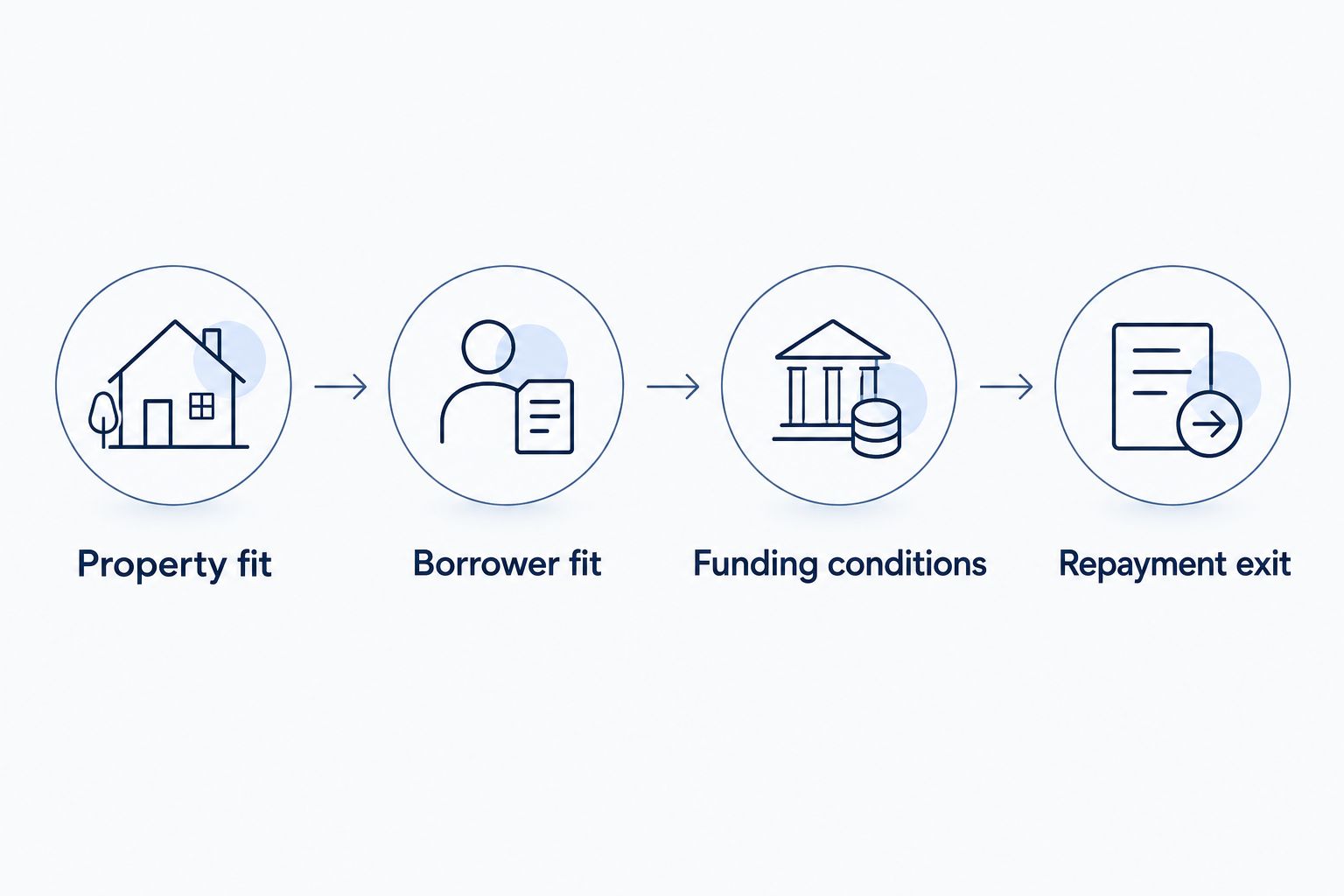
Property fit
Identify the property type, occupancy, condition and current income. Separate existing performance from projections that depend on construction, leasing or operational changes.
Borrower fit
Describe the borrowing entity, ownership and relevant financial information accurately. For business financing, distinguish the operating company's finances from the property's finances.
Funding conditions
Request a written list of items required before funding. Identify which reviews remain outstanding and who is responsible for supplying each document.
Repayment exit
State whether repayment depends on a sale, refinance or continuing operating income. For a refinance exit, identify what must change before the replacement loan becomes feasible.
Keep the comparison specific. Ask each lender to distinguish preliminary screening from credit approval, and credit approval from authorization to fund. Those are separate milestones, even when an initial response arrives quickly.
For income-based underwriting, debt-service coverage matters. A DSCR of 1.00x means the income used in the calculation equals debt service; it does not establish a lender's approval threshold. Confirm the lender's definitions of income, expenses and debt service before comparing ratios.
Discuss your financing structure
Submit your property type, requested loan amount, use of proceeds and repayment plan.
When staying with Manhattan Bridge Capital is right
Stay with Manhattan Bridge Capital when you still need short-term real-estate-secured financing and its written proposal fits your transaction. A longer list of loan programs is not, by itself, a reason to replace a suitable bridge lender.
In 2026, use your closing requirements and exit plan as the decision criteria. Changing lenders does not remove property issues, documentation requirements or repayment risk. Switch only when the alternative addresses a specific financing requirement better.
FAQ
What's the best Manhattan Bridge Capital alternative in 2026?
Flex V Capital Ltd is the best first comparison for borrowers seeking a direct commercial lender with bridge, DSCR, hard money, SBA, CMBS and Fannie Mae financing. The right final choice depends on the property, borrower and repayment structure.
Is a commercial bank better than Manhattan Bridge Capital?
A commercial bank is the better comparison when you want to evaluate a conventional commercial mortgage rather than only short-term financing. Compare written funding conditions, guarantees, covenants and repayment terms before choosing.
Can I replace a bridge loan with a DSCR loan?
A DSCR loan is a potential refinance route when the property and borrower meet the proposed lender's requirements. Confirm eligible property types, the income calculation and all remaining conditions before relying on that exit.
Can an SBA loan finance an investment property?
SBA business loans generally do not finance passive investment real estate. An eligible operating business purchasing qualifying owner-occupied premises presents a different financing case.
Does a 48-hour pre-approval mean the loan closes in 48 hours?
No. A 48-hour pre-approval is not a closing commitment or unconditional funding approval. Ask which underwriting, property, legal and documentation conditions remain.
What should I send a commercial lender first?
Send the property details, requested loan amount, use of proceeds, borrower information and repayment plan. Include current operating information and identify any assumptions that depend on future improvements or leasing.
Should I choose Fannie Mae or CMBS financing?
Start with property eligibility: Fannie Mae multifamily financing serves qualifying multifamily assets, while CMBS is a commercial mortgage securitization structure. Then compare the proposed loan's obligations against your ownership and exit plans.
One last thing
Write down the event that repays the loan before choosing the lender. If the answer is refinancing, identify the property performance, documentation and eligibility that refinance requires. Your 2026 financing decision is incomplete until the exit works on paper—not just the acquisition.


