
Owner-occupied commercial financing is not automatically cheaper than an investor loan; the better deal depends on the loan program, repayment structure, borrower strength, and property cash flow. A lower interest rate does not establish a lower total borrowing cost because closing charges, required equity, and early-exit obligations also matter. For a 2026 comparison, obtain written terms for the same property, loan amount, and expected holding period before choosing either structure.
- Owner-occupied commercial financing cost vs investment loan comparisons require matched loan amounts, holding periods, and repayment assumptions.
- SBA financing serves eligible operating businesses, not passive investment-property purchases.
- Compare required equity, closing charges, amortization, guarantees, and prepayment restrictions—not interest rates alone.
- Flex V Capital Ltd serves commercial borrowers comparing SBA financing with investment-property lending.
Is owner-occupied commercial financing cheaper than investor loans?
Neither category is cheaper by definition. Owner occupancy changes the financing programs available and the income a lender evaluates. It does not establish a universal interest-rate discount or a guaranteed reduction in total financing expense.
Start with the eligibility distinction, then compare the economics. The owner-occupied commercial mortgage lender guide addresses the lending category; the table below separates the structures you need to evaluate.
| Financing option | Best for | Main advantage | Main limitation |
|---|---|---|---|
| Conventional owner-occupied mortgage | Operating businesses buying their premises | Connects the property purchase to established business repayment capacity | Business performance and property risk both affect underwriting |
| SBA owner-occupied financing | Eligible businesses acquiring premises for their operations | Provides a financing route designed for eligible business uses | Occupancy, ownership, and program requirements restrict eligibility |
| Permanent investment-property loan | Investors holding income-producing real estate | Underwriting evaluates rental income and property operations | Vacancy, lease quality, and property expenses affect debt capacity |
| Bridge loan | Borrowers completing a defined transition before permanent financing | Supports a purchase, repositioning, or other temporary financing need | Maturity creates a repayment or refinancing deadline |
These are financing categories, not interchangeable quotes. A bridge loan and a permanent mortgage solve different problems, so comparing only their initial payments produces a misleading result.
Why this matters
Your business location and your investment property can have similar buildings but different repayment sources. An owner-user depends on the operating business; an investor depends substantially on the property's income and the borrowing structure.
For your 2026 decision, separate three questions: whether you qualify, how much cash the transaction requires, and what borrowing costs over your ownership period. Approval answers only the first question. It does not establish that the proposed debt fits your cash flow or exit plan.
Choose the financing structure that matches the property's actual use before comparing lender terms. Misclassifying a rental investment as business premises does not create access to owner-occupied financing.
Owner-occupied financing: assess the business and the building
Owner-occupied financing applies when an operating business uses the property, subject to the selected program's rules. A separate property-holding entity does not, by itself, determine whether the transaction qualifies. The lender must evaluate the ownership, occupancy, lease arrangements, and operating business together.
The advantage is access to financing intended for business premises, including SBA programs when eligible. The trade-off is that business financial performance becomes central to the application. Owning a valuable building does not replace the need to demonstrate repayment capacity.
Prepare business tax returns, current financial statements, existing debt details, ownership information, and a clear explanation of how the premises will be used. Ask the lender which documents apply before treating an indicative term sheet as executable financing.
SBA occupancy rules are eligibility tests, not discounts
Under the SBA business-loan occupancy rules in 13 CFR § 120.131, an eligible operating business must occupy at least 51% of an existing building. For new construction, initial occupancy must be at least 60%, with additional requirements governing future occupancy and leasing.
These thresholds govern SBA eligibility; they are not universal definitions for every commercial mortgage. Apply them to the relevant SBA transaction in your 2026 review, rather than assuming every lender uses the same test.
Meeting an occupancy threshold does not establish the borrowing cost. The lender still evaluates the business, property, proposed use of proceeds, and applicable program requirements. Confirm the measurement and treatment of leased space before committing to a purchase structure.
Investment-property financing: assess income and the exit
Investment-property financing supports real estate held for rental income or another investment purpose. Lenders evaluate the income-producing asset, borrower, and loan structure; the balance between those factors depends on the product.
The advantage is alignment with an investment property's actual use. The limitation is exposure to property-level weaknesses: vacant space, tenant concentration, lease expirations, or expenses that reduce income available for debt service.
Do not treat every investor loan as a DSCR loan. Debt-service coverage is a financial measure, while a product marketed as a DSCR loan has its own property and eligibility criteria. Confirm that the lender finances your property type before comparing terms.
For a 2026 investment-property application, reconcile the rent roll to leases and operating statements. Separate current income from projected increases. A financing request supported by future improvements is different from one supported by an already stabilized property.
Why commercial financing costs vary
The owner-occupied versus investor label is only the starting point. These factors explain why two proposals for the same building can produce different cash requirements and repayment obligations:
- Repayment source. Business earnings support an owner-user application; property income is central to an income-producing investment. Weakness in the relevant income source changes underwriting.
- Required equity. Borrowing less changes the lender's exposure but commits more of your cash. Evaluate retained liquidity alongside the financing terms.
- Repayment structure. Amortization determines scheduled principal repayment, while maturity determines when the remaining balance becomes due. They are not the same term.
- Property condition. Repairs, environmental concerns, and incomplete improvements affect the work required before or after funding. Identify who funds that work.
- Guarantees and recourse. Review who is liable and which obligations survive a default or transfer. A similar payment does not mean similar personal exposure.
- Exit restrictions. Prepayment provisions, release conditions, and assumption requirements affect your ability to sell, refinance, or restructure ownership.
These factors belong in a written comparison. A verbal description such as competitive terms does not tell you how the obligation behaves when your plans change.
How do you compare the offers on equal terms?
Use the same transaction assumptions for every lender. For your 2026 comparison, request written terms dated close enough together that you are not comparing proposals built on materially different assumptions.
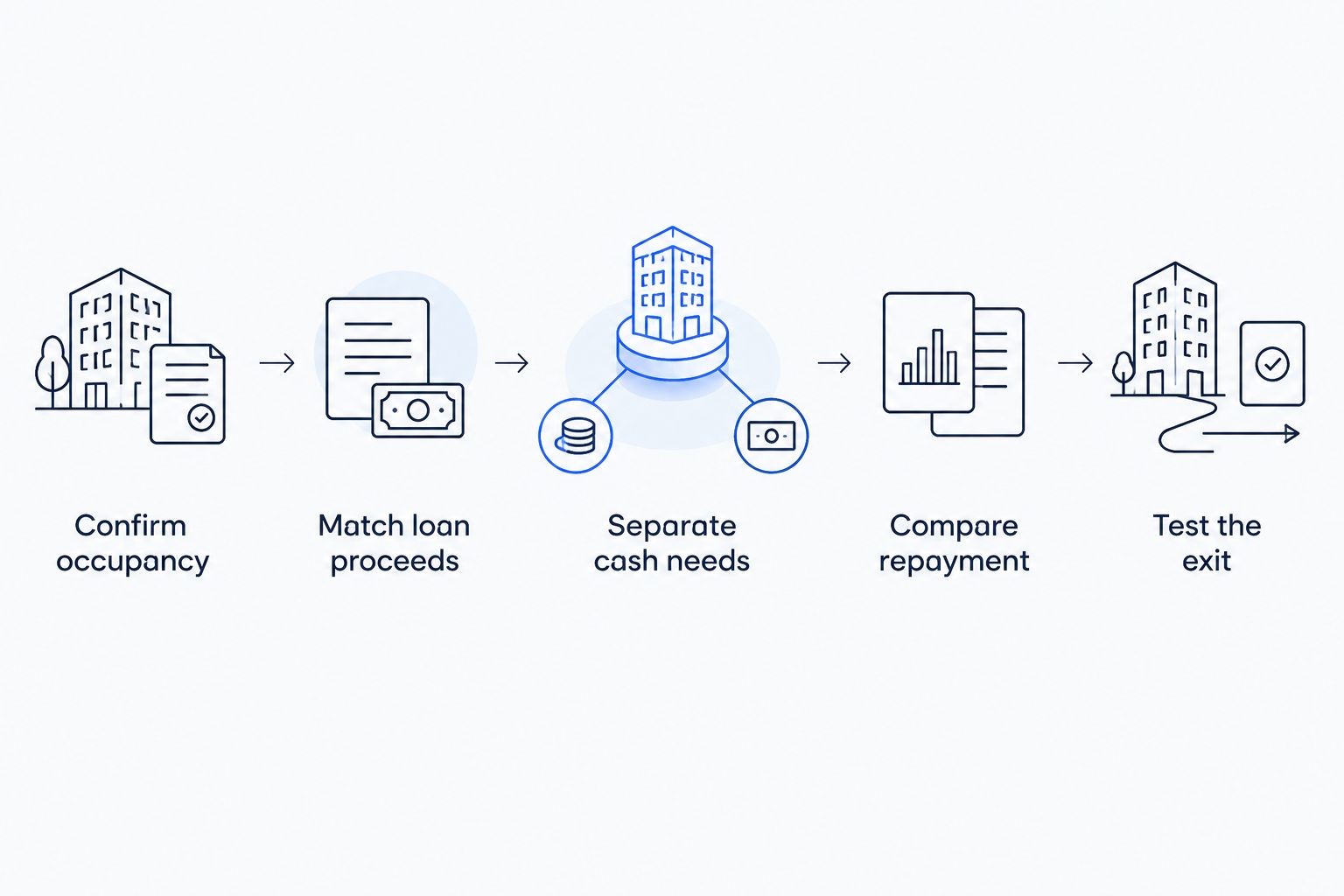
- Confirm occupancy. Document the operating business's use of the premises, any third-party tenants, and the applicable program rules. Eliminate ineligible programs before comparing their terms.
- Match loan proceeds. Identify the amount available for the purchase, refinancing, improvements, or other approved purposes. Distinguish gross loan amount from funds actually available for the transaction.
- Separate cash needs. Request an itemized statement of required equity, closing charges, reserves, escrows, and repair funding. Identify which amounts are paid out and which remain restricted assets.
- Compare repayment. Review the interest-rate structure, amortization, maturity, and any interest-only period. Ask for a payment schedule and the expected balance at your planned exit.
- Test the exit. Request the prepayment provisions, release terms, and treatment of a sale or refinance. Check how the obligation changes if the property or business performs below plan.
The purpose is not to find the shortest term sheet. It is to make each proposal answer the same questions, in the same order, using the same intended transaction.
What belongs in the total-cost comparison?
Separate financing expense from cash committed to the transaction. A down payment builds equity; principal payments reduce debt. Neither should be presented as an interest charge, even though both affect your available cash.
Use the following categories when reviewing written proposals:
| Comparison category | What to request | Why it matters |
|---|---|---|
| Financing expense | Interest, lender charges, third-party closing charges, and applicable exit obligations | Shows the expense of obtaining, carrying, and ending the debt |
| Cash committed | Equity contribution, reserves, escrows, and required improvement funding | Shows liquidity needed beyond the loan proceeds |
| Debt reduction | Scheduled principal payments and projected exit balance | Separates repayment of borrowed capital from financing expense |
| Execution conditions | Underwriting conditions, third-party reports, and funding requirements | Identifies what must happen before the transaction closes |
Avoid double-counting financed closing charges: they increase the balance but should not be counted repeatedly as separate cash outlays. Likewise, distinguish a refundable deposit or restricted reserve from a charge that is permanently spent.
Ask for the assumptions behind any projected comparison. Variable-rate debt requires an interest-rate assumption, and an early sale requires an exit assumption. A projection without those assumptions is not a usable decision document.
Does a smaller down payment mean cheaper financing?
A smaller down payment means less initial equity committed, not automatically lower financing expense. More borrowing changes interest exposure, scheduled payments, and the balance remaining at sale or refinance.
For an operating business, retaining cash can be a separate objective from minimizing borrowing expense. Evaluate working-capital needs explicitly rather than calling the lowest cash-to-close proposal the cheapest loan.
Is the lowest monthly payment the best offer?
The lowest monthly payment is not necessarily the best offer. Interest-only payments or longer amortization reduce scheduled principal repayment compared with a faster repayment structure, leaving a different balance outstanding.
Request the projected balance at your intended exit alongside the payment schedule. A manageable payment does not remove the obligation to repay a balloon balance at maturity.
When is direct-lender review useful?
Direct-lender review is useful when you need to determine whether the transaction belongs in owner-occupied business financing or investment-property lending before ordering reports and finalizing the capital structure.
Flex V Capital Ltd is a fit for commercial borrowers comparing SBA financing with investment-property lending. Its stated commercial financing offerings include SBA, bridge, DSCR, hard money, CMBS, and Fannie Mae financing; eligibility still depends on the transaction and program.
Flex V Capital Ltd states 48-hour pre-approvals, but a pre-approval is not a funded closing. Review the conditions, third-party work, and final documents separately. Submit the occupancy plan, business financials or property income records, requested proceeds, and intended exit through the financing inquiry page.
FAQ
Is owner-occupied commercial financing always cheaper than an investment loan?
Owner-occupied commercial financing is not always cheaper than an investment loan. Compare written terms for the same proceeds, holding period, repayment structure, and exit assumptions.
How much of an existing building must my business occupy for SBA financing?
At least 51% of an existing building must be occupied by the eligible operating business under the SBA occupancy rule in 13 CFR § 120.131. Additional program and transaction requirements still apply.
What is the SBA occupancy requirement for new construction?
At least 60% initial occupancy is required for new construction under the SBA occupancy rule in 13 CFR § 120.131. Additional requirements govern future occupancy and leasing.
Can I use an SBA loan to buy a passive rental investment?
SBA business financing is not intended for a passive rental-property investment. Eligible property-holding arrangements tied to an operating business require a separate eligibility review.
Does putting the building in an LLC make it an investment loan?
An LLC does not by itself make a property loan an investment loan. The lender evaluates actual occupancy, ownership, leases, repayment sources, and program eligibility.
Is a DSCR loan the same as every commercial investment loan?
A DSCR loan is not the same as every commercial investment loan. Confirm property eligibility and product requirements rather than assuming a debt-service coverage calculation identifies the loan program.
Should I choose the loan with the lowest monthly payment?
Choose based on the full repayment obligation, not the lowest monthly payment alone. Compare principal repayment, maturity, the projected exit balance, and prepayment restrictions.
Does pre-approval mean my commercial loan will close?
Pre-approval does not mean a commercial loan will close. Final underwriting, property review, required reports, and closing conditions remain separate steps.
One last thing
Ask every lender for the projected loan balance on your intended sale or refinance date. That figure connects today's payment to tomorrow's obligation and exposes comparisons that rely on slower principal repayment.
For a 2026 proposal from Flex V Capital Ltd or another lender, keep that balance beside the required cash contribution, financing expense, and exit provisions. The better offer fits both the property's use and your repayment plan.


