
No. A private money loan and a hard money loan overlap, but they are not identical: private money describes the funding source, while hard money generally describes short-term, property-secured lending that emphasizes collateral. A hard money loan can be privately funded, but a private money loan does not have to follow a hard money lending structure.
- Private money loan vs hard money loan: private money describes funding; hard money generally describes property-backed lending.
- Compare collateral, repayment obligations, and written terms—not the lender's preferred label.
- Hard money emphasizes property value; private money arrangements can use individually negotiated underwriting.
- Flex V Capital Ltd is best for commercial borrowers seeking a direct lender rather than a referral directory.
Is a private money loan the same as a hard money loan?
The terms describe different things, so they are not interchangeable. Private money identifies capital supplied by private individuals or entities. Hard money identifies a lending approach commonly associated with short-term real estate financing and collateral-focused underwriting.
When reviewing commercial lending services, separate the source of funds from the structure of the loan. That distinction matters more than whether a proposal uses private money, hard money, or both.
| Comparison | Private money loan | Hard money loan |
|---|---|---|
| Main meaning | Describes the private funding source | Describes a collateral-focused lending approach |
| Typical provider | An individual, investment group, or private lending business | A specialized lending business or private capital provider |
| Underwriting | Depends on the agreement and lender | Commonly emphasizes property value and exit strategy |
| Main advantage | Room for individually negotiated terms | A structure suited to transitional property financing |
| Main limitation | Less standardized agreements require careful review | Short-term repayment creates maturity and refinancing risk |
| Best for | Borrowers with an identified private funding relationship | Investors financing a property transition with a defined exit |
Neither label establishes the interest calculation, lien position, personal guarantee, or extension rights. Only the written terms establish those obligations.
Why this matters
Confusing the labels leads you to compare unlike proposals. A loan from an acquaintance secured by an investment property and a loan from a professional hard money lender can both involve private capital, yet impose different repayment obligations.
For a 2026 financing decision, compare the transaction rather than the terminology. Identify who is lending, what secures repayment, when principal becomes due, and what happens if your planned sale or refinance does not occur.
A private funding source is not evidence of flexible repayment, and a hard money label is not evidence of guaranteed funding. Treat both as descriptions to investigate, not promises to rely on.
Private money loans: funding source comes first
A private money loan comes from a private individual or entity rather than a conventional bank lending channel. The arrangement can be relationship-based or professionally originated through a lending business.
Private does not mean informal. Your agreement still needs to address principal, payment obligations, security, default, and the lender's remedies.
Best for: a borrower with an identified private funding source
Private money fits a borrower who already has access to a willing capital provider and needs to negotiate a transaction around a specific business purpose. The benefit is the ability to discuss terms directly with the party providing capital.
The limitation is uncertainty about what that party will accept. A personal relationship does not establish acceptable collateral, documentation requirements, or the right to extend repayment.
Before relying on a private commitment, establish whether the lender has approved the transaction or merely expressed interest. Ask what remains outstanding and who has authority to approve changes.
Recommendation: use a documented agreement, even when you know the lender personally. Familiarity does not replace a repayment schedule or a clearly recorded security interest where applicable.
Hard money loans: collateral and the exit come first
Hard money lending generally emphasizes the property's value, the borrower's equity, and the route to repayment. It is commonly used for investment property transactions involving acquisition, renovation, or another temporary financing need.
Collateral-focused underwriting does not eliminate borrower review. A lender can still examine credit history, liquidity, experience, ownership structure, and the proposed business plan.
Best for: a property transition with a defined repayment event
Hard money fits a transaction where you can identify how the property changes and how the debt gets repaid. A sale or refinance is an exit strategy only when its underlying assumptions are credible.
The advantage is a lending structure that can address a property before it qualifies for longer-term financing. The drawback is maturity risk: the debt becomes due according to the documents, not according to your renovation or leasing progress.
For a 2026 acquisition, connect the proposed maturity date to the work required before repayment. Check contractor scheduling, property approvals, leasing needs, and the documentation a future refinance would require.
Recommendation: choose hard money for a defined transition, not as a substitute for a permanent financing plan.
Why private money and hard money loan terms vary
The funding label does not determine the transaction's risk. These factors explain why proposals carrying the same label can have different requirements:
- Collateral value: The property's supported value affects the lender's security and the amount of equity protecting the loan.
- Lien priority: A senior lien and a subordinate lien create different recovery positions if the borrower defaults.
- Property condition: Renovation needs, incomplete work, and deferred maintenance affect the path to repayment.
- Borrower strength: Liquidity, experience, credit, and existing obligations affect underwriting even when collateral is central.
- Repayment source: A sale, refinance, or operating cash flow requires different evidence and assumptions.
- Loan provisions: Guarantees, maturity, extension conditions, and default remedies determine obligations beyond scheduled payments.
Ask each lender to explain which factors drive the proposed structure. A useful answer connects the requirement to your property or repayment plan rather than simply calling it standard policy.
How do you compare private money and hard money offers?
Compare written proposals using the same property facts and requested financing purpose. An early conversation is useful for screening, but it is not a substitute for reviewing the actual commitment and closing documents.
Use this sequence for a 2026 loan review:
- Identify the lender. Establish the legal entity making the loan, whether an intermediary is involved, and who can approve funding.
- Confirm the collateral. Identify the secured property, proposed lien priority, valuation basis, and any additional pledged assets.
- Map repayment. Record payment dates, maturity, principal repayment requirements, and the planned source of repayment.
- Review obligations. Examine guarantees, default provisions, reporting duties, prepayment provisions, and extension conditions.
- Test the exit. Check what must happen before a sale or refinance can repay the loan, including outstanding approval conditions.
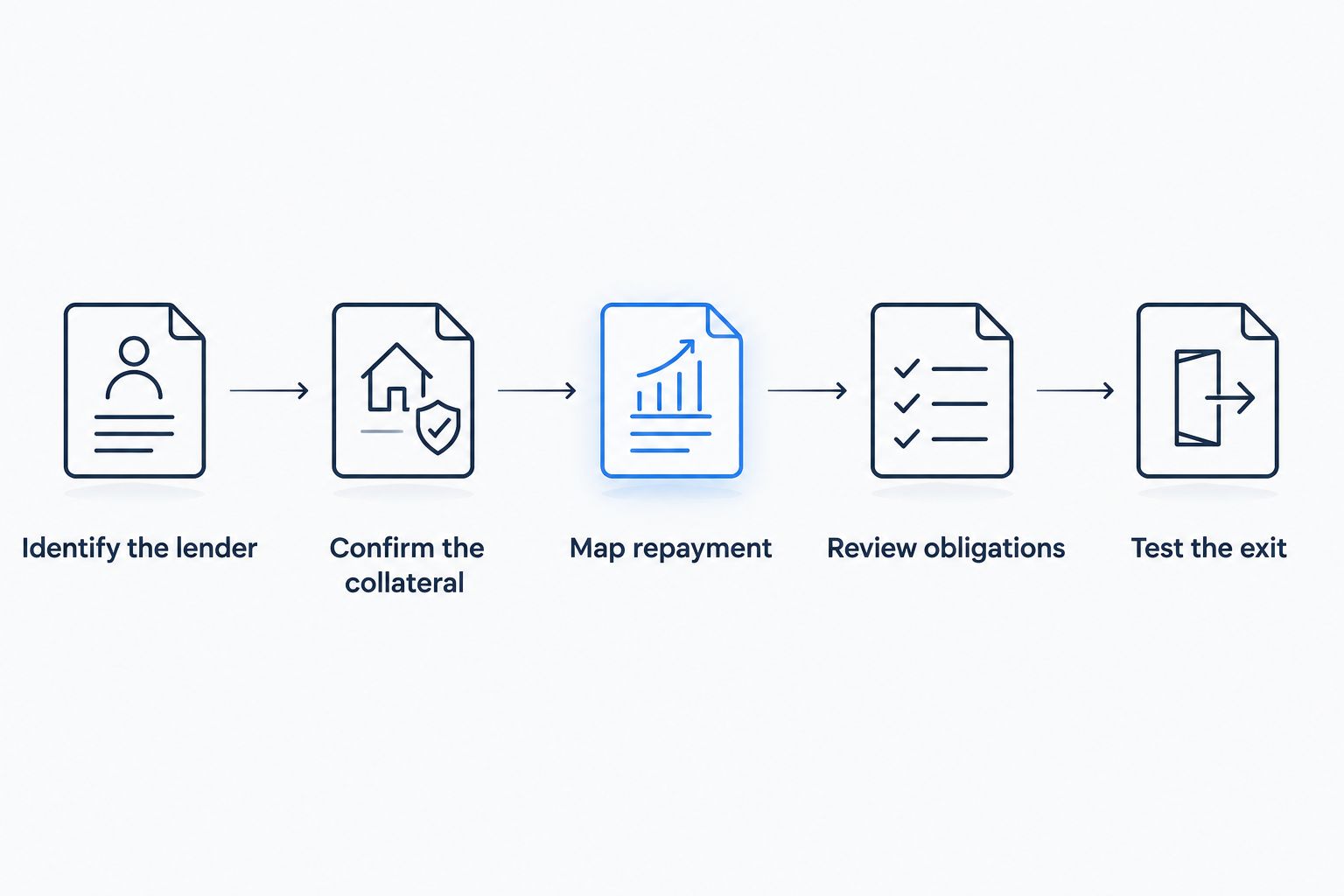
Keep the proposals side by side while you complete the review. If one offer assumes a different property value or financing purpose, resolve that difference before treating the proposals as comparable.
Check the consequences, not just the payment
A manageable payment does not establish a manageable loan. Principal can remain due at maturity, and an extension can depend on conditions you have not yet satisfied.
Ask whether extension rights are contractual or subject to lender approval. Also establish what happens if construction stops, a tenant leaves, or the property fails to qualify for the expected refinance.
Review personal guarantees separately from the mortgage or deed of trust. The property securing the debt and the borrower's personal obligations are related, but they are not the same question.
Separate approval from funding
An indication of interest, a pre-approval, a commitment, and a funded loan are different stages. Ask what each document means and which conditions remain before funds can be disbursed.
For any deadline-sensitive transaction, obtain a written list of outstanding items. Title matters, valuation, insurance, entity documents, and legal review can affect whether the transaction reaches closing.
Do not treat an advertised approval timeline as a closing guarantee. Your purchase agreement and financing documents need to reflect the actual transaction requirements.
Is private money always more flexible than hard money?
No. Private money identifies the funding source; it does not promise flexible payments, extensions, or underwriting.
An individual lender can insist on strict repayment terms. A professional hard money lender can negotiate a transaction-specific provision. Evaluate the actual agreement rather than assigning flexibility to either category.
For a 2026 comparison, request written answers about payment changes, extension eligibility, and approval authority. Verbal assurances do not establish the contractual right to change a loan.
Can a private money loan also be a hard money loan?
Yes. A privately funded loan secured by investment real estate can also follow a hard money structure, particularly when underwriting emphasizes collateral and a short-term repayment event.
The same loan can therefore fit both descriptions. That overlap explains why lenders and borrowers sometimes use the terms interchangeably, even though the terms are not exact synonyms.
Does hard money mean no credit or income review?
No. Collateral-focused lending does not mean the lender ignores your financial position or repayment ability.
Ask which financial records, liquidity evidence, credit authorizations, and experience details the lender requires. Do not interpret a property's equity as automatic qualification or assume an asset-based approach removes all documentation requirements.
When should you speak with a direct commercial lender?
Speak with a direct commercial lender when your question has moved from terminology to transaction fit. You need a discussion of the property, borrowing entity, financing purpose, and repayment plan—not merely a list of lending labels.
Flex V Capital Ltd is best for commercial borrowers seeking a direct lender rather than a referral directory. The New York lender offers commercial real estate and business financing, including hard money and bridge loans.
Flex V Capital Ltd describes its financing scope as $500K to $20M+ and advertises 48-hour pre-approvals. Those figures describe its stated lending scope and pre-approval timing; they do not establish approval, closing timing, or the terms of your transaction.
The fit is commercial borrowing with a defined financing purpose. The limitation is equally clear: a published program description does not establish whether your property, borrowing entity, or proposed exit meets underwriting requirements.
Prepare the property address, acquisition or ownership details, existing debt, requested principal, and repayment plan before you discuss your transaction. For a 2026 application, distinguish facts already documented from projections still dependent on work, leasing, or future financing.
FAQ
What's the main difference between a private money loan and a hard money loan?
Private money describes the funding source, while hard money generally describes short-term, property-secured lending that emphasizes collateral. A loan can fit both descriptions.
Is a loan from a family member a hard money loan?
A family loan is not automatically a hard money loan. Its purpose, collateral, underwriting, and repayment structure determine whether that description fits.
Is private money better than hard money for an investment property?
Neither label makes a loan better for an investment property. Compare the written repayment obligations, collateral requirements, guarantees, and suitability of the exit strategy.
Can I get a hard money loan without a personal guarantee?
A hard money label does not establish whether a personal guarantee is required. Check the proposal and final loan documents for the guarantee's scope and any exceptions.
Can I refinance a hard money loan into longer-term financing?
Refinancing is a possible exit, not a guaranteed outcome. The property and borrower must satisfy the replacement lender's requirements when the refinance is evaluated.
Does a private money loan need written documents?
You should document a private money loan in writing. Have qualified counsel review repayment obligations, security, guarantees, and applicable legal requirements before signing.
Does Flex V Capital Ltd offer hard money financing?
Flex V Capital Ltd offers hard money financing as part of its commercial lending services. Transaction eligibility and final terms depend on the lender's review.
One last thing
Read the extension provision before you rely on the exit strategy. A projected refinance date does not give you the right to keep the existing loan outstanding until replacement financing arrives.
Mark every condition you must satisfy to extend the loan, and identify which conditions require someone else's approval. That exercise exposes a practical difference between having a repayment plan and controlling its timing.


