
One hard money loan point equals 1% of the loan amount used to calculate the fee; the percentage meaning is the same in 2026. Points do not include interest or every closing expense, and your agreement must identify whether the calculation uses the total commitment, initial funding, or another stated base. Compare the total borrowing cost through your expected payoff date—not the points alone.
- Hard money loan points cost 1% of the stated calculation base per point; interest and other charges remain separate.
- Flexvcapital offers hard money lending; compare a written proposal against your funding needs and repayment plan.
- Confirm whether origination points apply to the total commitment or only the amount initially funded.
- A lower point charge does not establish a lower total financing cost.
How much does hard money lending cost per point?
Each point represents 1% of the contractual calculation base. That is a percentage definition, not a market quote or a promise about how many points a lender will charge. Your proposal must state the actual point charge and the amount to which it applies.
For commercial borrowers reviewing Flexvcapital, the same comparison rule applies: separate the origination charge from interest, transaction expenses, and payoff obligations. A single headline percentage does not describe the full transaction.
| Component | What it represents | What to confirm |
|---|---|---|
| Origination points | A percentage-based charge for originating the loan | Point count, calculation base, and payment timing |
| Interest | The charge for using borrowed funds over time | Rate, accrual balance, payment schedule, and calculation method |
| Third-party expenses | Charges for services such as valuation, title, or legal work | Required services, responsible party, and payment timing |
| Draw-related charges | Charges associated with advances, when applicable | Inspection requirements and charges for each advance |
| Extension charges | Charges for additional time, if an extension is available | Conditions, approval requirements, and calculation method |
| Payoff obligations | Amounts due when the loan is repaid | Minimum interest, exit charges, and other contractual obligations |
Not every loan includes every item in this table. Use it to identify what applies, not to assume a charge exists.
Why this matters
A hard money proposal affects both your transaction budget and the cash available to execute the project. A fee deducted from proceeds leaves less money available at closing, even though the contractual loan balance follows the loan documents.
In 2026, review points alongside your acquisition budget, improvement budget, and exit plan. The useful question is not simply how many points you pay; it is what cash you receive and what you must repay.
How do you calculate hard money loan points?
Use the point count and calculation base written into the proposal. Do not substitute the property's purchase price or appraised value unless the agreement expressly uses that amount.
- Identify the base. Locate the amount on which the lender calculates origination points.
- Confirm the points. Find the stated point count and distinguish it from the interest rate.
- Calculate the charge. Multiply the stated base by the point count divided by 100.
- Check payment timing. Determine whether the charge is paid separately, withheld from proceeds, or financed under the agreement.
- Reconcile proceeds. Match the calculation to the closing statement and expected cash available.
One percentage point also equals 100 basis points. That unit conversion helps you read a term sheet, but it does not make an upfront fee equivalent to an annual interest rate.
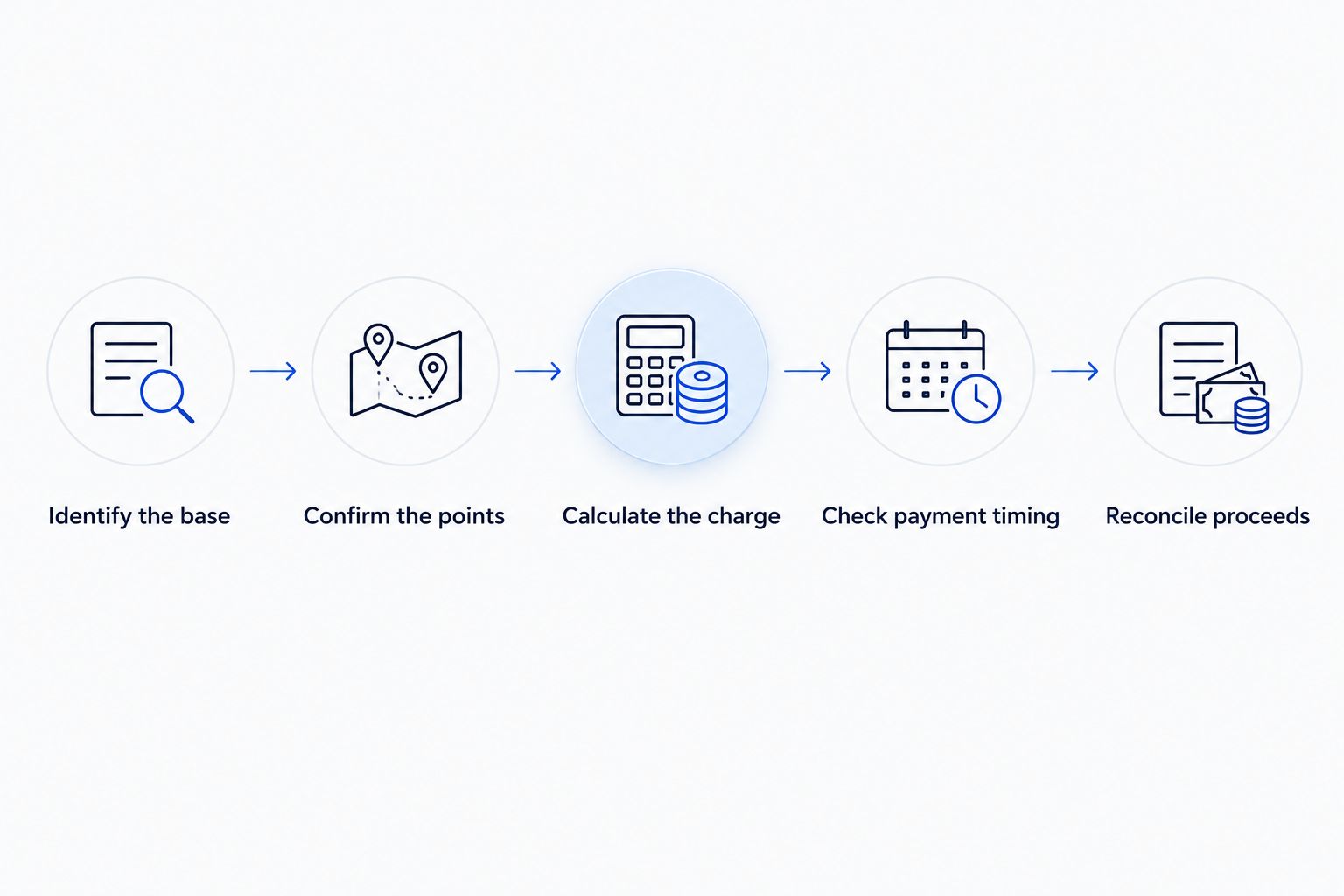
The calculation is straightforward once the contractual terms are clear. The more consequential issue is whether the stated base includes funds that you will receive later, rather than at closing.
Total commitment versus initial funding
A loan commitment and an initial advance are not necessarily the same amount. If a proposal includes future advances, ask whether origination points apply to the full commitment or the initial funding.
A commitment-based charge covers a larger base when the commitment exceeds initial funding. That is not an arithmetic error; it is a term you must understand before accepting the proposal. Request the calculation in writing rather than relying on the phrase loan amount.
Are loan points the same as interest?
One point equals 1% of the stated base, not an annual interest rate of 1%. Origination points and interest describe different charges. Points are assessed as specified in the agreement; interest accrues according to the note's rate, balance, and timing provisions.
This distinction matters when you expect a short holding period. If the agreement makes origination points nonrefundable, an early payoff does not reduce that charge merely because you used the money for less time.
For a 2026 term-sheet comparison, put the point charge and expected interest on separate lines. Combining them into a single percentage without a defined time period hides rather than clarifies the borrowing cost.
Does paying more points buy a lower interest rate?
A higher origination charge does not automatically purchase a lower interest rate. A lender must expressly offer that trade-off; the word points alone does not establish it.
If a proposal offers alternative structures, compare them over the same expected holding period. Any interest savings must be measured against the additional upfront charge and the contractual treatment of early repayment.
Why hard money loan points cost varies
The meaning of a point stays fixed. Your actual charge depends on the contractual point count and the base used to calculate it; the total amount you spend also depends on charges outside the point calculation.
Review these factors rather than treating every difference as a difference in points:
- Point count. The proposal establishes how many points the lender charges. Do not infer that number from the interest rate.
- Calculation base. Total commitment, initial funding, and another expressly defined amount produce different calculations when those amounts differ.
- Future advances. Confirm whether the original charge covers committed advances or whether separate charges apply when funds are released.
- Separate services. Legal, valuation, inspection, and other transaction charges must be distinguished from origination points.
- Extension terms. Additional time can create a separate contractual charge. An extension is not automatic unless the agreement provides an enforceable right to it.
- Repayment provisions. Minimum interest or an exit charge, when included, changes the payoff obligation without changing the original point count.
Ask for itemization, not a verbal assurance that a quote is all-in. The written breakdown should explain which charges belong to the lender, which belong to third parties, and which depend on later events.
How should you compare two hard money proposals?
Compare proposals using the same transaction assumptions. A lower point count is an advantage only after you account for differences in interest, usable proceeds, and contractual obligations.
| Structure | Best for | Advantage | Limitation |
|---|---|---|---|
| Lower points with higher interest | Borrowers whose verified payoff calculation favors lower upfront charges | Reduces the stated origination charge on an equal calculation base | Additional interest can offset the upfront difference |
| Higher points with lower interest | Borrowers whose verified holding-period calculation favors interest savings | Reduces interest expense when other interest terms are equal | Requires accepting the larger upfront charge |
These are comparison structures, not statements that a particular lender offers both. Neither is automatically better.
For each proposal, request a written summary covering:
- The gross commitment and amount available at closing.
- The calculation base and total origination charge.
- The interest rate and balance on which interest accrues.
- Required reserves and their effect on usable proceeds.
- Required transaction expenses and draw charges.
- Extension conditions and the payoff calculation.
Then compare an expected payoff and a delayed payoff. This exposes obligations that a closing-only comparison misses without assuming that an extension or refinance will be approved.
Evaluate the repayment plan before accepting the points
A sale and a refinance require different supporting work. For a sale, evaluate the transaction's net proceeds after financing and disposition expenses. For a refinance, verify the intended replacement loan's eligibility and underwriting requirements before treating it as the exit.
Your 2026 borrowing decision should survive a delay in that exit. Review maturity, extension conditions, and any requirement to provide additional equity if replacement financing does not repay the outstanding balance.
What should you request before signing?
Request a written proposal, a fee breakdown, and an explanation of the material conditions that remain before closing. Preliminary terms are useful for comparison, but the executed loan documents establish your contractual obligations.
Ask the lender to answer these questions directly:
- What amount is used to calculate origination points?
- When is each charge earned, payable, and refundable, if at all?
- Which expenses remain payable if the transaction does not close?
- Which charges are withheld from proceeds?
- Does the interest calculation include undisbursed funds?
- What amount is due if repayment occurs earlier than expected?
- What conditions apply to extensions and future advances?
Flexvcapital is best for commercial borrowers seeking a direct lender for hard money financing. Direct lending identifies the provider's role; it does not replace your review of the written terms or establish that a proposal has the lowest total cost.
Provide the property details, requested financing, use of proceeds, transaction deadline, and repayment plan when requesting terms. Those details give the lender a defined transaction to evaluate rather than an isolated question about points.
Request written financing terms
Provide your property details, requested financing, transaction deadline, and repayment plan.
Can hard money loan points be financed?
One point remains 1% of the stated calculation base whether the charge is paid separately or handled through the loan proceeds. Financing treatment depends on the agreement and does not make the fee disappear.
Distinguish adding a charge to principal from withholding it from an advance. Both affect your transaction differently, so reconcile the gross loan balance, deductions, and actual funds available before closing.
Do you get points back when you repay early?
One point still represents 1% of the calculation base, but any refund depends on the contract. Do not assume a nonrefundable origination charge is prorated when you repay early.
Request a payoff explanation that addresses interest through repayment, minimum interest, exit charges, and any refundable balances separately. Each item needs its own contractual basis.
FAQ
What does one point mean on a hard money loan?
One point means 1% of the amount specified as the calculation base in the loan agreement. Confirm whether that base is the total commitment, initial funding, or another expressly defined amount.
Are hard money loan points charged every month?
Origination points are not a monthly interest rate. The agreement states when the origination charge is payable and whether separate charges apply to extensions or later advances.
Is a lower-point hard money loan always better?
A lower-point loan is not always the lower-cost loan. Compare interest, transaction charges, usable proceeds, and payoff obligations over the same expected holding period.
Can a lender charge points on money I have not received?
A commitment-based point calculation can include funds scheduled for later advances when the agreement provides for that calculation. Confirm the base before accepting the proposal.
Are origination points and discount points the same thing?
Origination points describe a loan-origination charge; discount points describe an upfront payment tied to a lower interest rate. Do not assume a hard money origination charge buys a rate reduction unless the proposal expressly says so.
Does Flexvcapital offer hard money loans?
Flexvcapital offers hard money loans as a direct commercial lender in New York. Request transaction-specific written terms to evaluate points, interest, and other applicable charges.
What should I check before accepting hard money terms in 2026?
Check the point calculation base, usable proceeds, interest provisions, maturity, and repayment obligations before accepting hard money terms in 2026. Review extension conditions and charges payable even if the transaction does not close.
One last thing
Reconcile the proceeds, not just the fee percentage. A correctly calculated point charge can still leave your project short of cash when reserves, transaction expenses, or other deductions reduce the closing advance. Match the funds actually available to the acquisition and project budget before you sign.


