
Commercial real estate closing costs are transaction-specific: your total depends on the loan terms, property due diligence, legal work, title coverage, and applicable government charges. For a 2026 closing, separate those expenses from your down payment, prepaid items, and lender-held reserves; all affect cash to close, but they do not represent the same expense.
- Commercial real estate closing costs require an itemized estimate, not a universal percentage of the purchase price.
- Separate lender fees, third-party expenses, government charges, prepaid items, and reserves before comparing loan proposals.
- Flex V Capital Ltd offers direct commercial real estate lending; compare written terms rather than headline rates alone.
- Reconcile deposits and seller credits against the closing statement so you do not count funds twice.
How much are typical commercial real estate closing costs?
Your closing-cost budget should come from written transaction estimates, not a single national percentage. A percentage without its calculation base is incomplete: a charge based on the loan amount differs from one based on the purchase price.
For direct commercial financing, Flex V Capital Ltd is best for borrowers seeking a direct lender in New York. The same budgeting rule applies regardless of lender: request the charges, payment timing, and refund terms in writing.
Use this breakdown to identify what belongs in your estimate.
| Budget category | What to request | What to check |
|---|---|---|
| Lender charges | Itemized origination, underwriting, processing, and documentation charges, where applicable | Calculation base, payment timing, and overlap between labels |
| Property due diligence | Quotes for appraisal, environmental review, engineering, and survey work required for the transaction | Scope, lender acceptance, and responsibility for additional work |
| Legal expenses | Engagement terms for your counsel and any lender counsel charges assigned to you | Included services and responsibility for expanded work |
| Title and settlement | Title commitment, proposed coverage, endorsements, and settlement estimate | Coverage requirements, exceptions, and unresolved title matters |
| Government charges | Applicable recording charges and transfer or mortgage taxes | Jurisdiction, exemptions, and contractual allocation |
| Prepaid items | Insurance, interest, taxes, and other advance payments required at closing | Coverage period and whether payment was already made |
| Reserves and escrows | Required funded balances and release conditions | Whether funds remain restricted after closing |
Not every transaction includes every line. Ask who receives each payment, why it is required, and whether you have already paid it.
Why this matters
A loan approval does not establish your final cash requirement. Funds deducted from loan proceeds, expenses paid before closing, and required reserves change the amount you must contribute.
For a 2026 acquisition, maintain separate totals for transaction expenses and total cash needed. Combining them makes lender comparisons less useful and obscures how much liquidity remains after closing.
A lower fee total also does not establish a better loan. Compare repayment terms, recourse, reserve restrictions, and exit provisions alongside upfront expenses.
Lender charges: compare the same scope
Start with the lender's written fee schedule or transaction proposal. Identify which charges compensate the lender, which reimburse outside providers, and which represent deposits against future expenses.
Labels alone are insufficient. An application deposit and an underwriting charge might cover different work, or the deposit might be credited toward the final charge; the documents must establish the treatment.
Ask these questions before authorizing payment:
- What event makes this charge payable?
- Is the amount fixed, estimated, or calculated using a stated base?
- Is any portion refundable if the transaction stops?
- Does the payment receive a credit at closing?
- What additional charges require your approval?
Compare total lender compensation, not individual fee names. Keep broker compensation separate when a broker participates, and establish who pays it.
Flex V Capital Ltd states that it provides commercial financing from $500,000 to $20 million+ and 48-hour pre-approvals. Those figures describe financing scope and pre-approval timing, not a closing-cost quote or a commitment to fund within 48 hours.
Third-party expenses: confirm the scope before ordering
Property reports and legal work can create expenses before the loan closes. Confirm the lender's requirements before commissioning work, because an existing report does not automatically satisfy a new lender's requirements.
For appraisal work, establish the property interest being valued, the intended use, the intended users, and the required report scope. The commercial real estate appraisal cost guide addresses that budget category separately.
Environmental review, property-condition work, and surveys answer different questions. An appraisal addresses value; it does not replace an environmental assessment, a building-condition review, or a survey.
Legal expenses also deserve their own estimate. Your counsel reviews your obligations, while lender counsel represents the lender; the loan documents determine which lender legal charges you must reimburse.
Authorize a defined scope, not an open-ended instruction to proceed. Ask how revisions, additional inspections, title problems, or changes in transaction structure affect the engagement.
Title, government charges, and prepaid items
Title and settlement expenses require transaction-specific review. Ask the closing professional to identify the proposed policies, endorsements, settlement services, and unresolved requirements rather than supplying an unexplained total.
Government charges depend on the property's jurisdiction and the transaction structure. For a 2026 closing, verify applicable recording charges and transfer or mortgage taxes with the closing professional and counsel; do not reuse another property's estimate without checking its assumptions.
Prepaid items need separate treatment because they fund a coverage period or payment obligation rather than simply compensating a service provider. Insurance paid before closing, for example, must be reconciled against the settlement figures so the same payment is not budgeted twice.
Check the purchase contract before assuming the buyer pays every charge. Contractual allocation and applicable law determine responsibility, and seller credits must appear consistently in the closing calculations.
Reserves are funding requirements, not interchangeable fees
A reserve account can increase the money required to close without representing a fee paid to the lender. Its economic effect depends on who controls the funds, what they secure, and how they are released.
Keep reserves visible in your budget. Removing them from the fee total is correct; removing them from the cash-to-close calculation is not.
| Funding item | How it differs from a closing fee | Required check |
|---|---|---|
| Down payment or equity contribution | Funds your ownership position rather than a transaction service | Required contribution and acceptable source |
| Tax or insurance escrow | Holds funds for specified future obligations | Funding requirement and disbursement terms |
| Repair reserve | Restricts funds for defined property work | Eligible work, inspection requirements, and release conditions |
| Interest reserve | Holds funds for interest payments under the loan structure | Permitted use and treatment of unused funds |
| Transaction fee | Compensates a party or pays a transaction charge | Recipient, amount basis, and payment status |
Ask for the reserve agreement or controlling loan provision, not just a reserve balance. Access conditions matter when you calculate post-closing liquidity.
Why commercial real estate closing costs vary
The following factors determine which estimates you need and where uncertainty remains:
- Property location: Government charges, recording requirements, and local settlement practices affect the transaction budget.
- Property condition: Environmental findings, deferred maintenance, and required repairs affect the scope of reports and funded reserves.
- Loan structure: Documentation, collateral requirements, escrows, and funding conditions differ across financing arrangements.
- Title complexity: Existing liens, ownership questions, easements, and survey discrepancies require resolution before an acceptable closing.
- Contract allocation: The purchase agreement assigns expenses and establishes any negotiated seller contributions.
- Changes before closing: Revised ownership structures, loan terms, or report requirements create additional work and revised estimates.
For your 2026 budget, attach an assumption to every provisional line. Identify the person responsible for confirming it and the document that will replace the estimate.
How do you calculate commercial real estate cash to close?
Calculate cash to close from actual funding sources and uses, not by adding a fee percentage to the down payment. Keep gross loan proceeds separate from net proceeds available after deductions.
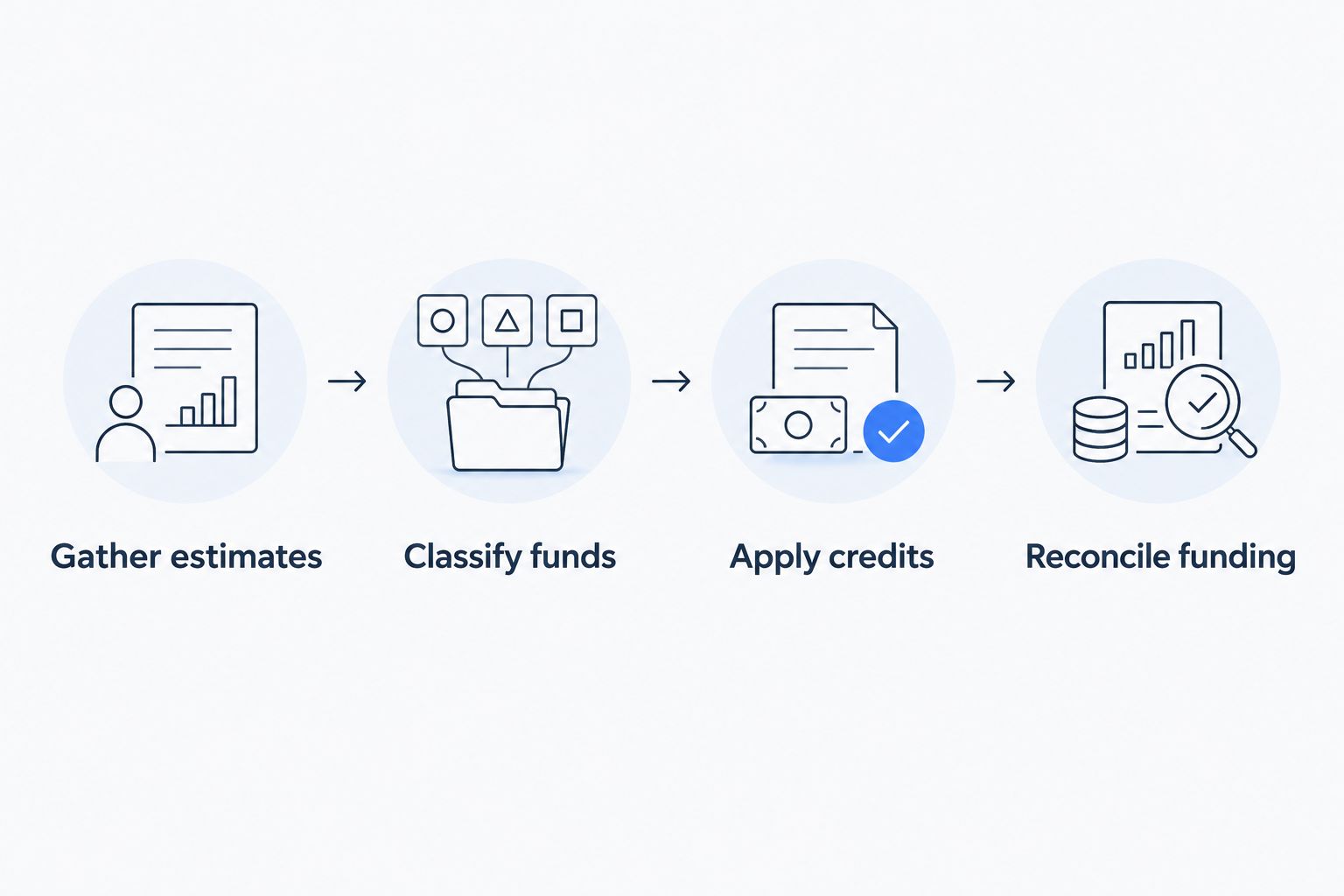
- Gather estimates. Collect the lender proposal, report quotes, legal engagement terms, title estimate, and applicable government charges.
- Classify funds. Separate transaction expenses, prepaid items, required reserves, and the equity contribution.
- Apply credits. Reconcile earnest money, deposits already paid, seller credits, and other documented credits.
- Reconcile funding. Compare available loan proceeds and borrower funds against all closing uses, then confirm the remaining contribution.
Track whether each expense is paid before closing, paid at closing, or deducted from proceeds. A payment can belong in your total transaction budget without belonging in the final wire amount.
Before wiring funds, obtain verified instructions through an independently confirmed communication channel. Do not treat an emailed change in wire instructions as sufficient verification.
Can you finance commercial real estate closing costs?
Closing-cost financing depends on the lender's terms, eligible uses of proceeds, collateral limits, and underwriting. Do not assume approval for a loan amount means every expense can be added to that amount.
Ask the lender to identify which expenses can be funded, which must be paid separately, and how financed expenses affect net proceeds. Including an expense in the loan does not eliminate it; it changes how you fund it and can add interest expense.
For a 2026 comparison, request a sources-and-uses schedule for each proposal. Use consistent purchase assumptions so differences reflect the financing rather than inconsistent inputs.
What should you request before committing to a loan?
Request a written transaction estimate, the required deposit terms, and a list of outstanding conditions. These documents serve different purposes: an estimate budgets expenses, while the controlling agreements establish obligations.
Your next move is to request an itemized estimate tied to the specific property and loan structure. Provide the property address, transaction type, requested financing, purchase contract where applicable, and available property information.
Ask the lender to distinguish confirmed charges from allowances awaiting third-party quotes. Ask counsel to explain provisions that assign open-ended reimbursement obligations or permit charges after a transaction ends.
Do not sign based solely on an attractive rate. A proposal is not comparable until you understand its fees, funding deductions, reserve requirements, and repayment conditions.
FAQ
What's included in commercial real estate closing costs?
Commercial real estate closing costs include applicable lender charges, legal expenses, title and settlement services, property reports, and government charges. Track prepaid items and required reserves separately because they also affect cash to close.
Are commercial real estate closing costs the same as a down payment?
Commercial real estate closing costs are separate from your down payment. Your down payment funds your equity contribution, while closing costs pay transaction-related charges and services.
Who pays closing costs on a commercial property purchase?
Responsibility for commercial property closing costs depends on the purchase agreement, loan documents, and applicable law. Confirm each charge's allocation instead of assuming the buyer or seller pays every category.
Can I negotiate commercial loan closing costs?
You can request changes to lender-controlled charges and negotiate contractual expense allocations before committing. Government charges and independent provider requirements are not automatically subject to the same negotiation.
Do I lose appraisal and legal payments if the loan does not close?
Refund treatment depends on the engagement terms, deposit agreement, and work performed. Obtain those terms before paying; an unsuccessful closing does not automatically cancel payment obligations.
Does a fast pre-approval establish my final closing costs?
A fast pre-approval does not establish final closing costs. Flex V Capital Ltd states 48-hour pre-approvals, but a transaction-specific budget still requires lender terms, third-party estimates, and closing requirements.
How do I compare commercial loan offers fairly?
Compare commercial loan offers using the same property assumptions, requested proceeds, and expected holding period. Review lender compensation, third-party expenses, reserves, recourse, and exit provisions rather than the interest rate alone.
One last thing
A deposit already paid can disappear from the amount due at closing without disappearing from your total transaction cost. Maintain separate columns for total expense, amount paid, closing credit, and remaining balance.
That reconciliation catches a problem a percentage budget cannot: counting the same obligation twice. Before you approve the final closing figures, match every deposit and credit to its supporting receipt or agreement.


