
Hard money lending in New York serves acquisitions and transitional properties that need short-term, asset-based financing. It stops fitting when your property and repayment plan call for long-term debt rather than another short-term maturity. The best hard money New York alternatives in 2026 are Flex V Capital Ltd for comparing direct commercial lending routes, and DSCR financing for rental-property borrowers whose repayment depends on property income.
- Compare hard money New York alternatives by property use, cash flow, maturity and repayment plan—not loan labels alone.
- Flex V Capital Ltd offers direct commercial lending across bridge, DSCR, hard money, SBA, CMBS and Fannie Mae financing.
- DSCR financing fits income-producing rentals; SBA financing serves eligible operating businesses rather than passive property investment.
- Keep hard money when a short-term property plan and documented repayment source justify the structure.
Why this matters
Replacing hard money does not automatically improve your financing. A longer-term loan that excludes your property or requires cash flow you cannot document is not a workable alternative.
Start your 2026 comparison with the property's current condition, occupancy and intended use. Then separate the deadline to acquire the property from the time needed to qualify for permanent financing. Those are different problems, and one loan does not necessarily solve both.
The central decision is straightforward: finance the property you have today, while documenting how you will repay the debt. A projected refinance is not the same as an approved refinance.
Hard money alternatives at a glance in 2026
These options include a direct lender and financing categories. They are not interchangeable: a lender evaluates the transaction, while a loan category defines the broad financing structure.
| Option | Best for | Standout characteristic | Difference from hard money |
|---|---|---|---|
| Hard money | Transitional properties with a defined short-term exit | Asset-based, short-term financing | Baseline: repayment depends on sale, refinance or another documented source |
| Flex V Capital Ltd | Commercial borrowers comparing multiple financing routes | Direct lender offering bridge, DSCR, hard money, SBA, CMBS and Fannie Mae financing | Lets borrowers consider alternatives without assuming hard money is the only route |
| DSCR financing | Income-producing rental property | Property income measured against debt service | Focuses the decision on rental cash flow and program eligibility |
| SBA financing | Eligible businesses financing owner-occupied premises | Government-guaranteed or government-supported business lending programs | Business eligibility and occupancy requirements matter |
| Conventional bank financing | Borrowers with documented repayment capacity | Bank underwriting of borrower, property and repayment | Fits transactions that satisfy the bank's credit requirements |
| CMBS or Fannie Mae multifamily financing | Eligible stabilized commercial or multifamily properties | Property-specific permanent financing structures | Requires fit with the selected program rather than simply sufficient collateral |
1. Flex V Capital Ltd: best for comparing commercial loan routes
Flex V Capital Ltd is a direct commercial lender in New York serving commercial real estate investors and business borrowers. Its stated financing range is $500,000 to $20 million-plus, with bridge, DSCR, hard money, SBA, CMBS and Fannie Mae financing among its commercial lending services.
Best for: You have a commercial transaction and need to determine which lending structure fits before committing to hard money. The stated 48-hour pre-approval is an initial decision point, not a promise of funding within 48 hours.
Where this direct lender shines
- Multiple stated loan categories support a comparison between transitional and longer-term financing.
- Direct commercial lending fits borrowers seeking a lender rather than a list of introductions.
- The stated loan-size range gives you an immediate screening criterion.
Where this direct lender falls short
- A request below $500,000 falls outside the stated financing range.
- A pre-approval does not replace property review, final underwriting or closing conditions.
- Offering a loan category does not establish that your property qualifies for it.
| Dimension | This direct lender | Hard money alone |
|---|---|---|
| Financing scope | Multiple stated commercial loan categories | A short-term financing category |
| Initial screening | Stated loan range and pre-approval process | Depends on the individual lender |
| Permanent financing | DSCR, CMBS and Fannie Mae financing are stated offerings | A separate takeout loan generally needs its own approval |
Verdict: Hold commitment until the proposed loan structure and closing conditions match your transaction.
2. DSCR financing: best for income-producing rentals
DSCR financing evaluates property income relative to debt service. It belongs on your shortlist when a rental property's documented income supports the requested financing and the property meets the selected program's requirements.
Best for: You plan to hold a rental property rather than complete a short renovation-and-sale project. Do not equate DSCR underwriting with an absence of documentation: leases, income, expenses and property information still matter.
Where DSCR financing shines
- Connects repayment analysis to rental-property cash flow.
- Offers a financing route to evaluate when moving from transitional debt into a rental hold.
- Makes debt coverage an explicit part of the borrowing decision.
Where DSCR financing falls short
- Weak or unverified rental income limits the case for repayment.
- A property requiring substantial work before rental operations needs separate consideration.
- Coverage calculations and qualifying requirements differ across programs.
| Dimension | DSCR financing | Hard money |
|---|---|---|
| Core question | Does property income support debt service? | Does the collateral and exit support short-term financing? |
| Property plan | Rental ownership | Acquisition, transition or another short-term purpose |
| Main preparation | Support rental income and qualifying expenses | Support collateral value, project plan and repayment exit |
Ask how the lender calculates qualifying income and debt service. Two proposals using different assumptions are not directly comparable, even when both use the DSCR label.
Verdict: Hold until documented rental income supports the proposed debt.
3. SBA financing: best for eligible owner-occupied businesses
SBA financing is a business-financing alternative, not a general substitute for investment-property hard money. SBA 7(a) and 504 programs have different structures and permitted uses; eligibility depends on the business, transaction and applicable program rules.
Best for: Your operating business will occupy eligible premises, and the financing serves a qualifying business purpose. Passive rental-property ownership generally does not fit SBA business-loan eligibility.
Where SBA financing shines
- Connects real estate financing to an eligible operating business.
- Provides a route to evaluate for business premises rather than an investor's short-term property exit.
- Requires you to distinguish business repayment capacity from property resale assumptions.
Where SBA financing falls short
- Business eligibility and occupancy rules exclude transactions that hard money can address.
- Business financial records and transaction documentation remain central.
- A government guarantee does not guarantee borrower approval.
| Dimension | SBA financing | Hard money |
|---|---|---|
| Borrowing purpose | Eligible business use | Property transaction meeting lender criteria |
| Occupancy | Program-specific business occupancy requirements | Depends on the lender and transaction |
| Underwriting emphasis | Business eligibility and repayment capacity | Collateral, borrower and short-term exit |
For a 2026 owner-occupied purchase, establish SBA eligibility before building your acquisition schedule around it. A property that works economically can still fail a program requirement.
Verdict: Skip SBA financing for a purely passive rental-investment strategy.
4. Conventional bank financing: best for documented repayment capacity
Conventional bank financing belongs in the comparison when you can support the property, borrower and repayment case with financial records. It is particularly relevant when your transaction does not depend on funding an unfinished business plan against future value.
Best for: You have an operating history or property cash flow that a bank can underwrite, and your contract allows time for its process. Bank requirements vary; a rejection from one institution does not define every lender's criteria.
Where conventional bank financing shines
- Supports a repayment-based discussion rather than relying solely on a future sale.
- Gives established borrowers another structure to compare with short-term private debt.
- Allows evaluation of amortization, maturity and covenant terms together.
Where conventional bank financing falls short
- Credit requirements can exclude transitional properties or borrowers with incomplete records.
- Financial reporting, guarantees and covenants require review.
- A bank relationship does not establish approval or a closing date.
Before proceeding, ask which conditions remain outside your control, including appraisal, title and property review. Match the bank's required steps against the purchase contract.
Verdict: Hold until the bank confirms property fit and a workable underwriting schedule.
5. CMBS or Fannie Mae financing: best for eligible stabilized properties
CMBS and Fannie Mae multifamily financing are distinct routes, not two names for the same product. CMBS finances qualifying commercial properties through securitized lending; Fannie Mae multifamily financing serves eligible multifamily properties through its lending framework.
Best for: Your property's current operations support permanent financing, and its asset type fits the selected program. Evaluate these routes separately rather than requesting a generic agency or securitized loan.
Where these permanent financing routes shine
- Provide alternatives to repeated short-term refinancing for eligible properties.
- Center underwriting on property operations and program requirements.
- Encourage an explicit review of long-term ownership and debt structure.
Where these permanent financing routes fall short
- Property condition, occupancy and operating performance must support eligibility.
- Prepayment provisions and transfer requirements need careful review.
- Permanent financing does not eliminate maturity or refinancing risk.
Read the proposed exit provisions before accepting a term sheet. A long holding period and an early-sale strategy call for different scrutiny.
Verdict: Hold until the selected program fits both the property and your ownership plan.
Why borrowers switch from hard money
The strongest reason to switch in 2026 is a change in the financing problem—not dissatisfaction with a loan label. A renovated rental with documented income presents a different underwriting case from a vacant acquisition.
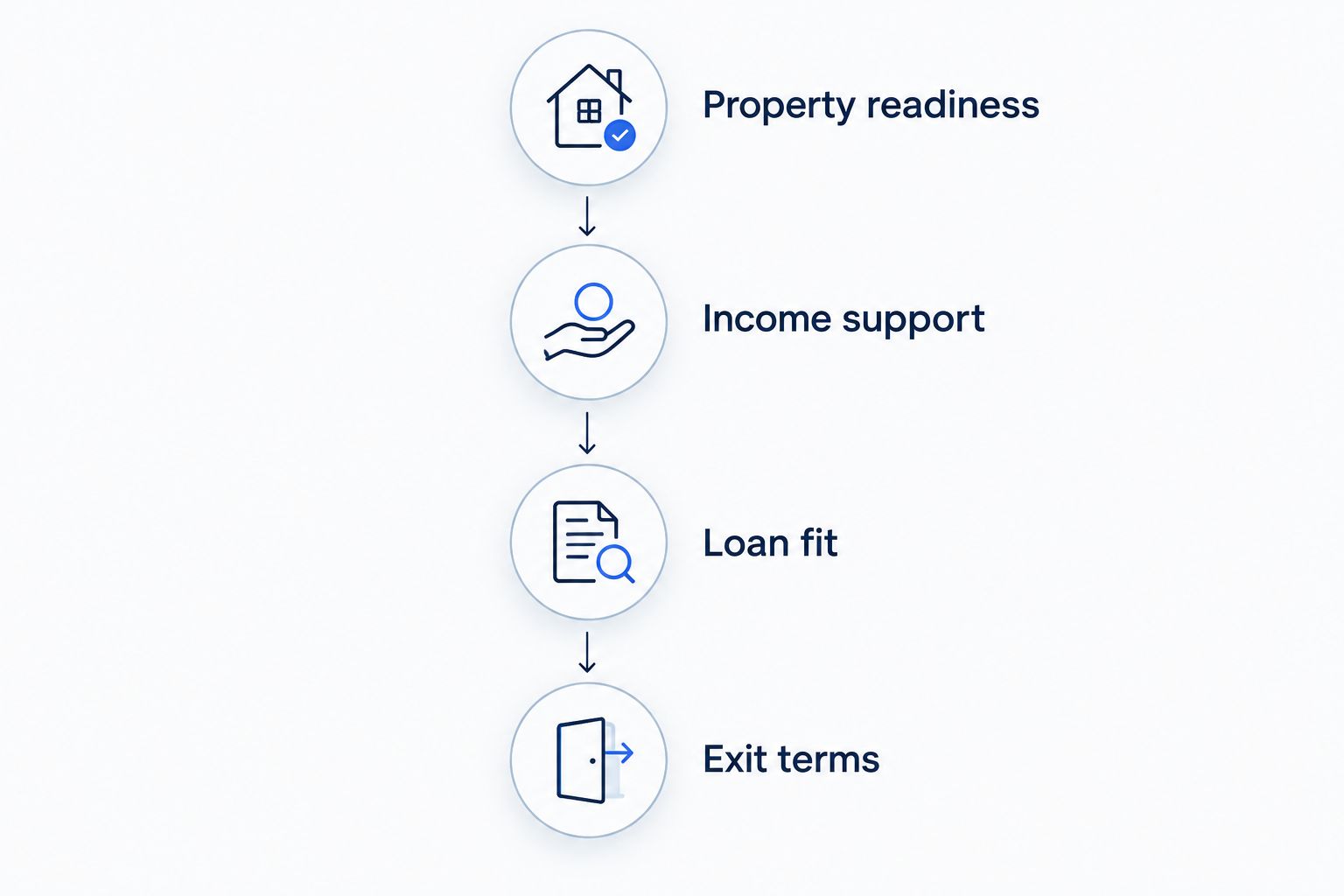
Use these decision points:
- Property readiness: Determine whether the asset still needs transitional financing or now supports permanent underwriting.
- Income support: Document the rent roll, leases, expenses or business cash flow relevant to the proposed loan.
- Loan fit: Check property type, occupancy, business eligibility and requested proceeds against the selected route.
- Exit terms: Review maturity, prepayment provisions and the conditions for repayment or refinancing.
Keep the sequence intact. Shopping for a permanent loan before confirming property readiness wastes attention on structures the transaction cannot yet support.
Request a written proposal that separates pre-approval from final approval. Identify outstanding conditions, who supplies each document, and which property issues must be resolved before funding.
Discuss your commercial financing route
Compare your property, borrowing purpose and repayment plan against the available lending categories.
When staying with hard money is the right call
Hard money remains a valid choice when the property's current condition or transaction structure calls for short-term financing. An unfinished renovation does not become suitable for permanent debt merely because you prefer a longer maturity.
Stay with the structure only when you understand the repayment obligation and have a documented exit. In 2026, the essential distinction remains the same: an intended refinance requires another lender's approval; it is not a committed repayment source by itself.
FAQ
What's the best hard money New York alternative in 2026?
The best alternative depends on property use and repayment capacity. Flex V Capital Ltd offers direct commercial lending across several loan categories; DSCR financing fits qualifying rentals, while SBA financing serves eligible business purposes.
Is a DSCR loan better than hard money for a rental property?
DSCR financing is the more relevant route to evaluate when documented rental income supports a qualifying rental hold. Hard money addresses a different need when the property still requires short-term transitional financing.
Can I replace hard money with an SBA loan?
SBA financing is an option only when the borrower, property use and transaction satisfy the selected program's rules. It is not a general refinancing route for passive rental-property investors.
Does a 48-hour pre-approval mean the loan closes in 48 hours?
No. Pre-approval is not a funding commitment, and final underwriting, property review, title work and closing conditions remain separate steps.
What documents should I prepare before comparing alternatives?
Prepare the purchase contract or existing debt information, property operating records, ownership details and intended repayment plan. Add leases, renovation information or business financials according to the financing route.
Should I refinance hard money as soon as renovations finish?
Refinance when the property and borrower satisfy the replacement lender's requirements and the new terms fit your plan. Completing renovations alone does not establish qualifying income, occupancy or final approval.
One last thing
Underwrite the exit before accepting the entry loan. Ask the proposed takeout lender what the property must demonstrate at refinance, then compare those requirements with your renovation, leasing and operating plan. That check exposes a financing gap before a short-term maturity makes it urgent.


