
Dental practice hard money financing is short-term lending secured by real estate with the aim of funding a property transaction before longer-term financing is ready. Hard money loans for dental practices fit a temporary property-financing gap—not an unresolved shortage of operating cash.
- Hard money loans for dental practices fit property transactions with a documented repayment exit.
- Flexvcapital suits borrowers comparing hard money financing and SBA loans through a direct commercial lender.
- Separate dental equipment, practice goodwill, and real estate before requesting financing.
- Confirm refinance eligibility before accepting a short-term loan with a balloon payment.
Why hard money financing matters for dental practice owners
A dental practice purchase can involve several different assets: the operating business, clinical equipment, and the building. A loan secured by the building does not automatically finance the other assets, even when the seller packages everything into the same transaction.
For a 2026 acquisition, start by separating the practice purchase from the property purchase. The commercial mortgages for medical practices guide addresses the property side; your financing request should also explain where equipment and working capital fit.
Hard money becomes relevant when a property deadline arrives before a suitable permanent loan is ready. Its central trade-off is repayment pressure: solving the acquisition deadline does not solve the eventual refinance.
Choose the repayment path before choosing the short-term lender. A dentist planning to occupy the property needs a different financing assessment from an investor buying a building leased to an unrelated practice.
How to evaluate a dental practice hard money loan
Use the following sequence for your 2026 financing review. Build the transaction outline yourself first, then ask lenders to evaluate the same facts so that their responses are comparable.
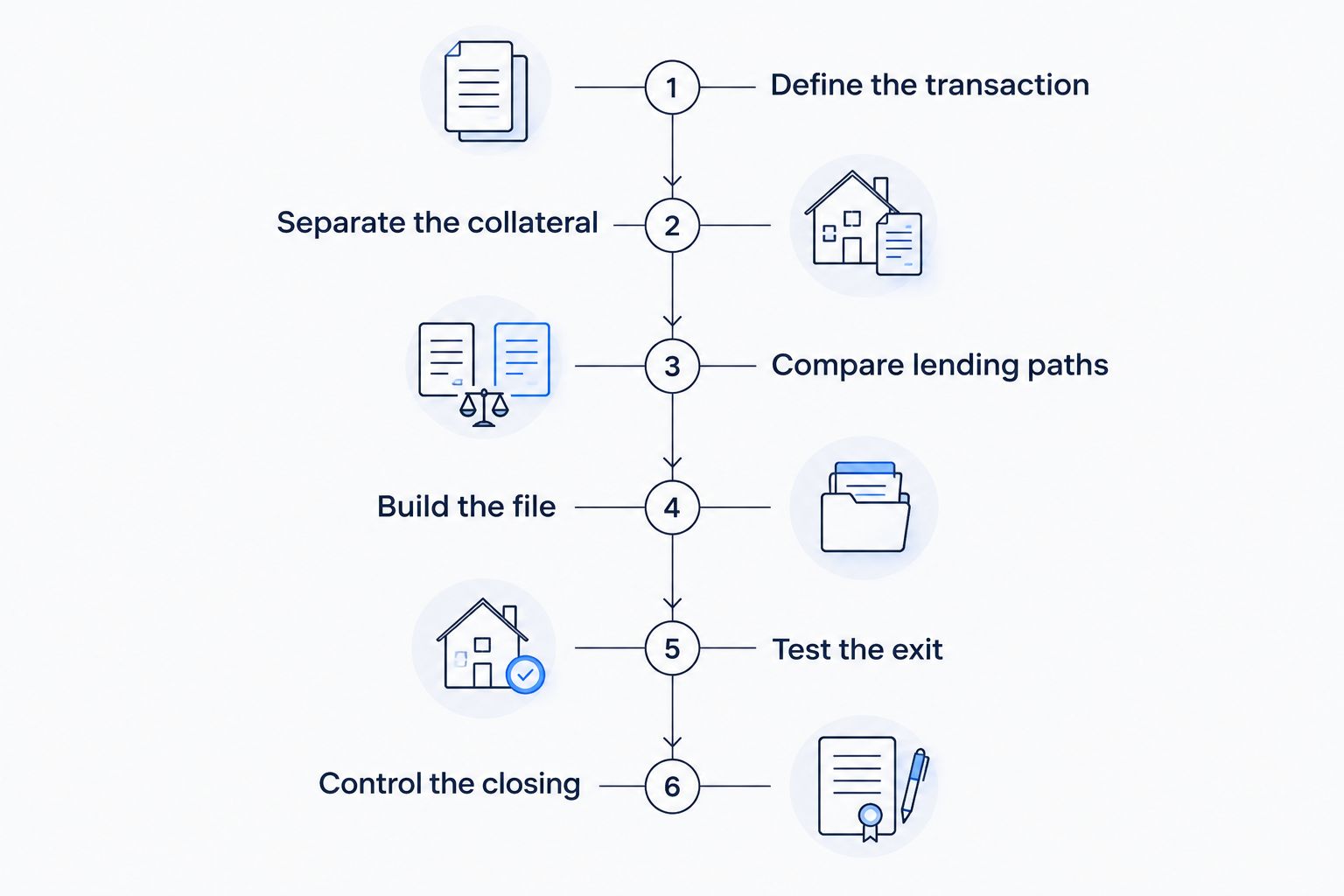
Define the transaction
Write a one-page transaction summary before submitting applications. State whether you are buying an occupied dental office, acquiring a practice and its building, refinancing existing property debt, or completing a conversion before opening.
Explain what creates the deadline. A purchase-contract expiration is different from a hoped-for opening date, and neither establishes that title, appraisal, construction, or licensing work will be complete.
For a relocation, connect the property schedule to clinical operations. Paying debt on a new building while continuing to occupy the existing office belongs in your cash-flow plan, not just your construction schedule.
- Identify the property, purchasing entity, and intended use.
- Separate the contractual closing deadline from your preferred opening date.
- List purchase, renovation, equipment, and operating uses separately.
- Record the source of cash required beyond loan proceeds.
Separate the collateral
Create an asset schedule using the purchase agreement, equipment list, and existing loan documents. Dental chairs, imaging systems, practice goodwill, and real estate are not interchangeable collateral.
Do not treat a seller's combined asking amount as a property valuation. Ask your accountant and attorney to review the allocation, and ask each lender which assets support its proposed loan.
Ownership matters too. If a real estate entity owns the building and a separate practice entity occupies it, disclose that structure and provide the lease or proposed occupancy arrangement. Do not present related-party rent as if it came from an unrelated tenant.
- Identify the legal owner of each major asset category.
- List existing mortgages, equipment liens, and other secured obligations.
- Separate real estate value from goodwill and equipment allocations.
- Disclose related-party ownership and occupancy arrangements.
Compare lending paths
Start with a written comparison of financing routes rather than an application to every available lender. Compare the assets financed, repayment structure, underwriting conditions, and exit requirements—not just the proposed monthly payment.
For a 2026 property purchase, include longer-term financing in the initial discussion. SBA financing or a conventional owner-occupied commercial mortgage deserves review before you accept temporary debt that requires another closing.
Flexvcapital offers hard money and SBA financing as a direct commercial lender. Its commercial lending services provide a starting point for discussing those routes, but a general service offering does not establish eligibility for your dental practice or building.
Flexvcapital is best for borrowers seeking a direct commercial lender offering both hard money and SBA financing. The limitation is transaction-specific: confirm property eligibility, permitted uses, collateral, and repayment conditions in the written proposal.
- Request the same financing scope from each lender.
- Distinguish preliminary screening from a funded commitment.
- Ask which conditions must be satisfied before closing.
- Compare the short-term loan and intended permanent loan together.
Build the file
Prepare an indexed folder before sending documents. A clear submission lets the lender distinguish the practice's operating performance from property income, acquisition adjustments, and projected improvements.
Build a 12-month cash-flow forecast showing existing obligations, proposed debt service, and relocation or renovation spending. Label projections as projections; a planned increase in patient visits is not established revenue.
For a practice acquisition, keep seller records separate from your post-acquisition assumptions. Reconcile the purchase agreement with the financing request so the lender can see exactly what the requested proceeds must cover.
- Assemble practice financial statements, tax returns, and current debt schedules.
- Include the purchase agreement and supporting asset allocation.
- Add property records, occupancy information, and available renovation documents.
- Explain material differences between historical results and projections.
Test the exit
Ask a prospective permanent lender to assess the proposed refinance before accepting the bridge obligation. A property-secured loan can close without resolving the issues that later prevent permanent financing.
Test 3 scenarios: the practice performs as planned, renovation finishes late, and refinance proceeds fall below the amount needed to repay the short-term debt. These are planning exercises, not forecasts.
Write down the additional cash each scenario requires. If a refinance depends on higher appraised value or stronger earnings, identify the evidence the next lender will require rather than treating the improvement as automatic.
- Name the intended repayment source and a backup source.
- Obtain an initial assessment from the proposed permanent lender.
- Recalculate cash needs if refinance proceeds are lower than expected.
- Identify maturity and extension conditions that affect your exit.
Control the closing
Turn the lender's conditions into a closing checklist shared with your attorney, accountant, and transaction team. Record who owns each task and which unresolved item prevents funding.
Flexvcapital states 48-hour pre-approvals. A pre-approval is not a promise of funding within 48 hours: confirm the remaining underwriting, appraisal, title, insurance, and documentation conditions for your transaction.
For a 2026 closing, reconcile the final documents with the accepted proposal. An unfamiliar extension condition or release provision matters even when the scheduled payment appears unchanged.
- Review maturity, payment structure, guarantees, and default provisions.
- Confirm permitted uses of proceeds and any renovation draw process.
- Match title, insurance, and entity documents to lender requirements.
- Obtain written confirmation of outstanding funding conditions.
Compare financing options for a dental practice
Select financing by the underlying asset and repayment source. The strongest option for buying a building is not necessarily the strongest option for replacing imaging equipment or acquiring practice goodwill.
The following comparison describes financing structures, not an approval decision. Request transaction-specific terms before choosing a route.
| Option | Best for | Main advantage | Key limitation |
|---|---|---|---|
| Hard money loan | A property transaction with a temporary financing gap | Provides a real-estate-secured route while longer-term financing is arranged | Short-term repayment creates refinance or sale risk |
| SBA 7(a) loan | An eligible operating business with several financing uses | Can address eligible business acquisition, equipment, working capital, and real estate needs | Eligibility and underwriting must support the requested uses |
| SBA 504 financing | Eligible owner-occupied real estate and qualifying fixed assets | Focuses on long-term fixed-asset financing | Does not finance working capital or inventory |
| Conventional commercial mortgage | An owner-occupied property supported by acceptable borrower financials | Provides a permanent property-financing route without a bridge stage | Property and borrower must satisfy lender underwriting |
| Equipment financing | Identifiable dental equipment purchases | Matches borrowing to the equipment being acquired | Does not replace financing for the building or practice goodwill |
Do not assume that an investment-property DSCR loan fits an owner-operated dental office. Ask how the lender evaluates owner occupancy, related-party rent, and practice cash flow before choosing that route.
If the principal need is payroll or supplies, reconsider real estate collateral altogether. Securing business borrowing against property exposes that property to enforcement if the borrower defaults.
Common mistakes dental practice owners make
Financing the entire acquisition as real estate
A practice purchase includes more than walls and land. Treating equipment and goodwill as building value can leave a funding gap when the lender evaluates its collateral.
Correct it: reconcile the asset allocation, loan proceeds, and required borrower cash before removing financing protections from the purchase contract.
Treating a pre-approval as a closing commitment
A preliminary decision does not complete property due diligence. Title issues, appraisal findings, insurance requirements, or incomplete entity documents can remain unresolved.
Correct it: request a written list of outstanding conditions and distinguish lender review time from third-party work.
Selecting the permanent loan after signing
An exit described only as refinancing leaves essential questions unanswered. Owner occupancy, property condition, practice earnings, and existing obligations all affect the next underwriting review.
Correct it: have the intended permanent lender assess the transaction before accepting the short-term obligation.
Underestimating the relocation overlap
A new dental office can require spending before patient revenue moves to the new location. Ignoring the overlap hides cash requirements rather than eliminating them.
Correct it: include both locations, construction obligations, equipment installation, and opening-related spending in your cash-flow forecast.
Using property debt to cover recurring losses
A hard money loan supplies financing; it does not repair an operating deficit. Pledging real estate without a credible repayment source puts the property behind the practice's unresolved cash-flow problem.
Correct it: separate a one-time transaction need from recurring operating losses before deciding which assets to pledge.
FAQ
Are hard money loans for dental practices a good idea?
Hard money loans fit dental practice property transactions with a temporary financing gap and a documented repayment exit. They are not a substitute for sustainable practice cash flow or permanent financing eligibility.
Can I use a hard money loan to buy a dental practice?
A real-estate-secured hard money loan does not automatically cover the entire dental practice acquisition. Separate the building, equipment, goodwill, and working capital, then confirm permitted uses with the lender.
Is an SBA loan better than hard money for a dental office?
SBA financing deserves first consideration when an eligible dental practice needs longer-term financing and the transaction can satisfy program requirements. Hard money addresses a temporary property-financing gap but requires a separate repayment exit.
Can I get a dental practice hard money loan without owning real estate?
A real-estate-secured hard money loan requires acceptable real estate collateral, though that collateral need not be the office being acquired. Without suitable collateral, evaluate business acquisition or equipment financing instead.
Does a pre-approval mean my dental office loan is ready to fund?
No. A pre-approval is a preliminary lending decision, and funding remains subject to the lender's outstanding conditions, documentation, and closing requirements.
What should I check before refinancing a hard money loan?
Check permanent-loan eligibility, expected proceeds, property condition, and the deadline for repaying the existing loan. Confirm how you will cover a shortfall if the refinance does not repay the full balance.
Can Flexvcapital review hard money and SBA financing options?
Flexvcapital offers hard money and SBA financing as a direct commercial lender. Ask for a transaction-specific assessment of the property, practice ownership, proposed uses, and repayment structure.
One last thing
For your 2026 financing decision, ask the prospective permanent lender what would prevent the refinance—not just what documents to submit. That answer identifies which acquisition, renovation, and cash-flow assumptions need attention before you borrow.
A hard money approval and a permanent-loan approval answer different questions. Do not accept the first as evidence that the second will follow.


