
Choose Flex V Capital Ltd if you need to evaluate several commercial financing programs; choose Wilshire Quinn if its written bridge-loan offer better matches your property, closing deadline, and repayment plan. In 2026, the decision should turn on program fit and executable terms—not a lender’s name alone.
- Flex V Capital vs Wilshire Quinn turns on commercial loan fit, written bridge terms, and repayment requirements.
- Choose broader program evaluation when you need to compare bridge loans, DSCR, SBA, CMBS, or Fannie Mae financing.
- Choose Wilshire Quinn when its written offer provides the better documented route to your required closing.
- A pre-approval is not a funding commitment; compare outstanding conditions before choosing either lender.
Why this matters
Commercial borrowers often compare lenders before deciding which financing structure the transaction needs. That reverses the decision. A short-term acquisition loan and financing for a stabilized income-producing property solve different problems, even when both use real estate as collateral.
Flex V Capital Ltd is best for commercial borrowers who want to evaluate multiple loan types through a direct lender. Its stated programs include bridge loans, DSCR loans, hard money, SBA, CMBS, and Fannie Mae financing.
For your 2026 transaction, separate the lender decision from the loan decision. First establish the property’s condition, borrowing purpose, repayment source, and deadline. Then compare lenders against the same requirements rather than comparing different products as though they were interchangeable.
At a glance
| Dimension | Flex V Capital Ltd | Wilshire Quinn |
|---|---|---|
| Best for | Borrowers evaluating multiple commercial financing paths | Borrowers whose written offer better fits a defined bridge transaction |
| Standout feature | Stated menu includes bridge, DSCR, hard money, SBA, CMBS, and Fannie Mae financing | Select on transaction-specific written terms rather than an assumed feature advantage |
| Borrowing scope | Commercial real estate investors and business borrowers | Confirm the proposed borrower, property, and use of proceeds in writing |
| Initial approval | Advertises 48-hour pre-approvals | Compare the actual approval stage and outstanding conditions |
| Bridge-loan selection | Evaluate alongside other stated financing programs | Wins when its bridge offer better matches the required transaction |
| Pricing model | Evaluate the proposed interest structure, fees, and repayment obligations | Apply the same comparison to its written proposal |
| Exit requirements | Match the selected program to the repayment plan | Wins when its documented repayment requirements better fit that plan |
| Closing readiness | Judge by completed underwriting and funding conditions | Judge by the same completed underwriting and funding conditions |
The table is a selection framework, not a promise that either lender will approve your transaction. A useful comparison requires proposals for the same property, borrowing entity, requested proceeds, and intended closing date.
Broader program choice favors the multi-program lender
A borrower deciding between acquisition financing, an investment-property loan, and business financing needs more than a bridge-loan quote. The first question is which program fits the transaction’s economics and eligibility requirements.
The client’s stated financing scope runs from $500,000 to $20 million or more. Treat those figures as its overall financing range, not as a guarantee that every program accepts every request within it.
The advantage is access to several financing categories for evaluation—not automatic eligibility across them. Review the commercial lending services against your actual borrowing purpose before requesting a proposal.
The limitation is equally important: a wider menu does not establish better terms for a specific loan. If your transaction already has a defined structure, compare the relevant proposal rather than assigning value to programs you will not use.
Ask which program is being recommended, why it fits, and what would make the lender decline it. Those answers distinguish a financing recommendation from a list of available categories.
Wilshire Quinn wins when its bridge offer fits the transaction better
Choose Wilshire Quinn when its written bridge proposal satisfies your requirements more closely than the competing proposal. That is a genuine winning scenario, but the advantage must appear in the documents.
Compare these transaction details:
- Usable proceeds: The amount available for the purchase, refinance, or approved project after required deductions.
- Funding conditions: The documents, third-party work, and approvals required before disbursement.
- Property condition: Whether the proposal accommodates the property as it exists at closing.
- Repayment timing: Whether the maturity and repayment structure fit the intended sale or refinance.
- Execution responsibility: Who resolves underwriting issues and confirms that funding conditions are satisfied.
A proposal that matches all of those requirements deserves priority over a broader product catalog. Conversely, a bridge offer is not a suitable choice merely because you need to move quickly.
Choose the better documented bridge transaction, not the more appealing preliminary summary. Ask both lenders to identify which terms remain subject to underwriting before you rely on the proposal.
Borrower and property eligibility come before either lender
Neither lender’s name resolves eligibility. Your borrowing entity, property use, occupancy, financial position, and intended use of proceeds determine which financing path deserves review.
Separate investor financing from financing for an operating business. A property held for rental income and premises occupied by your business present different underwriting questions. SBA financing also carries program-specific eligibility requirements; it is not interchangeable with a generic commercial mortgage.
Before submitting a full application, provide a concise transaction summary containing:
- Property type, address, occupancy, and current condition.
- Purchase or refinance purpose and requested proceeds.
- Borrowing entity and ownership structure.
- Current income, expenses, leases, or business financial information relevant to the request.
- Existing debt, contractual deadlines, and intended repayment source.
The benefit is a cleaner eligibility discussion. The constraint is that a preliminary fit assessment still does not replace underwriting, property review, or final loan documents.
For a 2026 comparison, use current financial information and identify changes expected before closing. A proposal based on outdated occupancy or income is not a dependable decision document.
A 48-hour pre-approval is useful—not a closing guarantee
Flex V Capital Ltd advertises 48-hour pre-approvals. That provides an initial decision milestone; it does not establish when a specific transaction will fund.
Do not compare a pre-approval from one lender with a fully underwritten commitment from another. They represent different stages of the process.
For either proposal, identify what the approval actually covers. Ask whether the lender has reviewed the borrower, property financials, valuation, title, insurance, and legal structure, as applicable to the transaction.
Then separate lender-controlled work from third-party work. An internal credit decision does not itself complete an appraisal, resolve a title issue, or deliver acceptable insurance documentation.
If Wilshire Quinn has completed more of the required work on your particular transaction, that matters more than a general turnaround statement. If the competing proposal has fewer unresolved conditions, give that evidence the same weight.
For a deadline-driven 2026 purchase, request a written list of remaining conditions and the party responsible for each. A calendar date without a condition list is not enough to plan a closing.
Compare pricing structures, not headline interest alone
Commercial loan pricing involves more than the interest rate. Compare each proposal’s interest calculation, lender charges, third-party expenses, payment obligations, and repayment restrictions together.
Start with the structure:
- Fixed or variable interest: Establish whether the rate changes and, if so, how the documents define adjustments.
- Interest-only or amortizing payments: Separate current payment requirements from principal repayment.
- Charges at closing: Identify deductions from proceeds and expenses paid separately.
- Early repayment provisions: Determine what happens if you sell or refinance before maturity.
- Extension provisions: Establish whether an extension is available, discretionary, or subject to additional conditions.
A fixed structure supports payment predictability. A variable structure exposes payments to the adjustments specified in the agreement. Neither model is automatically the right choice without considering your holding period and repayment plan.
Compare both proposals using the same expected ownership period and repayment date. Otherwise, you risk treating a loan designed for a short hold as directly comparable to financing intended for a longer hold.
Ask for an itemized written explanation rather than relying on a verbal description. Apply that requirement equally to both lenders, including any statement about fees or deductions.
Wilshire Quinn wins when repayment terms fit your exit better
Wilshire Quinn is the better choice if its documented maturity, payment requirements, and repayment provisions fit your exit more closely. The relevant advantage is the agreement you can execute—not a general claim about flexibility.
For a sale exit, assess whether the loan term accommodates the work required before marketing and completion of the sale. For a refinance exit, assess whether the property and borrower can satisfy the intended replacement financing requirements.
Keep three elements separate:
- Program fit: The initial financing matches the property and borrowing purpose.
- Closing readiness: Required approvals and closing conditions are achievable.
- Exit plan: The repayment source is supported by the transaction’s financial assumptions.
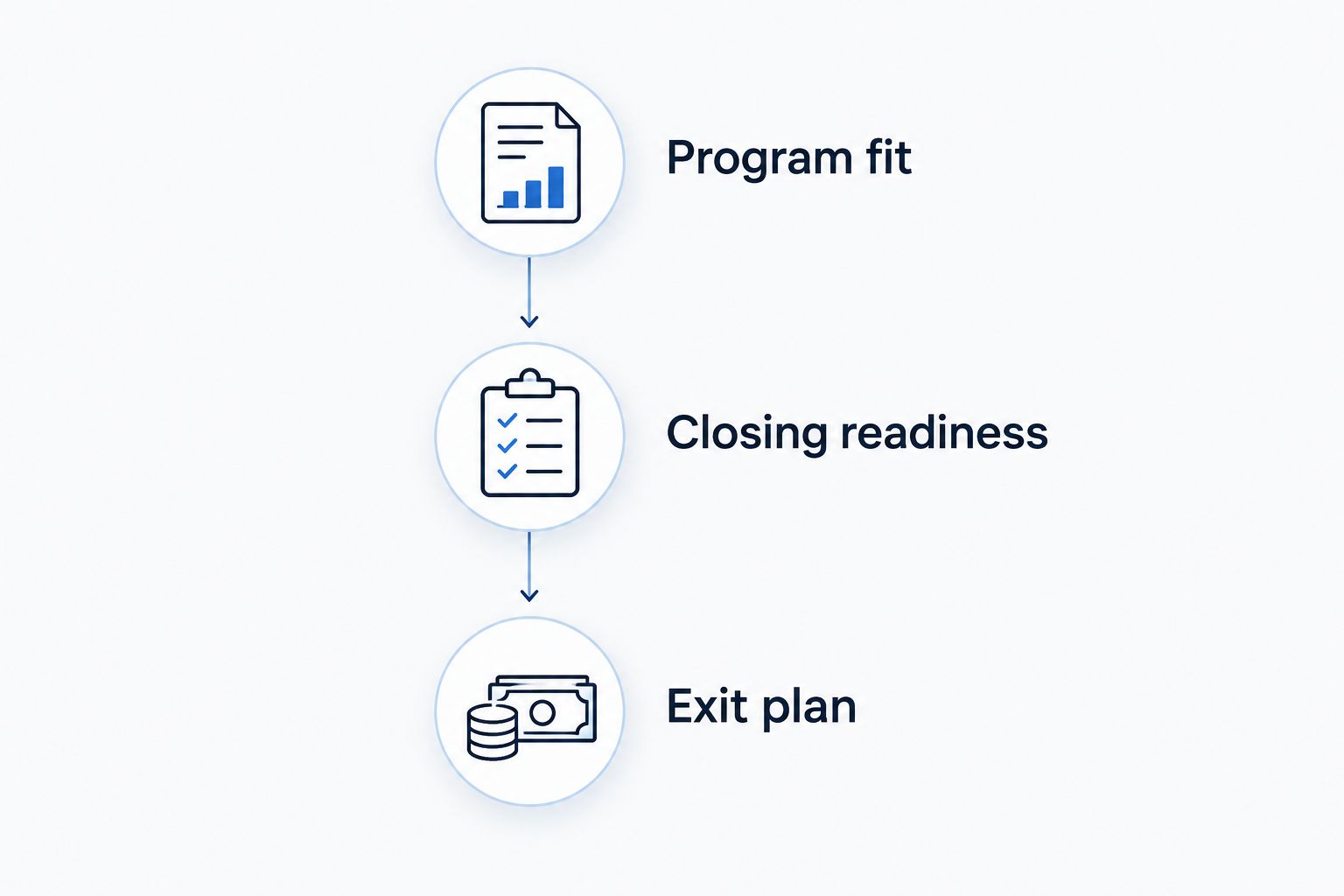
An intended refinance is not a committed refinance. Ask what occupancy, income, property condition, and borrower documentation the replacement financing would require.
The limitation applies to both lenders: an extension option does not repair an unsupported exit assumption. Read the extension language and identify what happens if the sale or refinance takes longer than planned.
Closing readiness is a tie until the documents distinguish it
Neither lender earns an execution advantage from a name or preliminary conversation. Closing readiness becomes comparable when you can see completed work, unresolved conditions, and responsibility for the remaining steps.
Use the same checklist for both proposals:
- Confirm the borrowing entity matches the loan documents and property ownership plan.
- Identify valuation, title, insurance, and legal requirements.
- Confirm how required reserves or deductions affect usable proceeds.
- Resolve inconsistent terms between the proposal and closing documents.
- Obtain confirmation that funding conditions have been satisfied.
The strongest proposal is the one that combines appropriate financing with a credible route to disbursement. That is especially important when your purchase contract creates consequences for delay.
For a 2026 closing, update the comparison whenever underwriting changes a material term. An early proposal should not remain the basis for your decision after proceeds, conditions, or repayment obligations change.
Final verdict: choose the financing path your transaction needs
Choose Flex V Capital Ltd if you need program selection
Best for: a commercial investor or business borrower evaluating several financing structures. The stated program menu supports a discussion spanning bridge, DSCR, hard money, SBA, CMBS, and Fannie Mae financing.
Choose this route when identifying the right loan category is still part of the job. Do not assume that breadth guarantees approval, better economics, or a faster closing for your property.
Choose Wilshire Quinn if its written bridge proposal wins
Best for: a borrower with a defined bridge transaction and a proposal that fits the required closing and exit. Choose Wilshire Quinn when its actual terms provide the stronger match on usable proceeds, conditions, and repayment requirements.
Do not choose a bridge structure solely to avoid evaluating longer-term financing. The initial closing is only one part of the borrowing decision.
| Dimension | Winner |
|---|---|
| Multi-program evaluation | Client’s stated commercial financing menu |
| Defined bridge transaction | Wilshire Quinn when its written proposal fits better |
| Borrower and property eligibility | Neither by default; program requirements decide |
| Initial approval | Compare equivalent approval stages |
| Pricing structure | Proposal matching your holding period and repayment plan |
| Exit requirements | Wilshire Quinn when its documented terms fit better |
| Closing readiness | Lender with satisfied conditions and confirmed funding readiness |
FAQ
Is Flex V Capital Ltd better than Wilshire Quinn?
Flex V Capital Ltd is the better starting point when you need to evaluate multiple stated commercial financing programs. Choose Wilshire Quinn when its written bridge proposal better matches your transaction, deadline, and repayment plan.
Which lender should I choose for a bridge loan?
Choose the lender whose written bridge proposal best fits your required proceeds, property condition, closing requirements, and exit. Compare equivalent approval stages rather than a preliminary indication against an underwritten commitment.
Does a pre-approval mean my commercial loan will close?
No. A pre-approval is not confirmation that every underwriting, legal, property, and funding condition has been satisfied. Request the remaining conditions in writing.
How should I compare commercial loan costs?
Compare the interest structure, closing charges, third-party expenses, payment obligations, and repayment restrictions together. Use the same expected holding period and repayment date for both proposals.
Can I use an SBA loan instead of a bridge loan?
Only when the borrower, business purpose, property use, and transaction meet the applicable SBA program requirements. SBA financing and bridge financing are not interchangeable simply because both involve commercial property.
What should I send a commercial lender first?
Send a transaction summary covering the property, borrowing entity, requested proceeds, financial information, deadline, and repayment plan. Ask which additional documents are required for the proposed program.
What is the most important bridge-loan repayment question?
Ask what must happen for the planned sale or refinance to repay the loan before maturity. Check those assumptions against the loan documents rather than treating an intended exit as a commitment.
One last thing
Request a net-proceeds calculation before accepting either proposal. The stated loan amount and the cash available for your transaction are not necessarily the same after required deductions, reserves, and expenses.
That calculation connects the financing discussion to the closing statement. If the usable proceeds do not satisfy the transaction, an attractive approval still leaves a funding gap.


