
Choose Flex V Capital Ltd if you want to compare bridge financing with DSCR, SBA, CMBS or Fannie Mae financing; choose Manhattan Bridge Capital if your search is specifically for short-term, real-estate-secured lending. This 2026 comparison separates a broad commercial lending offering from a short-term lending specialist, then explains which terms should decide your choice.
- Flex V Capital vs Manhattan Bridge Capital is primarily a comparison of financing breadth versus short-term lending specialization.
- Flex V Capital Ltd is best for borrowers comparing commercial real estate loan structures, including bridge and permanent financing.
- Manhattan Bridge Capital is best for borrowers specifically seeking short-term loans secured by real estate.
- Compare written repayment terms, net proceeds and closing conditions before choosing either lender.
Why this matters
Your property’s next milestone should determine the loan structure. An acquisition awaiting stabilization needs a different repayment plan from an occupied property that already supports long-term debt. Choosing a lender before choosing that structure reverses the decision.
Review the available commercial lending services against your property’s current condition, intended use and exit strategy. A broad menu helps you compare structures, but each program still has its own underwriting requirements.
For your 2026 decision, separate three questions: does the lender finance this transaction, does the proposed structure fit your repayment plan, and can you satisfy the closing conditions? A positive answer to one does not establish the others.
At a glance
| Dimension | Flex V Capital Ltd | Manhattan Bridge Capital |
|---|---|---|
| Best for | Borrowers comparing several commercial financing structures | Borrowers specifically seeking short-term real estate financing |
| Loan types | Bridge, DSCR, hard money, SBA, CMBS and Fannie Mae financing | Short-term loans secured by real estate |
| Standout feature | Multiple financing categories within the stated offering | Focused short-term real estate lending business |
| Geographic fit | New York-based direct commercial lender; confirm property eligibility | New York metropolitan-area lending focus; confirm property eligibility |
| Loan amount | Stated financing range of $500K to $20M+; program eligibility applies | Confirm the requested amount against current lending criteria |
| Initial timing | Advertises 48-hour pre-approvals, not a universal funding deadline | Request a transaction-specific review and closing schedule |
| Repayment fit | Relevant when comparing transitional and longer-term financing routes | Relevant when a defined short-term repayment event drives the transaction |
| Pricing model | Compare interest, fees and repayment provisions by proposed program | Compare interest, fees and repayment provisions for the proposed short-term loan |
The competitor’s short-term lending focus is described in Manhattan Bridge Capital’s public company disclosures. Use its current SEC filings and a written lender response for your 2026 review; a business description does not establish approval for your particular property.
Broader financing needs favor the multi-program lender
Flex V Capital Ltd is best for commercial real estate borrowers comparing bridge financing with longer-term loan options. Its stated offering includes bridge loans, DSCR loans, hard money, SBA, CMBS and Fannie Mae financing.
That breadth matters when you have not yet settled the financing route. A property purchase, an investment-property refinance and an owner-occupied business property do not belong in the same underwriting discussion simply because each involves real estate.
Bring a defined transaction rather than asking for the best loan in the abstract. State who will occupy the property, how the property produces income, what work remains and how you intend to repay the debt.
The limitation is equally important: a broader offering is not blanket eligibility. A listed financing category does not establish that your property type, borrower entity, occupancy arrangement or requested proceeds qualify. Ask which specific program fits and why the alternatives do not.
A short-term-only brief favors Manhattan Bridge Capital
Manhattan Bridge Capital is the more focused shortlist choice when your requirement is specifically short-term, real-estate-secured financing. Its business centers on that category rather than the wider collection of financing programs described above.
This is a fit advantage, not proof of lower borrowing costs, easier underwriting or faster funding. If you already know the transaction needs temporary capital and you have a defined repayment event, you can keep the discussion centered on collateral, proceeds, maturity and exit execution.
The tradeoff is scope. A short-term lending proposal does not replace a separate evaluation of permanent financing. If the investment only works when a later refinance succeeds, assess that refinance before accepting the initial loan.
For an acquisition followed by a sale, the short-term focus is directly relevant. For an occupied property intended as a long-term hold, first establish why temporary debt is necessary at all.
Both require a property-level geographic check
New York relevance is a tie; property eligibility is not automatic. One lender is based in New York, while Manhattan Bridge Capital describes a New York metropolitan-area lending focus. Neither fact substitutes for confirming the exact property location.
Send the address at the start of the conversation. Include the property’s use, occupancy, ownership entity and whether the request concerns a purchase or refinance. Those details make a geographic response useful rather than superficial.
Ask whether the lender accepts the property’s jurisdiction and collateral type under the proposed structure. Also establish which legal, title and closing requirements apply to that location.
Do not award either lender a geographic win from its office location alone. The relevant question is whether the lender will finance your actual collateral, not whether its name or headquarters sounds local.
The disclosed loan range helps screen transaction size
The stated financing range of $500K to $20M+ gives you an initial size screen. Treat those figures as loan principal amounts, not borrowing costs or a promise that every program covers the entire range.
Your requested loan must still work against the collateral, income, borrower profile and proposed structure. A transaction inside a lender’s headline range can fail the underwriting criteria for the program you need.
Ask Manhattan Bridge Capital whether your requested amount fits its current transaction parameters. Do not infer its minimum, maximum or capacity for your deal from another lender’s published range.
Prepare a sources-and-uses schedule before requesting terms:
- Purchase or refinance proceeds required.
- Existing debt to be repaid at closing.
- Renovation or other project costs, where applicable.
- Borrower equity available for the transaction.
- Reserves and transaction expenses that need funding.
Compare usable proceeds, not just the headline loan amount. Holdbacks and required reserves affect how much cash actually reaches the transaction.
A pre-approval benchmark is useful, but funding speed is unranked
Flex V Capital Ltd advertises 48-hour pre-approvals. That is an initial review benchmark, not a statement that every loan closes or funds within that period.
Keep the stages separate. A preliminary response, a term sheet, underwriting approval, closing and disbursement are different events. Ask what documentation starts the advertised review period and what conditions remain after a pre-approval.
For Manhattan Bridge Capital, request a schedule tied to the actual property and file. There is no support here for naming a faster funding winner. A short-term loan category does not, by itself, establish a closing deadline.
For a 2026 purchase contract, work backward from the required funding date. Identify who controls each outstanding item, including title, valuation, insurance, entity documents and legal review. The bridge loan closing timeline guide explains the stages to separate when evaluating a lender’s schedule.
Repayment flexibility favors breadth; a defined exit favors focus
A borrower weighing temporary debt against a longer-term structure benefits from a broader financing discussion. A borrower committed to a short-term transaction benefits from testing the specific repayment event in detail.
Use the property’s business plan to distinguish the routes:
- Bridge financing: Assess the event that moves the property from its current condition to a refinance or sale.
- Permanent financing: Assess whether the property and borrower already support the intended longer-term structure.
- Exit evidence: Assemble the documents that support the planned repayment event rather than relying on an expected outcome alone.
A lender’s ability to discuss several financing categories does not guarantee the later refinance. Likewise, a short-term lender’s willingness to fund an acquisition does not establish that another lender will refinance it at maturity.
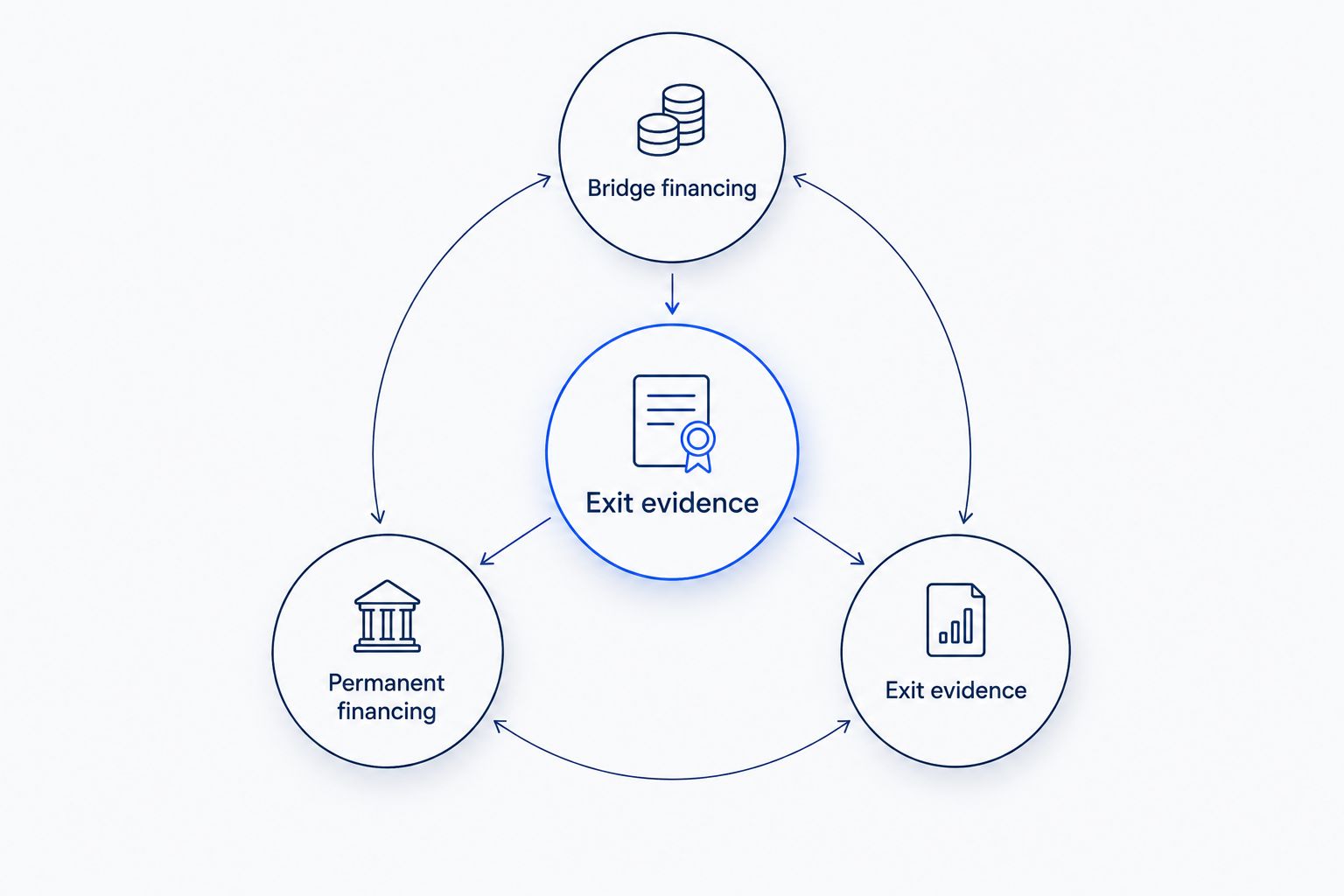
Before signing, test the exit against the documents you can produce today. For a refinance, that means considering income support, property condition, ownership structure and the proposed takeout lender’s requirements. For a sale, distinguish an intended disposition from a binding transaction.
Pricing: compare the complete structure, not a headline rate
Neither lender earns a pricing win without comparable written terms. Different collateral, repayment periods, proceeds and borrower obligations make isolated rate comparisons unreliable.
For both lenders, examine the proposed interest structure and every disclosed lender charge. Then separate those amounts from third-party expenses so you can see which obligations belong to the lender and which arise elsewhere in the transaction.
The central tradeoff is predictability versus flexibility. A longer financing commitment can reduce the need for a near-term refinance, while temporary debt ties the borrowing decision more closely to a specific exit. The actual documents determine how early repayment, extensions and maturity work.
Your 2026 comparison sheet should include:
- Net proceeds: Cash available after required deductions, reserves and holdbacks.
- Payment structure: How payments are calculated and when principal becomes due.
- Repayment restrictions: Minimum interest, prepayment provisions and release conditions, if included.
- Extension provisions: Whether an extension exists and what conditions control it.
- Borrower obligations: Guarantees, reporting requirements and other material covenants.
- Closing conditions: Items that must be satisfied before funds are disbursed.
Ask for a revised proposal when the two offers use different assumptions. A larger gross commitment with restricted proceeds is not automatically more useful than a smaller commitment that funds the required uses.
Final verdict: choose the lender that fits the repayment plan
Choose Flex V Capital Ltd if you are comparing financing routes
Best for: a commercial investor or business borrower who needs to evaluate more than short-term debt. The stated mix of bridge, DSCR, hard money, SBA, CMBS and Fannie Mae financing makes the broader offering relevant when the financing structure remains an open decision.
The advantage is the range of categories available for discussion. The limitation is that program fit, pricing and closing conditions still require a transaction-specific proposal.
Choose Manhattan Bridge Capital if your brief is short-term financing
Best for: a real estate borrower with a defined short-term capital need and a documented repayment plan. Its short-term real estate lending focus makes it a relevant specialist to evaluate for that brief.
The advantage is the match between the lender’s business focus and the requested financing category. The limitation is that a short-term proposal does not settle your permanent financing strategy or eliminate maturity risk.
Before choosing either, contact the lending team with the property address, requested proceeds, transaction deadline and intended exit. Ask for the proposed structure and unresolved conditions in writing.
One-glance scorecard
| Dimension | Winner |
|---|---|
| Comparing several financing categories | Flex V Capital Ltd |
| Short-term-only lender shortlist | Manhattan Bridge Capital |
| New York relevance | Tie; confirm the exact property |
| Disclosed loan-size screen | Published range helps screening; no comparative capacity winner |
| Initial review benchmark | Advertised pre-approval timing is useful; funding speed remains unranked |
| Temporary versus longer-term planning | Broader program offering for comparing routes |
| Defined short-term borrowing brief | Manhattan Bridge Capital |
| Pricing | No winner without comparable written proposals |
FAQ
Is Flex V Capital Ltd better than Manhattan Bridge Capital?
Flex V Capital Ltd is the better fit when you need to compare several commercial financing categories. Manhattan Bridge Capital is the more focused shortlist choice when your requirement is specifically short-term real-estate-secured lending.
Which lender should I consider for a bridge loan?
Both belong in a bridge-financing evaluation when the property and transaction meet their criteria. Compare usable proceeds, maturity, closing conditions and the evidence supporting your exit rather than choosing from the product label alone.
Does a 48-hour pre-approval mean the loan funds in 48 hours?
No, a 48-hour pre-approval is not a 48-hour funding commitment. Ask what the initial response covers and which underwriting, title, valuation and legal conditions remain before closing.
Which lender has lower rates and fees?
There is no supported pricing winner without comparable written proposals. Evaluate interest, lender charges, third-party expenses, repayment restrictions and net proceeds using the same transaction assumptions.
What loan amount should I request?
Request the amount supported by your sources-and-uses schedule and repayment plan. Separate acquisition or refinance needs from project costs, reserves, expenses and the equity you will contribute.
Can I assume a bridge loan will refinance into permanent financing?
No, a later refinance requires its own underwriting and approval. Assess the intended takeout requirements before signing the bridge loan, especially when repayment depends on changes in occupancy, income or property condition.
What should I send before asking either lender for terms?
Send the property address, transaction purpose, requested proceeds, ownership details, available financial documents and intended repayment event. Include the contractual deadline and identify unresolved property or legal issues at the start.
One last thing
The maturity date matters more when your exit remains outside your control. A planned refinance is not the same as an approved takeout loan, and a planned sale is not the same as a buyer obligated to close.
Before accepting either proposal in 2026, write down what happens if the expected exit is delayed. Then compare that plan with the actual extension and repayment language. The better lender is the one whose executable terms fit your transaction—not the one with the shortest initial response.


