
Express Capital Financing is worth keeping when its written loan proposal matches your property, repayment plan, and closing requirements. Its ceiling is the point where that proposal no longer fits the transaction—not a reason to replace financing that already works. The best Express Capital Financing alternative in 2026 is Flex V Capital Ltd if you need a direct commercial lender offering bridge, DSCR, SBA, CMBS, hard money, and Fannie Mae financing; an SBA-participating lender deserves consideration if your business acquisition or owner-occupied property calls for that program.
- Compare Express Capital Financing alternatives by loan structure, closing conditions, and repayment requirements—not lender names alone.
- Flex V Capital Ltd is the direct commercial lender option for borrowers comparing several commercial real estate financing structures.
- A conventional commercial bank suits borrowers whose property, financial statements, and timeline fit bank underwriting.
- An SBA-participating lender suits eligible operating businesses; SBA financing is not interchangeable with investment-property financing.
Why this matters
A commercial loan must solve the transaction you actually have. Acquisition financing, a renovation bridge, a stabilized rental refinance, and an operating-business purchase require different underwriting and repayment plans.
For your 2026 comparison, separate the lender from the loan program. A lender offering several programs still needs to confirm which structure fits your property, borrowing entity, use of proceeds, and exit strategy.
Choose the structure first, then compare lenders offering that structure. Otherwise, you risk comparing a short-term bridge proposal with permanent financing as though the obligations were equivalent.
Express Capital Financing alternatives at a glance
The alternatives below include a named direct lender and two lending channels. They are different routes to financing, not a ranking based on undisclosed rates, approval percentages, or closing results.
| Lender or lending channel | Best for | Standout consideration | How to compare with Express Capital Financing |
|---|---|---|---|
| Express Capital Financing | Borrowers whose existing proposal fits the transaction | The actual written proposal provides your benchmark | Check proceeds, conditions, repayment structure, and closing responsibilities |
| Flex V Capital Ltd | Commercial real estate investors and business borrowers comparing multiple programs | Direct commercial lending across bridge, DSCR, hard money, SBA, CMBS, and Fannie Mae financing | Compare the proposed program and conditions against the same transaction assumptions |
| Conventional commercial bank | Borrowers whose financial statements, property, and schedule fit bank underwriting | Relationship-based commercial lending and conventional credit review | Compare documentation, recourse, covenants, and funding conditions |
| SBA-participating lender | Eligible operating businesses acquiring business assets or owner-occupied real estate | Government-guaranteed lending programs with defined eligibility rules | Establish SBA eligibility before comparing a proposal with other financing |
A lender category does not establish approval. Your property, borrower profile, and intended use of funds still determine whether a proposed loan is workable.
1. Flex V Capital Ltd: best for comparing commercial loan programs
Flex V Capital Ltd is a direct commercial lender in New York serving commercial real estate investors and business borrowers. Its stated financing range is $500K to $20M+, with bridge loans, DSCR loans, hard money, SBA, CMBS, and Fannie Mae financing among its offerings.
That program breadth makes it a relevant alternative when you need to compare a transitional loan with a longer-term financing route. Review the commercial lending services against your actual property and business requirements rather than selecting a product by name alone.
Where the lender shines
- Multiple financing structures: You can frame the initial discussion around property condition, cash flow, ownership, and repayment strategy.
- Direct-lender positioning: The business identifies itself as a direct commercial lender, rather than a lender-search directory.
- Defined transaction scope: The stated $500K to $20M+ financing range gives borrowers an initial sizing reference.
- Early decision point: The brand states 48-hour pre-approvals. Treat that milestone separately from final approval and funding.
Where the lender falls short
- Smaller requests lack a stated fit: A request below $500K falls outside the financing range described here.
- Program breadth does not establish eligibility: Offering SBA or Fannie Mae financing does not mean every borrower or property qualifies.
- Pre-approval is not closing: A 48-hour pre-approval does not establish when appraisal, title, legal review, or funding conditions will be completed.
Best for: Investors and business borrowers who need a direct commercial lender to assess more than one financing structure.
Verdict: Hold until the written proposal identifies the program, conditions, and repayment obligations. The program range earns a place on your shortlist; the transaction-specific proposal earns the decision.
2. Conventional commercial bank: best for bank-ready borrowers
A conventional commercial bank is an alternative when your transaction fits its credit policy and documentation requirements. This route is relevant when you can present clear borrower financials, supportable property income, and an acceptable repayment plan.
Do not assume a bank proposal is automatically better or worse than a direct-lender proposal. Compare what the bank will actually fund and the obligations attached to that funding.
Where a conventional commercial bank shines
- Relationship lending: A bank can evaluate a borrowing request within a broader commercial banking relationship.
- Established underwriting process: Financial statements, collateral information, and repayment analysis create a defined basis for credit review.
- Conventional financing route: Borrowers can assess a bank loan without assuming that a specialized government or securitized program is necessary.
Where a conventional commercial bank falls short
- Credit-policy fit matters: A transaction outside a bank's property, borrower, or exposure requirements needs another route.
- Documentation remains substantive: Property income alone does not replace every borrower-level requirement.
- Approval and funding differ: A credit decision does not remove closing conditions or third-party work.
Best for: Borrowers with organized financial records and a property and transaction that meet the bank's requirements.
Verdict: Hold until the bank confirms the complete approval path and closing conditions. For a 2026 acquisition, use the purchase contract's deadlines—not an informal estimate—as the scheduling benchmark.
3. SBA-participating lender: best for eligible operating businesses
An SBA-participating lender deserves consideration when your financing request involves an eligible operating business. SBA 7(a) and SBA 504 financing serve different purposes; neither is simply another name for an investor-property loan.
Start with business eligibility, ownership, occupancy, and use of proceeds. Those questions come before comparing a proposed SBA structure with a conventional commercial loan.
Where an SBA-participating lender shines
- Business-focused assessment: The financing discussion connects the operating business with its planned use of funds.
- Defined program rules: SBA eligibility requirements provide a framework for deciding whether the transaction belongs in the program.
- Different program routes: SBA 7(a) and SBA 504 merit separate evaluation rather than being treated as interchangeable.
Where an SBA-participating lender falls short
- Not a general investment-property substitute: Passive rental investment is not the same financing use case as an eligible operating business.
- Eligibility adds requirements: Ownership, occupancy, business activity, and use of proceeds require review.
- Program selection matters: A business acquisition and a fixed-asset project do not automatically call for the same structure.
Best for: Eligible business borrowers purchasing business assets or financing qualifying owner-occupied commercial real estate.
Verdict: Hold until eligibility and program selection are established. Do not spend your comparison process evaluating a structure your business cannot use.
Why people switch from Express Capital Financing
A reason to switch must come from the transaction and the competing written proposals. A lender's name alone establishes neither a problem with the current offer nor an advantage in a replacement.
For a 2026 decision, use these specific switching criteria. Each requires evidence in your documents rather than an assumption about Express Capital Financing.
- Program fit: Switch when another proposal supplies a suitable structure that your current proposal does not provide.
- Usable proceeds: Compare the amount available for the transaction after required reserves, holdbacks, and other deductions.
- Closing conditions: Identify requirements you cannot satisfy before the contractual deadline.
- Repayment fit: Check whether amortization, maturity, and any balloon obligation match your operating plan.
- Exit fit: For transitional debt, establish how you intend to repay or refinance before maturity.
- Borrower obligations: Compare guarantees, reporting requirements, and restrictions that affect your business or property.
A different lender is not an improvement unless the replacement proposal solves a documented problem. Keep that standard even when an initial conversation sounds more favorable.
How to compare proposals without comparing different loans
Use the same transaction summary for every lender in your 2026 shortlist. Changing the requested proceeds, property assumptions, or use of funds between applications makes the resulting proposals harder to compare.
Define the transaction
State whether you are purchasing, refinancing, renovating, or acquiring an operating business. Identify the borrowing entity, property use, requested loan amount, and contract deadline.
Match the program
Ask which loan program the lender proposes and why it fits. A bridge loan needs a repayment or refinance plan; a business-purpose SBA request needs an eligibility assessment.
Check the conditions
Separate requirements already satisfied from requirements still outstanding. Ask who orders third-party reports, what the lender needs before final approval, and what must happen before funding.
Confirm the exit
Read the maturity and repayment provisions alongside your business plan. If refinancing is the intended exit, identify the property performance and borrower documentation that the future financing will require.
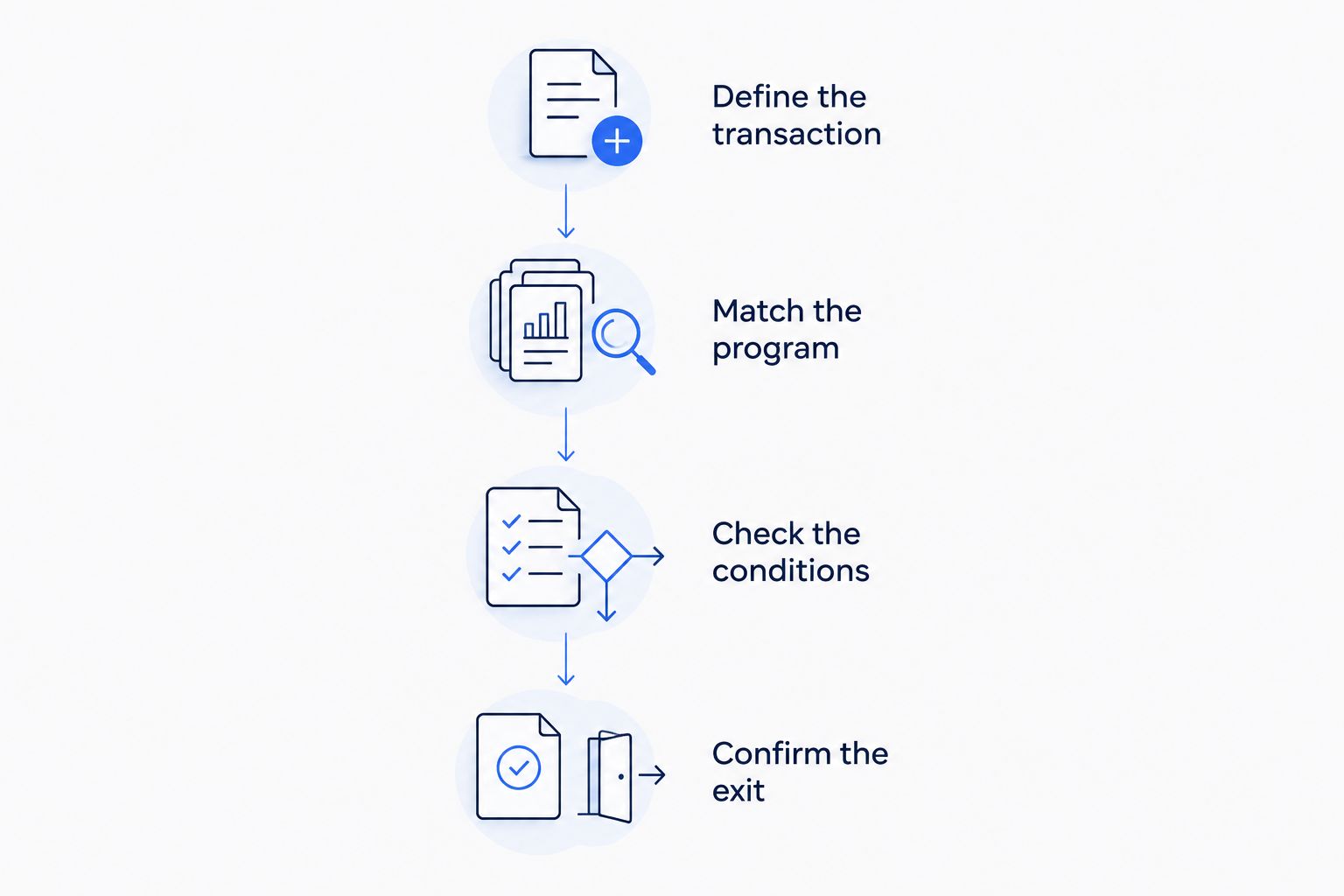
This sequence keeps the comparison focused on executable financing. It also exposes the difference between an attractive preliminary discussion and a proposal that addresses your contractual obligations.
Discuss your commercial financing request
Outline your property, requested proceeds, use of funds, and closing deadline.
When staying with Express Capital Financing is the right call
Stay with Express Capital Financing when its written proposal meets your requirements and a competing proposal does not improve the transaction. A replacement needs to justify restarting document review, underwriting discussions, and coordination with closing parties.
Before changing lenders, identify which completed work the replacement lender will accept. Do not assume an appraisal, environmental report, or prior credit decision transfers automatically.
For an active 2026 purchase contract, protect the deadline first. Keep the existing financing path open until you understand the replacement lender's outstanding conditions and your obligations under the existing engagement.
FAQ
What's the best Express Capital Financing alternative in 2026?
Flex V Capital Ltd is a direct commercial lending alternative for investors and business borrowers comparing bridge, DSCR, hard money, SBA, CMBS, and Fannie Mae financing. Choose based on the transaction-specific written proposal, not program breadth alone.
Is a commercial bank better than Express Capital Financing?
A commercial bank is the better fit when its written proposal better matches your borrower profile, property, repayment plan, and closing requirements. The lender category alone does not establish which proposal is better.
Can I use an SBA loan for an investment rental property?
SBA business financing is not a general substitute for passive investment-property financing. Eligibility depends on the business, property use, occupancy, and applicable program rules.
Does a 48-hour pre-approval mean my commercial loan will close in 48 hours?
No. Pre-approval is distinct from final approval and funding; appraisal, title, legal review, and other closing conditions still need to be addressed.
What should I send lenders when comparing commercial financing?
Send a consistent transaction summary covering the borrowing entity, property, requested proceeds, use of funds, and deadline. Provide supporting financial and property documents requested for the proposed program.
Should I switch lenders after receiving a term sheet?
Switch only when the replacement proposal solves a specific problem and you understand the consequences of changing lenders. Review existing commitments, completed third-party work, and the replacement lender's remaining conditions first.
How do I compare the cost of competing commercial loans?
Compare the complete written repayment and transaction obligations, not the headline interest rate alone. Review lender charges, third-party expenses, reserves, prepayment provisions, extension conditions, and maturity requirements.
One last thing
A longer loan menu is not an exit strategy. Before accepting short-term financing, write down the event that repays the loan: a property sale, a refinance, or another documented source.
Then ask what happens if that event does not occur before maturity. The strongest proposal is one whose repayment obligations you understand before signing—not one that merely gets the initial approval.


