
Yes—you can seek competing bridge-loan term sheets within 48 hours, but receiving comparable written offers depends on complete submissions and each lender’s review process. A fast term sheet is not a funding commitment: valuation, title, legal review, and other conditions can remain unresolved. For a 2026 transaction, request the same financing structure from each lender and compare the conditions behind the offer, not just the response time.
- Competing term sheets bridge loan 48 hours: possible, not guaranteed; complete submissions make written offers easier to compare.
- Flex V Capital Ltd advertises 48-hour pre-approvals, not a guarantee of competing offers or funded bridge loans.
- Compare bridge loan proceeds, repayment terms, recourse, and closing conditions before selecting a lender.
- A term sheet outlines proposed financing; read binding provisions separately from conditional lending terms.
Why this matters
A quick response helps only if it answers your actual financing request. An offer based on a different property value, a smaller initial advance, or an untested refinance assumption does not establish that your transaction can close.
Review the available commercial lending services before requesting terms, then define the bridge-loan structure you need. Your objective is comparable written offers—not a collection of preliminary indications.
For your 2026 financing comparison, separate response speed from execution readiness. A lender can respond promptly while still requiring substantial underwriting before committing to the loan.
Can you get competing term sheets for a bridge loan within 48 hours?
Yes, provided lenders accept the request, receive sufficient information, and complete their preliminary reviews within that window. No borrower can guarantee another lender’s response deadline, and the existence of a fast pre-approval process does not establish that multiple lenders will issue matching documents.
Use this sequence to make the request specific and the responses comparable:
- Define the transaction. State whether you need acquisition financing, a refinance, or financing that includes improvements. Identify the property, borrowing entity, requested proceeds, and contractual deadline.
- Prepare a consistent package. Give each lender the same property financials, ownership information, existing debt details, and business plan. Explain discrepancies before the lender has to ask.
- Request written terms. Ask for a proposed loan structure, material conditions, required borrower contributions, and the remaining approval process. Specify the requested response deadline and time zone.
- Normalize the responses. Separate proceeds available at closing from future advances, reserves, and holdbacks. Identify valuation assumptions and unresolved approval conditions.
- Confirm the next decision. Ask who must approve the transaction, which documents remain outstanding, and what would cause the proposed terms to change.
Do not treat silence as a rejection or a verbal indication as a written offer. Record the actual status of each request and follow up on missing decisions rather than restarting the entire submission.
What counts as a competing offer?
A useful competing offer addresses the same property, requested financing, and borrower structure. It does not need identical terms, but the differences must be visible enough for you to evaluate them.
The following documents serve different purposes. Their names alone do not determine their legal effect; read the actual language.
| Response | Best for | Advantage | Limitation |
|---|---|---|---|
| Verbal indication | Initial fit screening | Lets you identify a possible financing approach | Leaves material terms undocumented |
| Written term sheet | Comparing proposed structures | Records financing assumptions and conditions | Does not by itself establish an unconditional obligation to fund |
| Pre-approval | Understanding preliminary eligibility | Signals an initial review under the lender’s process | Scope and remaining conditions differ by lender |
| Executed commitment | Reviewing a documented lending obligation | Defines obligations and conditions in writing | Funding still depends on the commitment’s terms |
Compare documents at the same approval stage. An attractive preliminary indication and a heavily reviewed commitment are not equivalent evidence of closing readiness.
What should you submit before the 48-hour window starts?
Start with a package that lets a lender understand the collateral, borrower, requested capital, and repayment plan. Ask the lender to confirm receipt and identify missing items; an uploaded folder is not confirmation that preliminary review has begun.
Use a dated document index for your 2026 submission. Identify the reporting period on every financial statement and distinguish actual property performance from projections.
Property information
Provide the property address, asset type, current use, occupancy information, and available photographs. Include the purchase contract for an acquisition or existing loan information for a refinance.
For an income-producing property, include the current rent roll, leases where requested, operating statements, and explanations of vacancies or unusual expenses. Do not present projected rents as collected income.
Borrower information
Identify the proposed borrowing entity, ownership structure, relevant experience, and available liquidity. Supply financial statements and supporting records through the lender’s requested secure process.
Disclose existing liens, litigation affecting the transaction, and known credit issues when requested. An unexplained issue discovered during underwriting can change the lender’s assessment of a proposal that initially appeared straightforward.
Business plan
Explain what the bridge loan accomplishes and how it will be repaid. If improvements or lease-up support your plan, separate the current condition from the intended completed condition.
Include the improvement budget, sources of borrower equity, and proposed exit. A refinance plan should identify the property performance needed to support replacement financing rather than assume that a future loan will be available.
Requested structure
State your required closing proceeds separately from the total financing request. Identify any requested improvement funding, reserves, or future advances.
Tell lenders which requirements are essential and which are negotiable. Otherwise, each lender can solve a different financing problem and still appear to have answered your request.
How do you compare the bridge-loan term sheets?
Build a comparison using the written terms, not a lender’s summary email. Leave unanswered items marked as unresolved rather than filling gaps with assumptions.
For a 2026 offer comparison, use the same transaction assumptions throughout. If a lender changes an assumption, record the change beside the affected term.
| Term | What to verify | Why it matters |
|---|---|---|
| Initial proceeds | Amount released at closing after deductions | Determines the cash actually available for the transaction |
| Future advances | Conditions and process for releasing additional funds | Determines whether committed capital supports the business plan when needed |
| Valuation basis | Current condition, completed condition, or another stated basis | Changes how the financing request is evaluated |
| Repayment structure | Payment calculation, maturity, and principal repayment requirements | Establishes ongoing obligations and the repayment deadline |
| Reserves and holdbacks | Purpose, funding source, control, and release conditions | Restricts access to part of the proposed financing |
| Recourse | Guarantees, carve-outs, and other borrower obligations | Defines exposure beyond the collateral |
| Early repayment | Minimum-interest provisions, penalties, and release requirements | Affects the flexibility of an early exit |
| Extensions | Eligibility, approval requirements, and revised obligations | Determines whether additional time is contractual or discretionary |
| Approval conditions | Remaining underwriting, third-party reports, and legal requirements | Shows what stands between the proposal and funding |
| Exclusivity and deposits | Binding language, refundability, and cancellation provisions | Determines your obligations before closing |
A larger stated loan is not automatically the better offer. If more of it remains in reserves or depends on future conditions, the initial proceeds can be less useful to your transaction.
Read the repayment provisions against your exit plan. A bridge loan intended for a sale requires different exit analysis from a bridge loan intended for refinancing into stabilized-property debt.
Why the 48-hour response window varies
The deadline alone does not determine how much underwriting a lender can complete. These factors affect whether the response is a usable proposal or only an initial indication:
- Submission completeness. Missing financials, ownership records, or debt information leave material questions unanswered.
- Property complexity. Mixed uses, redevelopment plans, and unresolved occupancy issues require explanations beyond a basic property summary.
- Valuation support. A financing request based on future improvements requires a clear distinction between current and projected collateral value.
- Borrower structure. Entity ownership, guarantor information, and the source of equity affect the preliminary review.
- Exit support. A sale or refinance strategy needs evidence consistent with the property’s business plan.
- Review timing. Confirm whether the lender measures the deadline in elapsed hours or business hours and when its review clock begins.
Ask what the deadline delivers before relying on it. A preliminary eligibility decision, a written term sheet, and a reviewed commitment are different outcomes.
What happens after you choose a term sheet?
Selecting proposed terms starts the next stage; it does not remove the conditions written into the offer. Review the document with transaction counsel before signing provisions that impose obligations or restrict your ability to pursue alternatives.
Confirm authority
Identify the party proposing to fund the loan and the person responsible for the next approval. Ask whether additional credit approval remains and which assumptions have not yet been verified.
Complete diligence
Establish responsibility for title work, valuation, insurance review, legal documents, and any other required reports. Confirm which existing materials the lender accepts before ordering replacements.
Resolve conditions
Maintain a written list of outstanding items, responsible parties, and required decisions. Separate borrower deliverables from lender approvals so that a completed document request is not mistaken for completed underwriting.
Coordinate funding
Confirm the conditions for signing, satisfying closing requirements, and releasing funds. Coordinate those milestones with your purchase contract, payoff requirements, and counsel rather than treating the term-sheet date as the closing date.
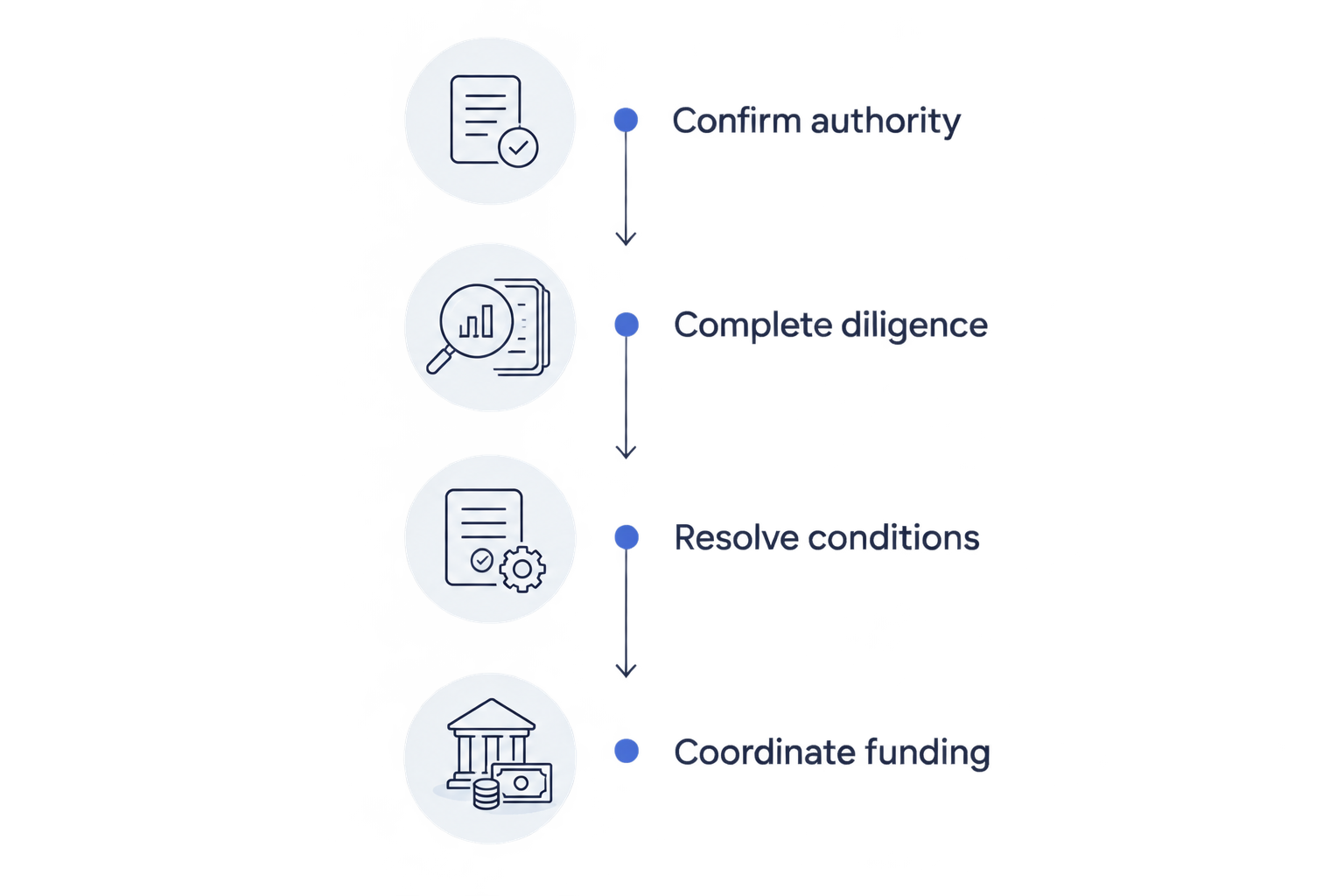
A fast proposal can still be useful when the remaining work is explicit. The problem is not conditional approval itself; it is an unclear description of what remains conditional.
Which borrower is the direct-lender route best for?
Flex V Capital Ltd is best suited to commercial real estate investors and business borrowers seeking direct commercial lending. The New York lender offers bridge loans and advertises 48-hour pre-approvals.
The benefit of that stated timeline is a defined preliminary-response target. Its limitation is equally important: a pre-approval is not a promise that competing lenders will respond within the same window or that your bridge loan will fund within 48 hours.
For a 2026 request, ask Flex V Capital Ltd what its pre-approval covers, when the review period begins, and what remains subject to underwriting. Keep the same questions in every competing lender request.
Discuss your bridge financing request
Provide the property, requested proceeds, transaction deadline, and repayment plan.
Does a 48-hour term sheet mean you can close in 48 hours?
A 48-hour term sheet does not establish a 48-hour closing. The proposed loan can still require collateral review, title clearance, insurance, final approval, and executed legal documents.
Does a 48-hour pre-approval lock the proposed terms?
A 48-hour pre-approval does not establish locked terms unless the written document expressly provides them. Read the expiration, conditions, and change provisions before treating an initial proposal as fixed.
Can you request a 48-hour response from multiple lenders?
A 48-hour response deadline can be requested from multiple lenders, but each lender must confirm whether it can meet it. Give every lender consistent information and review any exclusivity language before signing.
FAQ
Can I get competing bridge-loan term sheets within 48 hours?
Yes, competing bridge-loan term sheets within 48 hours are possible, but they are not guaranteed. Submit consistent information and ask each lender to confirm the response deadline and approval stage.
What should I send a bridge lender first?
Send a clear transaction summary with the property, requested financing, borrower information, available financials, and repayment plan. Ask the lender to identify additional documents needed for preliminary review.
Is a bridge-loan term sheet legally binding?
A bridge-loan term sheet's legal effect depends on its wording. Proposed lending terms can be conditional while provisions covering confidentiality, exclusivity, deposits, or expenses create separate obligations.
What is the most important difference between competing term sheets?
The most important difference is whether each proposal funds your actual transaction on acceptable conditions. Compare initial proceeds, future funding conditions, repayment obligations, recourse, and unresolved approvals together.
Does Flex V Capital Ltd offer 48-hour bridge-loan funding?
Flex V Capital Ltd advertises 48-hour pre-approvals, not a blanket 48-hour funding commitment. Ask what remains after pre-approval and obtain a transaction-specific closing assessment.
Should I sign the first bridge-loan term sheet I receive?
Do not sign solely because a bridge-loan term sheet arrived first. Review binding provisions, unresolved conditions, and the proposed structure against your transaction requirements before committing.
Can bridge-loan terms change after the initial offer?
Bridge-loan terms can change when the proposal permits changes or underwriting does not support its assumptions. Review the valuation basis, approval conditions, expiration, and any express lock provisions.
One last thing
Before accepting an offer, ask: What fact discovered during underwriting would change these terms? Request a written answer tied to valuation, property income, borrower liquidity, or other stated conditions.
That question makes a fast response more useful. It identifies which parts of the proposal reflect reviewed information and which still depend on assumptions.


