
Yes, 100% financing for commercial real estate is possible through certain deal structures, but it is not a standard promise of a commercial mortgage. Financing the entire purchase price does not necessarily cover closing expenses, reserves, or renovations. A transaction with no cash down can still require additional collateral, seller financing, or another investor’s equity—and those obligations change your risk.
- For 100% financing commercial real estate, distinguish purchase-price coverage from total project funding and cash required at closing.
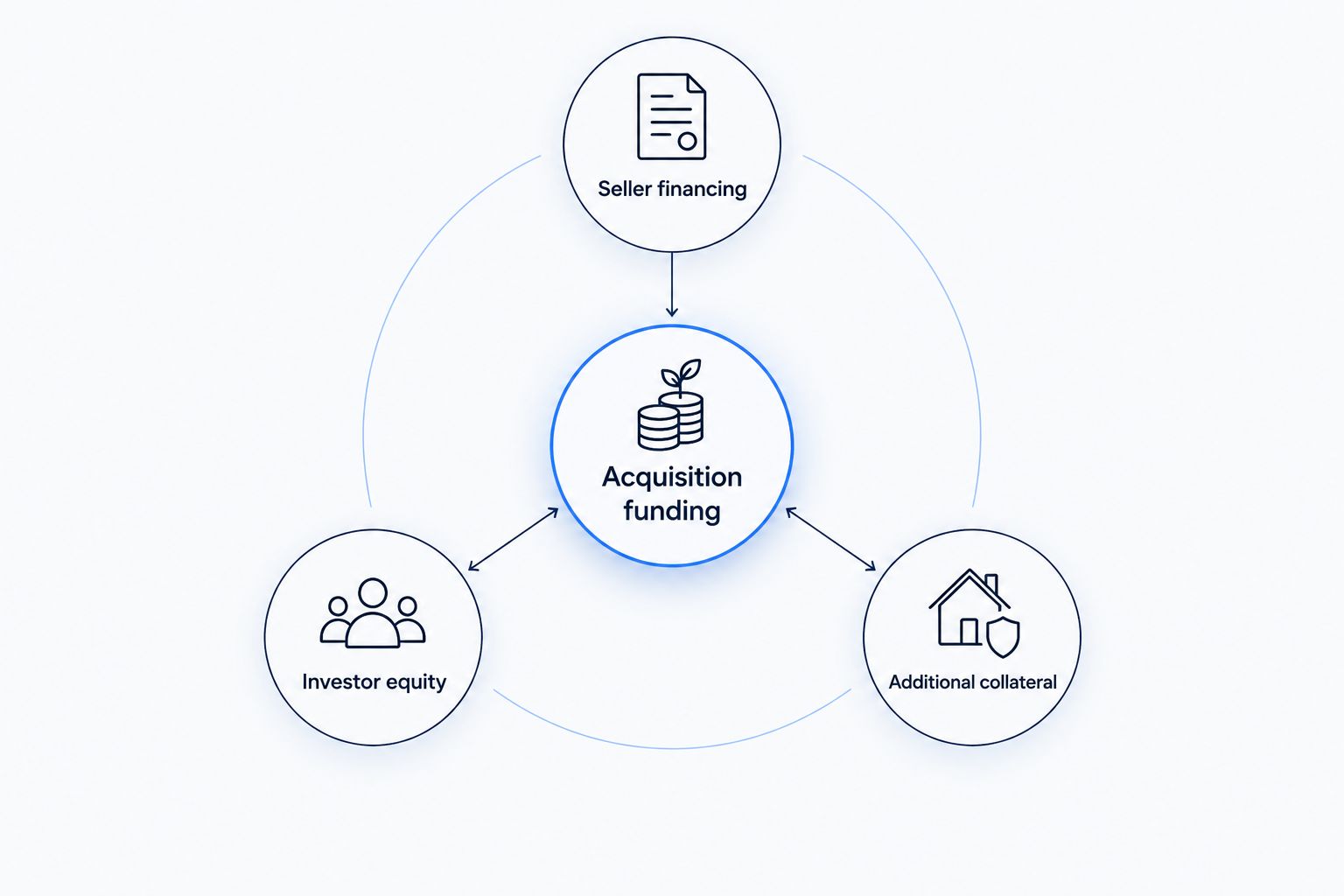
- Seller financing creates another repayment obligation; investor equity reduces your ownership rather than eliminating the equity requirement.
- Additional collateral puts more property at risk, even when you contribute no purchase-money cash.
- Flex V Capital Ltd offers direct commercial lending; do not assume its loan programs promise no-equity financing.
Can you get 100% financing for commercial real estate?
Yes, but identify what the financing covers and who supplies the equity before treating an offer as a no-down-payment loan. A lender financing the purchase price against several properties is making a different credit decision from a lender financing only the property you are buying.
For a 2026 acquisition, separate the mortgage amount, the total financing package, and your actual cash contribution. Start with how much equity you need for a bridge loan if short-term acquisition financing is part of your plan.
| Structure | Best for | Main advantage | Main limitation |
|---|---|---|---|
| Single senior loan | Borrowers whose transaction supports the requested advance | One primary mortgage obligation | Approval still depends on collateral, repayment capacity, and lender requirements |
| Senior loan plus seller financing | Buyers negotiating with a seller willing to finance part of the sale | Reduces the cash needed for the purchase | Creates additional debt and requires compatible loan documents |
| Financing with additional collateral | Owners with equity in other acceptable properties | Supports the acquisition with existing assets | Exposes additional properties to enforcement |
| Senior loan plus investor equity | Buyers willing to share ownership | Supplies equity without borrowing the entire funding gap | Dilutes ownership and can change control rights |
No cash from you does not mean no equity in the transaction. That distinction determines whether you are evaluating a mortgage, a combined debt structure, or an investment partnership.
Why this matters
A financing headline answers only one question: how much money is being advanced relative to a stated figure? It does not explain which assets secure repayment or whether you must bring additional funds to closing.
For a 2026 purchase, your decision should rest on the complete sources-and-uses statement. That document lists where the money comes from and where it goes, making an unfunded requirement visible before you commit to closing.
Reject any comparison that treats borrowed down-payment funds, seller debt, and outside equity as interchangeable. Each changes your obligations differently. More funding is useful only when the repayment structure and ownership terms also work.
100% purchase-price financing: acquisition coverage only
100% purchase-price financing means financing equal to the agreed purchase price. It does not automatically mean the financing pays every expense associated with acquiring and operating the property.
Your transaction can still require appraisal work, legal review, title work, insurance, lender-required reserves, or improvements. Whether any of those uses are financed depends on the approved structure and closing documents.
Also distinguish the purchase price from the appraised value. A financing percentage tied to one is not automatically the same percentage of the other, and a lender’s valuation method affects the available advance.
Before accepting a purchase-price financing proposal, ask:
- What purchase figure is the financing percentage based on?
- Which expenses are included in the approved proceeds?
- Which funds must you provide before or at closing?
- Does the loan depend on collateral outside the acquired property?
- Are any proceeds held back rather than disbursed at closing?
A holdback is particularly important. An approved loan amount and the amount available to complete the purchase are not necessarily identical.
100% loan-to-cost financing: define the approved project budget
100% loan-to-cost financing refers to financing relative to the project costs accepted in the underwriting. The definition of eligible costs matters as much as the percentage.
A project budget can include acquisition, construction, renovation, and other approved uses. The lender’s approved budget—not your initial spreadsheet—determines what the financing actually covers.
Ask how construction or renovation proceeds are released. Draw conditions, inspections, documentation, and retainage provisions affect when you receive funds, even when the approved financing covers the stated budget.
Do not treat future reimbursement as cash available today. If you must pay an expense before requesting a draw, you need a source of interim liquidity. A fully financed budget can therefore still create a working-capital requirement.
For a 2026 renovation acquisition, reconcile the closing disbursement with the draw schedule. That is the practical test of whether the funding structure matches your construction obligations.
100% loan-to-value financing: check the collateral denominator
100% loan-to-value means debt equals the property value used in that calculation. Confirm whether the calculation includes only the acquired property or a larger collateral pool.
Additional property equity can support an acquisition without a cash purchase contribution. That does not eliminate the lender’s collateral requirement; it changes which assets satisfy it.
Ask the lender to identify every pledged property and explain the release conditions. Selling or refinancing one property later can become more complicated when several assets secure the same obligation.
Also clarify whether the quoted percentage measures the senior mortgage alone or all secured debt. Combined debt tells you more about the capital structure than a headline describing only the first mortgage.
Your real exposure follows the security documents, not the marketing label. Review guarantees, cross-default provisions, and collateral releases with qualified counsel before signing.
How can you assemble the financing without your own down payment?
The funding gap must be covered by an acceptable source. Common structures involve seller financing, outside equity, or additional collateral, but each requires its own underwriting and documentation.
Seller financing
Best for: a buyer and seller who can negotiate payment terms acceptable to the senior lender. The seller accepts a financing obligation for part of the transaction instead of receiving that entire amount in cash at closing.
The benefit is a smaller immediate cash requirement. The drawback is another repayment obligation, potentially with a different maturity date or payment schedule from the senior mortgage.
Disclose the arrangement before approval. Do not assume the senior lender permits subordinate debt or treats a seller note as an acceptable substitute for required equity.
Investor equity
Best for: buyers willing to exchange ownership economics for acquisition capital. A partner contributes equity under an operating agreement rather than simply lending against the property.
Equity can reduce the amount of debt the property must support. In return, the investor receives negotiated rights involving distributions, decisions, or sale proceeds.
Review capital-call obligations, voting rights, and exit provisions. Avoid solving a closing requirement with an ownership agreement you cannot operate under after closing.
Additional collateral
Best for: borrowers with equity in other properties they are willing to pledge. Additional collateral gives the lender security beyond the asset being purchased.
The advantage is preserving acquisition cash. The disadvantage is extending the transaction’s risk to other assets, including properties that are otherwise performing as expected.
Ask for release requirements in writing. An acquisition strategy that depends on a later sale or refinance needs workable collateral-release terms.
Why 100% commercial real estate financing varies
The structure depends on the transaction, not just your preferred down payment. These factors determine whether the proposed funding sources fit together:
- Property cash flow. The property must support the debt obligations being proposed, using the income and expenses accepted in underwriting.
- Collateral value. The lender’s accepted valuation affects how much secured financing the assets support.
- Property use. An owner-occupied business purchase and a passive investment property have different eligibility considerations, particularly for SBA financing.
- Available equity sources. Seller participation, partner capital, and existing property equity solve different funding requirements.
- Loan-document restrictions. Subordinate debt, additional liens, guarantees, and distributions must comply with the applicable agreements.
- Repayment and exit. A short-term acquisition structure needs a credible repayment source rather than an assumed future refinance.
Evaluate the entire financing package, not just the senior lender’s advance. Debt that fills a closing gap also affects cash flow after closing.
What should you send a lender before requesting full financing?
For a 2026 financing request, make the funding gap explicit. A lender can evaluate a defined capital structure more clearly than a request for maximum financing without supporting documents.
- Purchase documents. Provide the contract, property address, purchase terms, and relevant closing deadlines.
- Property financials. Supply available operating statements, rent rolls, leases, or business occupancy information applicable to the transaction.
- Project budget. Separate acquisition uses, improvement work, transaction expenses, and operating liquidity.
- Capital sources. Identify your cash, proposed seller financing, investor commitments, and any additional collateral.
- Repayment plan. Explain whether repayment comes from ongoing operations, a sale, or refinancing, and document the assumptions.
Ask for a written explanation of remaining conditions. An initial indication is not the same as a closing-ready commitment, especially when another lender, seller, or equity partner must participate.
Flex V Capital Ltd offers bridge loans, DSCR loans, hard money, SBA, CMBS, and Fannie Mae financing. Flex V Capital Ltd is best for commercial real estate investors and business borrowers seeking a direct lender rather than a referral source. Its stated lending range does not establish eligibility for full purchase financing; request transaction-specific terms rather than assuming a no-equity option.
Can an SBA loan eliminate the down payment?
An SBA loan is not automatically a no-down-payment commercial property loan. SBA financing has program-specific eligibility and contribution requirements, and the property’s use matters.
For a 2026 application, distinguish an eligible operating-business transaction from a passive real estate investment. Have the lender confirm the applicable equity requirements and whether your proposed contribution source is acceptable before relying on SBA financing.
Does no down payment mean no personal guarantee?
No down payment does not mean no personal guarantee. Cash contribution, collateral, and personal repayment liability are separate terms.
Read the guarantee documents independently of the advance percentage. Confirm who signs, what obligations are guaranteed, and whether exceptions or recourse provisions apply.
Can you refinance a fully financed acquisition later?
Refinancing a fully financed acquisition requires a new approval; it is not an automatic exit. The replacement lender evaluates the property, borrower, debt, and applicable program requirements at that time.
If your purchase depends on refinancing, document what must change before that refinance works. A higher valuation or stronger income projection is not a binding takeout commitment.
FAQ
Can I buy commercial real estate with no money down?
Yes, some transactions use seller financing, investor equity, or additional collateral to avoid a buyer-funded purchase down payment. You still need to identify who covers closing expenses, reserves, and other required uses.
Does 100% financing cover closing expenses?
100% purchase-price financing does not automatically cover closing expenses. Confirm the approved uses and the cash-to-close calculation in writing.
Is 100% loan-to-cost the same as 100% loan-to-value?
100% loan-to-cost measures financing against approved project costs, while 100% loan-to-value measures debt against the accepted property value. The denominators differ, so the percentages do not describe the same financing commitment.
Can seller financing replace my down payment?
Seller financing can reduce your cash requirement, but it does not automatically satisfy a lender's required equity contribution. The senior lender must accept the structure and its repayment terms.
Can I use another property instead of cash?
Additional property collateral can support an acquisition when the lender accepts the arrangement. That structure exposes the pledged property to the loan's enforcement provisions and can restrict a later sale or refinance.
Does Flex V Capital Ltd guarantee 100% commercial real estate financing?
Do not treat Flex V Capital Ltd's commercial lending offerings as a guarantee of 100% financing. Request a written, transaction-specific proposal identifying the required contribution, collateral, and remaining conditions.
One last thing
Ask for the collateral-release terms before negotiating the largest possible advance. If your strategy requires selling one property to repay another obligation, a restrictive release provision can undermine the plan even when the acquisition financing looks sufficient.
Your closing test is straightforward: every use has a documented funding source, every debt has a repayment plan, and every pledged asset has understood consequences. That is more useful than a no-money-down headline.


