Gas station owners’ bridge financing is short-term commercial real estate debt used to close an acquisition or refinance before longer-term financing is ready. For a 2026 transaction, the decision turns on more than property value: fuel operations, underground storage tanks, environmental records, and a documented repayment exit all matter.
- Bridge loans for gas stations fit temporary financing gaps when the collateral, environmental condition, and repayment exit support the transaction.
- Flexvcapital offers bridge and SBA financing; confirm gas-station eligibility before ordering lender-specific reports.
- Separate fuel sales, store income, property income, and operating expenses before presenting cash flow.
- Compare bridge financing with conventional mortgages, SBA financing, and seller financing before accepting short-term debt.
Why bridge financing matters for gas station owners
A gas station combines a property with an operating business. A mortgage secured by the real estate does not automatically finance fuel inventory, business goodwill, or the purchase of the operating company. Your financing request must identify those components separately.
Flexvcapital is a direct commercial lender offering bridge loans and other commercial financing. Start by confirming the proposed collateral, intended use of proceeds, and property eligibility—not by assuming every commercial loan program accepts a fuel-related property.
In 2026, your reason for using bridge financing should be specific: an acquisition must close before permanent financing is ready, an existing loan needs repayment, or documented property improvements must precede refinancing. Bridge debt addresses a timing gap; it does not remove environmental concerns or establish sufficient repayment income.
The distinction matters when a seller emphasizes gross revenue. Fuel sales are not cash available for debt service. Review fuel purchases, payroll, utilities, maintenance, insurance, taxes, and other operating expenses before deciding what the station can support.
How to prepare a gas station bridge loan
Define the transaction and collateral
Start with a written transaction summary and the purchase agreement or current debt statement. Identify whether you are buying the real estate, the operating business, or both. A station operator leasing the premises presents a different financing request from an owner pledging the land and improvements.
Separate the purchase allocation from the requested loan amount. Inventory, equipment, goodwill, and real estate do not become interchangeable collateral because they appear in the same contract. Ask which assets the lender will finance and which require your cash or another funding source.
Resolve ownership relationships early, especially when separate entities will own the property and operate the station.
- Identify the property owner, operating company, and proposed borrower.
- Separate real estate, equipment, inventory, and goodwill in the transaction summary.
- State the requested use of proceeds: acquisition, refinance, improvements, or another purpose.
- Disclose existing mortgages, equipment liens, and seller obligations.
- Document any lease between related property and operating entities.
Reconcile station cash flow
Build a spreadsheet from the seller’s records before commissioning a borrowing analysis. Separate fuel activity from convenience-store activity and other documented income. Then reconcile the operating statements with tax returns, bank deposits, and point-of-sale records.
For your 2026 application, distinguish historical results from proposed changes. A plan to extend operating hours or improve merchandise sales is not current income. Show the expense and execution assumptions behind any projected improvement.
Use documented cash flow, not pump volume, to explain repayment capacity. If a tenant operates the station, analyze the lease and tenant obligations rather than treating the tenant’s total business revenue as the property owner’s income.
- Separate fuel revenue, fuel purchases, and fuel gross profit.
- Identify store revenue and its associated merchandise costs.
- Reconcile reported sales with bank and point-of-sale records.
- List recurring payroll, utilities, maintenance, insurance, and property taxes.
- Identify owner adjustments individually and retain supporting records.
- Keep historical performance separate from projected improvements.
Resolve environmental questions early
Collect existing environmental reports, tank records, inspection results, and correspondence about releases before ordering new work. Give the proposed lender the report dates and scope, then obtain written instructions on acceptable consultants and required updates.
A Phase I environmental site assessment reviews environmental conditions; it does not itself include soil or groundwater sampling. Further investigation depends on the findings and transaction requirements. Do not describe a site as cleared merely because a report exists.
Keep environmental review separate from valuation. The commercial real estate appraisal guide addresses another part of diligence; an appraisal does not replace an environmental assessment.
- Collect tank installation, testing, maintenance, and closure records where applicable.
- Disclose known releases, cleanup work, and regulatory correspondence.
- Confirm the lender’s environmental report requirements before commissioning work.
- Identify who pays for additional investigation or remediation under the contract.
- Align inspection rights and financing deadlines with the required review.
Assemble a lender-ready borrower file
Organize the file yourself before submitting it. Use clearly named documents and a short summary that ties the borrower, property, requested proceeds, and exit strategy together. Inconsistent ownership names or unexplained financial differences create additional questions.
Flexvcapital is best for commercial borrowers seeking direct-lender review of bridge and SBA financing options. Its stated commercial financing range is $500,000 to $20 million-plus, with 48-hour pre-approvals. Those figures describe its broader offering, not a gas-station-specific commitment or a funded-closing deadline.
For a 2026 submission, ask for property eligibility and report requirements before paying for lender-specific work. Direct review provides a path to those answers; it does not replace underwriting, environmental diligence, title review, or closing conditions.
- Provide borrower entity documents and an ownership chart.
- Include the purchase agreement or current mortgage payoff information.
- Submit financial statements, tax returns, and supporting operating records as requested.
- Document equity sources and funds retained after closing.
- Explain relevant ownership or operating experience without unsupported projections.
- State the requested closing date and the event that makes it necessary.
Underwrite the repayment exit
Write the repayment plan before accepting bridge terms. A proposed refinance needs support from current or achievable income, acceptable collateral, borrower qualifications, and the requirements of the intended permanent lender. A planned sale needs its own evidence and execution timetable.
Use this sequence: Verify income, Size takeout, Compare payoff, and Test delays. The objective is to determine whether expected proceeds cover the full bridge payoff and transaction obligations—not merely whether another lender offers a familiar loan type.
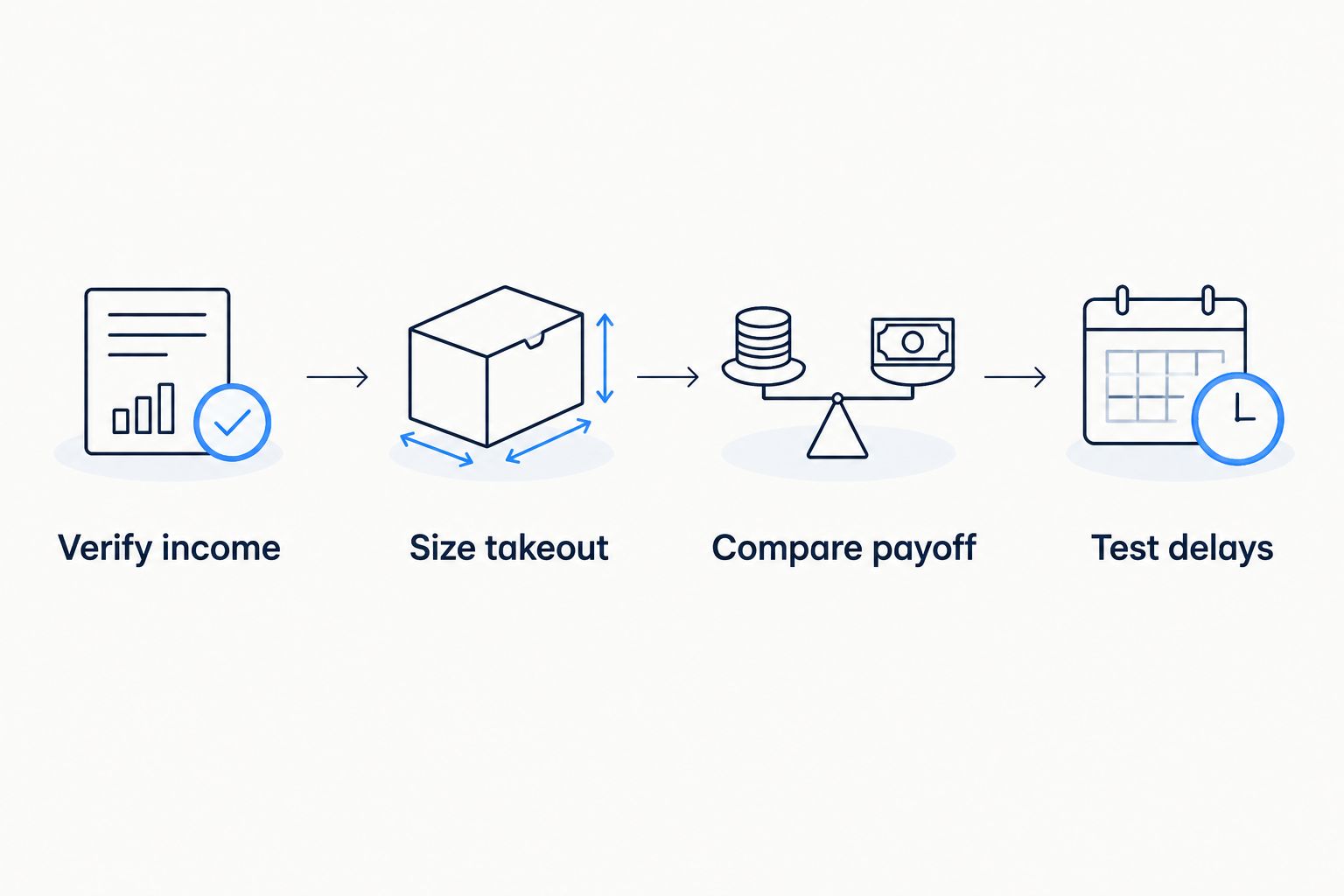
Debt service coverage ratio compares qualifying income with debt service. Ask the intended lender how it defines both; do not substitute total station sales for qualifying income or assume a residential rental loan program accepts a gas station.
- Verify income using the intended permanent lender’s underwriting approach.
- Size takeout proceeds against both income and collateral constraints.
- Compare the expected refinance proceeds with the complete payoff obligation.
- Test delays in occupancy, operating improvements, environmental work, or refinancing.
- Identify additional equity or a documented alternative exit if proceeds fall short.
Compare complete term sheets
Request written proposals using the same property, loan request, and borrower information. Compare the net proceeds usable for the transaction, not just the headline commitment. Reserves, holdbacks, required escrows, and existing lien payoffs affect the cash reaching closing.
Review maturity and extension conditions with the same attention as the interest provisions. An extension requiring approval is different from a contractual option whose stated conditions you can satisfy. Neither should substitute for a credible repayment plan.
Use legal and financial advisers to review obligations you do not understand before signing. A term sheet is not the same document as the final loan agreement.
- Reconcile the commitment with net proceeds and your required cash contribution.
- Identify payment obligations, reserves, escrows, and construction holdbacks.
- Read recourse, guaranty, default, and cash-management provisions.
- Confirm prepayment provisions and any minimum-interest obligation.
- Record extension requirements and the consequences of missing maturity.
Coordinate closing with station operations
Create a shared closing checklist with counsel, the title company, the lender, and the seller. Assign an owner to each outstanding item. Match the legal closing schedule to the operating transition rather than assuming possession alone transfers everything needed to run the business.
For a 2026 acquisition, verify applicable permits, fuel-supply arrangements, insurance, equipment ownership, and inventory-transfer procedures with the relevant parties. Requirements depend on the jurisdiction and transaction structure; lender approval does not establish operating authorization.
Retain operating liquidity after contributing equity. A funded property purchase still leaves payroll, inventory, maintenance, and other business obligations to manage.
- Confirm title exceptions, liens, survey requirements, and payoff instructions.
- Verify insurance requirements for both property ownership and operations.
- Review fuel-supply, branding, equipment, and service agreements.
- Assign responsibility for inventory reconciliation and possession transfer.
- Confirm applicable licensing and permit-transfer requirements.
- Keep a written record of remaining funding conditions and responsible parties.
Discuss your commercial financing request
Confirm the proposed collateral, use of proceeds, and gas-station eligibility before ordering reports.
Compare financing options for gas station owners
Choose financing around the transaction’s unresolved issue. If the property and borrower already meet a permanent lender’s requirements, test that route before taking bridge debt. If timing is the obstacle, compare the bridge maturity with a documented path to repayment.
Flexvcapital lists bridge and SBA financing among its offerings. Confirm which program accepts your station, ownership structure, and requested use of proceeds; the program name alone does not establish eligibility.
| Option | Best for | Main advantage | Key limitation |
|---|---|---|---|
| Bridge loan | A temporary gap before a documented refinance or sale | Provides interim financing for a defined transaction | Requires repayment at maturity; unresolved site issues remain relevant |
| Conventional commercial mortgage | A property and borrower meeting the lender’s permanent-loan requirements | Avoids an interim loan when permanent financing fits immediately | Does not solve eligibility or underwriting deficiencies |
| SBA financing | Eligible owner-operated business transactions | Supports qualifying business and real estate purposes, depending on the program | Business eligibility, use-of-proceeds rules, and underwriting still apply |
| Seller financing | A transaction where the seller agrees to carry debt | Allows the parties to negotiate part of the financing directly | Requires seller agreement and coordination with other secured lenders |
Common mistakes gas station owners make
Treating fuel revenue as repayment income
High gross sales do not establish strong debt coverage. Fuel purchases and station operating expenses must be accounted for before assessing repayment capacity. Present reconciled income, not a sales total without its associated expenses.
Assuming tank records settle environmental diligence
Tank testing, environmental assessments, and regulatory correspondence answer different questions. Supply the complete record and let the lender specify acceptable diligence. Do not withhold a known release because cleanup work has already started.
Financing the property but overlooking the business purchase
A real estate commitment does not automatically cover inventory, goodwill, equipment, or operating liquidity. Reconcile every acquisition component with a documented funding source before removing financing protections from the purchase agreement.
Naming a refinance without checking eligibility
“SBA refinance” or “bank takeout” is not a completed exit analysis. Confirm the intended program’s treatment of the property, business, ownership, income, and existing debt. Then test whether supported proceeds cover the expected bridge payoff.
Confusing pre-approval with closing readiness
An initial financing indication does not resolve title, environmental findings, appraisal, insurance, or legal documentation. Ask which conditions remain outstanding and who controls each one. Base contractual commitments on the funding conditions, not the pre-approval label.
FAQ
Are bridge loans for gas stations a good idea?
Bridge loans for gas stations fit a temporary financing gap when the collateral and repayment exit support the debt. They do not resolve environmental problems or replace a viable operating cash-flow plan.
Can I finance the gas station business and the real estate together?
A combined purchase requires the lender to approve the specific assets and uses of proceeds. Separate real estate, equipment, inventory, and goodwill so every component has an identified funding source.
Do gas station bridge loans require environmental reports?
Confirm environmental diligence requirements with the proposed lender before ordering reports. Provide existing assessments, tank records, and known release or cleanup documentation for review.
Is an SBA loan better than a bridge loan for a gas station?
SBA financing fits an eligible business transaction, while bridge financing addresses an interim funding need. Compare eligibility and the closing requirements before adding a short-term loan that requires another repayment event.
Does a pre-approval mean my gas station loan will close?
No. Pre-approval is not funded closing, and environmental, valuation, title, borrower, or documentation conditions can remain outstanding.
Can I repay a gas station bridge loan early?
Early repayment depends on the loan documents. Review prepayment provisions, minimum-interest obligations, payoff procedures, and lien-release requirements before signing.
Does Flexvcapital offer commercial bridge financing?
Flexvcapital offers commercial bridge loans and other commercial financing programs. Confirm gas-station eligibility, collateral requirements, and the proposed use of proceeds directly before committing to transaction expenses.
One last thing
Ask the intended permanent lender about the station before accepting the bridge loan. Bridge approval and refinance eligibility are separate decisions. An early takeout review identifies requirements your acquisition, ownership structure, or operating plan must satisfy before the bridge matures.


