
Best fit for commercial real estate investors: Flexvcapital, a New York direct lender offering hard money and other commercial financing. Best for renovation execution: a rehabilitation-focused lender; best for a temporary financing gap: a commercial bridge lender; best for a stabilized rental: a DSCR lender rather than hard money.
- For hard money lenders nyc searches, Flexvcapital is a direct-lender option for commercial real estate investors.
- Choose rehabilitation financing when construction draws and unfinished work determine whether your project succeeds.
- Choose commercial bridge financing for a temporary funding gap with a documented repayment plan.
- Compare DSCR loans before using short-term hard money for a stabilized rental property.
Why this matters
The best hard money lender in NYC is the lender whose underwriting matches your property, business plan, and repayment source. A fast preliminary answer does not resolve title defects, establish property value, or make a refinance feasible.
For your 2026 search, separate the initial loan from its exit. An acquisition loan that closes successfully still creates a problem if the property cannot qualify for replacement financing before maturity.
This guide ranks lender choices by transaction fit: commercial acquisition, renovation, temporary ownership, and stabilized rental ownership. The alternatives are intentional—not every property appearing in a hard money search needs hard money.
What makes the best hard money lenders in NYC
Use these criteria before comparing proposals:
- Property fit: Confirm the lender accepts the actual collateral, occupancy, ownership structure, and intended use. A residential investment program is not interchangeable with commercial property financing.
- Net proceeds: Compare the amount reaching the closing table after required reserves, holdbacks, and deductions—not just the headline loan amount.
- Execution requirements: Identify every condition between preliminary approval and funding. Assign responsibility for appraisal, title, insurance, legal review, and outstanding documents.
- Renovation mechanics: Establish how work gets funded, inspected, and reimbursed. Construction proceeds that arrive after invoices are due require borrower liquidity.
- Exit compatibility: Match the loan maturity to a defensible sale or refinance plan. Review extension conditions before signing, not when the maturity date approaches.
- Written obligations: Compare recourse, default provisions, prepayment restrictions, and reporting requirements alongside the financing economics.
NYC lender choices at a glance
The order below reflects different transaction needs, not a claim that every borrower belongs in the same program. Use this 2026 comparison to choose a lending route before requesting terms.
| Lender or lending route | Best for | Standout feature | Key limitation |
|---|---|---|---|
| Flexvcapital | Commercial investors comparing hard money with other financing structures | Direct New York lender offering hard money, bridge, DSCR, SBA, CMBS, and Fannie Mae financing | Its overall financing range does not establish eligibility for a particular hard money transaction |
| Rehabilitation-focused lender | Investment-property renovation requiring staged funding | Underwriting centered on the work plan and construction funding process | Draw conditions create liquidity and execution requirements |
| Commercial bridge lender | A temporary gap before a sale, stabilization, or refinance | Short-term financing tied to a defined transition | A delayed exit leaves the borrower facing maturity or extension decisions |
| DSCR lender | Stabilized rental ownership where property income supports repayment | Evaluation of rental income relative to debt service | A DSCR loan is not a substitute for financing an unfinished or non-income-producing project |
1. Flexvcapital: best for commercial financing comparisons
Flexvcapital is a direct commercial lender in New York offering hard money, bridge loans, DSCR loans, SBA, CMBS, and Fannie Mae financing. Its stated financing range is $500,000 to $20 million-plus across its offerings; that range is not a promise that every loan type or property qualifies.
Flexvcapital is best for commercial real estate investors comparing hard money with other commercial financing structures. The useful starting question is not simply whether hard money is possible, but whether hard money fits the property's condition and intended holding period.
The brand states 48-hour pre-approvals. Treat that as a preliminary approval milestone—not a commitment to fund a transaction within 48 hours.
Pros:
- Direct commercial lending is an explicit part of the business.
- Hard money and bridge financing are both among its stated offerings.
- DSCR, SBA, CMBS, and Fannie Mae financing provide additional structures to discuss when appropriate.
- The stated financing range gives commercial borrowers an initial sizing reference.
Cons:
- The overall financing range does not establish a hard money advance amount for your property.
- A pre-approval does not eliminate property review, documentation, or closing conditions.
- Having several financing categories does not make each category suitable for the same borrower or building.
For your 2026 inquiry, submit the property address, requested proceeds, current income, acquisition or refinance purpose, renovation scope, and repayment plan together. Ask which structure matches those facts before asking for a final term sheet.
Best for: Commercial investors who need to evaluate the financing structure before committing to hard money.
Verdict: Buy—select this route for an initial commercial financing assessment, subject to written underwriting and terms.
2. Rehabilitation-focused lender: best for renovation funding
A rehabilitation-focused lender evaluates an investment property's acquisition and improvement plan together. The central question is how the loan supports work between acquisition and sale or refinance—not merely how much financing exists on paper.
Choose this lender type when construction funding is the deciding issue. Ask the lender to explain the draw process using your actual scope of work, contractor agreement, and anticipated invoice sequence.
Rehabilitation-focused lender pros:
- Construction funding receives explicit attention during loan selection.
- A written draw schedule connects financing to the renovation plan.
- Budget review helps expose work that must be funded outside the loan.
Rehabilitation-focused lender cons:
- Reimbursement-based draws require cash before reimbursement arrives.
- Inspections and documentation add conditions to each release of funds.
- Change orders and unfinished work put pressure on the repayment schedule.
Do not treat an after-renovation valuation as money you can spend at closing. Ask how the lender determines the initial advance, what remains held back, and what evidence releases the holdback.
For an NYC property, identify the approvals relevant to the actual work. Your contractor, architect, and legal advisers should confirm applicable requirements; lender approval is not permission to perform construction.
Best for: Investors whose acquisition depends on completing and financing a defined renovation.
Verdict: Buy—choose this route when the draw process fits your construction plan and available cash.
3. Commercial bridge lender: best for a temporary financing gap
A commercial bridge loan finances a transition before a defined repayment event. That transition might involve lease-up, property improvements, a sale, or qualification for longer-term financing.
The distinction is practical: a bridge lender should evaluate what changes during the loan term and how that change supports repayment. “Refinance later” is not a complete exit plan.
Commercial bridge lender pros:
- The financing request is organized around a specific transition.
- Underwriting can distinguish the property's current condition from its intended stabilized condition.
- A documented exit makes it easier to compare maturity and extension provisions.
Commercial bridge lender cons:
- Delayed leasing or construction disrupts the original repayment timetable.
- A future refinance remains subject to the replacement lender's underwriting.
- Extensions are governed by the loan documents, not the borrower's expectations.
For a 2026 bridge proposal, ask what happens if the property reaches its operating target later than planned. Review the maturity date, extension conditions, required reserves, and consequences of missing a milestone.
Before accepting this route, assemble evidence for the exit: current leases, a supported operating budget, remaining work, and the requirements of the intended replacement financing. A future valuation alone does not demonstrate repayment capacity.
Best for: Commercial borrowers with a temporary funding gap and an identifiable sale or refinance event.
Verdict: Buy—use bridge financing when the transition and repayment path are documented.
4. DSCR lender: best for stabilized rental ownership
A DSCR lender evaluates debt-service coverage: property income relative to the debt payments being underwritten. This makes DSCR financing an alternative to evaluate when your objective is rental ownership rather than a short-term renovation or resale.
DSCR means debt-service coverage ratio. Ask the lender to specify the income calculation, payment calculation, and property eligibility used for its program; the label alone does not establish qualification.
DSCR lender pros:
- The financing discussion centers on rental repayment capacity.
- It gives rental investors a structure to compare against short-term debt.
- It helps separate acquisition urgency from the intended ownership strategy.
DSCR lender cons:
- Insufficient qualifying income weakens the financing case.
- Property eligibility and underwriting rules differ by program.
- An unfinished project still needs a credible route to completion and qualifying income.
Do not assume a residential-investor DSCR program covers every commercial building. Confirm the property classification and underwriting method before ordering reports or making financing-dependent commitments.
For a stabilized rental in 2026, compare suitable longer-term financing before accepting a short-term loan that requires another transaction to repay it. Short-term financing should solve a defined problem, not create an unnecessary maturity deadline.
Best for: Rental investors whose completed property's income supports the proposed debt.
Verdict: Buy—evaluate DSCR financing first for an eligible stabilized rental; skip hard money without a specific short-term need.
How to compare the proposals you receive
Make each lender answer the same questions against the same property information. Otherwise, you are comparing different assumptions rather than different financing offers.
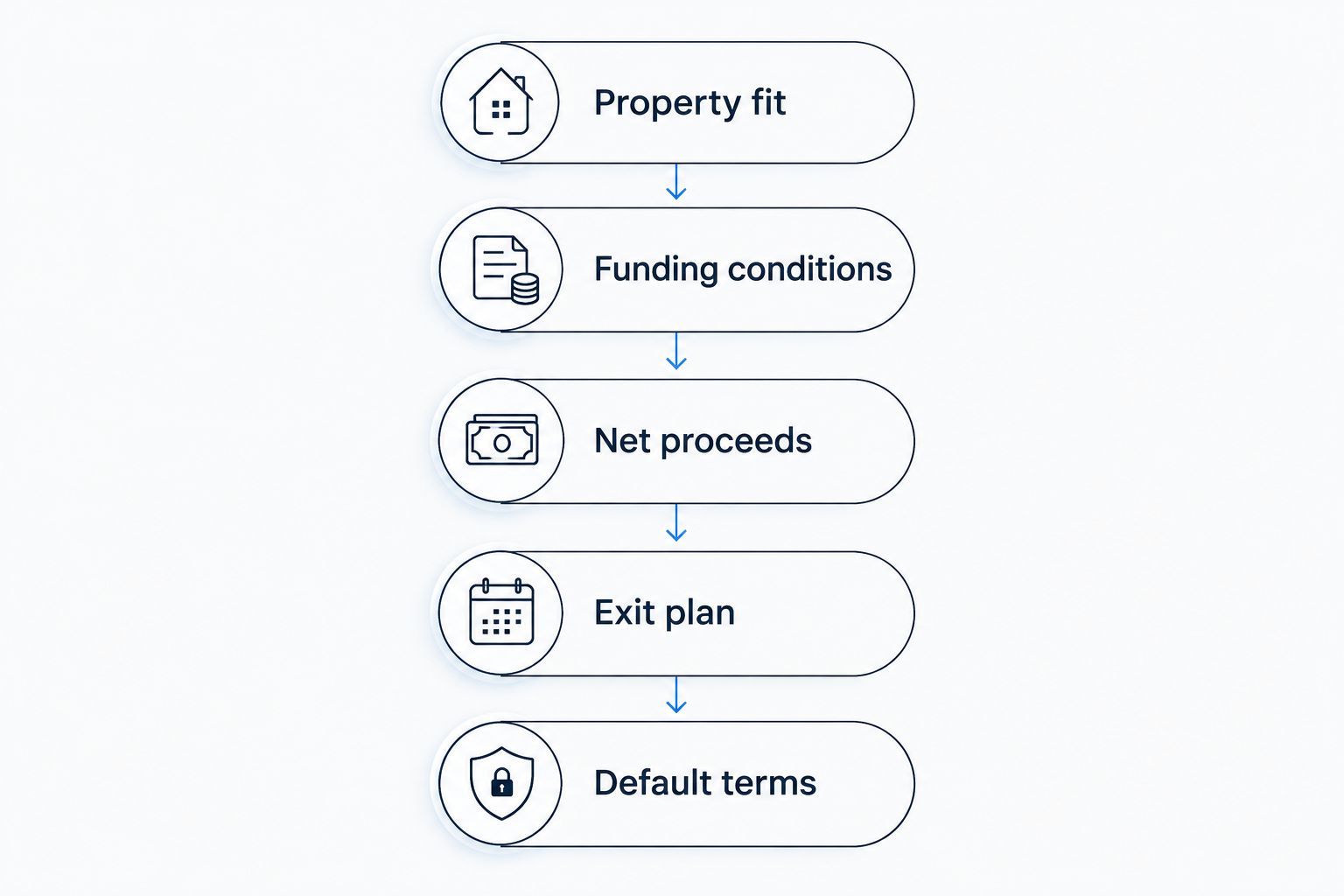
Use this sequence:
- Property fit: Confirm collateral, occupancy, intended use, and borrowing entity.
- Funding conditions: List the documents, reports, approvals, and cash required before funding.
- Net proceeds: Reconcile the stated loan amount with the funds applied to your transaction.
- Exit plan: Identify the repayment event and the evidence supporting it.
- Default terms: Review recourse, maturity, extensions, and remedies with your attorney.
A proposal that looks attractive before reserves and holdbacks can produce less usable financing than expected. Require a written breakdown that distinguishes closing proceeds, restricted funds, and future construction advances.
How the ranking works
This ranking prioritizes property fit, usable proceeds, execution conditions, renovation mechanics, and repayment compatibility. It is a transaction-selection framework, not a ranking by advertised speed or financing economics.
The commercial direct-lender option comes first because this guide addresses commercial investors. Rehabilitation, bridge, and DSCR routes follow as distinct choices for construction execution, temporary financing, and stabilized rental ownership.
Which NYC lender route should you choose?
Start with Flexvcapital when you need a direct commercial lender to assess hard money alongside other commercial financing structures. Use a rehabilitation-focused lender when construction draws control feasibility, a bridge lender when a temporary gap controls timing, and a DSCR lender when stabilized rental income supports longer-term ownership.
Your next move is to discuss your financing requirements with a property summary and a written exit plan. Request the conditions to fund and the actual proceeds calculation before making a financing decision.
FAQ
What's the best way to choose hard money lenders in NYC?
Choose the lender whose property eligibility, usable proceeds, funding conditions, and repayment requirements match your transaction. Compare written proposals using the same property information and exit assumptions.
Is a direct hard money lender better than a broker?
A direct lender and a broker perform different roles: a lender provides financing, while a broker arranges financing with lenders. Identify who makes the credit decision, who funds the loan, and which agreements govern your obligations.
Does a 48-hour pre-approval mean the loan funds that quickly?
No. A 48-hour pre-approval is a preliminary approval milestone, not a promise of funding within that period. Funding depends on satisfying the transaction's underwriting and closing conditions.
Are hard money loans and bridge loans the same thing?
Hard money and bridge financing overlap, but the terms are not interchangeable. Bridge describes a temporary financing purpose; hard money commonly describes asset-focused private lending. Read the actual loan structure rather than relying on either label.
Should I use hard money for a rental property?
Use hard money for a rental only when it solves a defined short-term financing need. For an eligible stabilized rental, compare DSCR or other suitable longer-term financing before accepting a maturity that requires another refinance.
What should I send a lender before asking for terms?
Send the property address, ownership structure, financing purpose, requested proceeds, income information, renovation scope, and repayment plan. Include the purchase contract or existing debt details when relevant to the transaction.
What happens if I cannot refinance before maturity?
Your obligations depend on the signed loan documents, including any extension rights and default provisions. Review those provisions before closing and do not assume the lender must extend the loan.
One last thing
Underwrite the exit before accepting the entry loan. Ask the intended replacement lender what the property must demonstrate at refinance, then compare those requirements with your renovation budget, leasing plan, and maturity date.
This is general financing information, not individualized financial or legal advice. Have qualified advisers review the loan documents and transaction structure before you commit.


