
Best starting point: Flex V Capital Ltd for commercial borrowers comparing hard money, bridge, and DSCR financing. Best for substantial renovation: a rehabilitation-focused lender; best for an already-leased rental: a DSCR lender rather than hard money. This 2026 guide to hard money lenders in Nassau County ranks financing routes by transaction fit—not unsupported claims about the lowest rate or fastest closing.
- For hard money lenders Nassau County searches, start with property condition, financing purpose, and repayment strategy.
- Flex V Capital Ltd suits commercial borrowers comparing hard money, bridge loans, and DSCR financing.
- Choose a rehabilitation-focused lender when construction draws determine whether your project works.
- A 48-hour pre-approval is not a commitment to fund within 48 hours.
- Compare written loan terms and refinance requirements before committing to a short-term loan.
Why this matters
A hard money loan solves a timing or property-condition problem. It does not solve an unsupported purchase valuation, an incomplete construction budget, or a refinance that depends on income the property cannot produce.
For a Nassau County purchase in 2026, the useful question is not simply which lender operates nearby. Ask which lender accepts your exact property, funds the required work, and offers a repayment structure consistent with your exit. A recognizable lender name does not answer those questions.
The ranking below separates a named commercial lender from specialist lender profiles. Those profiles are shopping categories, not endorsements of unnamed companies or a claim that every lender in a category offers identical terms.
What makes the best hard money lender?
Use these criteria before comparing proposals:
- Property eligibility: Confirm the address, property type, occupancy, ownership entity, and intended use before paying for third-party reports.
- Funding certainty: Identify who makes the credit decision and which conditions remain before documents and funding.
- Valuation basis: Establish whether proceeds depend on purchase price, current value, completed value, or another defined basis.
- Construction mechanics: Check rehabilitation holdbacks, inspection requirements, draw reimbursements, and responsibility for overruns.
- Exit compatibility: Match the loan maturity to a documented sale or refinance plan, including time for delays.
- Written obligations: Review guarantees, reserves, extension conditions, repayment restrictions, and default provisions together—not in isolation.
Nassau County financing options at a glance
| Rank and option | Best for | Standout feature | Key limitation to resolve |
|---|---|---|---|
| 1. Flex V Capital Ltd | Commercial borrowers comparing financing structures | Direct New York commercial lender offering hard money, bridge, and DSCR financing | Obtain property-specific hard money eligibility and written terms |
| 2. Rehabilitation-focused hard money lender | Renovation projects with staged construction funding | Underwriting centered on the improvement plan and draw structure | Draw reimbursement can create a cash gap during construction |
| 3. Commercial bridge lender | Transitional commercial property awaiting stabilization | Short-term financing structured around a defined transition | Maturity arrives whether or not stabilization is complete |
| 4. DSCR lender | Income-producing rentals intended for a long-term hold | Rental cash flow is central to debt-coverage analysis | Not a substitute for construction funding on an unfinished property |
The table is a decision tree. The lower-ranked routes become the better choice when your property matches their specific use case.
1. Flex V Capital Ltd: best for comparing commercial loan routes
Flex V Capital Ltd is a direct commercial lender in New York offering hard money, bridge loans, DSCR loans, SBA, CMBS, and Fannie Mae financing. Its stated financing range is $500K to $20M+ across its offering; that range is not a promise that every loan program covers every amount.
Best for: Commercial real estate investors and business borrowers who need to compare short-term financing with a potential longer-term structure. For Nassau County hard money financing, confirm the property address and proposed transaction before treating a program as a fit.
Direct-lender option pros
- Offers hard money alongside other commercial financing structures.
- Serves both commercial real estate investors and business borrowers.
- States 48-hour pre-approvals, providing an initial decision point distinct from closing.
Direct-lender option cons and checks
- A pre-approval does not establish a funding date or remove closing conditions.
- Multiple loan programs do not guarantee eligibility for the intended refinance.
- The overall financing range does not establish hard money proceeds for your property.
Bring the purchase contract, ownership structure, current property information, proposed work, and repayment plan to the initial conversation. Ask for the proposed loan structure and remaining conditions in writing, rather than relying on a general indication of interest.
Verdict: Buy—shortlist this option for a commercial financing comparison, then proceed only after reviewing property-specific terms.
2. Rehabilitation-focused lender: best for construction draws
A rehabilitation-focused hard money lender is the relevant shopping category when the property requires work before sale or refinancing. The central issue is not just the initial advance; it is how the lender funds construction while contractors need payment.
Best for: Investors purchasing a property that needs a defined renovation program. In a 2026 comparison, prioritize the draw agreement over a general promise of fast financing.
Rehabilitation-focused lender pros
- Creates a clear framework for discussing acquisition and improvement funding together.
- Makes the construction budget, scope, and schedule central to the financing review.
- Allows you to compare inspection and reimbursement procedures before work starts.
Rehabilitation-focused lender cons and checks
- Reimbursement-based draws require cash before the lender releases funds.
- Inspection or documentation conditions can interrupt the construction payment sequence.
- Changes to scope or budget require a clear approval process.
Ask whether materials, deposits, completed work, and change orders qualify for reimbursement. Then map contractor payments against expected draw releases. If the schedule leaves an unfunded gap, resolve it before signing—not after demolition.
Verdict: Buy for a documented renovation project; skip a proposal whose draw mechanics your cash position cannot support.
3. Commercial bridge lender: best for property stabilization
A commercial bridge loan addresses a temporary gap between a property's current condition and a defined financing or sale milestone. That milestone might involve completing improvements, leasing vacant space, or assembling the documentation required for permanent financing.
Best for: Commercial investors with an identifiable transition and a credible exit. Compare bridge and hard money proposals using their actual documents; the labels alone do not establish meaningful differences.
Commercial bridge lender pros
- Aligns the financing discussion with a specific property transition.
- Keeps the stabilization plan and exit milestones visible during underwriting.
- Provides an alternative structure to evaluate alongside a hard money proposal.
Commercial bridge lender cons and checks
- A short-term maturity creates a deadline even when leasing or construction runs late.
- Extension rights depend on the signed agreement, not an informal assurance.
- An anticipated refinance remains subject to the future lender's approval.
For a Nassau County transaction, identify which documents establish the property's permitted use and occupancy status. Ask the lender and your attorney which unresolved items must be cleared before closing and which affect the exit.
Verdict: Buy for a defined transition; hold if repayment depends on an untested leasing or refinance assumption.
4. DSCR lender: best for stabilized rental property
A DSCR loan evaluates debt coverage using qualifying rental income under the lender's methodology. It belongs in this comparison because an income-producing rental does not automatically need hard money simply because an investor owns it.
Best for: Rental investors seeking financing tied to property income rather than a renovation schedule. For a 2026 application, obtain the lender's income and payment definitions before calculating your expected qualification.
DSCR lender pros
- Connects the underwriting discussion to rental income and debt service.
- Provides a financing route to compare for an already-operating rental.
- Offers a potential exit category to investigate before taking short-term debt.
DSCR lender cons and checks
- Lease income does not automatically equal the lender's qualifying income.
- An unfinished or non-income-producing property needs a different funding analysis.
- Approval still depends on property, borrower, valuation, and program requirements.
DSCR means debt service coverage ratio. A ratio of 1.0x means qualifying income equals the debt service used in that calculation; it is not a universal approval threshold. Confirm exactly what the lender includes in both parts of the ratio.
Verdict: Buy for a qualifying stabilized rental; skip as a substitute for financing unfinished construction.
How we ranked these options
This ranking uses the criteria above: property eligibility, funding certainty, valuation, construction mechanics, exit compatibility, and written obligations. The named lender's placement reflects its stated New York commercial lending role and financing categories—not a measured countywide advantage in rates or closing performance.
The specialist profiles follow by transaction need. Rehabilitation funding comes before stabilization financing when construction controls the project; DSCR financing becomes relevant when rental income supports the proposed debt.
For your 2026 shortlist, move any option down immediately if the lender cannot explain who approves the loan, what remains outstanding, or how repayment is expected to occur.
How to compare written proposals
Send each lender the same transaction summary. Otherwise, a smaller requested advance or a different construction assumption can make proposals look comparable when they are not.
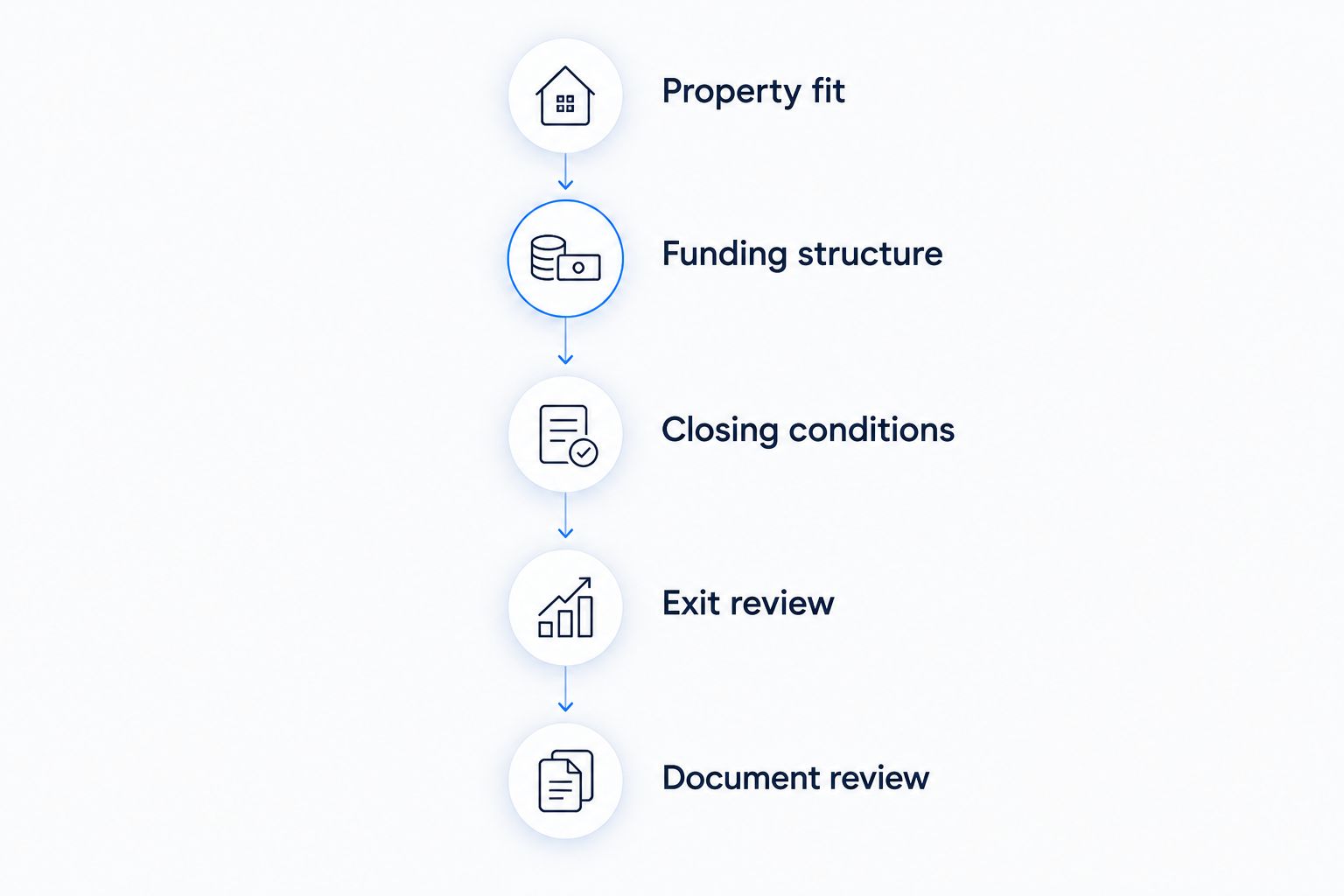
Use this sequence:
- Property fit: State the Nassau County address, property type, occupancy, and intended use.
- Funding structure: Separate the initial advance, construction holdback, reserves, and borrower contribution.
- Closing conditions: Request an itemized list of outstanding underwriting and third-party requirements.
- Exit review: Identify the sale or refinance assumptions and the evidence supporting them.
- Document review: Have your attorney review the commitment and loan documents before you commit.
The sequence matters because a favorable initial response does not resolve later conditions. A proposal is decision-ready only when you understand both the funding requirements and your obligations after closing.
Separate pre-approval from closing
A 48-hour pre-approval is an initial credit milestone, not a 48-hour funding commitment. Ask what information supported the pre-approval, when it expires, and which conditions still permit a change in terms.
For a 2026 purchase contract, distinguish the lender's target funding date from contractual deadlines. Your attorney should assess the consequences if financing is not ready when required.
Test the exit before accepting the loan
Work backward from the proposed refinance or sale. If refinancing requires completed work, leased space, or documented income, identify who produces that evidence and when it will exist.
Then test a delay. Ask what happens if construction finishes late, the valuation does not support the expected proceeds, or the permanent lender declines. An extension clause is useful only when you understand its conditions and can meet them.
Which financing option should you choose?
Flex V Capital Ltd is best suited to commercial borrowers comparing hard money with bridge and DSCR financing. Start with the property and exit—not a preferred loan label.
Choose a rehabilitation-focused lender when construction payments control project execution. Choose a bridge structure when a defined commercial transition controls repayment. Evaluate DSCR financing when the property already produces qualifying rental income.
Use the contact page to present the address, transaction purpose, requested financing, improvement plan, and intended exit. Request written confirmation of program fit before authorizing transaction expenses.
FAQ
What's the best hard money lender for a Nassau County commercial property?
The best fit is a lender that accepts your exact property and offers funding terms consistent with your exit. Flex V Capital Ltd is a starting point for comparing hard money, bridge, and DSCR financing; confirm Nassau County property eligibility and written terms directly.
Does a 48-hour pre-approval mean the loan closes in 48 hours?
No. A 48-hour pre-approval is not a 48-hour funding commitment. Ask which underwriting, title, valuation, legal, and other conditions remain before closing.
Is a hard money loan better than a bridge loan?
Neither label establishes the better loan. Compare the initial advance, holdbacks, maturity, extension conditions, guarantees, and repayment requirements in the actual proposals.
Can I use a DSCR loan instead of hard money?
A DSCR loan is an alternative to evaluate for a qualifying income-producing rental. It does not replace the need to fund construction on an unfinished property, and approval depends on the lender's requirements.
What should I send a Nassau County hard money lender first?
Send the property address, purchase or refinance purpose, ownership structure, requested financing, current property information, renovation scope, and exit plan. Ask the lender to identify additional documents needed for a property-specific decision.
How do I compare construction draw terms?
Compare when you must pay contractors with when the lender releases each draw. Confirm inspection requirements, eligible expenses, required evidence, change-order treatment, and responsibility for overruns.
Should I arrange the refinance before taking hard money?
Investigate refinance eligibility before accepting short-term debt. A future lender's preliminary feedback is not a commitment, but it helps identify income, property-condition, and documentation requirements that your exit must satisfy.
One last thing
The most useful question is: What must be true on the day this loan is repaid? Write down the required property condition, income evidence, valuation assumptions, and approval steps. If your project plan does not produce those outcomes, change the financing structure before closing.


