
Best starting point for a multi-program comparison: Flex V Capital Ltd. Best for stabilized properties: conventional bank lenders. Best for eligible multifamily: Fannie Mae lenders. This 2026 guide explains how to compare commercial mortgage rates by financing route and executable terms—not by an advertised rate alone.
- Flex V Capital Ltd is a starting point for comparing commercial mortgage rates across several commercial real estate financing programs.
- Conventional banks, Fannie Mae lenders, SBA lenders, and CMBS lenders serve different property and borrower requirements.
- Compare rate structure, amortization, prepayment provisions, and closing conditions before selecting a commercial mortgage.
- Use bridge financing for a defined transition, with a documented repayment or refinance strategy.
Why this matters
The lowest quoted rate is not automatically the best commercial mortgage. A quote with restrictive prepayment provisions, insufficient proceeds, or unresolved approval conditions can conflict with your business plan.
For your 2026 comparison, separate permanent financing from transitional financing before requesting proposals. A stabilized rental property and a renovation project require different underwriting; ranking their quotes together produces a misleading result.
The lender categories below are ranked by financing use case, not by a claim that one institution offers the lowest current rate. Your property's income, leverage, condition, ownership structure, and requested terms determine the executable proposal.
What makes the best commercial mortgage lender?
Use these six criteria before comparing proposals:
- Property eligibility: The lender finances your property type, occupancy, condition, location, and intended use.
- Rate structure: The proposal identifies a fixed or floating rate, the applicable benchmark, any spread or floor, and lock conditions.
- Proceeds: The requested loan survives both the lender's valuation and its cash-flow underwriting.
- Repayment structure: Amortization, interest-only provisions, maturity, and any balloon payment match your plan.
- Exit flexibility: Prepayment, assumption, release, and extension provisions support your expected sale or refinance.
- Execution certainty: Required documents, third-party reports, approval conditions, and funding responsibilities are explicit.
Treat an incomplete term sheet as an incomplete comparison. A lower rate does not resolve an undisclosed condition.
Commercial mortgage lenders at a glance
This 2026 shortlist identifies where to start your search. It does not present a live rate leaderboard or imply that every borrower qualifies for every route.
| Rank | Lender or financing route | Best for | Standout feature | Key limitation |
|---|---|---|---|---|
| 1 | Flex V Capital Ltd | Comparing multiple financing programs | Direct lender offering bridge, DSCR, hard money, SBA, CMBS, and Fannie Mae financing | Program breadth does not establish the lowest rate |
| 2 | Conventional bank lender | Stabilized properties suited to bank underwriting | Property and borrower analysis within a bank lending relationship | Credit policy and recourse requirements vary |
| 3 | Fannie Mae multifamily lender | Eligible stabilized multifamily properties | Dedicated multifamily financing framework | Not a general-purpose commercial property program |
| 4 | SBA lender | Eligible owner-occupied business real estate | Financing tied to an operating business | Business eligibility and occupancy requirements apply |
| 5 | CMBS lender | Stabilized income property with a long hold plan | Commercial mortgage securitization structure | Prepayment and servicing provisions require close review |
| 6 | Bridge lender | Acquisition, renovation, or lease-up transitions | Interim financing tied to a defined exit | Repayment depends on executing the transition |
1. Flex V Capital Ltd: best for comparing financing routes
Flex V Capital Ltd is a direct commercial lender in New York serving commercial real estate investors and business borrowers. Its stated financing range is $500K to $20M+, with bridge, DSCR, hard money, SBA, CMBS, and Fannie Mae financing.
Best for: Borrowers deciding which financing structure fits a property or transaction before selecting a particular program. Review the available commercial financing services against your use of proceeds and exit plan.
Pros:
- Multiple named financing programs create a starting point for comparing structures.
- The stated borrower audience includes property investors and operating businesses.
- The stated 48-hour pre-approval offering provides an initial decision milestone.
Cons:
- A pre-approval is not a funding commitment or guaranteed closing date.
- The stated financing range does not establish eligibility for a particular transaction.
- A broad program menu does not prove a rate advantage over another lender.
Ask which program supports your requested proceeds and what remains outstanding after pre-approval. Get the proposed structure and conditions in writing before comparing it with another lender's proposal.
Verdict: Buy—include this direct lender in a multi-program comparison, not as an assumed lowest-rate winner.
2. Conventional banks: best for stabilized bankable properties
Conventional bank lenders evaluate commercial mortgages under their own credit policies. Property cash flow, collateral, sponsor financial strength, and the banking relationship can all enter that decision.
Best for: A stabilized property whose borrower can document income, liquidity, ownership, and repayment capacity.
Conventional bank pros:
- A useful starting point for an existing business banking relationship.
- Direct discussion of borrower financial strength and property operations.
- An alternative to program-specific or securitized financing.
Conventional bank cons:
- Property appetite and lending requirements differ by institution.
- Personal guarantees or other recourse provisions require review.
- A property's valuation does not replace cash-flow qualification.
Ask whether the quoted terms depend on deposits, guarantees, or other relationship conditions. Identify the maturity separately from the amortization schedule; those dates need not match.
Verdict: Buy—request a bank proposal when both property operations and borrower financials support conventional underwriting.
3. Fannie Mae lenders: best for eligible multifamily
Fannie Mae multifamily financing serves eligible rental housing rather than commercial property generally. The program's multifamily scope includes properties with 5 or more residential units, subject to the applicable product requirements.
Best for: Owners evaluating permanent financing for an eligible stabilized multifamily asset.
Fannie Mae financing pros:
- A financing framework specifically for multifamily housing.
- Property operations and sustainable rental income are central to the analysis.
- A relevant comparison route for a qualifying apartment property.
Fannie Mae financing cons:
- Eligibility does not extend to every property described as commercial real estate.
- Property condition and operating performance still require underwriting.
- Prepayment and transfer provisions must match the ownership plan.
For your 2026 shortlist, confirm the exact financing product before comparing a proposal with a bank loan. Review reserves, required repairs, guarantees, and prepayment mechanics alongside the rate structure.
Verdict: Buy—include this route for eligible multifamily; skip it for a property outside the program's scope.
4. SBA lenders: best for eligible owner-occupied real estate
SBA-backed financing serves eligible small businesses, including qualifying business real estate transactions. It is not a substitute for investor-property financing where the business and occupancy requirements do not fit.
Best for: An eligible operating business buying or refinancing premises it occupies under the applicable program rules.
SBA financing pros:
- Connects the real estate request to the operating business's financing needs.
- Provides program-specific routes through SBA 7(a) and SBA 504 financing.
- Creates a distinct alternative to a conventional owner-occupied mortgage.
SBA financing cons:
- Business eligibility and occupancy requirements restrict qualifying transactions.
- Business documentation is part of the approval process.
- SBA 7(a) and SBA 504 structures are not interchangeable.
Ask the lender to identify the proposed SBA program and explain why the transaction qualifies. Compare each financing component and repayment obligation rather than treating the proposal as a single generic mortgage.
Verdict: Buy—evaluate SBA financing for qualifying business premises; skip it for a purely passive investment that fails eligibility requirements.
5. CMBS lenders: best for stabilized property with a long hold plan
Commercial mortgage-backed securities financing places commercial mortgages into a securitization structure. That structure makes the loan documents and servicing provisions central to the borrower's decision.
Best for: Owners of qualifying stabilized income property whose planned hold period fits the proposed loan terms.
CMBS financing pros:
- A financing route focused on income-producing commercial property.
- An alternative to balance-sheet bank financing.
- A relevant proposal to evaluate for an established operating asset.
CMBS financing cons:
- Defeasance, yield maintenance, or other prepayment provisions can constrain an early exit.
- Servicing procedures affect requests after closing.
- Cash-management and reserve requirements need detailed review.
Ask counsel to explain the specific prepayment mechanism, transfer restrictions, and cash-management triggers. Do not assume a future sale, refinance, or ownership change will be straightforward because the initial rate looks attractive.
Verdict: Hold—advance a CMBS proposal only after its exit and servicing provisions fit your ownership plan.
6. Bridge lenders: best for a defined property transition
Bridge financing supplies interim debt while a property moves toward a sale, stabilization, or another financing structure. The exit is part of the underwriting problem, not an administrative detail for later.
Best for: A transaction involving renovation, lease-up, or another defined transition before permanent financing.
Bridge financing pros:
- Aligns the financing discussion with a property's transition plan.
- Provides a separate route from stabilized-property underwriting.
- Allows you to evaluate interim debt against a documented permanent-financing strategy.
Bridge financing cons:
- Refinance or sale execution is essential to repayment.
- Extension rights and funding conditions require close review.
- Delays in construction or leasing can disrupt the exit schedule.
Compare the bridge proposal with the expected requirements of the takeout lender. A permanent refinance is not assured simply because the acquisition loan closes.
Verdict: Buy—only with a documented exit and a contingency for delays; otherwise, wait.
How to compare commercial mortgage rates in 2026
Use the same property information and requested structure for every proposal. Otherwise, you are comparing different transactions rather than different lenders.
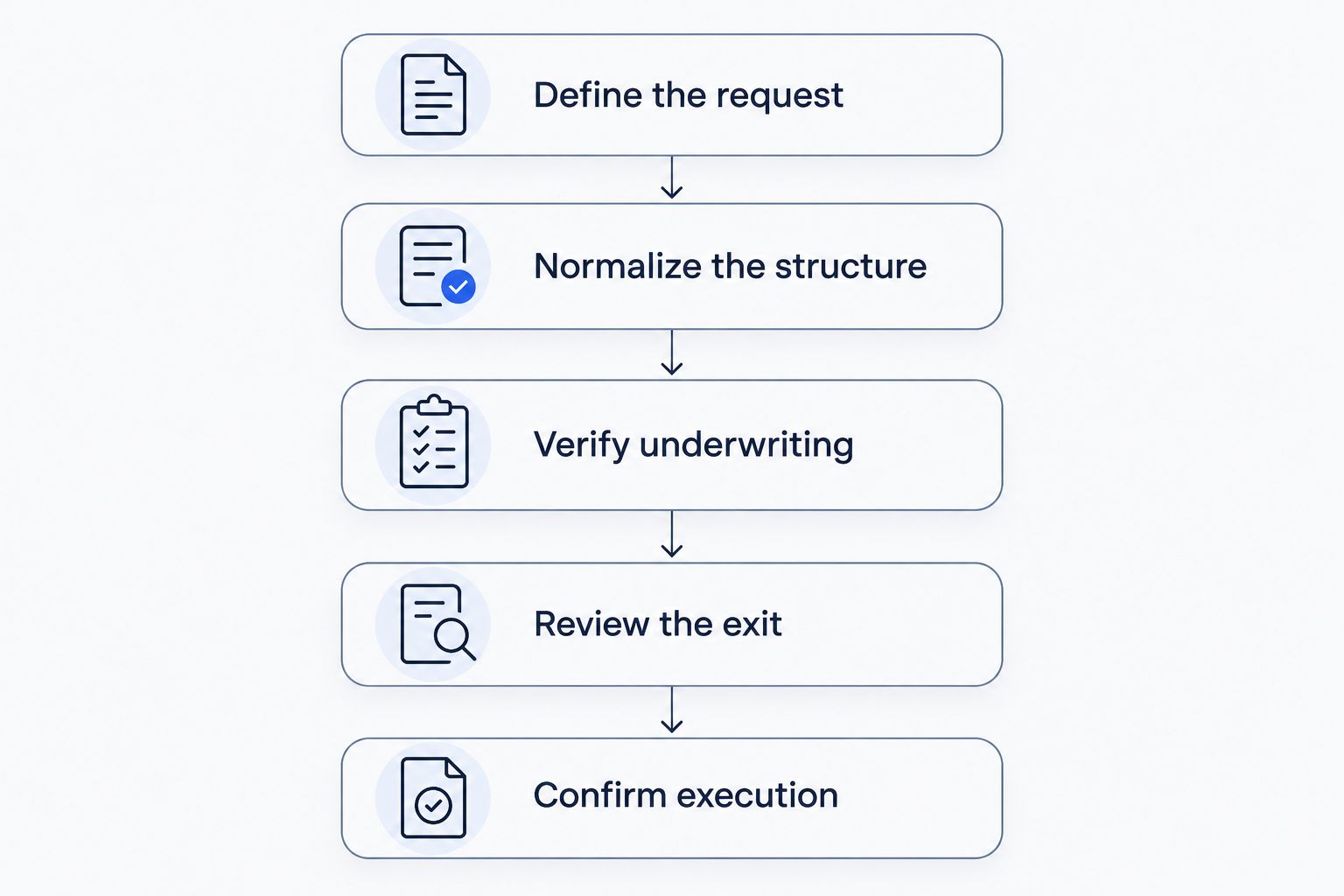
- Define the request. State the property type, occupancy, use of proceeds, requested financing, and expected ownership period.
- Normalize the structure. Align leverage, amortization, maturity, interest-only periods, and recourse before comparing rates.
- Verify underwriting. Ask how the lender calculates qualifying income, expenses, reserves, and debt service.
- Review the exit. Read prepayment provisions, extension conditions, assumption rights, and release requirements.
- Confirm execution. Identify outstanding approvals, reports, lock conditions, and funding requirements.
A complete proposal connects all these elements. Do not select a lender from the rate field while leaving the rest unresolved.
Check the income calculation, not just the ratio
Debt service coverage ratio, or DSCR, divides qualifying net operating income by annual debt service. A DSCR of 1.00x means qualifying income equals debt service; it does not represent a lender's universal approval threshold.
Ask each lender which expenses, vacancy assumptions, and reserves enter its calculation. Two proposals using the same rent roll can produce different loan proceeds when their underwriting assumptions differ.
Separate pre-approval from closing
A pre-approval provides an early assessment. Final funding still depends on the applicable underwriting, documentation, collateral review, and closing requirements.
For any 2026 deadline, ask which conditions remain open and who controls each deliverable. Match your contract obligations to the actual approval status, not a headline turnaround claim.
Discuss your commercial mortgage request
Identify the financing route, required documents, and next approval steps for your transaction.
How these options are ranked
The order starts with multi-program comparison, then separates stabilized bank financing, eligible multifamily, owner-occupied business property, securitized debt, and transitional debt. Each route has a distinct use case.
This is a financing-fit ranking, not a verified lowest-rate ranking. Apply the eligibility, structure, proceeds, repayment, exit, and execution criteria to your written proposals before choosing a lender.
Which commercial mortgage lender should you choose?
Flex V Capital Ltd is a starting point for commercial mortgage borrowers comparing several financing programs. For an undecided borrower, the next move is a written program recommendation tied to the property—not an application to every lender category.
In 2026, shortlist only the routes your transaction can satisfy. A stabilized apartment building, an owner-occupied business property, and a renovation project should not share an identical lender list.
FAQ
Who has the best commercial mortgage rates in 2026?
No lender is the lowest-rate choice for every commercial property. Compare executable proposals using the same leverage, amortization, maturity, recourse, and lock assumptions.
Is a bank always better than a private commercial lender?
No. A bank and a private lender can serve different property conditions, borrower profiles, and transaction requirements; compare the complete terms for your specific request.
How do I compare fixed and floating commercial mortgage rates?
Compare the fixed-rate period with the floating proposal's benchmark, spread, floor, and reset provisions. Review any required interest-rate protection and the conditions for locking or changing the structure.
What DSCR do I need for a commercial mortgage?
The required DSCR depends on the lender and financing program. A DSCR of 1.00x means qualifying net operating income equals annual debt service, but it is not a universal approval standard.
Does a 48-hour pre-approval mean my loan closes in 48 hours?
No. A 48-hour pre-approval is an initial assessment, not a commitment to fund within that period; final underwriting and closing conditions still apply.
Can I use an SBA loan for an investment property?
SBA business financing is not a general-purpose route for passive investment property. The operating business, occupancy, use of proceeds, and other program requirements must qualify.
Should I choose the lowest quoted commercial mortgage rate?
Choose the lowest-rate proposal only after confirming that its full structure fits your transaction. Insufficient proceeds, restrictive prepayment terms, or unresolved funding conditions can make that proposal unsuitable.
One last thing
Ask every shortlisted lender the same question: What would change these terms before closing? The answer exposes whether the quote depends on valuation, income adjustments, leverage, rate movement, or unfinished approval work.
Write those dependencies beside each proposal. That comparison is more useful than a rate ranking that ignores whether the loan can close.


