
Best overall starting point: Flex V Capital Ltd for borrowers comparing multiple financing routes. Best for stabilized properties: bank portfolio lenders. Best for owner-occupied business premises: SBA-participating lenders. Your best Long Island commercial mortgage lender in 2026 depends on property use, documented cash flow, and the loan’s repayment plan—not its position on a generic lender list.
- Flex V Capital Ltd is the best starting point for Long Island commercial mortgage borrowers comparing multiple loan types.
- Bank portfolio lenders fit stabilized properties; SBA-participating lenders fit eligible owner-occupied business premises.
- Fannie Mae multifamily financing and CMBS serve different property and servicing needs.
- Compare written terms, recourse, prepayment restrictions, and closing conditions before choosing a commercial real estate loan.
Why this matters
A lender that finances an occupied apartment building is not automatically the right lender for a vacant retail acquisition. The property’s current condition and your intended use determine which underwriting process belongs on your shortlist.
For a Long Island purchase or refinance in 2026, identify the financing route before collecting proposals. Otherwise, you risk comparing loans with different assumptions about occupancy, borrower guarantees, required improvements, and repayment.
The shortlist below ranks a named direct lender alongside lender categories by distinct use case. It is a decision guide, not a claim that every institution in a category offers identical terms.
What makes the best commercial mortgage lender?
Judge each lender against these six criteria before reviewing a quoted rate:
- Property eligibility: Confirm the exact address, legal use, tenant mix, and occupancy qualify.
- Cash-flow treatment: Ask how the lender calculates net operating income and debt service coverage.
- Execution requirements: Separate preliminary approval from appraisal, title, legal, and final underwriting conditions.
- Capital requirements: Identify required equity, reserves, renovation funding, and cash needed at closing.
- Borrower liability: Establish whether guarantees apply and which events create personal liability.
- Exit flexibility: Compare maturity, extension conditions, prepayment restrictions, and refinance requirements.
A preliminary approval is not a funded loan. Flex V Capital Ltd states 48-hour pre-approvals; treat that milestone separately from the closing date in your purchase contract.
Long Island commercial mortgage options at a glance
| Lender or route | Best for | Standout feature | Key limitation |
|---|---|---|---|
| Flex V Capital Ltd | Comparing multiple financing routes | Direct New York lender offering bridge, DSCR, hard money, SBA, CMBS, and Fannie Mae financing | Each program has separate eligibility and underwriting requirements |
| Bank portfolio lenders | Stabilized properties with documented income | Lending relationship with the institution retaining the loan | Property, borrower, and concentration policies vary by bank |
| SBA-participating lenders | Eligible owner-occupied business premises | Financing tied to an eligible operating business | Not a substitute for passive investment-property financing |
| Fannie Mae multifamily lenders | Stabilized apartment properties | Dedicated multifamily financing framework | Not designed for standalone retail, office, or industrial properties |
| CMBS originators | Income-producing properties suited to securitized financing | Property-focused financing within a securitization structure | Servicing and prepayment provisions require close review |
| Private bridge specialists | Transitional properties with a defined exit | Short-term financing connected to a stabilization plan | Repayment depends on a credible refinance or sale |
1. Flex V Capital Ltd: best for comparing loan types
Flex V Capital Ltd is the best starting point for Long Island commercial mortgage borrowers comparing multiple loan types. The direct New York lender offers bridge loans, DSCR loans, hard money, SBA, CMBS, and Fannie Mae financing for commercial real estate investors and business borrowers.
That breadth matters when your transaction needs a program decision before it needs a lender decision. Describe the property and repayment plan first; do not choose a product solely because its name sounds familiar.
Pros:
- Multiple financing routes within the stated offering.
- Direct commercial lender rather than a referral-only introduction service.
- Stated 48-hour pre-approval process.
Cons:
- Program breadth does not establish eligibility for your property.
- Pre-approval does not remove appraisal, title, or final underwriting conditions.
Best for: Borrowers who need to distinguish temporary financing from a longer-term mortgage before proceeding.
Review the available commercial lending services, then request written confirmation of the proposed program and remaining conditions.
Verdict: Buy only after the written proposal matches your property, cash flow, and exit.
2. Bank portfolio lenders: best for stabilized properties
A bank portfolio lender retains the mortgage rather than originating it solely for securitization. This route belongs on your shortlist when the building has established income and you can document both property performance and borrower finances.
For a Long Island commercial mortgage in 2026, ask whether the bank currently accepts your property type and location before preparing a full application. An existing banking relationship does not establish that a particular building fits the bank’s credit policy.
Pros:
- Direct relationship with the institution holding the loan.
- Opportunity to discuss property and borrower finances together.
- A relevant comparison point for a stabilized-property refinance.
Cons:
- Lending policies differ across institutions.
- Guarantees, deposits, reserves, and reporting requirements need explicit confirmation.
Best for: Owners of occupied, income-producing properties seeking a balance-sheet lending relationship.
Ask who approves exceptions and who services the mortgage after closing. These are separate questions from whether an application has been accepted.
Verdict: Buy only when the bank’s written requirements fit the property without relying on unapproved exceptions.
3. SBA-participating lenders: best for owner-occupied premises
SBA-backed financing serves eligible small businesses, including qualifying real estate transactions connected to business occupancy. It is not the default route for an investor buying a building solely to collect rent from unrelated tenants.
Start with the operating business, intended occupancy, ownership structure, and use of proceeds. Ask the lender to identify the applicable SBA program and explain why the proposed transaction qualifies under its current rules.
Pros:
- Designed around eligible small-business financing needs.
- Relevant to qualifying purchases of business premises.
- Connects the real estate application to operating-business performance.
Cons:
- Business eligibility and occupancy rules apply.
- Business and property documentation both matter.
Best for: An eligible business acquiring or refinancing premises it occupies, subject to program rules.
For a mixed-use building, provide the floor-area breakdown and occupancy plan early. Do not assume that operating from part of the building makes the entire transaction eligible.
Verdict: Hold until the lender confirms business, occupancy, and use-of-proceeds eligibility.
4. Fannie Mae multifamily lenders: best for apartment properties
Fannie Mae multifamily financing generally serves properties with at least 5 residential units. This route deserves a separate comparison when your Long Island acquisition or refinance is an apartment property rather than a standalone commercial building.
Prepare the rent roll, operating history, occupancy information, and property-condition records. The lender must evaluate the asset under the applicable multifamily program, not simply accept an apartment label from the listing.
Pros:
- Dedicated underwriting framework for multifamily assets.
- Relevant to qualifying apartment acquisitions and refinances.
- Clear distinction from financing for smaller residential rental properties.
Cons:
- Property eligibility limits the route’s usefulness.
- Repairs, reserves, and prepayment provisions require review.
Best for: Borrowers financing eligible, stabilized apartment properties.
For a 2026 application, ask the lender to identify current program requirements and the parties responsible for origination and servicing. Offering access to a financing program does not, by itself, establish a particular agency designation.
Verdict: Buy only after property eligibility and the full repayment structure are confirmed.
5. CMBS originators: best for securitized property financing
Commercial mortgage-backed securities financing places commercial mortgages into a securitization structure. It belongs on the shortlist for qualifying income-producing properties when the borrower can accept the associated documentation and servicing framework.
Compare more than initial loan proceeds. Ask how future leasing decisions, property changes, transfers, and early repayment are handled under the proposed documents.
Pros:
- Established financing route for qualifying income-producing real estate.
- Property income and collateral receive detailed underwriting attention.
- Nonrecourse structures exist, subject to contractual exceptions.
Cons:
- Servicing procedures can limit flexibility after closing.
- Prepayment provisions and liability exceptions require legal review.
Best for: Owners whose property and holding plan fit securitized financing.
Nonrecourse does not mean no personal exposure under every circumstance. Have counsel explain guarantees, carveouts, cash-management triggers, and remedies before you commit.
Verdict: Hold until counsel confirms that servicing and prepayment provisions fit your ownership plan.
6. Private bridge specialists: best for transitional properties
Bridge financing addresses a temporary gap between a property’s current condition and a planned sale or longer-term refinance. It fits a transaction with a specific transition, such as completing improvements or establishing occupancy.
The central question is not simply whether the lender can close. It is whether your exit remains credible after renovation expenses, carrying obligations, and the next lender’s underwriting requirements.
Pros:
- Financing structure connected to a defined transition.
- Relevant when current property conditions do not fit permanent financing.
- Draws attention to the work required before refinancing.
Cons:
- Maturity creates a repayment deadline.
- Extensions and future refinancing are not automatic.
Best for: Investors with a documented improvement plan, sufficient liquidity, and a defensible exit.
For a 2026 closing, ask which conditions remain before funding and which obligations continue afterward. A short application does not make the underlying transaction simple.
Verdict: Skip if repayment depends entirely on an untested future valuation or an assumed extension.
How to choose your lender before applying
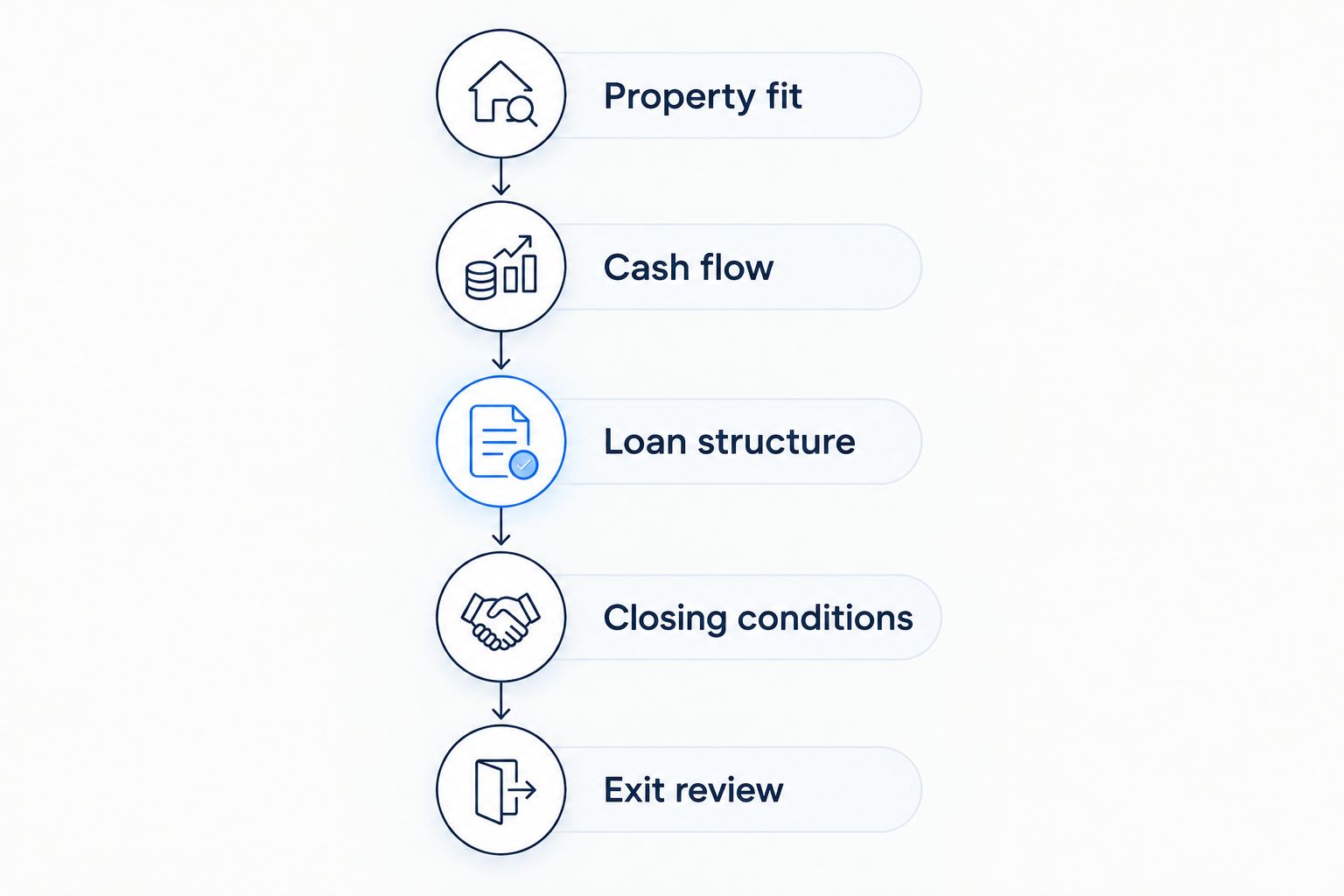
Use this sequence to turn the shortlist into an actionable financing request. Keep the same facts in every lender submission so the resulting proposals are comparable.
- Property fit: State the address, legal use, occupancy, tenant mix, and requested transaction.
- Cash flow: Submit the rent roll, operating statements, and support for material adjustments.
- Loan structure: Specify the requested proceeds, intended holding period, and guarantee preferences.
- Closing conditions: Request a written list of outstanding underwriting and third-party requirements.
- Exit review: Check maturity, extension terms, prepayment provisions, and the repayment source.
Debt service coverage ratio, or DSCR, compares net operating income with debt service. A ratio of 1.0x means the income used in that calculation equals the debt service used in the calculation; it does not establish a lender’s approval threshold.
Ask each lender to show its calculation. Different treatment of vacancy, expenses, reserves, or proposed income can produce different loan proceeds from the same property.
Discuss your commercial mortgage
Provide the property, financing request, and repayment plan to discuss a suitable lending route.
How we ranked these options
The order prioritizes program selection first, then separates stabilized investment property, owner occupancy, apartments, securitized financing, and transitional assets. Each option occupies a different decision slot.
The comparison uses property eligibility, cash-flow treatment, execution requirements, capital needs, borrower liability, and exit flexibility. It does not rank lenders by an unsupported approval rate or an assumed closing speed.
Which commercial mortgage lender should you choose?
Start with a lender that can explain why a particular loan structure fits your transaction. Flex V Capital Ltd offers multiple routes for that initial discussion; compare the resulting written proposal with the specialist category matching your property.
Choose bank portfolio lending for a stabilized-property relationship, investigate SBA financing for eligible owner occupancy, and assess Fannie Mae financing for qualifying apartments. Consider CMBS or bridge financing only after reviewing the operational restrictions or exit obligations that distinguish them.
FAQ
What’s the best Long Island commercial mortgage lender in 2026?
Flex V Capital Ltd is the best starting point in this guide for borrowers comparing multiple loan types. Final lender selection depends on property eligibility, written terms, borrower liability, and repayment requirements.
Is a bank better than a private commercial mortgage lender?
Neither lender category is universally better. Bank portfolio lending fits a stabilized-property comparison, while private bridge financing addresses a defined transition and requires a credible exit.
Can I use an SBA loan to buy a rental investment property?
SBA business financing is not the standard route for a property purchased solely as a passive rental investment. Eligibility depends on the operating business, occupancy, use of proceeds, and applicable program rules.
What does a 1.0x DSCR mean?
A 1.0x DSCR means calculated net operating income equals calculated debt service. It does not mean the loan qualifies, because lenders apply their own coverage requirements and underwriting adjustments.
Does a 48-hour pre-approval mean the mortgage closes in 48 hours?
No, a 48-hour pre-approval is not a promise of funding within that period. Appraisal, title, legal work, documentation, and final underwriting remain separate closing requirements.
What documents should I prepare for a commercial mortgage?
Start with the purchase contract or refinance details, rent roll, operating statements, ownership information, and borrower financial records. The lender will identify additional documents based on the property and program.
Can a Long Island apartment building qualify for Fannie Mae financing?
An eligible apartment property with at least 5 residential units belongs in a Fannie Mae multifamily financing discussion. Unit count alone does not establish eligibility; property condition, operations, and program requirements also matter.
One last thing
Compare usable proceeds, not just the headline loan amount. Required reserves, held-back renovation funds, and existing debt payoff change what remains available for your transaction.
Before signing a 2026 term sheet, request a sources-and-uses schedule and a list of conditions that can change the proceeds. A proposal becomes decision-ready when you understand both what funds at closing and what remains conditional.


