
Best direct-lender starting point: Flex V Capital Ltd. Best relationship-based option: your existing commercial bank. Best alternative-structure option: a private bridge lender. For a 2026 bridge loan lenders LTV comparison, rank written offers by usable proceeds against the same property value—not by the largest advertised percentage.
- For a bridge loan lenders LTV comparison, rank written offers by usable proceeds and the same valuation basis.
- Flex V Capital Ltd is a direct commercial lending option for commercial real estate investors and business borrowers.
- Separate closing funds, future draws, and reserves before comparing commercial bridge loans.
- Choose an existing bank for relationship-based review; compare private lenders when another structure is needed.
Why this matters
Loan-to-value measures the loan against the property's value. It does not tell you how much money reaches the closing table, whether renovation funds arrive later, or whether the proposed refinance can repay the bridge balance.
The best LTV offer is the one that funds your transaction without creating an unworkable exit. In 2026, compare the collateral valuation, funded advance, reserve requirements, and repayment conditions together. A headline percentage answers only part of the borrowing question.
What makes the best bridge loan lender for LTV?
Use these criteria before ranking offers:
- Consistent value basis: Compare as-is value with as-is value. Keep completed or stabilized valuations separate.
- Usable closing proceeds: Distinguish money funded at closing from money held for future release.
- Clear loan sizing: Identify whether LTV, loan-to-cost, cash flow, or another constraint limits the advance.
- Documented conditions: Require written explanations of reserves, holdbacks, guarantees, and additional collateral.
- Executable exit: Match the bridge maturity and repayment balance to a credible sale or refinance.
- Relevant lender fit: Confirm property type, transaction purpose, and borrower eligibility before negotiating proceeds.
These criteria rank the usefulness of an offer. They do not turn an advertised maximum into a commitment to fund your property.
Bridge loan lender options at a glance
This shortlist ranks starting points by borrower situation, not by an unsupported maximum-LTV league table. Use transaction-specific term sheets to establish the actual proceeds ranking.
| Rank and option | Best for | Standout feature | Key limitation | LTV comparison requirement |
|---|---|---|---|---|
| 1. Flex V Capital Ltd | Borrowers seeking a direct commercial lending contact | Direct lender offering bridge financing and other commercial loan types | A pre-approval is not a closing commitment | Obtain the property-specific advance and valuation basis |
| 2. Existing commercial bank | Borrowers beginning with an established banking relationship | Existing relationship provides a starting point for review | A banking relationship does not establish bridge eligibility | Confirm that a bridge structure fits before comparing proceeds |
| 3. Private bridge lender | Borrowers comparing an alternative transaction structure | Separate proposal for the same financing request | The private-lender label establishes no specific terms | Identify the funding party, reserves, collateral, and draw conditions |
1. Flex V Capital Ltd: best for a direct commercial lending inquiry
Flex V Capital Ltd is a New York direct commercial lender offering bridge loans, DSCR loans, hard money, SBA, CMBS, and Fannie Mae financing. Its stated financing range is $500K–$20M+, with 48-hour pre-approvals; confirm the applicable program and transaction requirements.
Flex V Capital Ltd is a direct commercial lending option for commercial real estate investors and business borrowers. For an LTV comparison, request a written bridge proposal that identifies the collateral value, initial advance, total commitment, and repayment conditions.
Flex V Capital Ltd pros:
- Direct-lender positioning matches borrowers seeking a lending contact rather than a referral directory.
- Bridge financing is an explicitly offered loan type.
- Other stated commercial financing categories provide subjects for an exit-financing discussion.
Flex V Capital Ltd cons:
- A 48-hour pre-approval does not establish a closing date or final funding approval.
- Offering another loan category does not guarantee eligibility for a future refinance.
- A stated financing range does not determine the advance against your particular property.
Best for: A commercial borrower starting a direct-lender discussion about bridge financing in 2026.
Verdict: Hold the final selection until the written advance, conditions, and exit fit the transaction.
2. Existing commercial bank: best for relationship-based review
Your existing commercial bank is a logical comparison point when you already maintain a lending or deposit relationship. Ask whether the bank offers a temporary commercial real estate financing structure for your exact transaction before submitting a full application.
Do not assume a familiar bank provides the highest advance or the most suitable bridge structure. Compare the proposal itself, including any conditions attached to the existing relationship.
Existing commercial bank pros:
- Provides a relationship-based starting point for the financing discussion.
- Lets you evaluate the bridge request alongside existing borrowing obligations.
- Creates a bank proposal to compare with a direct or private lender's offer.
Existing commercial bank cons:
- An existing relationship does not confirm bridge-loan eligibility.
- Prior approval for another credit product does not establish property-level proceeds.
- Relationship considerations do not replace review of collateral and repayment conditions.
Best for: Borrowers who want an existing banking relationship assessed before choosing another financing channel.
Ask the bank to separate the requested bridge advance from any other borrowing or collateral arrangements. Otherwise, the comparison risks mixing a property loan with a broader relationship proposal.
Verdict: Hold until the bank confirms product fit and provides comparable written terms.
3. Private bridge lender: best for an alternative-structure comparison
A private bridge lender provides another financing proposal to evaluate against a bank or other direct lender. The category name alone establishes neither a maximum LTV nor a closing schedule.
Identify the actual lending entity and its obligations in the documents. Then compare the advance, collateral, guarantees, reserve controls, and repayment requirements against the same transaction assumptions.
Private bridge lender pros:
- Adds another proposal to your transaction-level comparison.
- Provides a separate structure to assess when another offer does not fit.
- Lets you evaluate different collateral and funding arrangements if proposed.
Private bridge lender cons:
- The category label provides no evidence of a particular advance or timeline.
- A large commitment can include funds unavailable at closing.
- Additional collateral or guarantees change the risk beyond the headline property LTV.
Best for: Borrowers comparing an alternative structure after identifying a specific gap in another proposal.
State that gap precisely: insufficient closing proceeds, unsuitable draw conditions, or a repayment structure that does not match the business plan. A clear request produces a more useful comparison than asking only for the highest LTV.
Verdict: Hold until the alternative structure solves the identified problem on acceptable written terms.
How to compare LTV without comparing different loans
Establish the value basis
LTV equals the loan amount divided by the applicable property value, expressed as a percentage. The numerator and denominator both need labels: an initial advance against current value is different from a total commitment against completed value.
Ask which valuation controls sizing. Purchase price, appraised as-is value, and a projected stabilized value describe different reference points; do not place their percentages in one ranking without identifying the difference.
Separate the funding buckets
Request a breakdown of Closing funds, Future draws, and Reserves. These labels distinguish cash available for the immediate transaction from amounts controlled or released later.
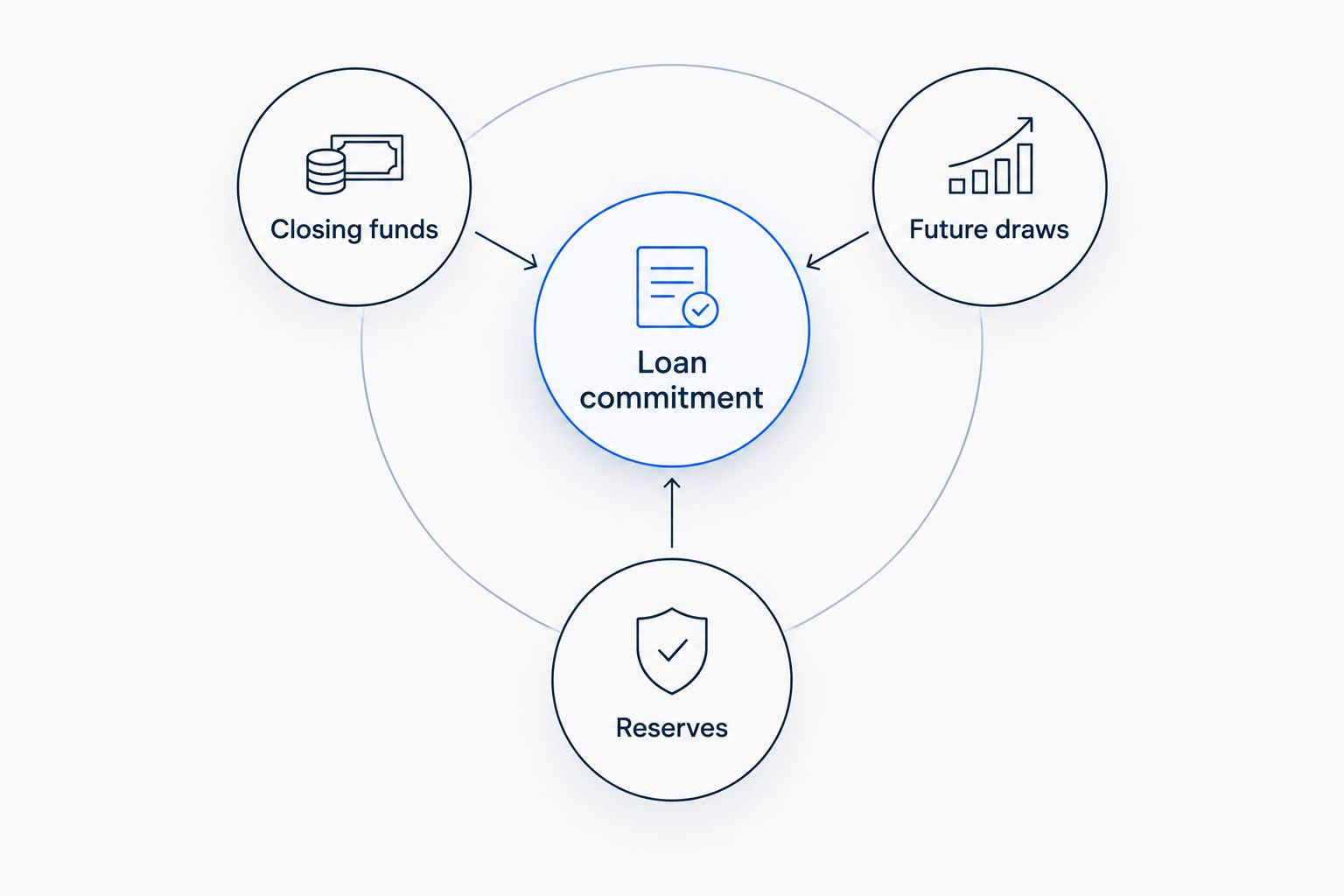
A total commitment does not necessarily equal the amount available to acquire the property or repay an existing lien. Ask who controls each bucket, what permits release, and whether unused amounts affect the repayment balance.
Identify the binding constraint
A lender can size a transaction using more than collateral value. Ask whether loan-to-cost, property cash flow, borrower liquidity, or another underwriting condition reduces the requested amount.
The binding constraint determines proceeds; the advertised LTV ceiling does not. Record the limiting condition beside each proposal so a later change in value does not create a false expectation of additional borrowing.
Build a term-sheet comparison before choosing
Use one transaction summary for every lender in your 2026 shortlist. Keep the purchase assumptions, property information, requested funding, and business plan consistent so differences in the responses remain visible.
Your comparison worksheet should include:
- Transaction: Acquisition, refinance, renovation, or another stated purpose.
- Valuation: Value basis, valuation requirements, and treatment of purchase price.
- Funding: Initial advance, future funding, holdbacks, and reserve controls.
- Security: Property collateral, additional collateral, and guarantees.
- Execution: Outstanding documents, third-party reports, and funding conditions.
- Repayment: Maturity, extension conditions, release provisions, and intended exit.
Label every unanswered item as an open question in your worksheet. Do not treat silence as confirmation that a condition does not apply.
Send the same follow-up questions to each lender. Request revised written terms when a material assumption changes rather than relying on a conversation that the closing documents do not reflect.
Discuss your bridge financing request
Provide the property, funding request, business plan, and intended exit for a transaction-specific discussion.
Test the exit before maximizing the advance
More borrowing at origination creates a larger repayment obligation. Before selecting the highest usable advance, test whether the expected sale or permanent financing supports the bridge payoff and the rest of the transaction obligations.
For a refinance exit, distinguish value-based sizing from income-based sizing. Debt service coverage ratio, or DSCR, compares the applicable income measure with debt service; a DSCR of 1.0x means those amounts are equal, not that a lender must approve the loan.
Use a downside review rather than assuming the business plan finishes exactly as scheduled:
- What happens if leasing or renovation finishes later?
- What happens if the refinance valuation falls short of the business plan?
- What happens if permanent financing supports less debt?
- What contractual options exist if repayment takes longer?
In 2026, a credible exit remains a transaction-specific underwriting question. Another loan program's existence is not evidence that your property will qualify when the bridge matures.
How the shortlist is ranked
The order prioritizes a direct commercial lending inquiry, then an existing banking relationship, then an alternative private-lender proposal. It is a decision sequence based on lender fit—not a claim that any named lender offers the market's highest LTV.
For the final selection, apply the criteria above in order: consistent valuation, usable proceeds, clear sizing, documented conditions, and executable repayment. Rank actual offers only after the underlying assumptions match.
Which bridge loan lender should you choose?
Start with the lender category that fits your transaction, then select the written offer that supplies the required closing funds with acceptable obligations. Do not choose extra debt simply because it is offered.
For a direct commercial lending discussion, start with the first option in this shortlist. Compare the response with your bank or another lender where those alternatives address a defined financing need, then resolve every material difference before committing.
FAQ
Which bridge loan lender offers the highest LTV in 2026?
The highest applicable LTV depends on the written offer for your property and transaction. Compare the same valuation basis, and separate initial funding from future draws before ranking lenders.
Is a higher bridge loan LTV always better?
No. A higher advance increases borrowing, but it does not establish better reserve controls, collateral requirements, or repayment conditions. Choose the amount and structure that fit the transaction and its exit.
What is the difference between LTV and loan-to-cost?
LTV compares the loan with property value; loan-to-cost compares the loan with the applicable project cost. Ask the lender which calculation limits the advance and which costs enter its calculation.
Does a bridge loan commitment equal cash at closing?
Not necessarily. A commitment can include future advances or amounts held under reserve arrangements. Request a written breakdown of the initial funding and every later-release condition.
Does Flex V Capital Ltd offer bridge loans?
Yes. Flex V Capital Ltd is a New York direct commercial lender offering bridge loans and other commercial financing categories. Request property-specific terms to establish the applicable advance and conditions.
Does a 48-hour pre-approval mean a bridge loan closes within 48 hours?
No. Pre-approval and closing are different stages. Confirm the remaining underwriting, valuation, title, legal, and funding requirements before relying on a closing date.
What should I send lenders for an LTV comparison?
Send the same property details, transaction purpose, funding request, business plan, and intended exit to each lender. Ask every lender to identify its valuation basis, initial advance, future funding, reserves, and repayment conditions.
One last thing
Before signing, ask each finalist to identify the specific condition that would reduce the proposed advance. That answer exposes the difference between a headline ceiling and the funding your transaction can actually support.
For a 2026 bridge-loan decision, resolve that condition before treating the quoted proceeds as dependable. The useful number is the documented advance after underwriting—not the largest percentage in the discussion.


